
Blog · · By Dhrumil Barot, Founder
MiniMax Pricing: M3 and M3.1 Flash API Cost per 1M Tokens
MiniMax M3.1 Flash costs $0.15/$0.60 per 1M tokens and M3 $0.30/$1.20 after its 50% cut. Full API price table, M Plan tiers and cost per task.
TL;DR: MiniMax pricing today covers two text models. MiniMax-M3.1-Flash costs $0.15 input and $0.60 output per 1M tokens; MiniMax-M3 costs $0.30 and $1.20 after a permanent 50% discount (up to 512K input tokens). The M Plan subscription starts at $22 a month, and Vynaris can show you what each request really cost before you commit to either. Prices verified 2026-11-15.
Try it: point your OpenAI client at https://api.vynaris.com/v1, set model to auto, and read the cost receipt on every response. Get a Vynaris API key.
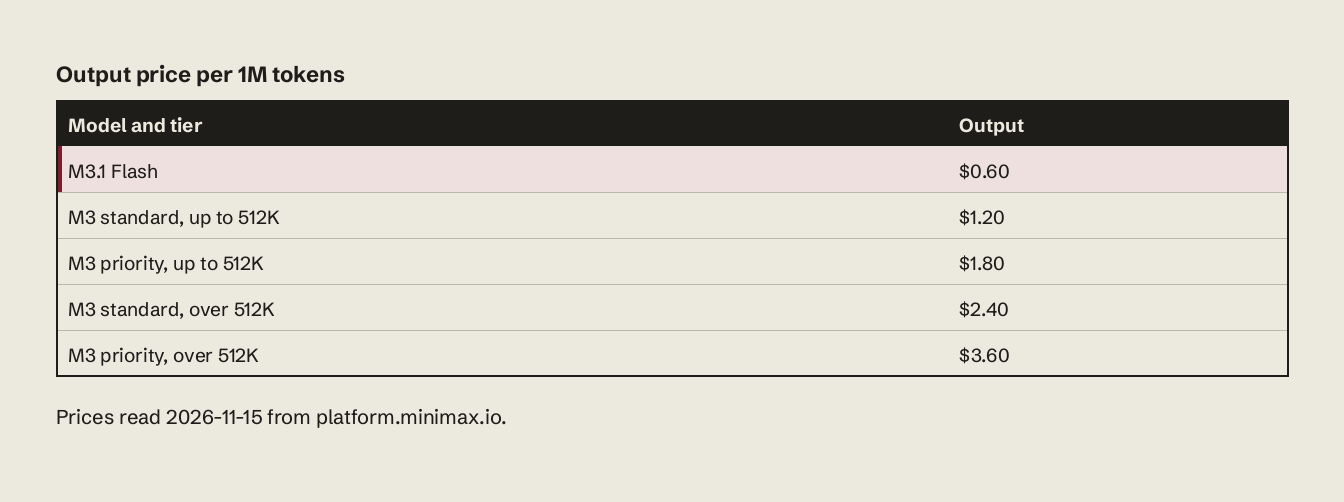
MiniMax API pricing is per token, billed separately for input, output and cache reads. On the official pricing page, MiniMax-M3.1-Flash is $0.15 per 1M input tokens, $0.60 per 1M output tokens and $0.015 per 1M cached input tokens. MiniMax-M3 is $0.30 / $1.20 / $0.06 up to 512K input tokens and double that above 512K. A priority tier costs 1.5x standard. The older M2.7 and M2.5 models are being retired on 2026-11-18, so any "MiniMax M2.7 pricing" you find elsewhere is now a migration question, not a buying one.
What does the MiniMax API cost per 1M tokens?
| Model and tier | Input | Output | Cache read |
|---|---|---|---|
| MiniMax-M3.1-Flash | $0.15 | $0.60 | $0.015 |
| MiniMax-M3, standard, up to 512K input | $0.30 (list $0.60) | $1.20 (list $2.40) | $0.06 (list $0.12) |
| MiniMax-M3, standard, over 512K input | $0.60 (list $1.20) | $2.40 (list $4.80) | $0.12 (list $0.24) |
| MiniMax-M3, priority, up to 512K input | $0.45 | $1.80 | $0.09 |
| MiniMax-M3, priority, over 512K input | $0.90 | $3.60 | $0.18 |
Source: MiniMax Pricing Overview, read 2026-11-15. MiniMax labels the M3 discount "Permanent 50% off". Priority pricing "is 1.5x standard" and is enabled with service_tier set to priority:
from openai import OpenAI
client = OpenAI(base_url="https://api.minimax.io/v1", api_key=MINIMAX_API_KEY)
resp = client.chat.completions.create(
    model="MiniMax-M3",
    messages=[{"role": "user", "content": "Summarise this diff"}],
    extra_body={"service_tier": "priority"},  # billed at 1.5x standard
)
print(resp.usage)
MiniMax's own rule of thumb: about 750 English words use 1,000 tokens.
How Vynaris fits a MiniMax decision
Vynaris is an OpenAI-compatible gateway at https://api.vynaris.com/v1 that routes each request and returns what it cost. Here is what it does for this subject, stated plainly:
- Cost receipts per request. Every response carries headers such as
x-vynaris-served-modelandx-vynaris-cost-usd, and the ledger exports to CSV. That gives you a real cost-per-task number to compare against the MiniMax table above. - Routing down with evidence. With
modelset toauto, a request starts in a frontier pool and moves to a cheaper model only when eval evidence clears the quality gate. - Pricing: provider list price + 3% until monthly usage reaches $500, then 1%. Prepaid top-ups from $20, no overages (Vynaris pricing).
What it does not do: MiniMax models are not on the Vynaris model list today. If you have decided on MiniMax and only MiniMax, call MiniMax directly; a gateway fee buys you nothing for a single pinned model.
Per-task math: one coding-agent step priced on MiniMax
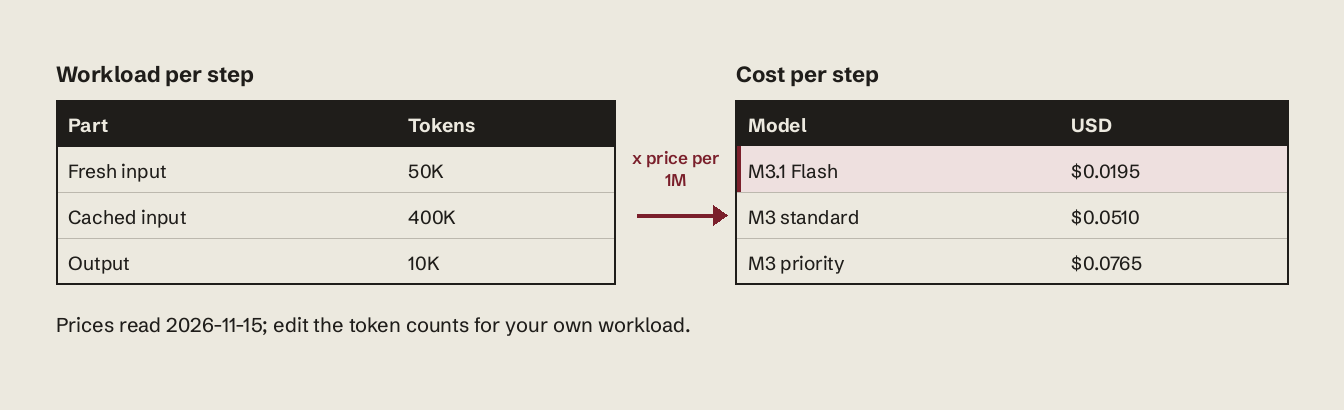
A per-token price only matters once you multiply it by a workload. Take one coding-agent step: 50K fresh input tokens, 400K cached input tokens (repo context the agent re-sends) and 10K output tokens.
| Model | Fresh input | Cached input | Output | Cost per step |
|---|---|---|---|---|
| MiniMax-M3.1-Flash | $0.0075 | $0.0060 | $0.0060 | $0.0195 |
| MiniMax-M3 standard | $0.0150 | $0.0240 | $0.0120 | $0.0510 |
| MiniMax-M3 priority | $0.0225 | $0.0360 | $0.0180 | $0.0765 |
Derivation for M3.1 Flash: 0.05M x $0.15 + 0.4M x $0.015 + 0.01M x $0.60 = $0.0075 + $0.006 + $0.006 = $0.0195. For M3 standard: 0.05 x $0.30 + 0.4 x $0.06 + 0.01 x $1.20 = $0.051. So 1,000 such steps cost $19.50 on M3.1 Flash and $51 on M3. Put your own token counts into the LLM cost calculator, or keep them in our LLM API cost spreadsheet template.
Caching is the biggest lever here. MiniMax caches automatically, without a code change, and a cache read on M3.1 Flash costs 10% of fresh input ($0.015 vs $0.15). On M3 it is 20% ($0.06 vs $0.30). Our prompt caching examples show how to keep the prefix stable so reads actually hit.
MiniMax M2.7 retirement on 2026-11-18
MiniMax M2.7 is no longer something you can buy. According to the MiniMax model list, the M2.5 and M2.7 families closed to new users on 2026-10-19 and retire on 2026-11-18. After that date, pay-as-you-go API requests to them stop working.
M Plan and Token Plan users are handled differently: since 2026-10-19, their M2.5 and M2.7 requests are routed to M3.1 Flash automatically, and the old model names keep working. If you are on pay-as-you-go, change the model ID before 2026-11-18:
# before: model="MiniMax-M2.7"
client.chat.completions.create(model="MiniMax-M3.1-Flash", messages=messages)
The model list also marks MiniMax-M2.7-highspeed, M2.1 and M2 as retired.
M Plan subscription tiers and usage windows
The M Plan is MiniMax's subscription for individuals, with three tiers. Prices read from minimax.io/m-plan on 2026-11-15:
| Tier | Monthly | Annual | Usage vs Go | Text model |
|---|---|---|---|---|
| Go | $22 | $220 | 1x | M3.1 Flash |
| Explore | $55 | $550 | 3x | M3.1 Flash |
| Build | $132 | $1,320 | 7.5x | M3.1 Flash |
The monthly figures are the list annual price divided by 12 ($264, $660 and $1,584). Annual billing is "pay for 10 months and get 2 months free" (M Plan FAQ). Explore and Build add the H3 video model; Build adds priority access during peak hours.
Usage rules you should know before paying:
- Text models are limited by a 5-hour window and a weekly window, which reset independently.
- Unused quota does not carry over to the next window or billing period.
- Past the limit, Credits are spent first, or you can switch your tool to a pay-as-you-go API key.
Is the MiniMax token plan cheaper than pay as you go?
It depends on volume, and MiniMax does not publish the plan quota in tokens, only as multiples of Go. So you can't compute the break-even from public numbers; you can only measure it. What you can compute is the pay-as-you-go spend each plan has to beat:
| Plan price | M3.1 Flash output tokens it buys | Agent steps it buys (example above) |
|---|---|---|
| $22 (Go) | 36.7M | 1,128 |
| $55 (Explore) | 91.7M | 2,820 |
| $132 (Build) | 220M | 6,769 |
Math: $22 / $0.60 per 1M = 36.7M output tokens; $22 / $0.0195 = 1,128 steps. If your month of pay-as-you-go use costs less than the plan, stay on pay-as-you-go. To check, run a week on the plan and read your remaining quota, from the M Plan FAQ:
mmx quota
# or
curl --location 'https://www.minimax.io/v1/token_plan/remains' \
  --header "Authorization: Bearer $MINIMAX_PLAN_KEY"
Then compare against your pay-as-you-go invoice for a similar week.
The plan also caps throughput through its windows, while pay-as-you-go is limited by rate limits of 200 RPM and 10,000,000 TPM for M3 and M3.1 Flash. For a production backend, pay-as-you-go is the safer fit; the plan is built for one person using coding tools.
How does MiniMax compare with DeepSeek on price?
DeepSeek prices by time of day, MiniMax does not. From the DeepSeek pricing page, read 2026-11-15:
| Model | Input (miss) | Input (cache hit) | Output |
|---|---|---|---|
| MiniMax-M3.1-Flash | $0.15 | $0.015 | $0.60 |
| MiniMax-M3 (up to 512K) | $0.30 | $0.06 | $1.20 |
| deepseek-flash, peak | $0.30 | $0.006 | $1.20 |
| deepseek-flash, off-peak | $0.15 | $0.003 | $0.60 |
| deepseek-v4-pro, peak | $1.32 | $0.044 | $3.96 |
DeepSeek's off-peak rates are half of peak; peak is 01:00-04:00 and 06:00-10:00 UTC on weekdays. On our example step, deepseek-flash costs $0.0294 at peak and $0.0147 off-peak, against $0.0195 for M3.1 Flash. DeepSeek wins on heavy cache reuse and off-peak batch work; M3.1 Flash is cheaper during DeepSeek's peak hours. The full model-by-model breakdown is in MiniMax vs DeepSeek.
FAQ
How much does the MiniMax API cost?
MiniMax-M3.1-Flash costs $0.15 per 1M input tokens and $0.60 per 1M output tokens. MiniMax-M3 costs $0.30 and $1.20 up to 512K input tokens, and $0.60 and $2.40 above that. Cache reads cost $0.015 (Flash) and $0.06 (M3).
What does MiniMax M2.7 cost per 1M tokens?
Nothing you can buy: M2.7 closed to new users on 2026-10-19 and retires on 2026-11-18. Its successor in the plans is M3.1 Flash at $0.15 / $0.60 per 1M tokens.
Is the MiniMax token plan cheaper than pay as you go?
Only if you use more than the plan price in tokens. Go costs $22 a month, which buys about 36.7M M3.1 Flash output tokens on pay-as-you-go. MiniMax does not state plan quotas in tokens, so measure a week of use before you commit.
Does MiniMax have a free tier?
The M Plan page lists a Free tier with limited access to M3.1 Flash in MiniMax Code. API usage beyond that is paid from your account balance or Credits.
Is the MiniMax API OpenAI compatible?
Yes. MiniMax serves an OpenAI Chat Completions endpoint, an OpenAI Responses endpoint and an Anthropic Messages endpoint at https://api.minimax.io/anthropic, so existing SDKs work after a base URL change.
What is MiniMax priority pricing?
Priority gives "priority admission for faster response times and improved request reliability" for 1.5x the standard price. Set service_tier to priority on the request.
Know your cost per task before you pick a model
The MiniMax table tells you the price; only your own traffic tells you the bill. Send a day of requests through one endpoint, read the cost on every response, and compare. Read what an LLM gateway is if you are new to the setup, then get your Vynaris API key.
Related articles
- MiniMax vs DeepSeek: M3 vs V4 Pro Price and Cost per Task
- Vertex AI Pricing: Gemini and Claude Per 1M Tokens
- Qwen Model Price: Every Qwen API Rate per 1M Tokens
- LLM API Pricing, July 2026: What 14 Models Cost Per Task, Not Per Token
- GPT-5.4 Nano Pricing: $0.20/$1.25 per 1M, Batch and Mini
- What a trust-and-safety UGC moderation cascade costs per 1M items screened