
Blog · · Updated · By Dhrumil Barot, Founder
LLM API Pricing, July 2026: What 14 Models Cost Per Task, Not Per Token
The gap between the most and least expensive mainstream API model is now 107x. Per-task math on 14 models across OpenAI, Anthropic, and DeepSeek, from prices verified 2026-07-10 - and where routing actually changes the bill.
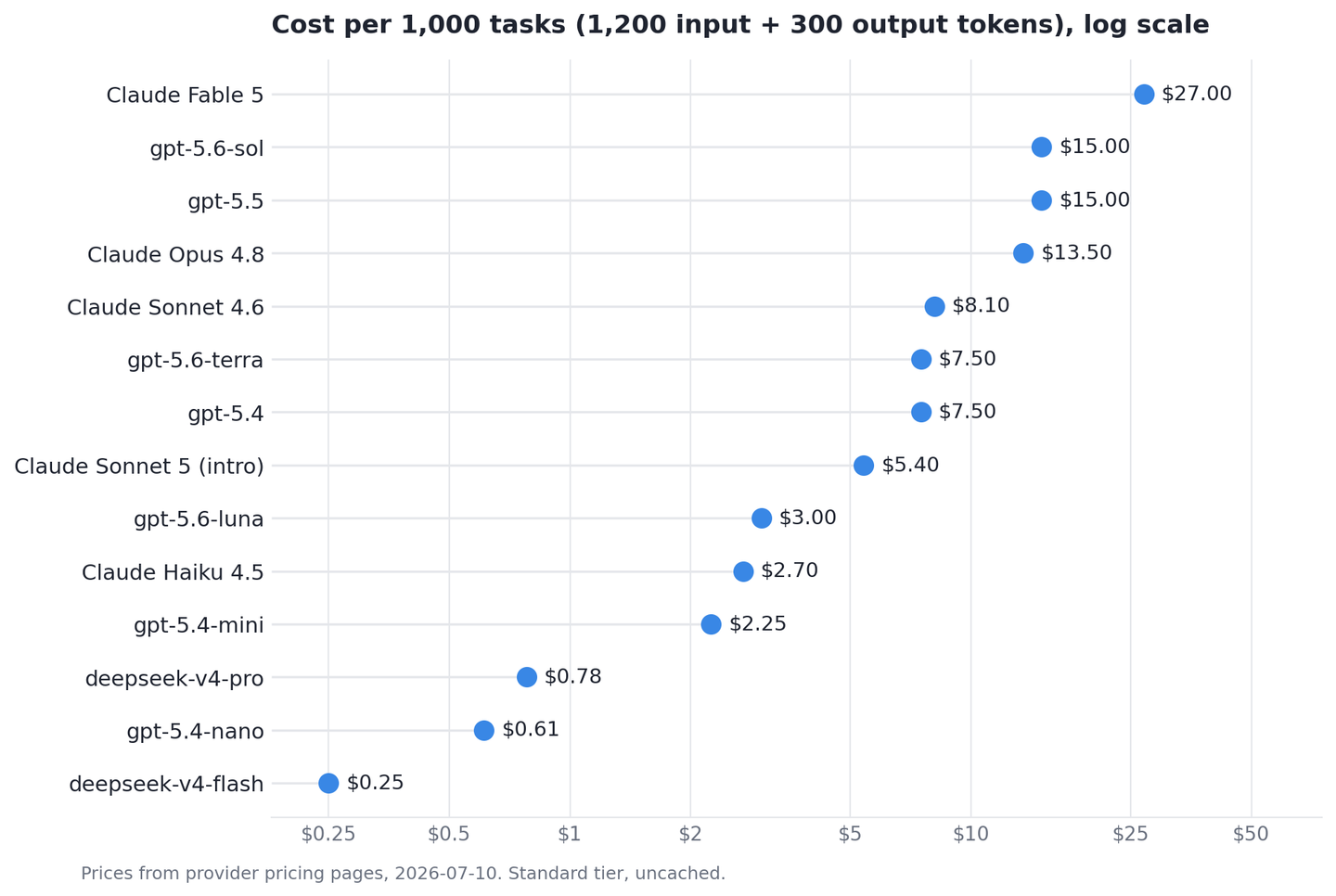
The gap between the most and least expensive mainstream API model is now 107x. Claude Fable 5 costs $27.00 per 1,000 routine tasks. DeepSeek-V4-Flash does the same volume for $0.25. Most teams pay flagship prices on workloads that sit far down that curve, because per-token price tables make the difference look small. Per-task math makes it look like what it is: the largest line item you can change in an afternoon.
All prices below were pulled from the providers' own pricing pages on 2026-07-10. If you are reading this later, check the dates before you act on the numbers.
The verdict table
One representative task: 1,200 input tokens plus 300 output tokens. That is a support-ticket triage, a JSON extraction from a document chunk, or one routing step inside an agent. The monthly column assumes 100,000 tasks.
| Model | Input $/1M | Output $/1M | Per 1,000 tasks | Per 100k tasks/mo |
|---|---|---|---|---|
| Claude Fable 5 | $10.00 | $50.00 | $27.00 | $2,700 |
| gpt-5.6-sol | $5.00 | $30.00 | $15.00 | $1,500 |
| gpt-5.5 | $5.00 | $30.00 | $15.00 | $1,500 |
| Claude Opus 4.8 | $5.00 | $25.00 | $13.50 | $1,350 |
| Claude Sonnet 4.6 | $3.00 | $15.00 | $8.10 | $810 |
| gpt-5.6-terra | $2.50 | $15.00 | $7.50 | $750 |
| gpt-5.4 | $2.50 | $15.00 | $7.50 | $750 |
| Claude Sonnet 5 (intro pricing) | $2.00 | $10.00 | $5.40 | $540 |
| gpt-5.6-luna | $1.00 | $6.00 | $3.00 | $300 |
| Claude Haiku 4.5 | $1.00 | $5.00 | $2.70 | $270 |
| gpt-5.4-mini | $0.75 | $4.50 | $2.25 | $225 |
| deepseek-v4-pro | $0.435 | $0.87 | $0.78 | $78 |
| gpt-5.4-nano | $0.20 | $1.25 | $0.61 | $62 |
| deepseek-v4-flash | $0.14 | $0.28 | $0.25 | $25 |
The math is one line: cost per task = (1,200 x input price + 300 x output price) / 1,000,000. Change the token counts to match your own workload and the ranking mostly holds, because output prices scale roughly with input prices across the board.
Three prices deserve a caveat. Claude Sonnet 5 is now standard at $2.00 input and $10.00 output. Anthropic canceled the scheduled 2026-09-01 increase, so the workload stays $5.40 per 1,000 tasks. Updated 2026-08-14. OpenAI's gpt-5.6 family and gpt-5.5 also carry long-context surcharges: gpt-5.6-sol doubles to $10.00 input and $45.00 output when your prompt crosses the short-context threshold. And DeepSeek's numbers are cache-miss prices; a cache hit on deepseek-v4-flash costs $0.0028 per million input tokens, which is not a typo.
Where the money actually goes
Notice the shape of the table. It is not a smooth slope. It is three clusters.
The flagship cluster ($13.50 to $27.00 per 1,000 tasks): Claude Fable 5, gpt-5.6-sol, gpt-5.5, Claude Opus 4.8. These models exist for work where being wrong is expensive: multi-file code changes, legal analysis, hard reasoning chains.
The mid cluster ($5.40 to $8.10): Claude Sonnet 4.6 and Sonnet 5, gpt-5.6-terra, gpt-5.4. Strong general models. Half to two-thirds cheaper than the flagships.
The floor ($0.25 to $3.00): gpt-5.6-luna, Claude Haiku 4.5, gpt-5.4-mini, gpt-5.4-nano, both DeepSeek models. This is where classification, extraction, formatting, summarization, and most agent plumbing belongs. A 5.6-sol request and a 5.4-nano request differ by 24x. Opus 4.8 to Haiku 4.5 is 5x within the same provider, same API shape, same SDK.
The uncomfortable question for any production system: what fraction of your requests genuinely need the top cluster? In agent workloads, where one user action fans out into ten or more model calls, the honest answer is usually a minority. The tool-selection step, the argument extraction, the retry formatting: none of that needs a $27.00-per-thousand model. The bill says you are paying as if it all does.
What the expensive model is actually for
The flagship cluster earns its price in specific places, and pretending otherwise produces quality regressions that cost more than the savings. Route the expensive model when the task has compounding error (a wrong plan poisons every downstream step), when the output ships without human review, or when a single task is worth dollars rather than fractions of a cent to you. A code-review agent that misses a security bug did not save you $12. It cost you an incident.
The mistake is not using Fable 5 or gpt-5.6-sol. The mistake is using them as the default for everything because switching models means touching code.
Don't route this
Honest limits of the cheap cluster, from the same pricing pages and public model cards: long-context work gets expensive or unsupported at the bottom (gpt-5.4-mini and nano list no long-context tier at all), and DeepSeek's concurrency limits are lower than the US providers', which matters at burst traffic. If your workload is 100 requests per day, the entire table above is noise; the spread between top and bottom is about $2.60 per day, and your engineering time costs more than that. Cost routing starts mattering somewhere around a few thousand requests per day.
Doing the math on your own traffic
Take yesterday's request log, bucket requests by what they actually do (generation vs extraction vs classification vs plumbing), multiply each bucket by the table above, once at your current model and once at the cheapest cluster that plausibly handles it. That delta, annualized, is the number to bring to your next infra discussion. The cost calculator does this arithmetic for any token mix and volume.
This is also exactly what Vynaris does continuously: an OpenAI-compatible gateway that sends each request to the cheapest model that holds quality on that task class, one base URL swap, with per-request costs visible instead of buried in a monthly invoice. Get an API key at vynaris.com.
FAQ
How much cheaper is gpt-5.4-nano than gpt-5.6-sol?
24x on a 1,200-in / 300-out task: $0.61 vs $15.00 per 1,000 tasks at standard pricing.
What is the cheapest LLM API in July 2026?
Of the models above, deepseek-v4-flash at $0.14 per million input tokens and $0.28 per million output tokens (cache miss). Per cached-input million it drops to $0.0028.
Do these prices include prompt caching?
No, the table is uncached. Caching cuts input costs by 90% or more on repeated prefixes at every provider listed: cached input is $0.50 on gpt-5.6-sol, $1.00 on Claude Fable 5, $0.0028 on deepseek-v4-flash.
When does Claude Sonnet 5 pricing change?
2026-09-01: from $2.00/$10.00 to $3.00/$15.00 per million input/output tokens, per Anthropic's pricing page.
Is the most expensive model the best model?
Not per task class. Public benchmarks show the mid and floor clusters matching flagships on classification and extraction. The flagship premium buys reasoning depth, which most production requests do not use.