
Blog · · By Dhrumil Barot, Founder
MiniMax vs DeepSeek: M3 vs V4 Pro Price and Cost per Task
MiniMax M3 costs $0.30/$1.20 per 1M tokens; DeepSeek V4 Pro costs $1.32/$3.96 at peak, half off-peak. Cost per coding, chat and long-doc task.
TL;DR: MiniMax-M3 is cheaper per fresh token than DeepSeek V4 Pro: $0.30 vs $1.32 per 1M input at DeepSeek peak hours (77% less). DeepSeek wins on cache reads ($0.044 vs $0.06 at peak, $0.022 off-peak), and its off-peak rates halve every price. On budget tiers, deepseek-flash off-peak and MiniMax-M3.1-Flash cost the same per token.
Is MiniMax cheaper than DeepSeek? For the flagships, yes, in most workloads. On our 50-turn coding-agent model (2M input tokens, 90% cache hits, 40K output), MiniMax-M3 costs $0.216 per task vs $0.502 for DeepSeek V4 Pro at peak and $0.251 off-peak. For a single 600K-token document, M3 crosses its 512K long-context tier and costs $0.370, still below V4 Pro peak ($0.808) and off-peak ($0.404). Prices verified 2026-11-11 from the DeepSeek pricing page and the MiniMax pricing page.
MiniMax vs DeepSeek at a glance
| Criterion | MiniMax-M3 | DeepSeek V4 Pro | MiniMax-M3.1-Flash | deepseek-flash |
|---|---|---|---|---|
| Input, cache miss ($/1M) | $0.30 (≤512K) / $0.60 (>512K) | $1.32 peak / $0.66 off-peak | $0.15 | $0.30 peak / $0.15 off-peak |
| Output ($/1M) | $1.20 / $2.40 | $3.96 peak / $1.98 off-peak | $0.60 | $1.20 peak / $0.60 off-peak |
| Cache read ($/1M) | $0.06 / $0.12 | $0.044 peak / $0.022 off-peak | $0.015 | $0.006 peak / $0.003 off-peak |
| Context window | 1M | 1M (384K max output) | 1M | 1M (384K max output) |
| Image input | Yes | No | Yes | Yes |
| Open weights | Yes | Yes (1.6T total, 49B active) | n/a | Yes (V4 family) |
| Pricing quirk | Price doubles above 512K input | Half price outside peak hours | Flat | Half price outside peak hours |
| Concurrency limit | Not published on pricing page | 500 | Not published on pricing page | 2,500 |
Model IDs: MiniMax-M3, MiniMax-M3.1-Flash, deepseek-v4-pro (DeepSeek-V4-Pro-0813) and deepseek-flash (DeepSeek-V4.1-Flash-1017, updated 2026-10-17 at unchanged prices). MiniMax lists M3 prices as a "permanent 50% off" from $0.60/$2.40, so the table shows what you pay today.
How do the two pricing models differ?
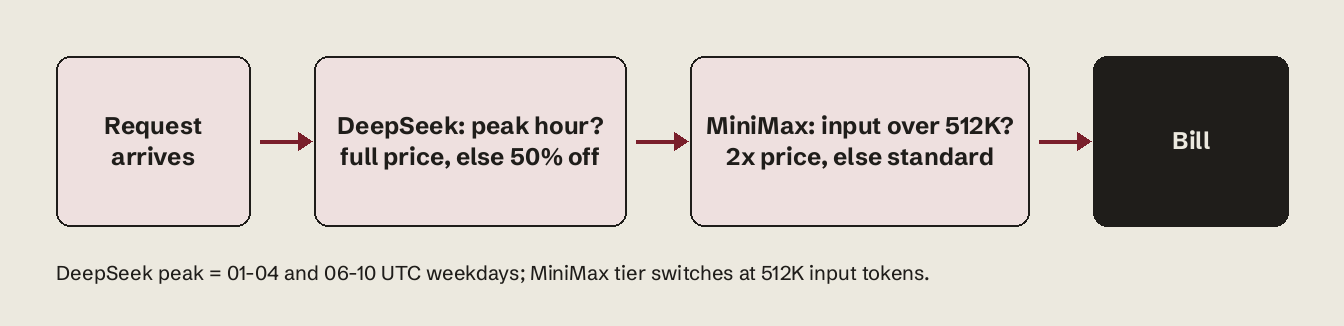
MiniMax prices by input length; DeepSeek prices by clock time. That is the deciding difference, and it matters more than the headline rate.
- MiniMax: a call with ≤512K input tokens bills at the standard rate. Above 512K, every token of that call bills at double ($0.60 in, $2.40 out). A
service_tier: "priority"flag buys faster admission at 1.5x. - DeepSeek: since 16:00 UTC on 2026-08-16, peak hours are 01:00-04:00 and 06:00-10:00 UTC, Monday to Friday, excluding Chinese public holidays. Every other hour, including weekends, bills at half. That is 7 peak hours a weekday, 35 of the week's 168 hours (21%).
If your traffic runs in US working hours (roughly 14:00-23:00 UTC), you never touch DeepSeek peak. If it runs in Asia or Europe mornings, you pay full rate.
Which is better for coding agents?
Use MiniMax-M3 for coding agents when you pay DeepSeek peak rates; use DeepSeek V4 Pro off-peak when cache hits dominate. MiniMax reports M3 at 59.0% on SWE-Bench Pro and 66.0% on Terminal-Bench 2.1 in its M3 release post. DeepSeek describes V4 Pro as open-source state of the art on agentic coding but does not publish the same benchmark set, so there is no clean head-to-head score. We do not invent one. Run both on 20 of your own tasks before you commit.
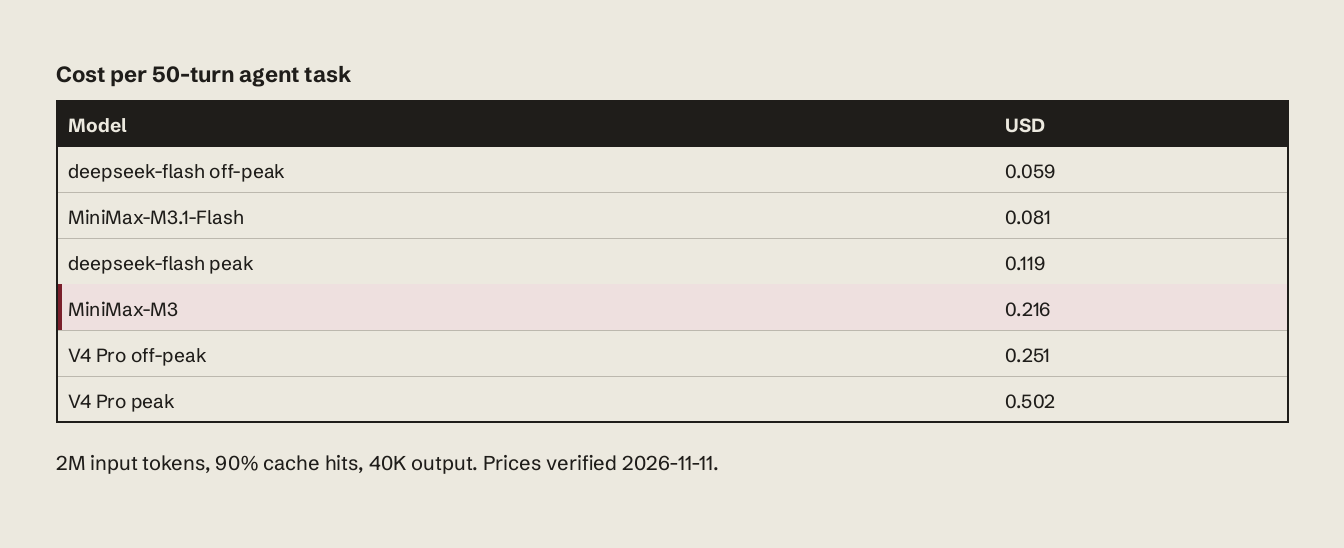
Cost is where the comparison is clean. Our coding-agent task model:
| Assumption | Value |
|---|---|
| Turns per task | 50 |
| Total input tokens across turns | 2,000,000 |
| Cache hit share | 90% (1.8M hit, 200K miss) |
| Output tokens | 40,000 |
| Longest single request | under 512K (M3 standard tier) |
| Model | Cost per task | Cost per 1,000 tasks |
|---|---|---|
| deepseek-flash off-peak | $0.059 | $59.40 |
| MiniMax-M3.1-Flash | $0.081 | $81.00 |
| deepseek-flash peak | $0.119 | $118.80 |
| MiniMax-M3 | $0.216 | $216.00 |
| DeepSeek V4 Pro off-peak | $0.251 | $250.80 |
| DeepSeek V4 Pro peak | $0.502 | $501.60 |
Derivation for M3: 200K × $0.30 + 1.8M × $0.06 + 40K × $1.20 = $0.060 + $0.108 + $0.048 = $0.216. For V4 Pro peak: $0.264 + $0.079 + $0.158 = $0.502. Change any row with your own numbers in the Vynaris cost calculator.
How do cache and off-peak discounts change the bill?
Cache discounts are steeper on DeepSeek. A V4 Pro cache hit costs 3.3% of a miss ($0.044 vs $1.32); an M3 cache read costs 20% of a miss ($0.06 vs $0.30). So the more of your input repeats, the closer DeepSeek gets. At 100% cache hits, V4 Pro off-peak input ($0.022) is cheaper than M3 ($0.06), but output still costs $1.98 vs $1.20, so M3 stays ahead whenever output is a real share of tokens. We break down why cache reads drive agent bills in cache reads dominate agent costs.
Two caching mechanics to know:
- DeepSeek caches automatically, but a request hits only if it fully matches a persisted prefix unit (KV cache guide). Changing an early system-prompt line breaks the hit.
- MiniMax also caches automatically and reports
cache_read_input_tokensin the response usage. Put static content (system prompt, tool list) first and dynamic content last.
Off-peak is a straight 50% cut on every DeepSeek line item. Batch jobs, evals and nightly reindexing should be scheduled outside 01:00-04:00 and 06:00-10:00 UTC on weekdays.
What context window does each offer?
Both offer 1M tokens. DeepSeek caps output at 384K tokens. The difference is price above 512K: MiniMax doubles every token of that call, while DeepSeek charges the same rate at any length.
| Long-document job (600K in, 4K out, no cache) | Cost per call |
|---|---|
| MiniMax-M3.1-Flash | $0.092 |
| deepseek-flash off-peak | $0.092 |
| deepseek-flash peak | $0.185 |
| MiniMax-M3 (>512K tier) | $0.370 |
| DeepSeek V4 Pro off-peak | $0.404 |
| DeepSeek V4 Pro peak | $0.808 |
M3 still wins at 600K, but the gap shrinks from 2.3x (agent task, peak) to 2.2x, and off-peak V4 Pro is only 9% dearer. If you can split documents under 512K per call, M3 halves again to $0.185.
Chat and short requests
A 3,000-token prompt with a 500-token answer costs $0.0015 on M3, $0.0059 on V4 Pro peak and $0.0030 off-peak. Per 1M such calls that is $1,500 vs $5,940. For short calls, the flash tiers ($0.00075 each for M3.1-Flash and deepseek-flash off-peak) are usually the right pick.
Does the MiniMax Token Plan beat pay-as-you-go?
The Token Plan is a subscription, not per-token billing, and on paper it is far cheaper. MiniMax lists three tiers in the M3 release post:
| Plan | Price per month | M3 tokens per month (approx.) | Effective $ per 1M tokens |
|---|---|---|---|
| Plus | $20 | 1.7B | $0.0118 |
| Max | $50 | 5.1B | $0.0098 |
| Ultra | $120 | 9.8B | $0.0122 |
Derivation: $20 / 1,700M tokens = $0.0118 per 1M. That is below even the M3 cache-read price ($0.06). The catch: MiniMax says text, image, speech and music share one usage pool, and the plan is sold for MiniMax Code and daily developer work, not as a production API contract. Use it for your own coding agent; keep pay-as-you-go for customer traffic where you need predictable limits. DeepSeek has no equivalent subscription; its pay-as-you-go balance is drawn from granted credit first, then topped-up credit.
Thinking modes and effort
Both flagships are reasoning models, and reasoning tokens bill as output. DeepSeek V4 Pro and deepseek-flash support thinking (the default) and non-thinking modes, with three effort levels since 2026-08-13: low, high and max. DeepSeek's own guidance is low for simple tasks, high for daily agent work and max for complex cases. Dropping from max to low is often the biggest single lever on a V4 Pro bill, because output is its priciest line at $3.96 per 1M peak. MiniMax-M3.1-Flash exposes tunable thinking depth; M3 is listed without that control on the models page. Measure output tokens per task on both before you trust any per-token comparison, including ours.
Choose MiniMax if, choose DeepSeek if
Choose MiniMax-M3 if:
- Your traffic lands in DeepSeek peak hours (Asia or Europe business mornings).
- Your agent emits a lot of output: $1.20 vs $3.96 per 1M at peak.
- You need image input on the flagship tier (V4 Pro has no vision).
- You prefer a flat subscription: the Token Plan lists Plus at $20/month for about 1.7B tokens.
Choose DeepSeek if:
- You can push batch work off-peak and get 50% off everything.
- Prompts are huge and highly repetitive (cache hits at $0.022 off-peak).
- You need single calls above 512K input regularly at Flash prices.
- You need high concurrency: 2,500 on deepseek-flash.
Don't route by price alone if your evals show one model failing a task class. A $0.216 task that fails twice costs more than a $0.502 task that passes once.
Routing between them
Both expose an OpenAI-compatible API, so switching is a base-URL change: https://api.deepseek.com for DeepSeek. The useful move is to stop picking one: send peak-hour and output-heavy work to M3, off-peak batch and cache-heavy work to DeepSeek. Vynaris does this per request behind one endpoint, choosing the cheapest model that meets your quality bar; see what an LLM gateway does if you'd rather build it yourself. For third-party V4 Pro prices, see our 17-provider DeepSeek V4 Pro price spread, and for the Flash vision tier, DeepSeek V4 Flash image cost.
FAQ
Is MiniMax cheaper than DeepSeek?
MiniMax-M3 is cheaper than DeepSeek V4 Pro on input ($0.30 vs $1.32 peak) and output ($1.20 vs $3.96 peak). DeepSeek is cheaper on cache reads, and its off-peak rates halve the gap. The budget tiers, M3.1-Flash and deepseek-flash off-peak, cost the same per token.
Which is better for coding agents, MiniMax M3 or DeepSeek V4 Pro?
MiniMax publishes 59.0% on SWE-Bench Pro for M3; DeepSeek does not publish a matching score for V4 Pro. On cost, M3 is $0.216 per 50-turn task vs $0.502 for V4 Pro at peak. Test both on your own repo before switching.
What are DeepSeek's peak hours?
01:00-04:00 and 06:00-10:00 UTC, Monday to Friday, excluding Chinese public holidays. All other hours bill at half price.
What context window do MiniMax M3 and DeepSeek V4 have?
Both support 1M tokens. DeepSeek limits output to 384K tokens. MiniMax charges double for calls above 512K input tokens.
Are MiniMax M3 and DeepSeek V4 open source?
Both are open-weight. DeepSeek V4 Pro has 1.6T total and 49B active parameters; MiniMax calls M3 the first open-weight model combining 1M context, frontier coding and native multimodality.
Can I use both with the same code?
Yes. Both accept OpenAI-format requests, and DeepSeek also offers an Anthropic-format endpoint at https://api.deepseek.com/anthropic.
Related articles
- DeepSeek V4 Pro 0423 costs 2.20x across 17 providers
- DeepSeek V4 price reset: off-peak costs 77–83% more
- DeepSeek v4 in production: the 100x price gap and the fine print that shrinks it
- gpt-5.4-mini vs Haiku 4.5 vs deepseek-v4-flash: extraction cost
- DeepSeek V4 Flash Vision caps images at 384 tokens: $0.08448 per 1,000 images before text and output
- DeepSeek Tokenizer: Vocab Size, Token Counts and Cost