
Blog · · Updated · By Dhrumil Barot, Founder
gpt-5.4-mini vs Haiku 4.5 vs deepseek-v4-flash: extraction cost
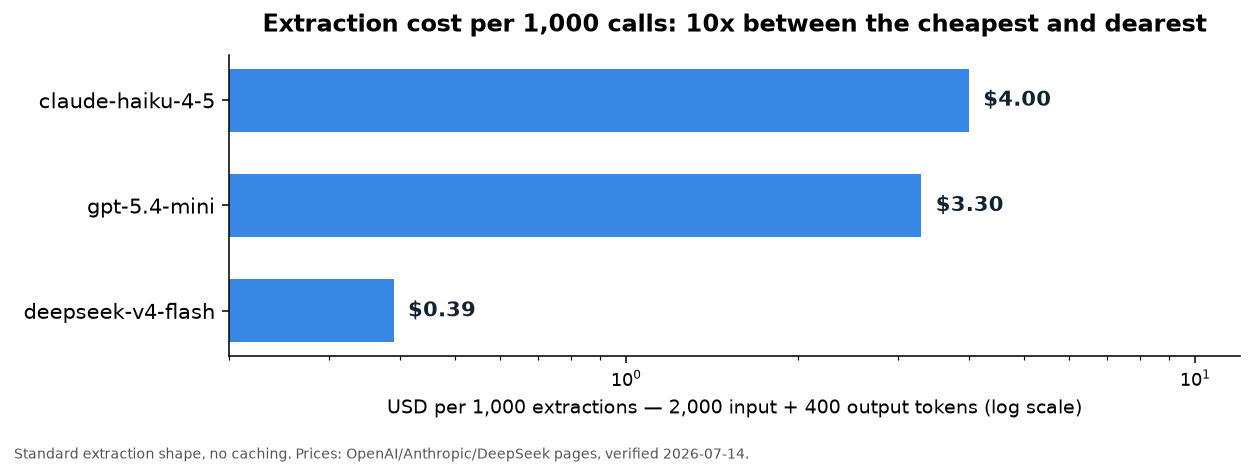
For a standard extraction call, deepseek-v4-flash costs $0.39 per 1,000 vs $3.30 for gpt-5.4-mini and $4.00 for Claude Haiku 4.5 — a 10x spread. When the cheapest wins, when it doesn't, and how to benchmark on your own schema. Prices verified 2026-07-14.
For a standard extraction call (2,000 input, 400 output tokens), deepseek-v4-flash costs $0.39 per 1,000 extractions, against $3.30 for gpt-5.4-mini and $4.00 for Claude Haiku 4.5 — a 10x spread on identical work. For high-volume, simple-schema extraction the cheapest model usually wins; the exceptions are worth knowing before you commit. Prices verified 2026-07-14.
Verdict
| Model | Input $/1M | Output $/1M | Cost /1,000 extractions | Best for |
|---|---|---|---|---|
| deepseek-v4-flash | $0.14 | $0.28 | $0.39 | High-volume, cost-driven pipelines; output-heavy JSON |
| gpt-5.4-mini | $0.75 | $4.50 | $3.30 | OpenAI-native stacks; strong instruction-following on messy input |
| Claude Haiku 4.5 | $1.00 | $5.00 | $4.00 | Extended-thinking edge cases; Anthropic-native tooling |
Cost figures are the standard extraction shape (2,000 input + 400 output tokens per call), first-party rates, no caching. All three are cheap in absolute terms; the question is whether 10x matters at your volume.
What we compared, and the task shape
Extraction is the classic workhorse job: feed a document, transcript, or email, get structured JSON back. It is input-heavy and output-light, and it runs at volume — thousands to millions of calls a month. That shape is why the cheapest per-token model tends to win, and why this comparison is decided on price far more than on a leaderboard.
We modeled three task shapes so you can find yours:
| Shape | Input | Output | deepseek-v4-flash | gpt-5.4-mini | Claude Haiku 4.5 |
|---|---|---|---|---|---|
| Light | 1,500 | 200 | $0.27 | $2.02 | $2.50 |
| Standard | 2,000 | 400 | $0.39 | $3.30 | $4.00 |
| Heavy JSON | 3,000 | 900 | $0.67 | $6.30 | $7.50 |
All figures are USD per 1,000 extractions, prices verified 2026-07-14 (sources below). deepseek-v4-flash stays roughly 8–10x cheaper across every shape, and the gap widens as output grows, because its output tokens cost $0.28/1M against $5.00 for Haiku 4.5 — a 17.9x difference. Heavy-JSON extraction, where the model emits long structured records, is exactly where a cheap output price compounds.
At 25,000 extractions a month on the standard shape, that is $9.80 on deepseek-v4-flash, $82.50 on gpt-5.4-mini, and $100.00 on Claude Haiku 4.5. If you are staring at that gap and wondering where your own numbers land, run your task shape through the calculator before you pick.
The quality question, honestly
Cost is verifiable to the cent. Quality is not, and this is where extraction comparisons usually cheat by quoting a benchmark that has nothing to do with pulling fields out of a document. We will not.
There is no primary-source, apples-to-apples extraction benchmark published for these three exact models. What exists is third-party signal, useful for direction, not for a decision:
- On the Artificial Analysis Intelligence Index (a third-party aggregate, not an extraction test), gpt-5.4-mini and deepseek-v4-flash both score 40. Treat that as "same rough tier," not a ranking.
- Independent testing put deepseek-v4-flash at 0.792 on IFBench (instruction-following), which is the capability that actually predicts structured-output reliability — whether the model respects your schema, enum values, and required fields.
- Claude Haiku 4.5 is the only one of the three with extended thinking, and Anthropic rates its latency "fastest" in the current lineup, with a 200k-token context window (verified on the Anthropic model page, 2026-07-14).
The load-bearing quality metric for extraction is not general intelligence; it is schema adherence and field accuracy on your documents. A model that scores a point higher on a math benchmark can still hallucinate a field your downstream code trusts. Benchmark on your own data before you route production volume — the recipe is below.
When the more expensive model wins
Ten-times-cheaper is not free if it costs you a re-run or a bad record. deepseek-v4-flash is the default for volume, but here is where paying more is the cheaper decision:
- Fragile schemas and strict validation. If a malformed field breaks a downstream job, a model that fails schema validation even 2% more often can erase the price gap in retries and cleanup. Test schema-validity rate, not just cost.
- Messy, adversarial input. Poorly formatted source text (OCR output, forwarded email chains, mixed languages) rewards stronger instruction-following. gpt-5.4-mini's instruction-following is the reason it earns its higher price on the ugliest inputs.
- Ambiguity that needs reasoning. When extraction requires inferring an unstated value rather than copying a present one, Haiku 4.5's extended thinking can justify its cost. Pure copy-out extraction does not need it.
- Latency and stack fit. If you already run on OpenAI or Anthropic tooling, the integration cost of a third provider may outweigh the token saving at low volume. The saving only dominates once volume is high enough to matter.
The honest rule: route the easy 90% of extractions to deepseek-v4-flash and reserve a stronger model for the hard, high-stakes 10%. That is right-sizing, and it beats picking one model for everything.
Caching barely moves this one
Prompt caching is a big win for agents that re-read a large stable prefix. Extraction is different: the document changes every call, so only the schema and instructions are cacheable. On a 1,000-token stable prefix plus a 1,000-token fresh document plus 400 output, a cache hit saves 20% on gpt-5.4-mini, 22% on Claude Haiku 4.5, and 35% on deepseek-v4-flash. Worth turning on, but it does not change the ranking, and it will not rescue an expensive model into contention. Caching is a multiplier on the model you picked, not a substitute for picking the cheap one.
How to benchmark this on your own data
Do not trust our numbers or anyone's leaderboard for your schema. The eval is an afternoon:
- Pull 200 real documents you have already extracted correctly (your ground truth).
- Run all three models with the same prompt and JSON schema in strict mode.
- Score two things: schema-validity rate (does it parse and satisfy the schema?) and field accuracy (does each field match ground truth?).
- Multiply each model's per-call cost by your monthly volume, then divide by its accuracy to get cost-per-correct-extraction. That number, not the sticker price, is the one to route on.
An OpenAI-compatible gateway makes step 2 a one-line change instead of three SDK rewrites: point one base URL at a router, send the same request to each model, and compare validity, accuracy, and cost side by side. That is the model routing case for extraction — you keep the cheap model on the easy bulk and fail over to a stronger one only when validation trips. We walked the wider pricing field in the July 2026 cost-per-task breakdown, and the same input-heavy logic that governs agent scaffolding cost applies here.
FAQ
What is the cheapest model for high-volume extraction in 2026? On the shapes here, deepseek-v4-flash at $0.39 per 1,000 standard extractions, roughly 10x cheaper than gpt-5.4-mini ($3.30) and Claude Haiku 4.5 ($4.00), prices verified 2026-07-14. It wins most where output volume is high, because its output price ($0.28/1M) is ~18x below the others.
Is deepseek-v4-flash accurate enough for extraction? Its instruction-following (IFBench 0.792, third-party) is strong, which predicts good schema adherence, and it supports JSON mode. But there is no primary-source extraction benchmark for it, so validate schema-validity rate on your own documents before routing production volume.
When should I pay for gpt-5.4-mini or Claude Haiku 4.5 instead? When input is messy, schemas are fragile, or extraction needs inference rather than copy-out. gpt-5.4-mini's instruction-following suits adversarial input; Haiku 4.5's extended thinking suits ambiguity. Route the hard minority to them and keep the bulk cheap.
Does prompt caching change the ranking? No. Extraction caches only the stable schema and instructions, not the changing document. Caching saves 20–35% here but leaves deepseek-v4-flash cheapest by a wide margin.
How do I compare quality fairly? Score schema-validity rate and field accuracy against your own ground-truth set, then compute cost-per-correct-extraction. General-intelligence leaderboards do not measure extraction and should not decide it.
Sources
- OpenAI API pricing (gpt-5.4-mini: input $0.75, cached input $0.075, output $4.50), verified 2026-07-14: https://developers.openai.com/api/docs/pricing
- Anthropic pricing and model overview (Claude Haiku 4.5: input $1.00, cache read $0.10, output $5.00; 200k context, extended thinking, fastest latency), verified 2026-07-14: https://platform.claude.com/docs/en/docs/about-claude/pricing
- DeepSeek API pricing (deepseek-v4-flash: input $0.14, cache hit $0.0028, output $0.28), verified 2026-07-14: https://api-docs.deepseek.com/quick_start/pricing
- Third-party quality signal (support only, not primary): Artificial Analysis Intelligence Index (gpt-5.4-mini, deepseek-v4-flash = 40): https://artificialanalysis.ai/models/gpt-5-4-mini ; deepseek-v4-flash IFBench 0.792 / AIME 2026 96.7: https://layerlens.ai/blog/deepseek-v4-flash-aime2026
- Cost math script: reproducible from the assumptions above.
Prices change. We re-verify every figure in this post monthly and stamp updates. Numbers are current as of 2026-07-14.
Want cost-per-correct-extraction on your own schema? Vynaris is an OpenAI-compatible gateway that routes each request to the cheapest right-sized model and shows the per-request cost. One base URL swap. Get an API key at vynaris.com.