
Blog · · Updated · By Dhrumil Barot, Founder
DeepSeek v4 in production: the 100x price gap and the fine print that shrinks it
DeepSeek v4-flash is 89-179x cheaper per output token than frontier, ~54x on a real task. The catch: concurrency caps, cache rules, a 2026-07-24 rename.
Per output token, deepseek-v4-flash costs $0.28/1M against $25 for Claude Opus 4.8 and $50 for Claude Fable 5, an 89x to 179x sticker gap. On a real balanced task the gap is smaller but still large: 54x cheaper than Opus 4.8, 11x cheaper than Claude Haiku 4.5. The fine print that decides production fit is concurrency ceilings, cache determinism, and a forced rename this week. Prices verified 2026-07-22.
Verdict
| Model | Input $/1M | Output $/1M | Cost /1,000 balanced tasks | When to pick it |
|---|---|---|---|---|
| deepseek-v4-flash | $0.14 | $0.28 | $1.26 | High-volume, cost-driven, output-heavy serving |
| deepseek-v4-pro | $0.435 | $0.87 | $3.92 | Harder reasoning at a third of frontier price |
| Gemini 3.1 Flash-Lite | $0.25 | $1.50 | $3.75 | Google-native budget tier (still listed) |
| Gemini 3.5 Flash-Lite | $0.30 | $2.50 | $5.55 | Google-native, newer, but repriced upward |
| Claude Haiku 4.5 | $1.00 | $5.00 | $13.50 | Anthropic-native tooling, extended thinking |
| Claude Sonnet 5 | $2.00 | $10.00 | $27.00 | Quality-sensitive production on Anthropic |
| Claude Opus 4.8 | $5.00 | $25.00 | $67.50 | Hardest reasoning, strict SLA, native stack |
Balanced task = 6,000 input plus 1,500 output tokens, first-party rates, no caching. Sonnet 5 is shown at its now-standard $2/$10 price; Anthropic canceled the scheduled 2026-09-01 increase. DeepSeek's new peak/off-peak rows are covered in the August 16 price-reset analysis. Full derivation is below. Updated 2026-08-14.
The sticker gap is real, and the input:output ratio moves it
DeepSeek's headline is genuine. On raw per-token rates, deepseek-v4-flash undercuts the frontier by two orders of magnitude on output. But a bill is not a sticker. What you actually pay is set by your input tokens and output tokens per task, and the two providers do not scale the same way.
Input rates compress the gap. DeepSeek input is $0.14/1M; Opus 4.8 input is $5/1M. That is 35.7x, not 89x. So an input-heavy task, which most retrieval and classification jobs are, lands closer to the input multiple than the output one.
| Task shape | deepseek-v4-flash | Claude Opus 4.8 | Gap |
|---|---|---|---|
| Balanced (6k in / 1.5k out) | $1.26 | $67.50 | 54x |
| Output-heavy (4k in / 4k out) | $1.68 | $120.00 | 71x |
The gap widens as your work gets more generative. That is the same logic that governs extraction workloads, where a cheap output price compounds on long structured records. If your production traffic is output-heavy (agents, long generation, code), DeepSeek's advantage is largest. If it is input-heavy with short answers, the advantage is real but narrower.
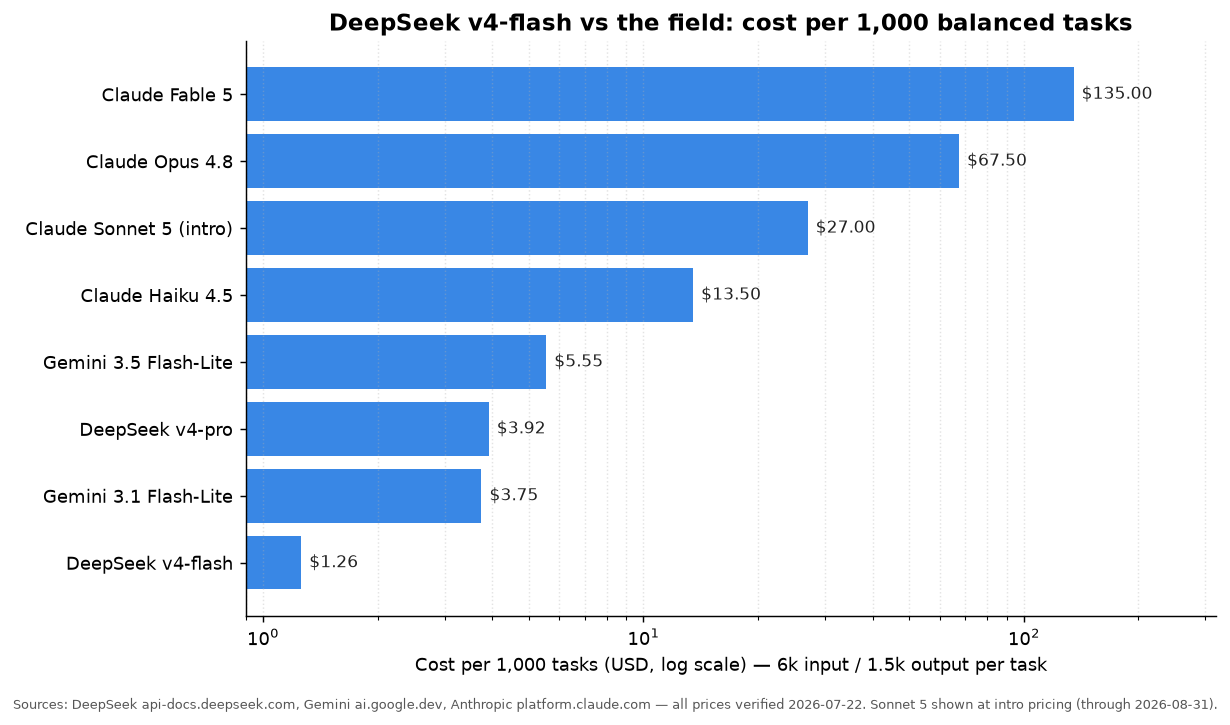
At one million balanced tasks a month, that is $1,260 on deepseek-v4-flash against $67,500 on Opus 4.8. Before you route on those numbers, put your own token shape through the calculator, because the ratio, not the sticker, decides your saving.
Fine print 1: the concurrency ceiling
The first production constraint is not quality. It is throughput headroom. DeepSeek's live docs publish a concurrency limit of 2,500 for deepseek-v4-flash and 500 for deepseek-v4-pro, verified 2026-07-22. That is a hard cap on in-flight requests on the first-party API.
What that cap means depends on how long each request holds a slot. If a typical call occupies a slot for about 8 seconds, 2,500 slots is roughly 300 requests per second of ceiling. For v4-pro, 500 slots at the same hold time is roughly 60 requests per second. Those figures are illustrative arithmetic, not a service guarantee, and your real hold time varies with output length. The point stands: at scale you plan around a published ceiling, and burst traffic above it queues or errors.
Frontier vendors sell their way around this. Anthropic and the other majors publish tiered rate limits and negotiate higher enterprise limits with support commitments. If your product needs a contractual throughput floor, that is part of what the higher price buys. A cost table cannot show it, so name it in your own decision.
Fine print 2: cache determinism decides your real input bill
DeepSeek prices a cache hit on input at $0.0028/1M against $0.14 on a miss, a 50x spread. Prompt caching is automatic, but a hit only lands when the request prefix is byte-identical to a recent one. A moving timestamp, a reordered system prompt, or per-user context in the prefix silently drops you back to the miss rate.
The math is worth seeing. On the balanced shape, moving from 0% to 90% input cache-hit rate cuts the task bill 58.8%, from $1.26 to $0.519 per 1,000. But output never caches. At a 90% hit rate, output is 81% of what remains. So caching helps the input side hard and then stops, and an output-heavy workload feels it least. Structure your prefix for determinism if you want the cheap input rate, and do not assume the headline $0.0028 applies to a request you have not stabilized.
Fine print 3: a rename lands 2026-07-24
DeepSeek's docs state that the model names deepseek-chat and deepseek-reasoner are deprecated on 2026-07-24 15:59 UTC, folding into deepseek-v4-flash as its non-thinking and thinking modes. If your production config still points at those identifiers, that is a code touch this week, not next quarter. Frontier providers deprecate too, but the timing here is immediate. Validate your model IDs before the window closes.
When the expensive model wins
Two orders of magnitude cheaper is not cheaper if it costs you a re-run, an outage, or a support escalation. Right-sizing means knowing where DeepSeek is the wrong call.
- Contractual latency or uptime. If a customer SLA depends on tail latency or a throughput floor, a published concurrency cap with no negotiated support is a risk. Frontier enterprise tiers exist for this.
- Hardest reasoning. For multi-step reasoning where an error propagates, Opus 4.8 or Sonnet 5 can earn their price by failing less. Test quality on your task, not on a general leaderboard.
- Native stack and data terms. If you already run on Anthropic or Google tooling and have data-residency or compliance terms, adding a third provider has integration and governance cost that a low token price does not offset at modest volume.
- Long stable prefixes with strict cache economics. Anthropic bills a 900k-token request at the same per-token rate as a 9k one and offers a large context window; if your economics depend on a specific caching model, price both providers on your real prefix.
The honest rule is the same as always: route the easy, high-volume majority to the cheap model and reserve a stronger one for the hard, high-stakes minority. That is model routing, and it beats a single-model decision in either direction. The wider field is in the July 2026 cost-per-task breakdown.
v4-flash or v4-pro?
Within DeepSeek, flash is the volume workhorse and pro is the reasoning step up. On the balanced shape, v4-pro costs $3.92 per 1,000 against $1.26 for flash, so pro is 3.1x flash and still far under any frontier model. Note the tighter concurrency ceiling on pro (500 versus 2,500). Route bulk traffic to flash, escalate to pro only where flash's answer quality actually fails, and keep the ceiling difference in mind when you size for peak.
FAQ
How much cheaper is DeepSeek v4 than frontier models? Per output token, deepseek-v4-flash ($0.28/1M) is 89x cheaper than Claude Opus 4.8 ($25/1M) and 179x cheaper than Claude Fable 5 ($50/1M). On a balanced 6k-in/1.5k-out task it is 54x cheaper than Opus 4.8 and 11x cheaper than Claude Haiku 4.5. Prices verified 2026-07-22.
Why is my real gap smaller than 100x? Because input tokens cost less to begin with, so the input rate ratio (35.7x versus Opus 4.8) pulls a mixed task below the output ratio. The more output-heavy your workload, the closer you get to the full gap.
What limits DeepSeek v4 in production? First-party concurrency ceilings (2,500 for flash, 500 for pro), no negotiated SLA at the self-serve tier, and cache hits that only land on byte-identical prefixes. Plan throughput around the cap and structure prefixes for cache determinism.
Is the DeepSeek cache discount reliable? The $0.0028/1M cache-hit rate is real but conditional. A hit requires a stable, repeated prefix; moving content in the prefix drops you to the $0.14 miss rate. Output tokens never cache.
Do I need to change my code before 2026-07-24? If you call deepseek-chat or deepseek-reasoner, yes. Those names deprecate 2026-07-24 15:59 UTC and become modes of deepseek-v4-flash. Update the model ID.
Sources
- DeepSeek API pricing (deepseek-v4-flash $0.14 / cache hit $0.0028 / $0.28, concurrency 2,500; deepseek-v4-pro $0.435 / $0.003625 / $0.87, concurrency 500; deepseek-chat and deepseek-reasoner deprecate 2026-07-24 15:59 UTC), verified 2026-07-22: https://api-docs.deepseek.com/quick_start/pricing
- Anthropic pricing (Haiku 4.5 $1/$5; Sonnet 5 $2/$10 standard; Opus 4.8 $5/$25; Fable 5 $10/$50; 1M-context flat rate; cache read 0.1x), re-verified 2026-08-14: https://platform.claude.com/docs/en/about-claude/pricing
- Google Gemini API pricing (Gemini 3.5 Flash-Lite $0.30/$2.50; Gemini 3.1 Flash-Lite $0.25/$1.50), verified 2026-07-22: https://ai.google.dev/gemini-api/docs/pricing
- Cost math script: reproducible from the assumptions above.
Prices change. We re-verify every figure in this post monthly and stamp updates. Numbers are current as of 2026-07-22.
Want cost-per-task on your own token shape across DeepSeek and the frontier? Vynaris is an OpenAI-compatible gateway that routes each request to the cheapest right-sized model and reports the per-request cost. One base URL swap. Get an API key at vynaris.com.
Further reading: DeepSeek V4 Pro 0423 pricing across 17 OpenRouter providers.