
Blog · · By Dhrumil Barot, Founder
DeepSeek V4 Pro 0423 costs 2.20x across 17 providers
DeepSeek V4 Pro 0423 costs $10.44-$22.94 per 1,000 8k-input/2k-output calls across 17 OpenRouter endpoints. Retry break-evens included.
The same OpenRouter model ID spans a 2.1973x task-cost range. DeepSeek V4 Pro 0423 costs $10.44 per 1,000 calls on DigitalOcean and $22.94 on Azure for 8,000 input plus 2,000 output tokens. The first retry break-even arrives at a 16.53% failure rate.
Prices verified 2026-08-31.
TL;DR
- OpenRouter lists 17 endpoints under
deepseek/deepseek-v4-pro. Input rates run from $0.87 to $1.91 per 1M tokens. Output runs from $1.74 to $3.83. - The fixed 8k-input/2k-output task costs $0.01044 on DigitalOcean and $0.02294 on Azure. That is $10.44 versus $22.94 per 1,000 calls.
- DigitalOcean remains cheaper than the next endpoint, StreamLake, until its independent failure rate reaches 16.53% under a geometric retry model. It can reach 54.49% before matching Azure's nominal cost.
- These are catalog prices, not quality-adjusted bills. Endpoint quantization, supported parameters, availability, latency, and output quality are not equivalent by default.
Verdict table
| Buyer question | Numeric answer | Verdict |
|---|---|---|
| Lowest catalog cost | DigitalOcean at $10.44/1K tasks | Start here for a price-first test |
| Next-lowest catalog cost | StreamLake at $12.51/1K | DigitalOcean has 16.53% retry headroom |
| Highest catalog cost | Azure at $22.94/1K | Costs 2.1973x the floor on this task |
| Current DeepSeek direct reference | $9.24 off-peak or $18.48 peak/1K | Different 0813 version; not an endpoint substitute |
| Missing decision data | 17 of 17 endpoints have no 30-minute throughput value in the captured payload | Benchmark before committing |
The buyer threshold is 16.53%, not 2.20x. A cheap endpoint that repeats enough work can lose to the next price tier. A more expensive endpoint can also win if it clears a parameter, data-policy, region, or reliability requirement the floor cannot satisfy.
What the catalog actually contains
OpenRouter's public endpoint payload names the model DeepSeek: DeepSeek V4 Pro 0423. Every row uses the model ID deepseek/deepseek-v4-pro. The endpoint count is 17.
That shared label does not make each implementation identical. The catalog marks some endpoints FP8, some FP4, and others as unknown quantization. Maximum completion limits and supported request parameters also differ. The listed context window is roughly one million tokens across the set, but several exact limits differ.
The table below converts the catalog's per-token values into per-million rates. The task column uses one uncached call with 8,000 input and 2,000 output tokens.
| Provider | Quant. | Input $/1M | Output $/1M | $/1K tasks | Floor failure break-even |
|---|---|---|---|---|---|
| DigitalOcean | unknown | $0.870 | $1.740 | $10.44 | 0.00% |
| StreamLake | FP8 | $1.042 | $2.085 | $12.51 | 16.53% |
| GMICloud | FP8 | $1.044 | $2.088 | $12.53 | 16.67% |
| Ionstream | FP4 | $1.131 | $2.262 | $13.57 | 23.08% |
| CoreWeave | FP8 | $1.150 | $2.550 | $14.30 | 26.99% |
| DeepInfra | FP8 | $1.300 | $2.600 | $15.60 | 33.08% |
| Alibaba | FP8 | $1.416 | $2.832 | $16.99 | 38.56% |
| SiliconFlow | FP8 | $1.502 | $3.135 | $18.28 | 42.90% |
| Novita | FP8 | $1.600 | $3.200 | $19.20 | 45.63% |
| Venice | unknown | $1.650 | $3.301 | $19.80 | 47.28% |
| AtlasCloud | FP4 | $1.680 | $3.380 | $20.20 | 48.32% |
| Baidu | FP8 | $1.690 | $3.380 | $20.28 | 48.52% |
| NextBit | FP8 | $1.720 | $3.450 | $20.66 | 49.47% |
| BaseTen | FP4 | $1.740 | $3.480 | $20.88 | 50.00% |
| Fireworks | unknown | $1.740 | $3.480 | $20.88 | 50.00% |
| Parasail | FP8 | $1.740 | $3.480 | $20.88 | 50.00% |
| Azure | unknown | $1.910 | $3.830 | $22.94 | 54.49% |
The input spread is 2.1954x. The output spread is 2.2011x. This workload lands between them at 2.1973x because output tokens carry roughly twice the input rate on almost every endpoint.
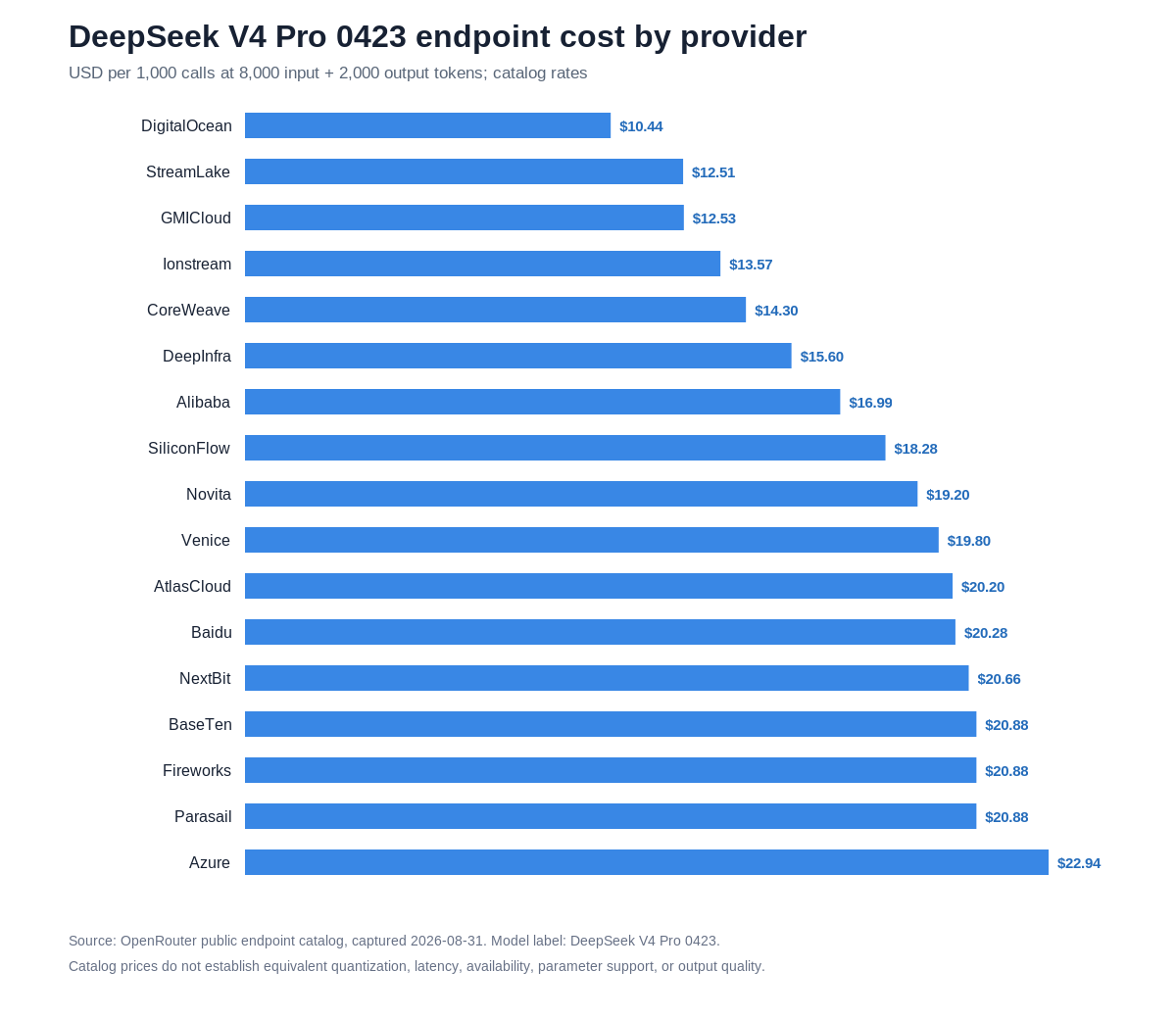
Reproduce the $10.44 to $22.94 range
For input rate I and output rate O, the per-request cost is:
task cost = 8,000 / 1,000,000 × I + 2,000 / 1,000,000 × ODigitalOcean is:
0.008 × $0.87 + 0.002 × $1.74
= $0.00696 + $0.00348
= $0.01044 per task
= $10.44 per 1,000 tasks
Azure is:
0.008 × $1.91 + 0.002 × $3.83
= $0.01528 + $0.00766
= $0.02294 per task
= $22.94 per 1,000 tasks
Replace the 8,000/2,000 shape with your measured payload in the LLM cost calculator. The catalog's cost per token matters less than the tokens your accepted task actually consumes.
Retry break-even: 16.53% is the first line
Nominal price assumes every attempt succeeds. To price repeated attempts, let C be one attempt's cost and f be the independent failure probability. If we retry until success, expected attempts are 1 / (1 - f).
expected successful-task cost = C / (1 - f)Set DigitalOcean's expected cost equal to StreamLake's nominal $0.01250712:
$0.01044 / (1 - f) = $0.01250712
f = 1 - $0.01044 / $0.01250712
f = 16.53%
At 16.53%, the lowest sticker loses its advantage over the next endpoint. Against Azure, the same equation gives 54.49%.
This is an optimistic sensitivity, not a measured endpoint failure claim. It assumes failures are independent, every retry uses the same tokens, partial failures do not add a different bill, and the comparison endpoint never fails. Real retries can expand prompts, repeat tool calls, or trigger fallbacks. Use accepted cost per task, not HTTP success alone.
Our fallback-chain cost model covers partial attempts and hedged calls. The DeepSeek V4 production analysis covers concurrency and cache constraints that a price table misses.
DeepSeek direct is a different version
DeepSeek's own live pricing page currently names DeepSeek-V4-Pro-0813. It charges $0.66 per 1M cache-miss input tokens and $1.98 per 1M output tokens off-peak. Peak rates are $1.32 and $3.96.
On the same task, that derives to $9.24 per 1,000 calls off-peak and $18.48 peak:
off-peak = 8 × $0.66 + 2 × $1.98 = $9.24 per 1K
peak     = 8 × $1.32 + 2 × $3.96 = $18.48 per 1K
Do not rank those rows inside the 17-endpoint table. OpenRouter labels its set 0423; DeepSeek labels its current direct model 0813. Treat the direct rates as a current family reference until a controlled test establishes version and behavior equivalence. Our August 16 DeepSeek price-reset analysis explains the peak and off-peak schedule.
When a more expensive endpoint wins
The floor wins only after it passes your product gates. OpenRouter's captured payload has no 30-minute throughput or latency value for any of the 17 endpoints. That absence blocks a speed-adjusted ranking.
The payload does expose different quantization tags, maximum output limits, supported parameters, tool-choice modes, and recent availability fields. Those are selection filters, not footnotes. An endpoint that cannot honor required tool calls, structured output, retention policy, or region is not cheap. It is ineligible.
OpenRouter says its default load balancing prioritizes stable, low-cost providers and keeps remaining providers as fallbacks. It also supports explicit sorting by price, throughput, or latency. That policy can reduce manual work, but it does not replace an application-level acceptance test.
Pay more when a measured endpoint improves accepted outcomes, meets the region or data policy, supports the parameters you send, or reduces retry waste by more than its price premium. Stay on the floor when outputs and service behavior are equivalent under your own test. The catalog alone cannot settle that choice.
FAQ
Which DeepSeek V4 Pro provider is cheapest on OpenRouter?
DigitalOcean is cheapest in the 2026-08-31 endpoint snapshot at $0.87 per 1M input tokens and $1.74 per 1M output tokens. The worked 8k-input/2k-output task costs $10.44 per 1,000 calls.
How much do DeepSeek V4 Pro endpoint prices vary?
Input varies 2.1954x, output varies 2.2011x, and the worked task varies 2.1973x across 17 catalog endpoints. The range is $10.44 to $22.94 per 1,000 calls.
Does the cheapest endpoint stay cheapest after retries?
Only below the retry threshold. DigitalOcean reaches StreamLake's nominal cost at a 16.53% independent failure rate in the shown geometric model. Use your measured accepted-task failures before routing production traffic.
Is DeepSeek's direct API cheaper than OpenRouter's endpoints?
Its current 0813 off-peak rate produces $9.24 per 1,000 worked calls, below the OpenRouter 0423 floor of $10.44. The versions differ, so that is not an apples-to-apples provider comparison.
Should I sort providers by price?
Use price sorting only after filtering for required parameters, data policy, region, and measured acceptance. Otherwise a nominal saving can become retry cost or an invalid request.
Sources
- OpenRouter DeepSeek V4 Pro endpoint catalog, captured 2026-08-31: 17 endpoint names, model label, prices, quantization, parameters, limits, and public status fields.
- OpenRouter provider-routing documentation, captured 2026-08-31: default price-aware load balancing, fallbacks, sorting, parameter requirements, and price ceilings.
- DeepSeek models and pricing, captured 2026-08-31: current
DeepSeek-V4-Pro-0813model name, cache-miss rates, output rates, peak schedule, and concurrency limit.
The full endpoint table is saved as artifacts/deepseek-v4-pro-17-provider-price-spread.csv. All arithmetic and chart data are reproducible in artifacts/deepseek-v4-pro-17-provider-price-spread-math.py.