Blog · · By Dhrumil Barot, Founder
Qwen Model Price: Every Qwen API Rate per 1M Tokens
Qwen API prices run from $0.03 to $2.50 per 1M input tokens on Alibaba Model Studio. Rates by model, region, scope and context tier, checked 2026-11-12.
TL;DR: On Alibaba Cloud Model Studio, the flagship qwen3.8-max costs $2 per 1M input tokens and $6 per 1M output in the International scope, and $1.65 / $4.951 in the Global scope, 17.5% less for the same model. The cheapest current text model, qwen3.7-flash, starts at $0.03 / $0.13 for requests up to 32K input tokens. Prices below were read from Alibaba's pricing page on 2026-11-12.
The Qwen model price you pay depends on four things, not one: the model, the region you call, the service deployment scope you pick (International, Global, US, EU and so on), and the size of each request, because several Qwen models price by input-length tier. On a typical request of 3,000 input and 600 output tokens, qwen3.8-max costs $9.60 per 1,000 requests in the International scope and $7.92 in the Global scope; qwen3.8-flash costs $0.73; qwen3.7-flash costs $0.17. Every price on this page comes from the Model Studio pricing page, and every per-request figure shows its arithmetic.
Qwen API price table (Singapore, International scope)
These are pay-as-you-go list prices per 1M tokens for the Singapore region, the one most non-China developers sign up in. "Tier" is the input size of a single request.
| Model ID | Tier (input tokens) | Input / 1M | Output / 1M | Cost per 1,000 requests* |
|---|---|---|---|---|
| qwen3.8-max | up to 1M | $2.00 | $6.00 | $9.60 |
| qwen3.7-max | up to 1M | $2.50 | $7.50 | $12.00 |
| qwen-max (legacy, non-thinking) | no tiers | $1.60 | $6.40 | $8.64 |
| qwen3.7-plus | up to 256K | $0.40 | $1.60 | $2.16 |
| qwen3.6-plus | up to 256K | $0.50 | $3.00 | $3.30 |
| qwen-plus (non-thinking / thinking) | up to 256K | $0.40 | $1.20 / $4.00 | $1.92 / $3.60 |
| qwen3.8-flash | up to 1M | $0.15 | $0.47 | $0.73 |
| qwen3.7-flash | up to 32K | $0.03 | $0.13 | $0.17 |
| qwen-flash | up to 256K | $0.05 | $0.40 | $0.39 |
| qwen3-coder-flash | up to 32K | $0.30 | $1.50 | $1.80 |
| qwen3.8-27b (open weights) | up to 1M | $0.50 | $3.00 | $3.30 |
*3,000 input + 600 output tokens per request. Example: qwen3.8-max = 3,000 x $2/1M + 600 x $6/1M = $0.0060 + $0.0036 = $0.0096 per request. qwen3.7-plus currently shows a limited-time 20% discount on its list price; the table uses list price.
No Qwen 4 model had a price on the Model Studio page on 2026-11-12. When one appears, check whether it adds a new tier structure before assuming it follows qwen3.8-max.
Want the same workload priced against GPT, Claude and DeepSeek? Put your own token counts into the LLM cost calculator, or browse per-model pages on vynaris.com/models.
Why do Qwen prices differ between regions?
Qwen prices differ because Model Studio bills by where inference runs, and you choose that with the service deployment scope. Alibaba's regions guide says the region decides "the access point and data storage location", while the deployment scope "determines the inference execution location". If you have no data-residency rule, it recommends "the Global scope for a larger inference resource pool". US (Virginia) offers Global and US scopes; Germany (Frankfurt) offers Global and EU.
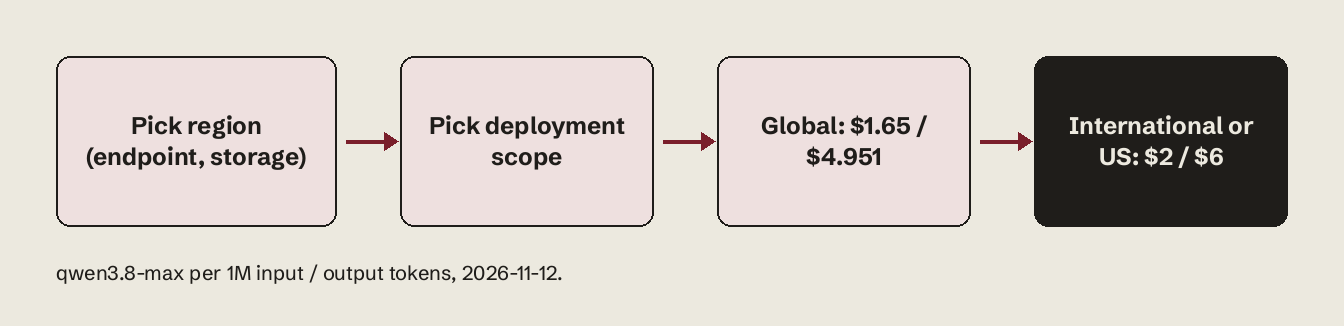
The same model in three places:
| Model | Singapore, International | US (Virginia), US scope | US (Virginia), Global | China (Beijing) |
|---|---|---|---|---|
| qwen3.8-max | $2.00 / $6.00 | $2.00 / $6.00 | $1.65 / $4.951 | $1.65 / $4.951 |
| qwen3.8-flash | $0.15 / $0.47 | $0.15 / $0.47 | $0.113 / $0.382 | $0.113 / $0.382 |
| qwen3.7-plus (list) | $0.40 / $1.60 | $0.40 / $1.60 | $0.276 / $1.101 | $0.276 / $1.101 |
| qwen3-coder-flash (up to 32K) | $0.30 / $1.50 | n/a | $0.144 / $0.574 | $0.144 / $0.574 |
| qwen-max (legacy) | $1.60 / $6.40 | n/a | n/a | $0.345 / $1.377 |
For qwen3.8-max the Global scope is exactly 82.5% of the International price on both input and output ($1.65 / $2 = 0.825). On our 3,000-in, 600-out request that is $0.0079206 instead of $0.0096, or $7.92 instead of $9.60 per 1,000. For qwen3-coder-flash the gap is larger: Global charges less than half the International rate.
Two operational rules from the same guide: each region has its own endpoint, API key and model list, which "cannot be used across regions"; and the older DashScope domain "will no longer support new features after September 30, 2026", so new integrations should use the workspace-dedicated domain.
Do Qwen models have tiered pricing by context length?
Yes. Several Qwen models charge by the total input tokens in a single request, and every token in that request is billed at its tier's price, not just the tokens above the threshold. Alibaba's example: with tiers of 0 to 32K and 32K to 128K, a 100K-token request is billed entirely at the second tier.
That creates price cliffs. qwen3.7-flash input costs $0.03 per 1M up to 32K tokens and $0.10 from 32K to 256K:
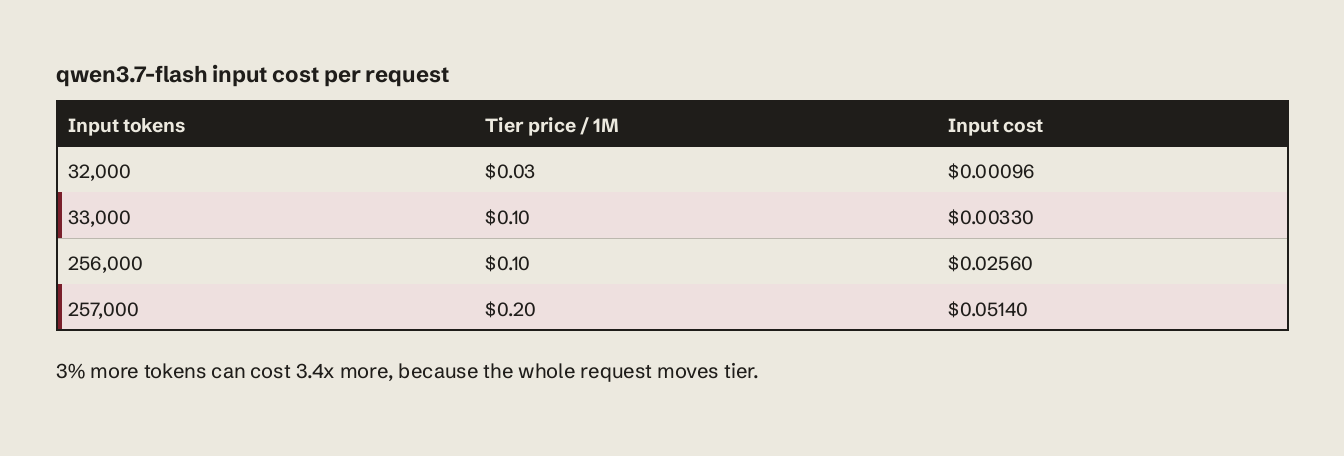
The tiers for the models that have them, International scope:
| Model | Tier 1 | Tier 2 | Tier 3 | Tier 4 |
|---|---|---|---|---|
| qwen3.7-flash | up to 32K: $0.03 / $0.13 | 32K to 256K: $0.10 / $0.40 | 256K to 1M: $0.20 / $0.80 | |
| qwen3-coder-flash | up to 32K: $0.30 / $1.50 | 32K to 128K: $0.50 / $2.50 | 128K to 256K: $0.80 / $4.00 | 256K to 1M: $1.60 / $9.60 |
| qwen3.7-plus | up to 256K: $0.40 / $1.60 | 256K to 1M: $1.20 in | ||
| qwen3.6-plus | up to 256K: $0.50 / $3.00 | 256K to 1M: $2.00 / $6.00 | ||
| qwen-plus (non-thinking) | up to 256K: $0.40 / $1.20 | 256K to 1M: $1.20 / $3.60 |
If your prompts sit near a boundary, trimming retrieved context by a few thousand tokens can cut the input bill by more than half. qwen3.8-max and qwen3.8-flash have a single tier up to 1M tokens, which makes them easier to budget.
A small cost function that respects the tiers:
# (max_input_tokens, input_price_per_1M, output_price_per_1M), International scope, 2026-11-12
QWEN37_FLASH = [(32_000, 0.03, 0.13), (256_000, 0.10, 0.40), (1_000_000, 0.20, 0.80)]

def qwen_cost(tiers, input_tokens, output_tokens):
    for limit, p_in, p_out in tiers:
        if input_tokens <= limit:
            return input_tokens * p_in / 1e6 + output_tokens * p_out / 1e6
    raise ValueError("request exceeds the model's largest tier")

print(qwen_cost(QWEN37_FLASH, 3_000, 600))   # 0.000168
print(qwen_cost(QWEN37_FLASH, 33_000, 600))  # 0.00354
Batch, cache and free quota discounts
Model Studio has three ways to pay less than list price, with one catch: batch and cache discounts do not stack.
| Discount | What it does | Exact rule |
|---|---|---|
| Batch inference | Async jobs at half price | Input and output at 50% of the real-time price |
| Context cache | Cheaper repeated prefixes | Cache hits at 10% of input price; explicit cache creation at 125% |
| Batch + cache | Not allowed together | "These two discounts cannot apply simultaneously" |
| Free quota | 1M tokens on many models | Singapore region, International scope only, valid 90 days |
On our request shape, a qwen3.8-max batch job costs $9.60 x 0.5 = $4.80 per 1,000 requests. The free quota runs 90 days from activation, model release or approval, whichever is later, and Alibaba's free quota page warns that you are then billed pay-as-you-go automatically unless you switch on "Free Quota Only". The caching mechanics are the same idea as on other providers; our prompt caching in production guide works through when a cache write pays back.
How do I call a Qwen model and get these prices?
Use the OpenAI-compatible endpoint of the region whose prices you want, with a key created in that region. Alibaba's regions guide lists the older Singapore DashScope domain as dashscope-intl.aliyuncs.com; new workspaces get a workspace-dedicated domain shown in the console.
from openai import OpenAI

client = OpenAI(
    api_key="sk-...",  # a key from the same region as the endpoint
    base_url="https://dashscope-intl.aliyuncs.com/compatible-mode/v1",
)
r = client.chat.completions.create(
    model="qwen3.8-flash",
    messages=[{"role": "user", "content": "Summarise this invoice in one line."}],
)
print(r.usage.prompt_tokens, r.usage.completion_tokens)
The same call from the shell, printing only the token counts you are billed for:
curl -s https://dashscope-intl.aliyuncs.com/compatible-mode/v1/chat/completions \
  -H "Authorization: Bearer $DASHSCOPE_API_KEY" -H "Content-Type: application/json" \
  -d '{"model": "qwen3.8-flash", "messages": [{"role": "user", "content": "ping"}]}' \
  | jq '.usage'
Read usage on every response and price it with the tier function above; the model ID and scope you call are what you are billed for.
Subscription plans: Coding Plan and Token Plan
Besides pay-as-you-go, Model Studio sells subscriptions for interactive use in coding tools. Coding Plan Pro is $50 a month with up to 6,000 requests per 5 hours, 45,000 per week and 90,000 per month, uses its own sk-sp- key and the base URL https://coding-intl.dashscope.aliyuncs.com/v1, and has limited slots (Coding Plan docs). Alibaba notes one query can use 5 to 30 or more model calls, so 90,000 requests is not 90,000 tasks. The Lite plan closed to new subscribers on 2026-03-20. Token Plan is a credit-based subscription in the same family. Both are meant for people working in tools, not for application backends, which stay on pay-as-you-go.
Is Qwen cheaper on third-party hosts?
Sometimes, for the open-weight models only. Alibaba's own API is the only source for closed models such as qwen3.8-max and qwen3.7-plus. Open-weight Qwen checkpoints are resold by clouds at their own prices: Amazon Bedrock listed Qwen3 235B A22B 2507 at $0.22 / $0.88 per 1M tokens in its 2026-10-12 price list, or $1.19 per 1,000 of our requests (3,000 x $0.22/1M + 600 x $0.88/1M). That is cheaper than qwen3.8-27b on Model Studio International ($3.30) but a different, older model. Compare like for like: same checkpoint, same context limit, same quantisation. Our Amazon Bedrock pricing guide has the full Bedrock table.
If you split traffic between Qwen, DeepSeek and the US labs to chase these gaps, the price table becomes something you maintain. Vynaris is an OpenAI-compatible endpoint that bills provider list price plus a 3% fee on the first $500 a month and 1% after, and reports which model served each request, so you can route by price without keeping a table per region. For the closest competitor on price, see MiniMax vs DeepSeek, and for where per-token prices are heading, cost per token over time.
FAQ
How much does the Qwen API cost per 1M tokens?
From $0.03 input and $0.13 output (qwen3.7-flash, requests up to 32K tokens) to $2.50 input and $7.50 output (qwen3.7-max), International scope, 2026-11-12. The flagship qwen3.8-max is $2 / $6.
Is the Qwen API free?
New Model Studio users in the Singapore region get a free quota, typically 1M tokens per eligible model, valid for 90 days. Only the International scope qualifies. After that, usage is billed pay-as-you-go.
Why is Qwen cheaper in China (Beijing)?
Beijing and the Global scope share the lower price list: qwen3.8-max is $1.65 / $4.951 there versus $2 / $6 International. Pick by data-residency needs first; the Global scope schedules inference across a larger resource pool.
Does thinking mode cost more on Qwen?
On qwen-plus, yes: output costs $4 per 1M in thinking mode versus $1.20 without it, and thinking also produces more output tokens. qwen3.8-max and qwen3.7-plus charge one output rate for both modes, but thinking still adds output tokens.
What is the cheapest Qwen model for coding?
qwen3-coder-flash at $0.30 / $1.50 (International, up to 32K) or $0.144 / $0.574 in the Global scope. Above 32K input tokens its price rises by tier, up to $1.60 / $9.60 beyond 256K.
Related articles
- Claude API Pricing: Every Model, Cache and Batch Rate
- OpenAI API Pricing: Every GPT Model, Cache and Batch Rate
- Mistral API Pricing: Every Model, Cache and Batch Rate
- Vertex AI Pricing: Gemini and Claude Per 1M Tokens
- Cost Per Token Over Time: LLM Price History Explained
- LLM API Cost Spreadsheet Template: Free Layout + Price CSVs