Blog · · By Dhrumil Barot, Founder
Vertex AI Pricing: Gemini and Claude Per 1M Tokens
Vertex AI pricing for Gemini runs $0.25 to $4.00 per 1M input tokens, with a 10% non-global premium and 50% off for Batch. Gemini 4 Argon doubles on 2026-12-01. Prices verified 2026-11-06.
TL;DR: Vertex AI pricing for Gemini matches the Gemini Developer API on the global endpoint: Gemini 3.5 Flash is $1.50 input and $9.00 output per 1M tokens. Pick a regional (non-global) endpoint and you pay 10% more. Use Batch or Flex and you pay 50% less.
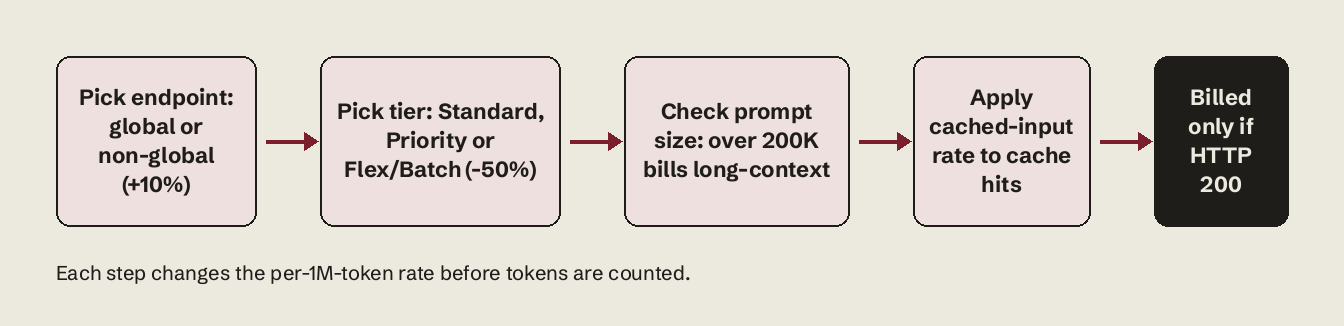
Vertex AI bills generative models per 1M tokens, separately for input, output and cached input, and only for requests that return HTTP 200. Prices verified 2026-11-06 against the Vertex AI generative AI pricing page. The three things that move your bill most are the endpoint (global vs non-global), the service tier (Standard, Priority, Flex/Batch) and whether a prompt crosses 200K input tokens. Gemini 4 Argon also doubles on 2026-12-01 when its promo ends.
Vertex AI pricing table: Gemini per 1M tokens
Standard tier, global endpoint, text input, verified 2026-11-06. Non-global is the regional price.
| Model | Input | Output | Cached input | Non-global input / output |
|---|---|---|---|---|
| Gemini 4 Argon (to 2026-11-30) | $2.00 | $10.00 | $0.10 | $2.20 / $11.00 |
| Gemini 4 Argon (from 2026-12-01) | $4.00 | $20.00 | $0.20 | $4.40 / $22.00 |
| Gemini 3.1 Pro Preview (up to 200K) | $2.00 | $12.00 | $0.20 | global only |
| Gemini 3.1 Pro Preview (over 200K) | $4.00 | $18.00 | $0.40 | global only |
| Gemini 3.8 Flash (to 2026-12-31) | $0.75 | $3.75 | $0.075 | $0.825 / $4.125 |
| Gemini 3.8 Flash (from 2027-01-01) | $1.50 | $7.50 | $0.15 | $1.65 / $8.25 |
| Gemini 3.5 Flash | $1.50 | $9.00 | $0.15 | $1.65 / $9.90 |
| Gemini 3.5 Flash-Lite | $0.30 | $2.50 | $0.03 | $0.33 / $2.75 |
| Gemini 3.1 Flash-Lite | $0.25 | $1.50 | $0.025 | $0.275 / $1.65 |
Gemini 3.7 Flash and Gemini 3.6 Flash carry the same intro pricing as Gemini 3.8 Flash: $0.75 / $3.75 through 2026-12-31, then $1.50 / $7.50. The Argon post-promo row comes from the Gemini Developer API pricing page. Vertex describes its current Argon price as "50% credits back on net spend", so the list price after the promo is the doubled figure.
The same rules appear as exact values in the Vertex footnotes:
Non-global endpoint price  = global price x 1.10   (Gemini 3 and later, since 2026-07-01)
Prompt > 200K input tokens = ALL input and output tokens billed at the long-context rate
Billed requests            = HTTP 200 only (4xx and 5xx are free)
Tuned model, non-global    = 1.5 x base model price
How much does Gemini cost per 1M tokens on Vertex AI?
Gemini costs between $0.25 and $4.00 per 1M input tokens on Vertex AI, and between $1.50 and $20.00 per 1M output tokens, depending on the model. Output is the line that dominates most bills: on Gemini 3.5 Flash it is 6x the input price.
A worked example makes the spread concrete. Take 10,000 requests a month, each with 3,000 input tokens and 800 output tokens. That is 30M input and 8M output tokens.
| Model (Standard, global) | Input cost | Output cost | Monthly total |
|---|---|---|---|
| Gemini 3.1 Flash-Lite | 30 x $0.25 = $7.50 | 8 x $1.50 = $12.00 | $19.50 |
| Gemini 3.8 Flash (intro) | 30 x $0.75 = $22.50 | 8 x $3.75 = $30.00 | $52.50 |
| Gemini 3.8 Flash (2027) | 30 x $1.50 = $45.00 | 8 x $7.50 = $60.00 | $105.00 |
| Gemini 3.5 Flash | 30 x $1.50 = $45.00 | 8 x $9.00 = $72.00 | $117.00 |
| Gemini 4 Argon (promo) | 30 x $2.00 = $60.00 | 8 x $10.00 = $80.00 | $140.00 |
| Gemini 3.1 Pro Preview | 30 x $2.00 = $60.00 | 8 x $12.00 = $96.00 | $156.00 |
| Gemini 4 Argon (from Dec 1) | 30 x $4.00 = $120.00 | 8 x $20.00 = $160.00 | $280.00 |
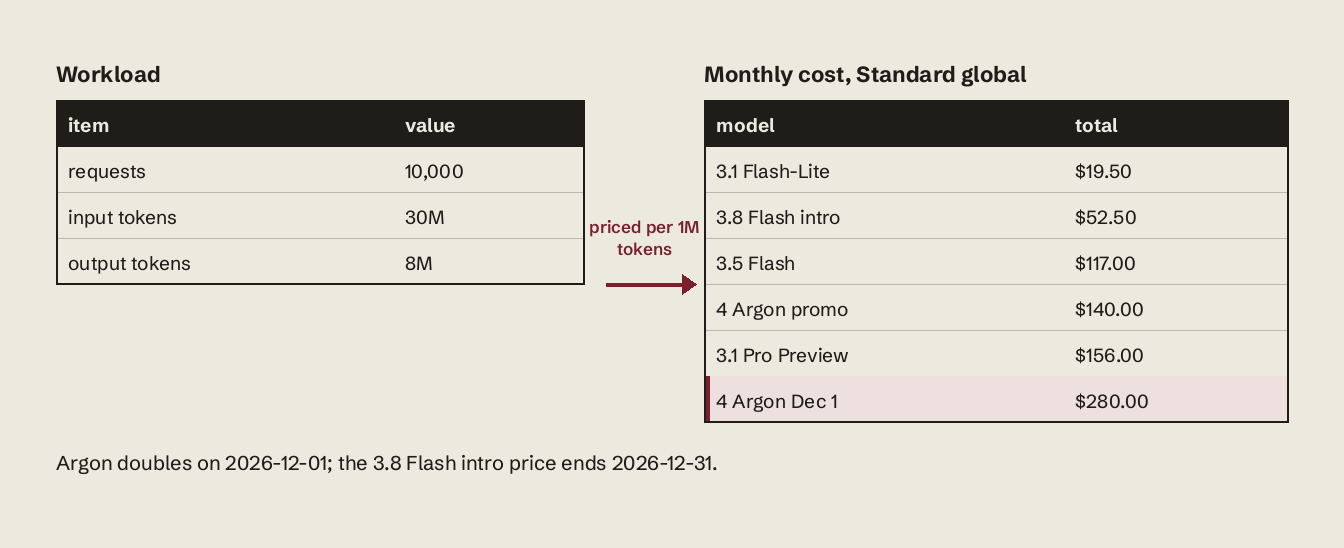
The Argon line is the one to watch. The same workload goes from $140 to $280 on 2026-12-01 without a code change. The same arithmetic as a script you can edit:
# Vertex AI Standard, global endpoint, USD per 1M tokens (verified 2026-11-06)
PRICES = {
    "gemini-3.1-flash-lite": (0.25, 1.50),
    "gemini-3.5-flash": (1.50, 9.00),
    "gemini-4-argon (from 2026-12-01)": (4.00, 20.00),
}
input_m, output_m = 30, 8      # millions of tokens per month
non_global = False             # True adds the 10% regional premium
batch = False                  # True applies 50% off (verified for Gemini 3.5 Flash; check other models)

for model, (inp, out) in PRICES.items():
    cost = input_m * inp + output_m * out
    cost *= 1.10 if non_global else 1.0
    cost *= 0.5 if batch else 1.0
    print(f"{model}: ${cost:,.2f}")
Plug your own token counts into our LLM cost calculator to see where your workload lands.
Is Vertex AI more expensive than the Gemini API?
No, not on the global endpoint. Vertex AI and the Gemini Developer API list the same per-token prices for the models checked here: Gemini 3.1 Pro Preview at $2.00 / $12.00, Gemini 3.5 Flash-Lite at $0.30 / $2.50, Gemini 3.1 Flash-Lite at $0.25 / $1.50 and Gemini 3.8 Flash at $0.75 / $3.75. Vertex costs more in two cases:
- Non-global endpoints. A regional endpoint such as
us-central1adds 10% to every token line. For the $117 Gemini 3.5 Flash workload above, that is $49.50 + $79.20 = $128.70. - Tuned models in a region. A tuned endpoint costs 1.5x the base model in a non-global region, and the same as base on global.
What you get for the money on Vertex is Google Cloud billing, IAM, VPC controls and data residency. If you don't need residency, the global endpoint gives you the same price and more capacity. The endpoint is chosen by hostname, so the 10% is decided in one line of config:
# Global endpoint: base price, largest capacity pool
https://aiplatform.googleapis.com/v1/projects/PROJECT/locations/global/publishers/google/models/gemini-3.5-flash:generateContent

# Multi-region endpoints: +10%, processing stays in the US or EU
aiplatform.us.rep.googleapis.com
aiplatform.eu.rep.googleapis.com
How is Claude billed on Vertex AI?
Is Claude more expensive on Vertex than on the Anthropic API? Only on regional endpoints, as far as published rules go. Claude on Vertex is billed by Google, and Google's Claude price table did not render when we checked on 2026-11-06, so we won't print Vertex Claude prices we can't verify. What is documented by Anthropic itself:
- For Claude Sonnet 4.5, Haiku 4.5, Opus 4.5 and every later model, regional and multi-region endpoints on Google Cloud cost 10% more than global endpoints.
- Google Cloud offers global and multi-region endpoints for these models, plus regional endpoints for Claude Sonnet 4.6 and earlier.
- Claude Opus 4.1 and earlier keep their older pricing structure.
For reference, the first-party Anthropic API prices on the same date:
| Claude model | Input / 1M | Output / 1M | Cache hit / 1M |
|---|---|---|---|
| Claude Opus 5.5 | $4.00 | $20.00 | $0.20 |
| Claude Sonnet 5.5 | $2.00 | $10.00 | $0.10 |
| Claude Haiku 5.5 (up to 100K prompt) | $0.10 | $0.50 | $0.01 |
| Claude Sonnet 4.6 | $3.00 | $15.00 | $0.30 |
So the practical rule: on Vertex, a multi-region us or eu endpoint for Claude costs 10% more than the global one. Check the Vertex console SKU for the global price before you assume parity with the Anthropic API. The tokenizer matters too: Claude 4.7 and later produce about 30% more tokens for the same text, per Anthropic, so compare cost per task, not per token. Our Claude API pricing guide has the full Anthropic table.
Does Vertex charge for batch and cached tokens differently?
Yes. Batch and Flex cut Gemini prices by 50%, and cached input costs 10% of the input price.
| Gemini 3.5 Flash, global | Input | Output | Cached input |
|---|---|---|---|
| Standard | $1.50 | $9.00 | $0.15 |
| Flex / Batch | $0.75 | $4.50 | $0.075 |
| Flex / Batch, non-global | $0.825 | $4.95 | $0.0825 |
The earlier workload on Batch costs 30 x $0.75 + 8 x $4.50 = $58.50 a month instead of $117. The catch is latency: Batch is asynchronous, so it fits evals, backfills and nightly jobs, not chat. Anthropic's Batch API offers the same 50% discount on input and output. We compared both in batch APIs when latency is free.
Caching has its own cost on the Developer API: a storage fee per 1M tokens per hour ($1.00 on Gemini 3.5 Flash-Lite, $4.50 on Gemini 3.1 Pro Preview). A cache only pays off when it is read often enough to beat that storage charge. See prompt caching in production for the break-even math.
What do Vertex usage tiers and 429 limits mean for cost?
Vertex usage tiers set throughput, not price. Your organization's 30-day spend places it in a tier, and each tier sets a prioritized tokens-per-minute (TPM) threshold per model, from the Vertex dynamic shared quota docs:
| Tier | 30-day spend | Pro and Argon TPM | Flash and Flash-Lite TPM |
|---|---|---|---|
| Tier 1 | $10 to $250 | 500,000 | 2,000,000 |
| Tier 2 | $250 to $2,000 | 1,000,000 | 4,000,000 |
| Tier 3 | $2,000 to $50,000 | 2,000,000 | 10,000,000 |
| Tier 4 | over $50,000 | 10,000,000 | 50,000,000 |
Traffic above your threshold is served when spare capacity exists and throttled first when it doesn't, which shows up as 429 errors. There is no separate requests-per-minute limit per tier. The thresholds apply to the global endpoint; regional endpoints draw on smaller pools.
The cost link is indirect but real. A 429 is free, since only HTTP 200 responses are billed, but your retries and fallbacks are not. If a 429 sends traffic to a pricier model, that is where the money goes. Two numbers to know:
- From 2026-11-13, Gemini 4 completions longer than 32K tokens are billed for retrievable tokens even if the request fails on a timeout.
- Grounding with Google Search includes 5,000 queries a month free across Gemini 3 and 4, then costs $14 per 1,000.
Which Vertex model should you price first?
Price the cheapest model that passes your quality bar, then move up only for the requests that fail. For most extraction and classification work, Gemini 3.1 Flash-Lite at $0.25 / $1.50 is the floor. Gemini 3.8 Flash at intro pricing is cheaper than Gemini 3.5 Flash on both input and output until 2026-12-31. Treat Gemini 4 Argon as a $4 / $20 model when you budget, because that is its price from December.
Where this gets awkward is running several providers at once: Gemini on Vertex, Claude on Anthropic, a fallback somewhere else. That means three billing accounts, three quota systems and three sets of 429 behaviour. Vynaris puts those models behind one OpenAI-compatible endpoint, so you can send each request to the cheapest model that handles it and fail over when one provider throttles. If you only use Gemini and already live in Google Cloud, Vertex on the global endpoint is the simpler choice.
FAQ
Is Vertex AI free to use?
No. The Vertex pricing page lists a per-1M-token price for every Gemini model, billed from the first successful request. The free allowances it lists are narrower: 5,000 grounding queries a month across Gemini 3 and 4. The Gemini Developer API has a free tier on some models, but Gemini 4 Argon is not on it.
Why is my Vertex AI bill higher than the pricing page?
Usually one of four things: a non-global endpoint (+10%), prompts over 200K tokens (every token bills at the long-context rate), thinking tokens counted as output, or grounding queries past the 5,000 free each month. Check the SKU names on your billing export; they say which rate applied.
Does Vertex AI charge for failed requests?
No. Vertex charges only for requests that return HTTP 200, so 4xx and 5xx responses cost nothing. The exception from 2026-11-13: Gemini 4 completions over 32K tokens are billed for retrievable tokens even when the request times out.
What is the difference between global and regional pricing on Vertex AI?
The global endpoint routes requests to any location with capacity and has the base price. Regional and multi-region endpoints keep processing inside a geography and cost 10% more for Gemini 3 and later and for Claude 4.5 and later.
Is Gemini cheaper on Vertex AI or AI Studio?
The per-token price is the same on the global endpoint for the models we checked. AI Studio (the Gemini Developer API) adds a free tier; Vertex adds Google Cloud IAM, data residency and committed-use discounts through Flexible Savings Plans.
When does Gemini 4 Argon pricing change?
On 2026-12-01. Input goes from $2.00 to $4.00 per 1M tokens and output from $10.00 to $20.00, on both Vertex and the Gemini Developer API.