
Blog · · Updated · By Dhrumil Barot, Founder
Batch APIs: OpenAI vs Anthropic 50% off and when 24h latency is free
OpenAI and Anthropic both cut async jobs 50% (input and output, under 24h). The per-task math on a 100,000-task nightly pipeline, and when batching is a trap. Verified 2026-07-19.
Both OpenAI and Anthropic cut the price of an async job in half: 50% off input and output tokens, jobs finishing inside 24 hours. On a 100,000-task nightly extraction pipeline that is the difference between $300 and $150 on Claude Haiku 4.5, or $1,500 and $750 on Claude Opus 4.8. The discount never changes which model is cheapest, so the order of operations is fixed: right-size first, then batch. Prices verified 2026-07-19.
TL;DR
- The batch API discount is identical on both providers: 50% off input and output tokens, jobs complete within 24 hours. Anthropic's page states it plainly; OpenAI's guide says "Each batch completes within 24 hours (and often more quickly)."
- Batch is a flat 2x cut on whatever your model already costs. It does not re-rank models. On our nightly job Claude Opus 4.8 batched still costs $750 while Claude Haiku 4.5 standard costs $300. Model choice is the bigger lever (5x here); batch multiplies it (to 10x).
- 24-hour latency is free money only for work no user is waiting on: overnight evals, bulk extraction, digest generation, backfills. Put it anywhere near a request path and the discount is a trap.
What the two providers actually offer
The terms are close enough that the choice between them is a model-quality and per-token-price decision, not a batch-mechanics one.
Anthropic's Batch API gives "a 50% discount on both input and output tokens" and processes requests asynchronously. OpenAI's Batch API advertises the same "50% cost discount compared to synchronous APIs" and the same 24-hour ceiling. Both put batch jobs in a separate, higher rate-limit pool, which matters when a nightly job would otherwise blow through your synchronous rate limits.
The verdict table below prices a representative batch-eligible task: 2,000 input tokens and 200 output tokens, the shape of a document-classification or field-extraction call. Standard is the synchronous list price; batch is the same job at half. Prices verified 2026-07-19.
| Model | Std $/1M (in+out) | Batch $/1M (in+out) | Batch $/task | Pick it when |
|---|---|---|---|---|
| Claude Opus 4.8 | $5 / $25 | $2.50 / $12.50 | $0.0075 | The task's accuracy decides real money and cheaper models miss |
| gpt-5.6-terra | $2.50 / $15 | $1.25 / $7.50 | $0.0040 | Mid-tier reasoning on OpenAI, output-heavy tasks |
| Claude Sonnet 5 | $2 / $10 | $1 / $5 | $0.0030 | Balanced quality on Anthropic |
| gpt-5.6-luna | $1 / $6 | $0.50 / $3 | $0.0016 | Cheap OpenAI tier, short structured outputs |
| Claude Haiku 4.5 | $1 / $5 | $0.50 / $2.50 | $0.0015 | High-volume classification the small model handles |
| gpt-5.4-mini | $0.75 / $4.50 | $0.375 / $2.25 | $0.0012 | The cheapest viable extraction workhorse |
The Sonnet 5 batch numbers use the now-standard $2/$10 rate. Anthropic canceled the scheduled 2026-09-01 increase, so Batch stays $1/$5. We recomputed the correction in the Sonnet 5 pricing update.
The workload, priced standard vs batch
One nightly pipeline: 100,000 documents, each classified or field-extracted in a single call at 2,000 input and 200 output tokens. No human waits on any single result; the whole run needs to be done by morning. That is the textbook batch case.
| Model | Standard / night | Batch / night | Saved / night | Saved / year |
|---|---|---|---|---|
| Claude Opus 4.8 | $1,500 | $750 | $750 | $273,750 |
| gpt-5.6-terra | $800 | $400 | $400 | $146,000 |
| Claude Sonnet 5 | $600 | $300 | $300 | $109,500 |
| gpt-5.6-luna | $320 | $160 | $160 | $58,400 |
| Claude Haiku 4.5 | $300 | $150 | $150 | $54,750 |
| gpt-5.4-mini | $240 | $120 | $120 | $43,800 |
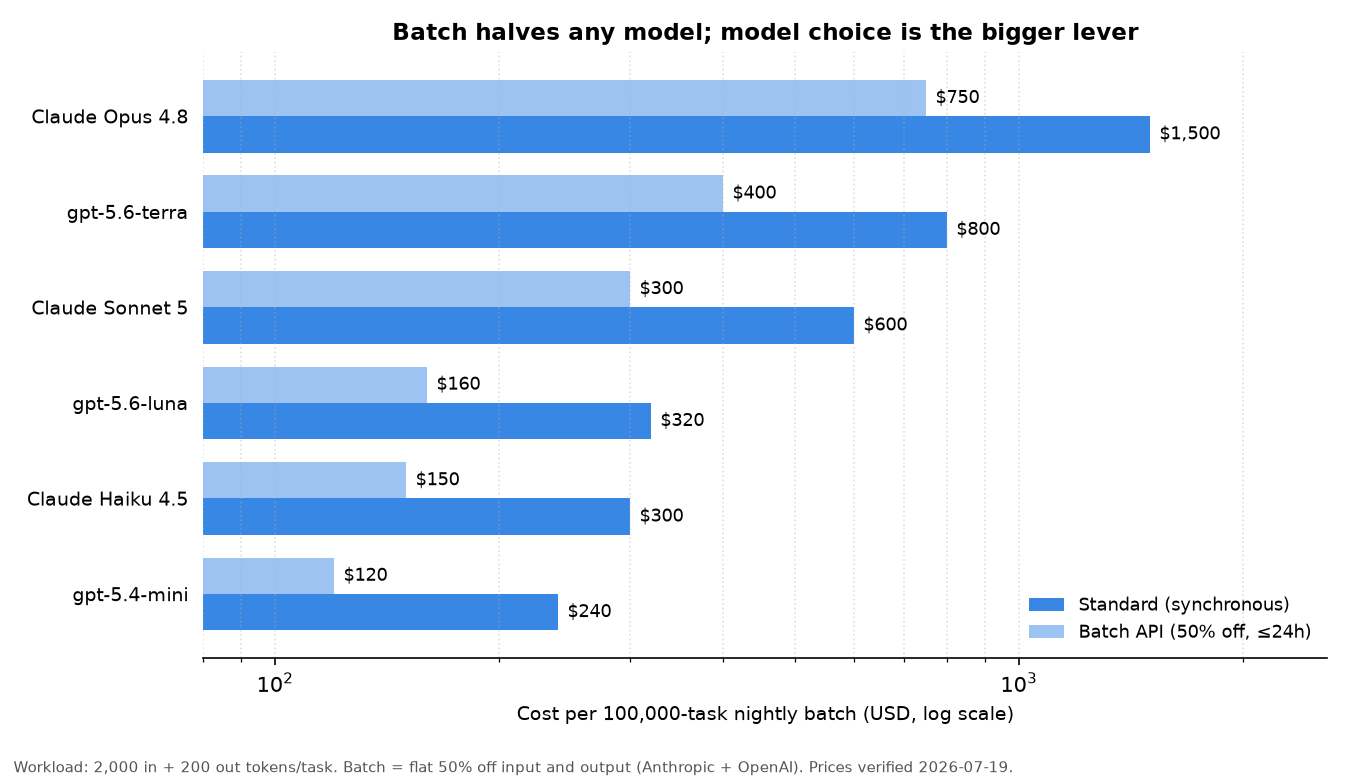
Two things fall out of the arithmetic. First, the batch discount is exactly 0.5x on every row, so it cannot change which model is cheapest. The gap between Opus 4.8 and gpt-5.4-mini is 12.5x standard and 12.5x batched. Second, the two levers stack cleanly. Moving from Opus 4.8 to Haiku 4.5 on the standard API is a 5x cut ($1,500 to $300). Batching Haiku on top takes it to $150, a 10x cut versus where you started. Right-sizing the model buys the big multiple; batch buys the last 2x for free, provided you can wait.
If you want to run your own token shape and volume through this, the calculator takes the per-task in/out counts and a batch toggle.
Batch versus caching: which discount wins the input line
Batch is not the only way to halve an input bill. Prompt caching cuts a repeated prefix to 0.1x on a cache hit, a deeper cut than batch's 0.5x. So which mechanism should a high-volume input workload reach for?
| Anthropic model | Base input $/1M | Batch input (0.5x) | Cache read (0.1x) |
|---|---|---|---|
| Claude Opus 4.8 | $5.00 | $2.50 | $0.50 |
| Claude Sonnet 5 | $2.00 | $1.00 | $0.20 |
| Claude Haiku 4.5 | $1.00 | $0.50 | $0.10 |
Caching wins per input token, but only on the shared prefix and only when you get hits. Batch wins on coverage: it discounts input and output, every token, with no hit-rate risk. The honest limit is timing. Anthropic's page says the batch discount stacks with caching, but a 5-minute or 1-hour cache is unlikely to survive a job the API is allowed to take up to 24 hours to finish. On a nightly batch you should plan to get the 0.5x, not both. The full prompt-caching break-even math covers the case where the prefix does stay hot and caching is the better tool.
When 24-hour latency is not free money
The discount is real, but the latency it demands is a hard constraint, not a preference. Do not batch when:
- A user is waiting. Chat, search, autocomplete, any interactive inference has a latency budget in milliseconds. A 24-hour completion window is not a slow response, it is a different product.
- The output feeds the next step within the same session. An agent loop that reads a tool result and acts on it cannot pause overnight between steps. Batch is for independent, embarrassingly parallel tasks, not sequential ones.
- You need results before you can retry. Batch failures surface at the end of the window. If a malformed prompt breaks 5% of a 100,000-task run, you learn it hours later and re-batch, adding another window. Validate the prompt on a synchronous sample first.
- The volume is small. The 50% saves $150 a night on a 100,000-task Haiku job. On a 500-task job that is $0.75. The engineering to build, submit, poll, and reconcile a batch pipeline is not worth it below a few thousand tasks a run.
The expensive-model case still holds inside batch. If Opus 4.8 extracts a field correctly on the first pass where Haiku 4.5 needs a re-run and human review, the $750 batch beats a $150 batch that generates rework. Batch does not fix a wrong model choice; it halves the cost of a right one. This is the same cost-per-task discipline that governs the synchronous bill.
FAQ
Is the batch discount the same on OpenAI and Anthropic? Yes: 50% off both input and output tokens, jobs completing within 24 hours, on both providers as of 2026-07-19. The choice between them is a model-quality and per-token-price decision, not a batch-terms one.
Does batch change which model is cheapest? No. The discount is a flat 0.5x on every model, so it preserves the ranking. Opus 4.8 batched ($750/night) is still dearer than Haiku 4.5 standard ($300/night) on our workload. Right-size the model first.
Can I stack batch with prompt caching? Anthropic says the discounts stack, but a 5-minute or 1-hour cache rarely survives a job that may take up to 24 hours. Plan for the batch 0.5x on a nightly run, and treat any caching on top as a bonus, not a budget line.
What workloads are batch-eligible? Anything no user waits on: overnight evaluation runs, bulk document classification and extraction, embedding backfills, digest and report generation, dataset labeling. If the result must return in a request, it is not batch-eligible.
For a concrete digest workload, our news-monitoring cost playbook prices embedding dedupe, 700 extraction calls and one daily synthesis across four Batch models.
How much does batch actually save at scale? On a 100,000-task nightly job, the flat 50% is worth $54,750 a year on Claude Haiku 4.5 and $273,750 a year on Claude Opus 4.8. The absolute saving scales with your token volume and your model's price.
Sources
- Anthropic pricing (batch 50% discount table, cache multipliers, Sonnet 5 $2/$10 standard), re-verified 2026-08-14: https://platform.claude.com/docs/en/about-claude/pricing
- OpenAI API pricing (GPT-5.6 Terra/Luna, GPT-5.4-mini standard rates), captured 2026-07-19: https://developers.openai.com/api/docs/pricing
- OpenAI Batch API guide (50% discount, 24-hour completion window), captured 2026-07-19: https://developers.openai.com/api/docs/guides/batch
- Cost model script and per-task arithmetic: from the assumptions table above.
Prices change. We re-verify every figure in this post monthly and stamp updates. Numbers here are current as of 2026-07-19.
Batching a nightly job is the easy 50%. The harder, bigger win is sending each task to the cheapest model that still gets it right. Vynaris is an OpenAI-compatible gateway that routes each request to the right-sized model and shows the per-request cost, batch or synchronous. One base URL swap. Get an API key at vynaris.com.