
Blog · · Updated · By Dhrumil Barot, Founder
Prompt caching break-even: below 21.7% hit rate, caching costs more
Below a 21.7% hit rate (5-min cache) or 52.6% (1-hour), prompt caching costs more than not caching. Per-provider break-even math, verified 2026-07-15.
Caching stopped being automatic free money. OpenAI now charges a 1.25x premium to write the cache on its GPT-5.6 family, matching Anthropic's long-standing 1.25x, and that write fee creates a floor: below a 21.7% cache-hit rate on the five-minute cache, prompt caching costs more than not caching at all. Prices verified 2026-07-15 against each provider's live pricing page.
TL;DR
- On Anthropic and OpenAI's GPT-5.6 five-minute cache, you need a cache-hit rate above 21.7% for caching to beat no caching. On Anthropic's one-hour cache the threshold is 52.6%. Below those lines the write premium on every miss outweighs the read discount.
- Providers with no write premium have a break-even of 0%: any hit saves. That includes OpenAI's GPT-5.5, DeepSeek v4 (cache hit $0.0028 vs miss $0.14, a 50x gap), and Google's implicit caching.
- Gemini's explicit cache breaks even on hourly storage rent, not a write fee: at $1.00–$4.50 per million tokens per hour, you need roughly 2 to 4 reads per hour of the cached content before it pays.
What we computed and why
Every guide tells you to turn on caching. Almost none tell you when it loses money. Caching a prefix is a bet: you pay a write cost up front, then hope enough later requests read that prefix at the discounted rate to more than repay the write. When the reads do not arrive, or the cache expires between them, you paid the premium for nothing.
Two things changed the arithmetic this year. First, OpenAI added a 1.25x cache-write charge on its GPT-5.6 models, so a cache miss now costs more than a plain uncached request instead of the same. Second, agentic workloads pushed cached input to the majority of many teams' bills. One Hacker News comment on the "AI margin collapse" thread (693 points) put cached input at roughly 90% of an agentic coding tool's API cost. When one line item is 90% of the bill, the rules that govern it are worth deriving exactly.
So we derived the break-even hit rate for each provider's pricing model, from the published multipliers only. No internal data, no benchmarks. Just the formula and the numbers on the pricing pages.
The two pricing models
Providers charge for caching in one of two shapes.
Multiplier model (Anthropic, OpenAI). A cache write costs a multiple of the base input-token price; a cache read costs a small fraction of it. Anthropic's page states the multipliers directly:
| Cache operation | Multiplier | Duration |
|---|---|---|
| 5-minute cache write | 1.25x base input | cache valid 5 minutes |
| 1-hour cache write | 2x base input | cache valid 1 hour |
| Cache read (hit) | 0.1x base input | same window as the write |
OpenAI's GPT-5.6 family uses the same shape: cache write 1.25x, cache read 0.1x. OpenAI's GPT-5.5 keeps the old model, where a write is billed at the normal input rate (no premium) and a hit still costs 0.1x.
Storage-rent model (Google Gemini explicit caching). You pay to process the content once, then rent storage per hour for as long as you keep it cached, and reads come at 0.1x. There is no per-write multiplier; the hourly rent is the cost you are betting against.
The break-even formula
Take a stable prefix of P tokens sent on every request. With caching on, each request either hits (pays the read multiplier) or misses (the cache is cold or expired, so it re-writes, paying the write multiplier). Let h be the fraction of requests that hit. The per-request prefix cost, in units of the base input price, is:
cost_with_caching  = h * read_mult + (1 - h) * write_mult
cost_without_cache = 1.0
Setting them equal and solving for the break-even hit rate:
h* = (write_mult - 1) / (write_mult - read_mult)For the five-minute cache: (1.25 - 1) / (1.25 - 0.1) = 0.25 / 1.15 = 21.7%. For the one-hour cache: (2 - 1) / (2 - 0.1) = 1 / 1.9 = 52.6%. When there is no write premium (write_mult = 1.0), the numerator is zero, so h* is 0%: any hit at all lowers the bill.
Break-even by provider
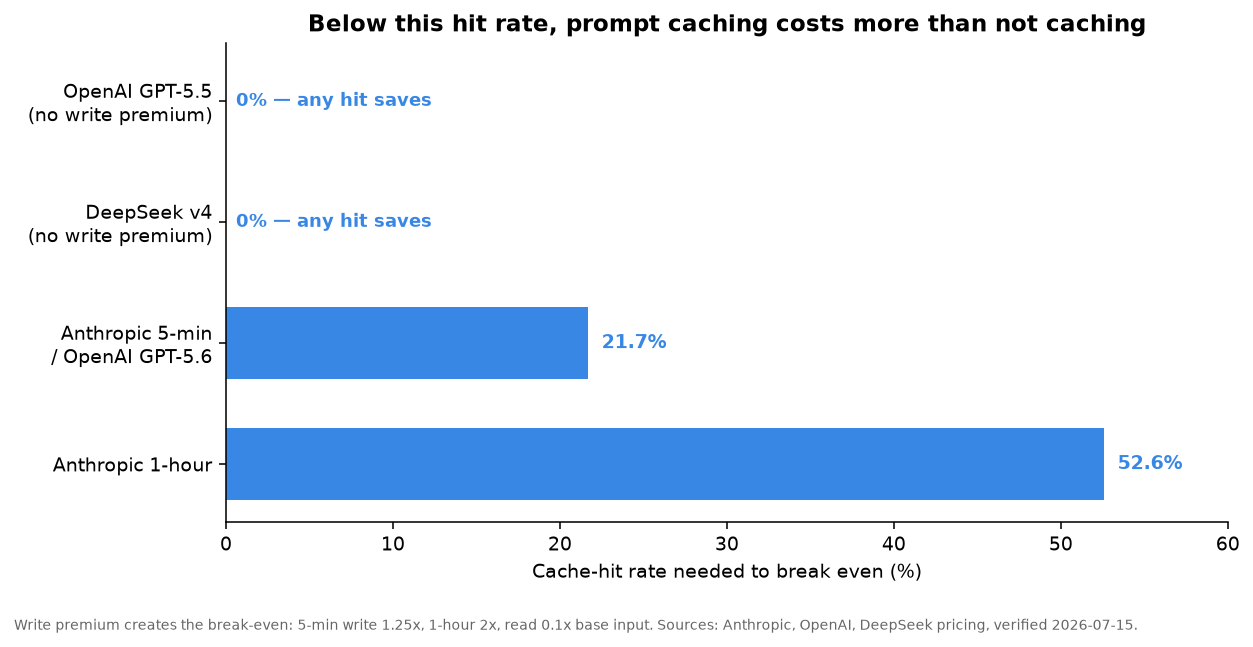
| Provider / tier | Write | Read | Break-even hit rate |
|---|---|---|---|
| OpenAI GPT-5.5 | 1.0x (no premium) | 0.1x | 0% (any hit saves) |
| DeepSeek v4 | 1.0x (no premium) | ~0.02x | 0% (any hit saves) |
| Anthropic 5-min | 1.25x | 0.1x | 21.7% |
| OpenAI GPT-5.6 | 1.25x | 0.1x | 21.7% |
| Anthropic 1-hour | 2x | 0.1x | 52.6% |
The gap between the top and bottom rows is the whole story. On a no-premium provider, caching is a strict improvement and you should default it on. On a 1.25x-write provider, caching a prefix that most requests will not reuse within five minutes is a surcharge. On the one-hour cache you need better than a coin flip.
The discount at the other end
The break-even is the floor. The ceiling is worth naming too, because it explains why teams tolerate the risk. As the hit rate climbs, the effective prefix cost falls toward the read rate of 0.1x, a 90% discount. Here is the per-request prefix cost, again in units of the base input price:
| Hit rate | Anthropic 5-min | Anthropic 1-hour | No-premium (GPT-5.5) |
|---|---|---|---|
| 10% | 1.135 (a tax) | 1.810 (a tax) | 0.910 |
| 21.7% | 1.000 (break-even) | 1.587 | 0.804 |
| 52.6% | 0.645 | 1.000 (break-even) | 0.526 |
| 90% | 0.235 | 0.290 | 0.190 |
| 100% | 0.100 (90% off) | 0.100 (90% off) | 0.100 |
A well-kept cache at 90%+ hit rate is the largest single lever in agent cost, which is exactly why cached input balloons to most of the bill. The trap is assuming you live at the right end of this table when your traffic pattern puts you at the left.
A worked dollar example
Take a 40,000-token stable prefix, 1,000 requests, on Claude Opus 4.8 (base input $5/MTok, five-minute write $6.25, read $0.50):
| Hit rate | With caching | Without caching | Result |
|---|---|---|---|
| 10% | $227.00 | $200.00 | caching costs $27 more |
| 21.7% | $200.00 | $200.00 | break-even |
| 50% | $135.00 | $200.00 | caching saves $65 |
| 90% | $43.00 | $200.00 | caching saves $157 |
The 10% row is the one people do not expect. You turned caching on, your hit rate was low because the prefix rarely repeated inside the window, and you paid 13.5% more than if you had left it off. Run your own prefix size, hit rate, and model through the calculator before assuming the feature is saving you money.
Gemini is a different bet
Gemini's explicit context caching does not charge a write multiplier. It rents storage by the hour, so its break-even is a reads-per-hour number, not a hit-rate percentage. Caching saves (base input minus cached read) on each read but costs the hourly rent whether or not anyone reads:
| Model | Base input | Cached read | Storage rent | Break-even |
|---|---|---|---|---|
| Gemini 2.5 Flash | $0.30/MTok | $0.03/MTok | $1.00/MTok/hr | 3.7 reads/hour |
| Gemini 2.5 Pro (≤200k) | $1.25/MTok | $0.125/MTok | $4.50/MTok/hr | 4.0 reads/hour |
| Gemini 2.5 Pro (>200k) | $2.50/MTok | $0.25/MTok | $4.50/MTok/hr | 2.0 reads/hour |
Below roughly two to four reads per hour of the cached content, the rent exceeds the read savings and you are paying to store data nobody is using. Large prompts break even faster because each read saves more against the same flat rent. Gemini also offers implicit caching, which is automatic and carries no storage fee, but you do not control what it caches or for how long.
What it means for routing
Two operational rules fall out of this.
First, match the cache tier to the reuse window. The one-hour cache only makes sense if the same prefix will be read many times across an hour; its 2x write and 52.6% break-even punish sparse reuse. For bursty interactive traffic, the five-minute cache with its 21.7% floor is the safer default, and for one-shot requests, turn caching off entirely.
Second, cross-model routing multiplies the write cost. Caches are per model. Every time a router hands a turn to a different model, the new model must write its own copy of the prefix and pay the premium again. That is a large part of why interleaved routing saves less than batched routing, a number we work through in the coding-agent router savings analysis. The related failure, re-writing a cache you already paid for, is priced out in the cache-write churn teardown.
Where we are wrong
The break-even hit rate is exact given the multipliers, but the hit rate itself is the hard part to know in advance, and it is the input that decides everything. The honest way to measure it is to read your own usage response: the ratio of cache-read tokens to cache-creation tokens across a representative window is your real hit rate. Plug that into the formula, not an optimistic guess.
Three caveats. The Batch API halves both write and read on Anthropic, so the ratios hold but absolute dollars fall for non-interactive work. These are first-party rates; Bedrock, Vertex, and data-residency endpoints carry their own multipliers that stack on top. Anthropic made Sonnet 5's $2/$10 rate standard on 2026-08-14, so the previously scheduled September increase no longer changes these dollars. We still re-verify every price monthly.
Sources
- Anthropic pricing and cache multipliers (5-min write 1.25x, 1-hour 2x, read 0.1x), verified 2026-07-15: https://platform.claude.com/docs/en/docs/about-claude/pricing
- OpenAI API pricing (GPT-5.6 cache write 1.25x, cached read 0.1x; GPT-5.5 no write premium), verified 2026-07-15: https://developers.openai.com/api/docs/pricing
- Google Gemini pricing (cached input 0.1x, storage $1.00–$4.50/MTok/hr), verified 2026-07-15: https://ai.google.dev/gemini-api/docs/pricing
- DeepSeek pricing (v4-flash cache hit $0.0028 vs miss $0.14), verified 2026-07-15: https://api-docs.deepseek.com/quick_start/pricing
- Community context (not a price source): "cached input is ~90% of agentic API cost", HN 693 points, 2026-07: https://martinalderson.com/posts/the-upcoming-ai-margin-collapse-part-1-glm-5-2/
- Reproducible math for every figure: artifacts/prompt-caching-break-even-2026-math.py
Prices change. Numbers are current as of 2026-07-15; we re-verify monthly and stamp updates.
Want your real cache-hit rate priced across providers? Vynaris is an OpenAI-compatible gateway that routes each request to the cheapest right-sized model and shows the per-request cost, cache included. One base URL swap. Get an API key at vynaris.com.