
Blog · · By Dhrumil Barot, Founder
Cost Per Token Over Time: LLM Price History Explained
LLM cost per token has fallen 10x to 40x a year at fixed quality since 2023, but flagship output prices barely moved and cost per task fell far less.
TL;DR: Cost per token is the list price a provider charges per million input or output tokens, and at fixed quality it has fallen roughly 10x to 40x per year since 2023. Flagship prices moved much less: GPT-4 output cost $60 per 1M tokens in March 2023 and gpt-6-astra output costs $50 today. Cost per task fell slower still, because reasoning tokens and new tokenizers add tokens to every request.
Cost per token over time is the history of what LLM providers charge per million tokens (MTok), usually tracked per model tier. The short answer: the price of a given level of capability has collapsed, from $30 input and $60 output per 1M tokens for GPT-4 in March 2023 to $2 and $10 for gpt-6.1-sol and $0.10 and $0.50 for gpt-6-luna on OpenAI's pricing page as of 2026-11-11. a16z measured a 10x drop per year at equal capability; Epoch AI measured 9x to 900x per year depending on the benchmark. But the most capable model you can buy still costs about what GPT-4 did, and an agent that thinks for 8,000 tokens can cost as much per task as GPT-4 did. All prices below were verified on 2026-11-11 against provider pages.
What is cost per token?
Cost per token is the price a provider bills for each unit of text the model reads (input) or writes (output), quoted per 1M tokens. Output is priced higher: 5x input on most current Claude and OpenAI models. A token is a chunk of text produced by the model's tokenizer, so the same sentence can be a different number of tokens on two models. That detail matters later.
Cost per task is the number you actually pay: input tokens times the input price, plus output tokens (including hidden reasoning tokens) times the output price, for one finished job. Our cost calculator does this arithmetic for any model on our model list.
| Cost per token | Cost per task | |
|---|---|---|
| What it measures | List price per 1M input or output tokens | Total billed for one finished job |
| Where you find it | Provider pricing page | Your usage logs, or a calculator |
| Changes when | Provider reprices | Price, tokenizer, reasoning effort, prompt size or model choice changes |
| Trend since 2023 | Down 10x to 40x per year at fixed quality | Down much less on reasoning-heavy work |
| Use it for | Comparing providers on one model tier | Budgeting and choosing a model |
Use the per-token price to compare two providers selling the same model. Use the per-job figure for budgets and model choice.
How much have LLM token prices dropped?
LLM token prices have dropped 10x to 40x per year at a fixed capability level, and roughly 2x to 4x per tier over three years. Both statements are true; they measure different things.
At fixed capability (the cheapest model that clears a benchmark score):
- a16z's LLMflation analysis found GPT-3-level performance (MMLU 42) cost $60 per 1M tokens in November 2021 and $0.06 three years later on Llama 3.2 3B: 1,000x in 3 years, about 10x per year. At MMLU 83 (GPT-4 level) prices fell about 62x from March 2023.
- Epoch AI found the price to reach GPT-4's score on GPQA Diamond fell 40x per year, with milestones ranging from 9x to 900x per year. Its blended price for GPT-4-0314 was $37.50 per 1M tokens; Gemini 2.0 Flash matched its MMLU score in February 2025 at $0.18.
Within a named tier, here are official list prices per 1M tokens (input / output):
| Date | Model | Input | Output | Source |
|---|---|---|---|---|
| 2023-03 | GPT-4 (8K) | $30.00 | $60.00 | OpenAI GPT-4 launch post |
| 2023-03 | gpt-3.5-turbo | $2.00 | $2.00 | OpenAI ChatGPT API post |
| 2023-11 | GPT-4 Turbo | $10.00 | $30.00 | OpenAI DevDay post |
| 2024-03 | Claude 3 Opus | $15.00 | $75.00 | Anthropic Claude 3 post |
| 2024-03 | Claude 3 Sonnet | $3.00 | $15.00 | Anthropic Claude 3 post |
| 2024-03 | Claude 3 Haiku | $0.25 | $1.25 | Anthropic Claude 3 post |
| 2024-07 | GPT-4o mini | $0.15 | $0.60 | OpenAI GPT-4o mini post |
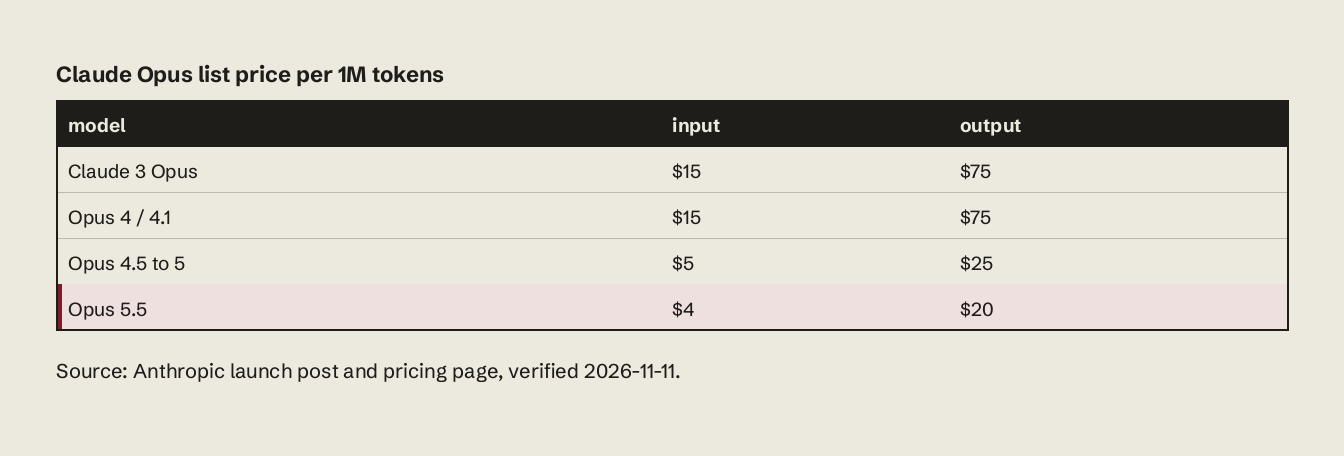
| Opus 4.5 to Opus 5 | Claude Opus | $5.00 | $25.00 | Anthropic pricing, 2026-11-11 |
| Haiku 4.5 | Claude Haiku | $1.00 | $5.00 | Anthropic pricing, 2026-11-11 |
| 2026-11 | Claude Opus 5.5 | $4.00 | $20.00 | Anthropic pricing, 2026-11-11 |
| 2026-11 | Claude Sonnet 5.5 | $2.00 | $10.00 | Anthropic pricing, 2026-11-11 |
| 2026-11 | Claude Haiku 5.5 | $0.10 | $0.50 | Anthropic pricing, 2026-11-11 |
| 2026-11 | gpt-6-astra | $10.00 | $50.00 | OpenAI pricing, 2026-11-11 |
| 2026-11 | gpt-6.1-sol | $2.00 | $10.00 | OpenAI pricing, 2026-11-11 |
| 2026-11 | gpt-6-luna | $0.10 | $0.50 | OpenAI pricing, 2026-11-11 |
Three patterns stand out:
- Top tiers fell slowly. Claude Opus went from $15/$75 (Claude 3 Opus, Opus 4 and 4.1) to $5/$25 (Opus 4.5) to $4/$20 (Opus 5.5): 3.75x cheaper in about 2.5 years. OpenAI's flagship output price went from $60 (GPT-4) to $50 (gpt-6-astra), only 17% lower. a16z noted the same in 2024: o1 output cost $60 per 1M, the same as GPT-3 at launch.
- Small tiers fell fast, but not in a straight line. Claude Haiku went from $0.25/$1.25 to $1/$5 with Haiku 4.5 (a 4x increase) and then to $0.10/$0.50 with Haiku 5.5. Haiku 5.5 also charges $0.50/$2.50 when a prompt is over 100,000 tokens.
- Most of the "1,000x" comes from switching tiers. A task that needed GPT-4 in 2023 can often run on a small model today. That is where the decline lives.
Why has the price of a finished job fallen less?
A finished job got cheaper more slowly than the list price because the number of tokens per task has grown. Three things push it up:
- Reasoning tokens. Reasoning models write hidden "thinking" tokens before the answer, and you pay for them as output. OpenAI's reasoning guide says a model may generate "anywhere from a few hundred to tens of thousands of reasoning tokens" and recommends reserving at least 25,000 tokens for reasoning and output. A call that hits
max_output_tokensbefore any visible text still bills input and reasoning tokens. - Tokenizer changes. Anthropic's pricing page states that Claude 4.7 and later use a tokenizer that "produces approximately 30% more tokens for the same text". Opus 4.6 and Opus 4.7 have the same $5/$25 list price, so the same prompt costs about 30% more on 4.7. Tokenizers can also cut cost: OpenAI's GPT-4o tokenizer used 2.9x fewer tokens for Hindi and 4.4x fewer for Gujarati than its predecessor.
- Bigger prompts. Agents resend tool results and conversation history on every turn, so input tokens grow with each step. Our analysis of cache reads in agent costs shows how quickly this compounds.
Worked example: one task in 2023 vs 2026
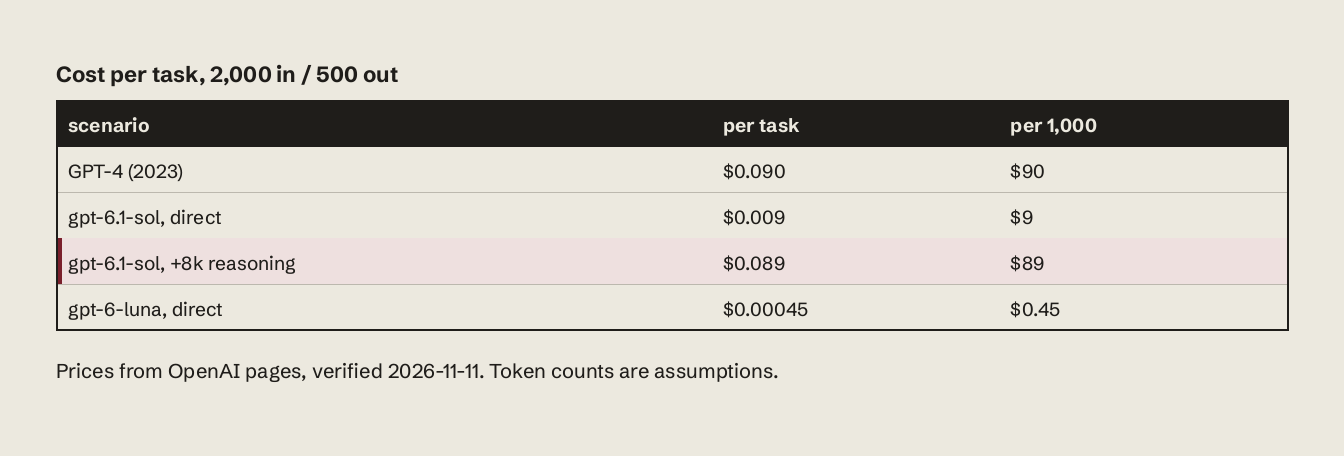
Take a support-ticket summary with 2,000 input tokens and a 500-token answer. These token counts are our assumption; edit them for your workload.
| Scenario | Input cost | Output cost | Cost per task | Per 1,000 tasks |
|---|---|---|---|---|
| GPT-4, March 2023 ($30/$60) | 2,000 x $30/1M = $0.060 | 500 x $60/1M = $0.030 | $0.090 | $90 |
| gpt-6.1-sol, no reasoning ($2/$10) | 2,000 x $2/1M = $0.004 | 500 x $10/1M = $0.005 | $0.009 | $9 |
| gpt-6.1-sol, 8,000 reasoning tokens | $0.004 | 8,500 x $10/1M = $0.085 | $0.089 | $89 |
| gpt-6-luna, no reasoning ($0.10/$0.50) | 2,000 x $0.10/1M = $0.0002 | 500 x $0.50/1M = $0.00025 | $0.00045 | $0.45 |
The same job is 10x cheaper on gpt-6.1-sol than on GPT-4 when the model answers directly ($0.090 vs $0.009). If it spends 8,000 tokens reasoning, the cost per task is $0.089, within about 1% of what GPT-4 charged in 2023. On gpt-6-luna the task costs $0.00045, 200x less than GPT-4, which is the "LLMflation" curve in practice.
How do reasoning tokens change the bill?
Reasoning tokens change the bill by adding output-priced tokens you never see. Output is the expensive side (5x input on gpt-6.1-sol and Claude Sonnet 5.5), so a model that thinks for 10x its answer length can multiply the output line by 10. The usage object reports them under output_tokens_details.reasoning_tokens, so log that field per request. To control it, lower reasoning.effort for routine calls (OpenAI defaults GPT-5.6 and GPT-6.1 Sol to medium) and cap max_output_tokens only with a margin, since a capped call still bills what it consumed.
How the decline happens
The a16z analysis names the drivers: cheaper GPU compute per operation, smaller models trained on more data (a 1B-parameter model beating a 175B one from three years earlier), quantization, and open-weight models served by competing hosts at thin margins. Price discounts on the billing side add to this: OpenAI Batch costs half the standard rate (gpt-6.1-sol $1/$5), and a Claude cache hit costs 5% of base input on Opus 5.5 and Sonnet 5.5. DeepSeek bills deepseek-flash at $0.15 input and $0.60 output off-peak, half its peak rate. See our OpenAI API pricing and Claude API pricing guides for every discount line.
Pitfalls when reading price history
- Mixing blended and split prices. Epoch AI blends input and output 3:1; a16z averages them. Compare like with like.
- Ignoring the tokenizer. A 30% tokenizer change is invisible on a pricing table.
- Ignoring prompt-length tiers. Haiku 5.5 is $0.10 input up to 100,000 tokens and $0.50 above it.
- Comparing promo prices. OpenAI notes GPT-5.6 Sol's promotional pricing ends November 30, 2026. Our GPT-5.6 promo expiry analysis covers what changes.
- Assuming prices only fall. Haiku 4.5 cost 4x Claude 3 Haiku.
Will prices keep falling?
Probably, but nobody can promise the rate. a16z wrote that the decline comes from several independent factors and "its rate may slow down"; Epoch AI noted the fastest drops came in the most recent year, "so it's less clear that those will persist." The pattern so far: each new frontier tier launches near the old top price, and the price of last year's capability falls by an order of magnitude. Plan budgets on cost per task, not on the headline per-token cut.
When per-token prices move this often, the cheapest model for a task changes every few months. Vynaris routes each request to the lowest-cost model that meets your quality bar through one OpenAI-compatible API, so a price cut shows up in your bill without a code change. If you want to understand the pattern first, read what an LLM gateway is.
FAQ
How much have LLM token prices dropped since GPT-4?
GPT-4 launched at $30 input and $60 output per 1M tokens in March 2023. Today gpt-6.1-sol costs $2 and $10, and gpt-6-luna $0.10 and $0.50 (OpenAI pricing, 2026-11-11). At GPT-4-level quality, a16z measured a 62x drop; Epoch AI measured 40x per year on GPQA.
Why are output tokens more expensive than input tokens?
Output tokens are generated one at a time, while input tokens are processed in parallel, so output costs more compute per token. Current Claude and OpenAI models price output at 5x input.
Why has the price of a finished job fallen less?
Tasks use more tokens than before: reasoning models add hidden output tokens, newer tokenizers can produce about 30% more tokens for the same text (Claude 4.7 and later), and agents resend growing context each turn.
How do reasoning tokens change the bill?
They are billed at the output rate even though you never see them. In our worked example, 8,000 reasoning tokens raised a gpt-6.1-sol task from $0.009 to $0.089.
Will LLM prices keep falling?
The price of a fixed capability level has fallen 10x or more per year since 2021, and the drivers (hardware, smaller models, open weights) are still active. Frontier tiers have fallen much less, and both a16z and Epoch AI say the rate may slow.
Is there an index of LLM token prices over time?
Epoch AI publishes the lowest price to reach fixed benchmark scores over time, and a16z published the LLMflation chart. For current list prices across providers, see our LLM pricing resources.