
Blog · · Updated · By Dhrumil Barot, Founder
GPT-5.6 promo did not expire: Luna stays $0.20/$1.20 and Sol $4/$20
Correction: GPT-5.6 promo remains active. Sol is $4/$20, Terra $2/$12, and Luna $0.20/$1.20 per MTok. Prices verified 2026-09-13.
Updated 2026-09-13: This article previously said the GPT-5.6 promotion had expired. That was wrong. GPT-5.6 Sol remains $4 input and $20 output per million tokens. GPT-5.6 Terra remains $2/$12, while GPT-5.6 Luna remains $0.20/$1.20. Prices verified 2026-09-13.
TL;DR
- OpenAI's live pricing page says Sol promotional pricing remains available at least through 2026-11-21.
- A 10k-input/2k-output Standard call costs $0.0800 on Sol, $0.0440 on Terra, and $0.0044 on Luna.
- Those figures are 27.3%, 20.0%, and 80.0% below the incorrect costs implied by our prior rate card.
- We have replaced the article in place. This is a correction, not a newly announced price cut.
Corrected verdict table
| Model | Current input/output per MTok | Incorrect rate previously shown | Current 10k/2k task | Incorrect 10k/2k task | Correction |
|---|---|---|---|---|---|
| gpt-5.6-sol | $4 / $20 | $5 / $30 | $0.0800 | $0.1100 | 27.3% lower |
| gpt-5.6-terra | $2 / $12 | $2.5 / $15 | $0.0440 | $0.0550 | 20.0% lower |
| gpt-5.6-luna | $0.20 / $1.20 | $1 / $6 | $0.0044 | $0.0220 | 80.0% lower |
The workload uses 10,000 uncached input tokens and 2,000 output tokens per call. For Sol, (10,000 × $4 + 2,000 × $20) / 1,000,000 = $0.08. The correction is ($0.11 - $0.08) / $0.11 = 27.3%. These are editable assumptions, not observed Vynaris traffic.
Source: OpenAI API pricing and the previous version of this article. Prices verified 2026-09-13.
What the live page says
OpenAI's official API pricing page lists the current Standard short-context rates. Sol is $4 input, $0.40 cached input, $5 cache write, and $20 output per MTok. Terra is $2/$0.20/$2.50/$12. Luna is $0.20/$0.02/$0.25/$1.20.
The same page states that Sol's promotional pricing is available at least through 2026-11-21. The model IDs shown there are gpt-5.6-sol, gpt-5.6-terra, and gpt-5.6-luna. That checks both the prices and the names against one primary source.
OpenAI's 2026-07-30 announcement also says it cut Luna by 80% and Terra by 20%. The live post showed 20.9 million views when checked on 2026-09-13. It describes Fast mode for Sol as a speed option, not evidence that Standard pricing ended.
Our 2026-09-11 interpretation of the pricing page was wrong. The conclusion outran the evidence. The prior article even cited the 2026-11-21 language, which should have stopped publication. Receipts only help when we listen to them.
What the correction changes per 1,000 tasks
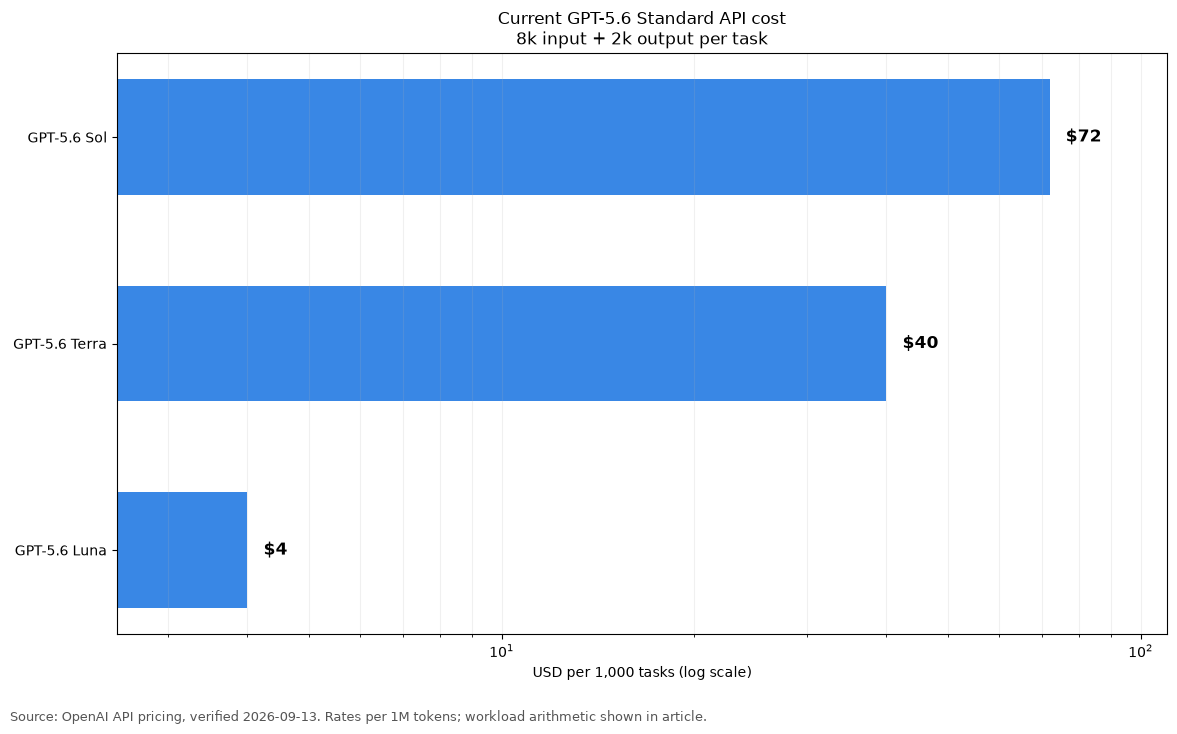
For an 8k-input/2k-output workload, the current Standard bill is $72 per 1,000 Sol tasks, $40 for Terra, and $4 for Luna. The calculations are (8,000 × input rate + 2,000 × output rate) / 1,000,000 × 1,000.
That makes Sol 18 times Luna's token bill for this shape: $72 / $4 = 18. This ratio says nothing about answer quality or retries. It only tells us what identical token volumes cost.
Use the LLM cost calculator when your workload differs. The per-request cost changes with the input-to-output ratio, cache share, and service tier. A rate card without a workload is accounting theatre.
Cache and long-context math also move back down
For Sol, 8,000 cached input tokens plus 2,000 output tokens cost $3.20 + $40 = $43.20 per 1,000 Standard tasks. The previous article incorrectly gave $64.
Current Sol long-context rates are $8 input and $30 output per MTok. A 300k-input/2k-output request therefore costs (300,000 × $8 + 2,000 × $30) / 1,000,000 = $2.46, not $3.09. Our long-context pricing analysis explains when the higher rate applies.
Batch remains half of Standard. On the same 8k/2k workload, batch inference costs $36 per 1,000 Sol tasks: (8,000 × $2 + 2,000 × $10) / 1,000,000 × 1,000 = $36. Batch is cheaper because the request contract differs; it is not a free drop-in for synchronous traffic.
What should change in a production budget
Restore the current $4/$20 Sol, $2/$12 Terra, and $0.20/$1.20 Luna rows. At 100,000 monthly 8k/2k tasks, that means $7,200 for Sol, $4,000 for Terra, or $400 for Luna. Each total is the per-1,000 figure multiplied by 100.
Do not treat 2026-11-21 as a guaranteed expiry date. OpenAI says the Sol price lasts at least through that date. It may continue longer. Keep a separate scenario for any future rate increase and re-fetch the provider page before changing routes.
The original Sol price-cut analysis had the right current rates and workload result. This update restores that basis.
Honest tradeoff
The corrected price strengthens the case for these models, but price alone cannot pick the model. A cheaper call can lose after retries, slow responses, or failed tasks. Measure cost per successful outcome before rerouting.
There is also a documentation risk. Provider pricing pages combine service tiers, context bands, caching, and regional uplifts. Automating a diff without preserving section labels can manufacture a price change. We will retain the page snapshot with the row context from this correction forward.
Sources
- OpenAI API pricing, current rates, model IDs, service tiers, and Sol promotion note; verified 2026-09-13.
- OpenAI pricing announcement, published 2026-07-30; read directly in Firefox on 2026-09-13.
- Reproducible arithmetic:
artifacts/gpt-56-promo-expired-sol-5-30-terra-2-5-15-luna-1-6-math.py.