
Blog · · By Dhrumil Barot, Founder
LLM Vendors: 7 API Providers Ranked by Price per 1M Tokens
The main LLM vendors are OpenAI, Anthropic, Google, xAI, Mistral and DeepSeek. Each one's API price per 1M tokens, the cost of one workload, data terms and dated price rises, verified 2026-11-19.
TL;DR: The six LLM vendors most teams buy API access from are OpenAI, Anthropic, Google, xAI, Mistral and DeepSeek. Their flagship prices run from $0.30 to $8.00 per 1M input tokens, and the same 1,000-request workload costs between $0.45 and $36.00 depending on the model. Vynaris is option 1 because it puts these vendors behind one OpenAI-compatible endpoint and shows the provider cost of every request. Prices verified 2026-11-19.
Try it: point your OpenAI client at https://api.vynaris.com/v1 and send the same prompt to models from several vendors, then read what each one cost. Get a Vynaris API key.
LLM vendors are the companies that train large language models and sell access to them through an API: OpenAI (GPT-6 family), Anthropic (Claude), Google (Gemini), xAI (Grok), Mistral and DeepSeek. Cloud platforms such as AWS Bedrock, Azure and Vertex AI resell some of these models, and gateways such as Vynaris put several vendors behind one API. On price, DeepSeek's deepseek-flash at $0.30 input and $1.20 output per 1M tokens and Mistral Large at $0.50 / $1.50 are the cheapest capable models. OpenAI's gpt-6-luna and Anthropic's Claude Haiku 5.5 both cost $0.10 / $0.50 for small, fast work. The most expensive tier is GPT-6.2 Astra at $8 / $40. Most pages ranking for this query are dated 2025 and list companies, not prices; this one lists what you pay today.
How we judged the vendors
We ranked on four things a buyer can check:
- Price per 1M input and output tokens on the vendor's own pricing page, read 2026-11-19.
- Cost of one workload: 1,000 requests of 2,000 input and 500 output tokens (2M in, 0.5M out). Per-token prices hide how much output costs.
- Data terms: whether your prompts can train the vendor's models on the tier you pay for.
- Price changes ahead: dated increases already printed on the pricing page.
Option 1 is a gateway, not a vendor, because the question most readers have after this list is "which one", and the honest answer is often "more than one".
Summary table: LLM vendors compared
| # | Vendor | Model priced | Input / 1M | Output / 1M | 1,000-request workload | Note |
|---|---|---|---|---|---|---|
| 1 | Vynaris (gateway) | any listed model | provider price + 3% | provider price + 3% | e.g. $9.27 on Claude Sonnet 5.5 | 1% after $500/month |
| 2 | OpenAI | gpt-6.2-sol | $2.00 | $10.00 | $9.00 | Batch is half price |
| 3 | Anthropic | Claude Sonnet 5.5 | $2.00 | $10.00 | $9.00 | Cache reads at 0.1x |
| 4 | Gemini 3.8 Flash | $0.75 | $3.75 | $3.38 | Doubles 2027-01-01 | |
| 5 | xAI | grok-4.7 | $2.00 | $6.00 | $7.00 | Lowest output price at this tier |
| 6 | Mistral | Mistral Large | $0.50 | $1.50 | $1.75 | Batch -50% |
| 7 | DeepSeek | deepseek-flash | $0.30 | $1.20 | $1.20 | Off-peak half price |
Sources: OpenAI pricing, Claude pricing, Gemini API pricing, xAI models, Mistral pricing, DeepSeek pricing, all read 2026-11-19 except DeepSeek (2026-11-18).
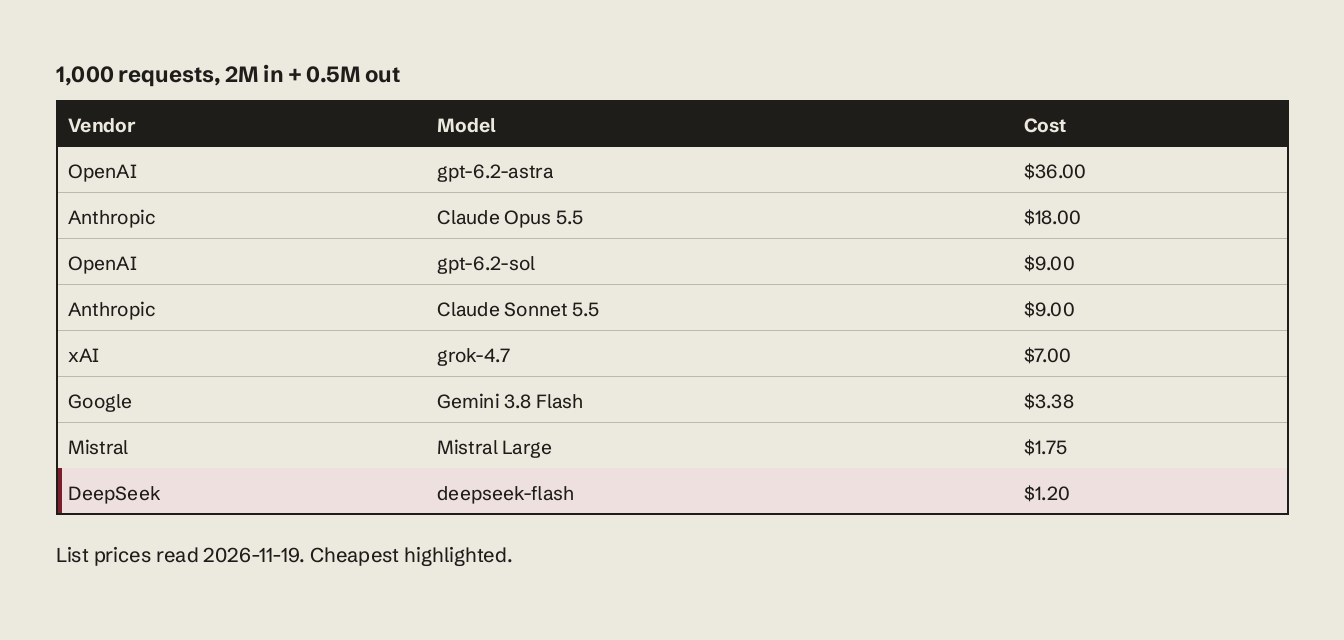
The workload math, so you can redo it with your own numbers:
cost = (input_tokens x input_price + output_tokens x output_price) / 1,000,000

Claude Sonnet 5.5:  (2,000,000 x 2.00 + 500,000 x 10.00) / 1M = $9.00
Gemini 3.8 Flash:   (2,000,000 x 0.75 + 500,000 x 3.75)  / 1M = $3.38
deepseek-flash:     (2,000,000 x 0.30 + 500,000 x 1.20)  / 1M = $1.20
gpt-6-luna:         (2,000,000 x 0.10 + 500,000 x 0.50)  / 1M = $0.45
Put your own token counts into the LLM cost calculator with any model pair.
1. Vynaris: one endpoint for several LLM vendors
Vynaris is an OpenAI-compatible gateway at https://api.vynaris.com/v1. You keep the OpenAI SDK, change the base URL, and pick a model by its exact ID or let auto choose. The Vynaris model list carries models from OpenAI, Anthropic, Google, Mistral, DeepSeek, xAI, Qwen, Meta and Cohere.
- Best for: teams that use, or want to test, more than one vendor.
- Pricing: provider list price + 3% until monthly usage reaches $500, then 1%. Prepaid top-ups from $20, and no overages: requests stop when the balance reaches zero (Vynaris pricing).
- What you see: "The response headers and exportable ledger show the model, provider cost, Vynaris fee, and final charge."
- Limits: if you only ever call one vendor, calling that vendor directly is cheaper by the fee. On the Sonnet 5.5 workload above that is $9.27 vs $9.00.
from openai import OpenAI

client = OpenAI(base_url="https://api.vynaris.com/v1", api_key="VYNARIS_KEY")
for model in ["gpt-6.2-sol", "claude-sonnet-5.5", "deepseek-flash"]:
    r = client.chat.completions.create(
        model=model,
        messages=[{"role": "user", "content": "Summarize this ticket in one line: ..."}],
    )
    print(model, r.usage.prompt_tokens, r.usage.completion_tokens)
Check exact model IDs on the model list before you run this. Our OpenAI-compatible API providers guide covers other endpoints that accept the same client.
2. OpenAI
OpenAI sells the GPT-6 family in Standard, Batch, Flex, Fast and Ultrafast tiers. Standard prices per 1M tokens: gpt-6.2-astra $8.00 / $40.00, gpt-6.2-sol $2.00 / $10.00, and gpt-6-luna $0.10 / $0.50.
- Best for: the widest tier menu; Batch halves the price (
gpt-6.2-sol$1.00 / $5.00) when you can wait. - Strength you can check: cached input on
gpt-6.2-solis $0.10, 5% of the input price. - Watch: regional data-residency endpoints add 10% for models released on or after 2026-03-05, and Priority was renamed Fast mode on 2026-07-30 at 2x Standard (OpenAI pricing).
Full breakdown: OpenAI API pricing.
3. Anthropic
Anthropic sells Claude. Per 1M tokens: Claude Opus 5.5 $4 / $20, Claude Sonnet 5.5 $2 / $10, Claude Haiku 5.5 $0.10 / $0.50 for prompts up to 100,000 tokens ($0.50 / $2.50 above), and Claude Fable 5.2 $8 / $40.
- Best for: long agentic work and coding, with prompt caching that reads at 0.1x the input price on most models.
- Watch: Claude 4.7 and later use a tokenizer that "produces approximately 30% more tokens for the same text", so compare cost per task, not per token. US-only inference adds a 1.1x multiplier (Claude pricing).
Full breakdown: Claude API pricing.
4. Google (Gemini)
Google sells Gemini through the Gemini Developer API and Vertex AI. Gemini 3.8 Flash costs $0.75 / $3.75 per 1M tokens through 2026-12-31 and $1.50 / $7.50 from 2027-01-01. Gemini 4 Argon costs $2 / $10 through 2026-11-30 and $4 / $20 from 2026-12-01. Gemini 2.5 Flash-Lite is $0.10 / $0.40.
- Best for: a free tier to prototype on, and cheap Flash-Lite models.
- Data terms: the pricing page marks free-tier content "Used to improve our products: Yes" and paid-tier content "No" (Gemini API pricing). Do not send customer data on the free tier.
- Watch: both price doublings above are already printed. Our Argon workload goes from $9.00 to $18.00 on 2026-12-01.
Full breakdown: Gemini API pricing.
5. xAI (Grok)
xAI sells Grok. grok-4.7 costs $2.00 input and $6.00 output per 1M tokens (xAI models), the lowest output price among the $2-input flagships in this list.
- Best for: output-heavy work at flagship tier: our workload costs $7.00 vs $9.00 on GPT-6.2 Sol or Sonnet 5.5.
- Watch:
logprobsandtop_logprobsare not supported on grok-4.20 and newer and are silently ignored.
6. Mistral
Mistral, based in France, sells open-weight and proprietary models. Mistral Large costs $0.50 input and $1.50 output per 1M tokens. Batch processing cuts the price by 50%, and cached input tokens cut input cost "by up to 90%" (Mistral pricing).
- Best for: an EU vendor at a low price; our workload is $1.75.
- Watch: OCR is priced per 1,000 pages and speech per minute, not per token.
Full breakdown: Mistral API pricing.
7. DeepSeek
DeepSeek sells open-weight models through its own API. deepseek-flash costs $0.30 per 1M input tokens on a cache miss, $0.006 on a cache hit and $1.20 output at peak hours, and half that off-peak, with a 1M-token context (DeepSeek pricing).
- Best for: the lowest price for a capable model: $1.20 for our workload at peak, $0.60 off-peak.
- Watch: price depends on the time of day, so batch jobs should run off-peak.
Which LLM API is cheapest?
DeepSeek's deepseek-flash is the cheapest capable model in this list at $0.30 / $1.20 per 1M tokens ($0.15 / $0.60 off-peak). For small tasks such as classification or routing, OpenAI's gpt-6-luna and Anthropic's Claude Haiku 5.5 cost $0.10 / $0.50, so our workload costs $0.45 on either. Cheapest per token is not cheapest per task: a model that fails and needs a retry costs twice.
Should you use one LLM vendor or several?
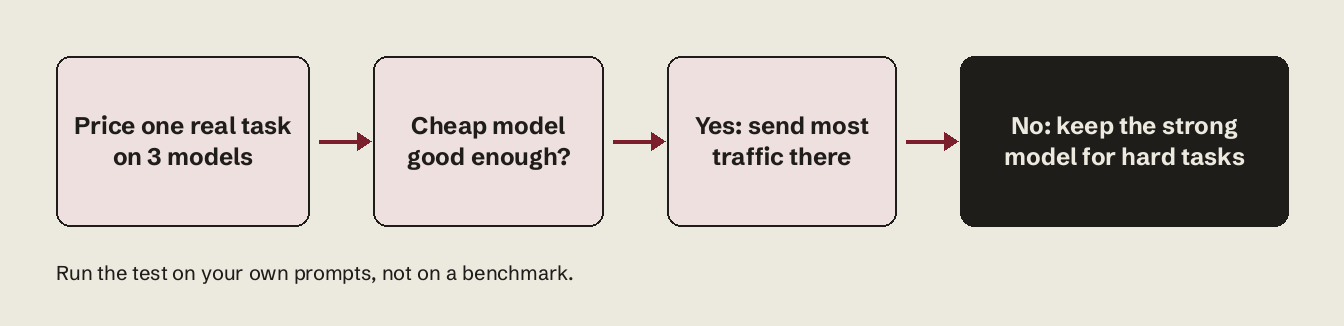
Use one vendor when one model passes your quality bar at a price you accept; a gateway fee adds cost and gives nothing back. Use several when tasks differ in difficulty: easy tasks on a $0.10 model and hard ones on a $2 model can cost a fraction of sending everything to the expensive one. Several vendors also cover outages and dated price rises like Google's on 2026-12-01. See when not to use an LLM router for the break-even math.
What is the difference between a model maker and a cloud platform?
A model maker (OpenAI, Anthropic, Google, xAI, Mistral, DeepSeek) trains the model and sells it on its own API. A cloud platform (AWS Bedrock, Azure, Google Vertex AI) resells models inside your cloud account, under that cloud's billing, regions and compliance terms. A gateway such as Vynaris sits in front of several vendors and gives you one API and one bill.
How to choose an LLM vendor
- Start with Vynaris if you have not settled on a model: price the same task on three vendors through one endpoint and read the cost of each request.
- Pick OpenAI or Anthropic for the strongest models and the deepest caching and batch discounts.
- Pick Google for a free tier while prototyping, and plan for the 2026-12-01 and 2027-01-01 increases.
- Pick Mistral or DeepSeek when price per task matters more than the last points of quality.
FAQ
Who are the main LLM vendors?
OpenAI, Anthropic, Google, xAI, Mistral and DeepSeek sell API access to models they train. Meta, Qwen and Cohere also publish models that gateways and clouds serve.
Which LLM API is cheapest?
DeepSeek deepseek-flash at $0.30 / $1.20 per 1M tokens for capable models; gpt-6-luna and Claude Haiku 5.5 at $0.10 / $0.50 for small tasks. Prices read 2026-11-19.
Should I use one vendor or several?
One, if a single model is good enough at your price. Several, if your tasks vary in difficulty or you need a fallback during outages.
What is the difference between a model maker and a cloud platform?
A model maker trains and sells its own models; a cloud platform resells them inside your cloud account with that cloud's billing and compliance.
Do LLM vendors train on my API data?
It depends on the tier. Google's pricing page marks free-tier Gemini content as used to improve its products and paid-tier content as not used. Read each vendor's terms before sending customer data.
Are LLM API prices going up?
Some are. Google's pricing page lists Gemini 4 Argon doubling on 2026-12-01 and Gemini 3.8 Flash doubling on 2027-01-01.
Price your real prompts across vendors before you commit to one. Send them through one endpoint and read the cost on every response. Get your Vynaris API key.
Related articles
- Qwen Model Price: Every Qwen API Rate per 1M Tokens
- OpenClaw Models: 10 Best, Ranked by Cost per Task
- DeepSeek V4 Pro 0423 costs 2.20x across 17 providers
- Cost Per Token Over Time: LLM Price History Explained
- Model fallback chains: designing for provider outages without doubling your bill
- LLM API Cost Spreadsheet Template: Free Layout + Price CSVs