
Blog · · Updated · By Dhrumil Barot, Founder
Claude Opus 5 kept Opus 4.8's exact $5/$25 sticker: the re-route math
Claude Opus 5 launched at Opus 4.8's exact $5/$25 sticker. Same price does not mean same bill: the effort dial swings cost per task 5.3x. The re-route math, verified 2026-07-25.
Anthropic shipped Claude Opus 5 on 2026-07-24 at $5 per million input tokens and $25 per million output, the exact sticker of the Opus 4.8 it replaces. A flagship bump with a zero-dollar price rise. Two generations ago Opus 4 and 4.1 charged $15/$75, so the sticker has fallen 67% in a year. Prices verified 2026-07-25. But the same sticker does not mean the same bill.
The reason is the effort setting. Opus 5 ships with five of them, and the effort dial, not the price per token, sets your cost per token times tokens, which is what you actually pay per task. On one fixed token shape the dial swings the bill 5.3x. So there are two re-route decisions to make this week, and one of them saves nothing unless you also touch the dial.
The three verified facts before any math
Read live off Anthropic's pricing page and launch note, 2026-07-25:
- Opus 5 standard is $5/$25, byte-for-byte identical to Opus 4.8. Cache read $0.50 and batch $2.50/$12.50 are also unchanged.
- Opus 5 gets fast mode at $10/$50 (roughly 2.5x speed at 2x price). Opus 4.7 lost fast mode the same week; a
speed: "fast"request on 4.7 now returns an error. - The tool-use system-prompt tax dropped to 286 tokens (auto) / 406 (any-or-tool), down from 4.8's 290/410 and far below 4.7's 675. On $5 input that is a $0.00002 saving per request, which is both real and rounding error.
Both Opus 4.8 and Opus 5 run on the newer tokenizer (Claude 4.7+), which emits about 30% more tokens for the same text than Sonnet 4.6 and earlier. Because both models share it, the 4.8-to-5 comparison is clean; the inflation only bites when you compare against a pre-4.7 model, a trap we measured separately.
Verdict: who re-routes, who touches the dial
| Your position today | The move | What it saves |
|---|---|---|
| On Opus 4.8, fixed token shape | Point the string at Opus 5 | $0 change, free quality upgrade |
| On Opus 4.8, but Opus 5 "thinks" more | Cap the effort setting | Protects against a silent rise |
| Paying Fable 5 for headroom | Test Opus 5 at high effort | Up to 50% on identical tokens |
| Running max effort on easy tickets | Drop to low | Up to 3.9x on those tasks |
| Need speed, eyeing fast mode | Price it as a Fable 5 call | Fast mode $10/$50 = Fable sticker |
Re-route 1: Opus 4.8 → Opus 5 is free, with one asterisk
At identical token counts the two models cost the same to the cent, so moving up is a $0 upgrade. The asterisk: a smarter model can choose to spend more reasoning tokens per task at the same effort label. Hold the token shape fixed and the bill is flat; let Opus 5 emit 25% more output at "high" and the same task costs 18.8% more, not because the rate moved but because you bought more output. The upgrade is free; the behavior is not automatically free. Cap the effort setting on your cheap, high-volume paths and the flat sticker stays flat.
Re-route 2: Fable 5 → Opus 5, but the dial decides the size
On a fixed 18,000-input, 11,000-output task, Opus 5 at high effort costs $0.365 against Fable 5's $0.730, exactly half, because Fable 5's $10/$50 is a clean 2x of Opus 5 on both sides. If Opus 5 clears your quality bar at high effort, that is a 50% cut for higher measured intelligence.
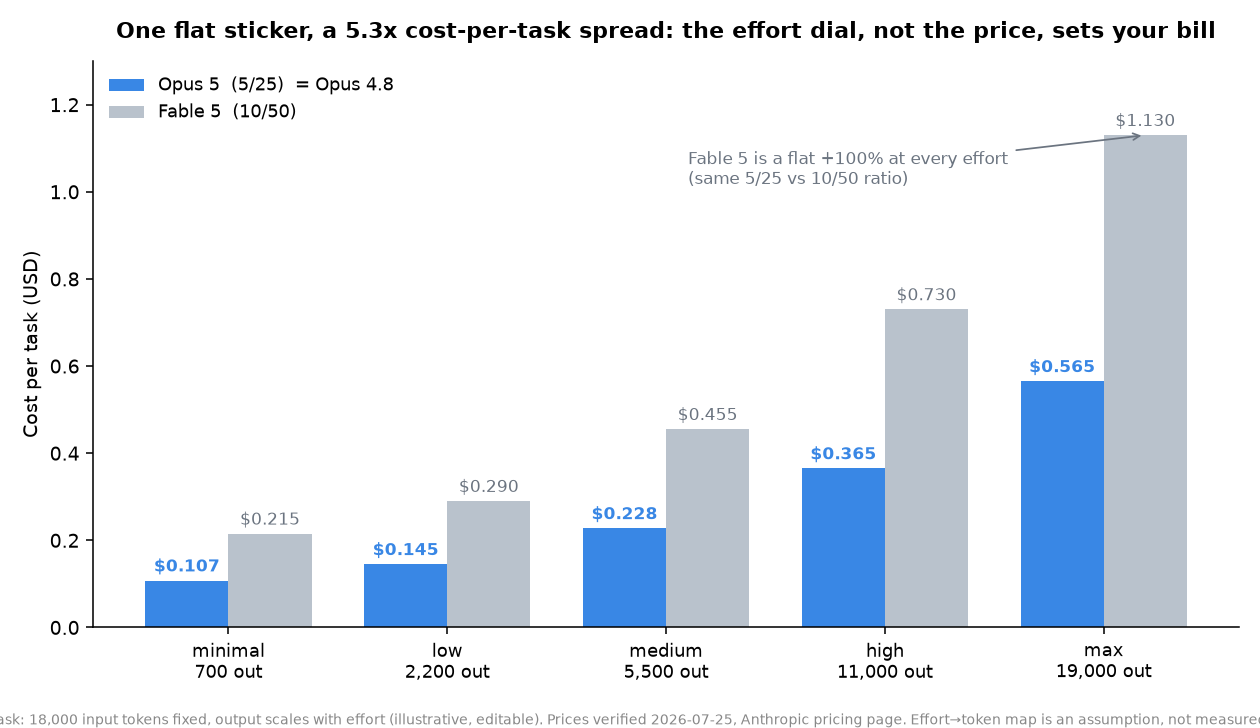
The honest half: Fable 5 still wins when its capability lets you run a lower effort setting to reach the same answer. Fable 5 at medium effort ($0.455) beats Opus 5 at max ($0.565) by 19.5%. The break-even is concrete: to match Opus 5 at max, Fable 5 has to reach the answer in 7,700 output tokens against Opus 5's 19,000, a 59% token cut at equal quality. On ground-truth-hard work where the frontier model settles the task in one shorter pass, that cut is real and Fable 5 earns its premium. On everything else, Opus 5 at a disciplined effort setting is the cheaper path. Run your own shape through the cost calculator before you migrate a routing table on a launch-day headline.
The setting almost nobody audits
The quiet cost story is not the sticker; it is that the same $5/$25 buys a $0.107 task at minimal effort and a $0.565 task at max, a 5.3x spread decided by a parameter most teams leave on default. That is the same lesson the GPT-5.6 "27% cheaper" migration taught from the other side: a flat sticker hid a tier-routing decision, not a price cut. Here the decision is the effort dial. Right-sizing it per task is worth more than the model swap, and it is a config line rather than a rewrite.
For the full cross-model rate sheet behind every price here, see the July 2026 LLM price list; for how fast mode, data residency, and priority tiers stack on top of any sticker, the price-multipliers breakdown. A cheaper flagship only helps your agent if you also stop paying frontier effort on tasks a low setting would close. The per-effort verdict across all three models lives in the comparison companion.
What to do this week
- Opus 4.8 users: repoint to Opus 5. Then watch output tokens per task for a week; if they drift up, cap the effort setting.
- Fable 5 users: A/B Opus 5 at high effort on your hardest 10% of traffic. If quality holds, take the 50%. Keep Fable 5 only where a shorter frontier pass beats the 59% token break-even.
- Everyone: treat the effort setting as a model-routing decision, not a default. It is the biggest lever on this launch, and it is a config line, not a rewrite.
FAQ
Is Claude Opus 5 more expensive than Opus 4.8? No. Both are $5 input / $25 output per million tokens, with identical cache and batch rates. On a fixed token shape, moving from 4.8 to 5 changes your bill by $0.
Why would my bill rise if the sticker is identical? Because cost per task is rate times tokens, and a smarter model can spend more reasoning tokens at the same effort label. Hold effort and tokens fixed and the bill is flat; let the model think longer and you pay for the extra output at the same rate.
How much cheaper is Opus 5 than Fable 5? Exactly 50% on identical tokens, because Fable 5's $10/$50 is a clean 2x of Opus 5's $5/$25. The gap narrows only if Fable 5's capability lets you run a lower effort setting or fewer retries.
What happened to Opus 4.7 fast mode? It was removed. A speed: "fast" request on Opus 4.7 now returns an error. Fast mode is available on Opus 5 and Opus 4.8 only, at $10/$50.
Where do the per-task dollar figures come from? Our own arithmetic on live-verified sticker prices, with an editable effort-to-token assumption printed in the caption and the comparison companion. Third-party trackers reported a similar ~1.7x high-to-max effort spread; we could not page-verify those figures, so they inform none of the numbers above.
Sources
- Anthropic pricing (Opus 5 $5/$25, fast mode $10/$50, batch $2.50/$12.50, tool-use tax 286/406, Opus 4.7 fast mode removed), verified live 2026-07-25: https://platform.claude.com/docs/en/about-claude/pricing
- Anthropic, Claude Opus 5 launch announcement (2026-07-24; $5/$25 "same as Opus 4.8", effort settings, fast mode ~2.5x speed at 2x price): https://www.anthropic.com/news/claude-opus-5
- Hacker News, "Claude Opus 5" (1,365 points read live 2026-07-25): https://news.ycombinator.com/item?id=49038433
- All arithmetic:
claude-opus-5-same-sticker-as-opus-48-reroute-cost-math-math.py, assumptions editable inline.
Related: July 2026 LLM price list · Opus 5 vs Fable 5 vs Opus 4.8 by effort