
Blog · · Updated · By Dhrumil Barot, Founder
We rebuilt the "GPT-5.6 migration = 27% cheaper" claim from live prices: the saving is not a price cut
gpt-5.5 and gpt-5.6-sol cost an identical $5/$30 per million tokens, so a model-string swap saves 0%. We rebuild the reported 27% migration saving from live prices: it is tier down-routing, not a price cut. Prices verified 2026-07-18.
A widely-shared migration report says moving a production AI agent from GPT-5.5 to GPT-5.6 made it 2.2x faster and 27% cheaper. We rebuilt the 27% from live list prices, and it cannot come from the flagship sticker: gpt-5.5 is $5/$30 per million tokens and gpt-5.6-sol is $5/$30, identical. Swap the model string and keep everything on the flagship and you save exactly 0%. The 27% is a workload-reshaping result, and down-routing 3 of 8 calls in a plan-edit-verify loop reproduces 26% of it before any efficiency gain. Prices verified 2026-07-18.
The claim comes from a public write-up (ploy.ai, surfaced on Hacker News at 258 points) reporting a real production migration. We do not use their internal numbers as evidence; we treat the 27% as the community claim under test and rebuild it from prices anyone can check. Every number below is derived from an editable assumptions table and the providers' live pricing page. Nothing here is measured from inside any product.
The sticker did not move
GPT-5.6 shipped in three tiers. The top tier, Sol, carries the exact same per-token price as the GPT-5.5 flagship it replaces:
model         input $/1M   output $/1M
--------------------------------------
gpt-5.5       $5.00        $30.00
gpt-5.6-sol   $5.00        $30.00
gpt-5.6-terra $2.50        $15.00
gpt-5.6-luna  $1.00        $6.00
Prices verified 2026-07-18 from OpenAI's pricing page. Read the top two rows: a migration that swaps gpt-5.5 for gpt-5.6-sol and changes nothing else pays the same input rate, the same output rate, for the same tokens. The bill is byte-for-byte identical. If someone reports 27% off a migration, the 27% is hiding in the two rows below Sol, or in the token count, not in the flagship price.
So the useful question is not "is GPT-5.6 cheaper" (on the flagship, it is not). It is: which levers does the release hand you, and how much does each one actually pay?
The workload we price
A coding agent is a loop, not a single call: it plans, edits, runs tests, reads failures, patches, and repeats. Each pass re-sends the system prompt, tool schemas, and code context, so agent inference cost behaves nothing like chat. We reuse the same public task shape from our GPT-5.6 tier breakdown so the numbers reconcile across posts.
| Assumption | Value | Note |
|---|---|---|
| Stable prefix per call | 15,000 tok | system + tool schemas + loaded code, re-sent each call |
| Fresh input per call | 2,000 tok | new tool results, appended messages |
| Visible output per call | 838 tok | diffs + tool calls, averaged |
| Reasoning tokens per call | 500 (low) | billed at the output rate, invisible in the response |
| Calls per task | 8 | plan (1) + edit (3) + verify (2) + 2 back-and-forth |
| Total input per task | 136,000 tok | 8 x (15,000 + 2,000) |
| Total output per task | 10,704 tok | 8 x (838 + 500) |
On the FROM model, gpt-5.5, that task costs $1,001.12 per 1,000 tasks (input $680, output $321, no caching, to keep the migration levers visible on their own). Because Sol prices match gpt-5.5 exactly, the naive swap costs the same $1,001.12. That is our zero line.
Where the 27% actually comes from
Three levers, each priced independently against the $1,001.12 base. This is the whole teardown.
lever                                        cost/1k    saved
------------------------------------------------------------
base: all gpt-5.5                            $1,001.12    -
naive swap -> all gpt-5.6-sol (same tokens)  $1,001.12   0.0%
token efficiency: -10% output tokens         $  969.01   3.2%
move 2 verify calls Sol -> Terra             $  875.98  12.5%
move 2 verify calls Sol -> Luna              $  800.90  20.0%
move 5 mechanical calls Sol -> Terra         $  688.27  31.2%
move 5 mechanical calls Sol -> Luna          $  500.56  50.0%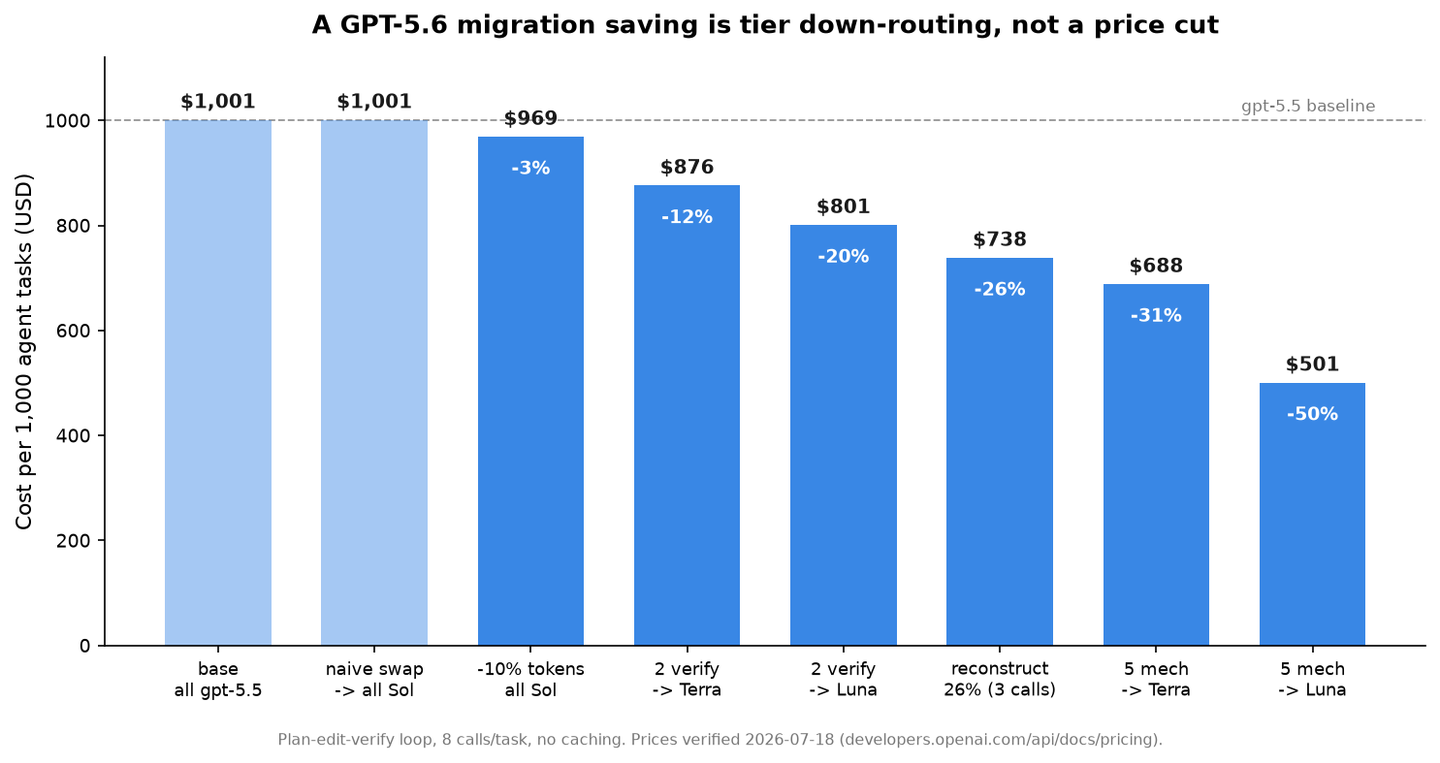
The pattern is stark. The model-string swap does nothing. Token efficiency, the thing the release notes advertise, is worth only 3.2% at a 10% token reduction, because output is just 32% of this task's cost and efficiency only touches output. The lever that moves the bill is right-sizing the calls: sending the mechanical steps to the cheaper GPT-5.6 tiers the release created.
Reconstructing 27%
You do not need the efficiency story to hit the reported number. Each call in this loop costs $0.12514 on Sol. The same call costs $0.06257 on gpt-5.6-terra (half) and $0.02503 on gpt-5.6-luna (a fifth). So moving one call off the flagship saves 6.25% of the task on Terra or 10% on Luna.
Move the two verify calls to Luna and one edit to Terra, 3 of 8 calls, and you save $262.79 per 1,000 tasks: 26.2%, from list prices alone. Add a real 10% token-efficiency gain from the newer model and the total reaches 28.6%, bracketing the reported 27%. This is the moment to run your own call count and context size through the calculator rather than trust our task shape.
reconstruction                          cost/1k    saved
--------------------------------------------------------
base: all gpt-5.5                       $1,001.12    -
2 verify -> Luna, 1 edit -> Terra       $  738.33  26.2%
  + 10% token efficiency on top         $  714.64  28.6%
Read what that means. The migration report's 27% is not evidence that GPT-5.6 is a cheaper model. It is evidence that the team re-shaped the workload during the migration, pushing the low-stakes steps down to Terra and Luna while keeping planning on Sol. Down-routing 4 to 5 of the 8 calls to Terra alone would have produced 31% to 50%, more than they reported, which suggests the migrated agent still ran several steps on the flagship. If your migration swapped the model string and left everything on Sol, you captured none of the 27% and shipped the same bill.
The speed claim is a different axis
The report also says 2.2x faster. We cannot rebuild that from prices, and we do not try. Latency depends on the provider's serving stack and the model's token throughput, neither of which appears on a pricing page. Speed and cost move on separate dials here: GPT-5.6 being faster does not lower the Sol sticker, and down-routing to Terra or Luna changes cost whether or not it changes latency. Treat "2.2x faster" and "27% cheaper" as two independent findings that happened in the same migration, not as one effect.
Where a GPT-5.6 migration does NOT save
The honest section. Down-routing is the whole saving, so any workload that cannot down-route saves nothing.
- Sol-only quality bars. If every step needs frontier judgement, you keep all 8 calls on Sol, and Sol is priced exactly like gpt-5.5. Saving: 0%. The migration buys you speed and whatever token efficiency you can measure, and not a cent of tier arbitrage.
- Reasoning-heavy loops that must stay on Sol. Push reasoning to 8,000 tokens per call and the task costs $2,801.12 per 1,000 on both gpt-5.5 and gpt-5.6-sol. Same sticker, same tokens, same bill. The reasoning-effort dial swings the cost far harder than the migration does; we took that apart in the reasoning-token tax. If your agent thinks hard on every step and cannot use a smaller tier, migrating does not help the invoice.
- You already down-routed on 5.5. GPT-5.5 also had cheaper siblings. A team already routing mechanical steps to a mini model before the migration has spent the down-routing lever; moving to GPT-5.6's tiers is lateral, not a 27% cut.
- Retries eat the arbitrage. A cheaper tier that fails the verify loop more often adds calls. If Luna needs two extra passes where Sol needed zero, the per-task gap narrows. Route the cheap tiers onto steps where a wrong answer is caught cheaply, never onto planning, where a bad plan wastes every downstream call.
What it means for routing
The takeaway is not "migrate to GPT-5.6." It is "the saving people attribute to the migration is a model-routing decision that had nothing to do with the version bump." The three-tier split is the release's real gift: a clean, same-vendor way to send the plan step to a frontier tier and the mechanical steps to a tier that costs a half or a fifth.
- Price the split, not the version. Every call you move from Sol to Luna removes 80% of that call's cost. The version number is a distraction; the tier assignment is the bill.
- Keep the planner expensive. Plan quality cascades. Route edits and verification down, hold planning on Sol, and the 26% arrives with no drop in plan quality.
- Measure token efficiency, do not assume it. The 3.2% efficiency lever is real but small and model-dependent. Count tokens on your own traces before crediting the new model with a saving that down-routing actually produced.
An OpenAI-compatible gateway makes the split testable without rewriting provider glue: point one base URL at a router, send verify-step calls to Luna, keep planning on Sol, and read the invoice. For the full per-tier task math see our GPT-5.6 Sol vs Terra vs Luna breakdown, and for the base rates behind every model here, the July 2026 price list.
FAQ
Is GPT-5.6 cheaper than GPT-5.5? On the flagship tier, no. gpt-5.6-sol is $5/$30 per million tokens, identical to gpt-5.5. The cheaper GPT-5.6 tiers (Terra $2.50/$15, Luna $1/$6) are cheaper than the gpt-5.5 flagship, but that is a tier choice, not a version discount.
Then where does the reported 27% come from? From re-shaping the workload during the migration: moving mechanical steps to Terra and Luna, plus whatever token-efficiency the newer model delivers. Moving 3 of 8 calls in our loop reproduces 26% before any efficiency gain.
How much does token efficiency contribute? About 3.2% at a 10% output-token reduction on this task, because output is only 32% of the cost and efficiency touches output alone. Real but minor next to tier routing.
What if I keep everything on Sol? You save 0% on the sticker. A Sol-only migration buys speed and token efficiency, not tier arbitrage.
Can I reproduce this on my own workload? Yes. Swap your call count, context size, and reasoning budget into the assumptions table and rerun the math script; the levers behave the same, only the magnitudes change.
Sources
- OpenAI API pricing (gpt-5.5, gpt-5.6-sol/terra/luna input, output, cache-read rates), verified 2026-07-18: https://developers.openai.com/api/docs/pricing
- Community migration claim under test (ploy.ai report, Hacker News 258 points / 131 comments), read 2026-07-18: https://news.ycombinator.com/item?id=48882716
- All arithmetic:
gpt-56-production-migration-27-percent-cheaper-cost-model-math.py, assumptions editable inline.
Related: GPT-5.6 Sol vs Terra vs Luna cost per task · the reasoning-token tax