
Blog · · Updated · By Dhrumil Barot, Founder
The reasoning-token tax: 90% of your bill is tokens you never see
Reasoning models bill you for thousands of invisible thinking tokens at the output rate — about 90% of the total. Worked bills across gpt-5.6-sol, Claude Opus 4.8, and Gemini 3.1 Pro Preview, prices verified 2026-07-16, plus how to cap the tax.
Ask a reasoning model one hard question and it prints a 600-token answer. Your invoice charges you for 8,600 tokens. The missing 8,000 are reasoning tokens: the model's private scratch work, invisible in the API response, and billed at the full output rate. On a medium-effort question that is 90% of the bill spent on text you never see. We priced the same question across three reasoning models against their live pricing pages, verified 2026-07-16, and the reasoning tax runs 70% to 95% of the total depending on how hard the model thinks.
TL;DR
- On one medium-effort question (2,000 input, 600 visible answer, 8,000 reasoning tokens), reasoning tokens are ~90% of the bill: $240 of $268 per 1,000 questions on gpt-5.6-sol, $200 of $225 on Claude Opus 4.8, $96 of $107 on Gemini 3.1 Pro Preview.
- Budget from the visible answer alone and you underestimate by ~10x: $28/1,000 becomes $268/1,000 on gpt-5.6-sol, because you pay for 8,600 output tokens, not 600.
- Capping reasoning cuts the bill hard: bounding gpt-5.6-sol from a high 19,000-token budget to 1,500 tokens takes $598 to $73 per 1,000 questions, 88% less.
What a reasoning model actually bills you
A reasoning model does not answer immediately. It generates a long internal chain of intermediate steps first, then a short final answer. The intermediate steps are tokens too, and all three major providers bill them at the output rate. They just do not show them to you.
The providers say so in writing. OpenAI's reasoning guide: reasoning tokens "still occupy space in the model's context window and are billed as output tokens," and a model "may generate anywhere from a few hundred to tens of thousands of reasoning tokens." Google's Gemini pricing page labels every output row "Output price (including thinking tokens)." Anthropic's extended-thinking docs are blunter still: "The billed output token count will not match the count of tokens you see in the response," and "You're charged for the full thinking tokens generated by the original request, not the summary tokens."
So the output-token line on your invoice is two things glued together: the answer you read, plus a much larger block of reasoning you cannot. The second block sets the price.
The teardown: one question, three models
Take a single hard question. Input is 2,000 tokens of prompt and context. The visible answer is 600 tokens. The model thinks for 8,000 tokens on the way there, a medium effort well inside OpenAI's stated range. Prices are per million tokens, verified 2026-07-16 from the OpenAI, Google, and Anthropic pricing pages.
The output bill counts the visible answer and the reasoning together: (600 + 8,000) tokens at the output rate. Here is the per-1,000-question invoice, medium effort:
| Model | Input $/MTok | Output $/MTok | Bill /1,000 Q | Reasoning $ | Invisible % |
|---|---|---|---|---|---|
| gpt-5.6-sol | $5 | $30 | $268 | $240 | 89.6% |
| Claude Opus 4.8 | $5 | $25 | $225 | $200 | 88.9% |
| Gemini 3.1 Pro Preview | $2 | $12 | $107 | $96 | 89.6% |
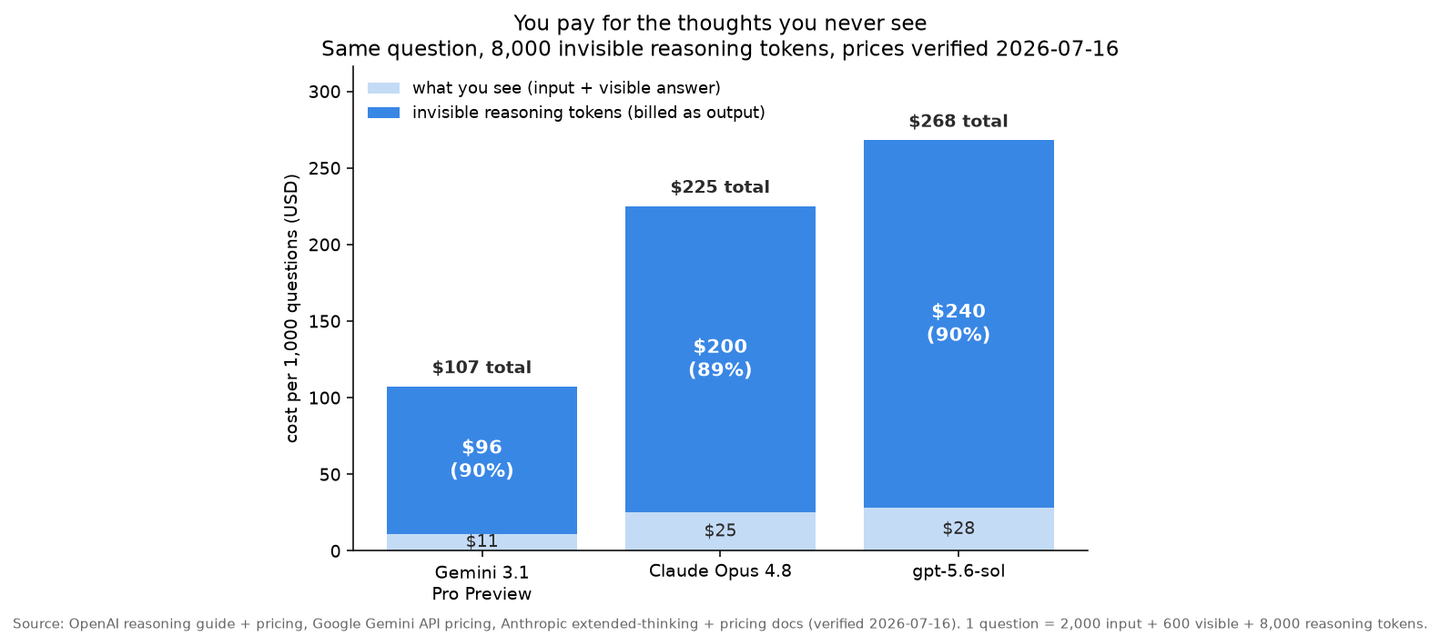
The arithmetic on gpt-5.6-sol, envelope fully open: input is 2,000 / 1,000,000 × $5 = $0.010. Visible answer is 600 / 1,000,000 × $30 = $0.018. Reasoning is 8,000 / 1,000,000 × $30 = $0.240. Total $0.268 per question, and $0.240 of it, 89.6%, is thinking you never see. Times 1,000, that is $268 where a from-the-answer estimate said $28.
The effort dial changes everything
Reasoning tokens are not fixed. The same model on the same question spends more or fewer depending on how hard the problem is and how the effort parameter is set. Watch the invisible share climb as the model thinks longer, per 1,000 questions:
| Reasoning tokens | gpt-5.6-sol | Claude Opus 4.8 | Gemini 3.1 Pro | Invisible % |
|---|---|---|---|---|
| 2,400 (low) | $100 | $85 | $40 | ~71% |
| 8,000 (medium) | $268 | $225 | $107 | ~89% |
| 19,000 (high) | $598 | $500 | $239 | ~95% |
At a high effort setting, 95% of the bill is reasoning. The visible answer, still 600 tokens, is a rounding error. This is why two teams running the "same" model can see a 6x cost difference with no code change visible in a diff: one left the effort dial high.
What you budgeted vs what you pay
The trap is estimating cost from the visible answer, because that is the only part you can see when you test. On the medium question:
| Model | Budgeted from visible answer /1,000 | Real bill /1,000 | Multiple |
|---|---|---|---|
| gpt-5.6-sol | $28 | $268 | 9.6x |
| Claude Opus 4.8 | $25 | $225 | 9.0x |
| Gemini 3.1 Pro Preview | $11 | $107 | 9.6x |
You budgeted for 600 output tokens. You paid for 8,600. Every reasoning model on the market has this ~10x gap between the answer length you observe and the output length you are billed, and it does not appear until the invoice. It is the same shape of surprise as the 33,000-token scaffolding tax a coding agent pays before it reads your prompt: real tokens, real dollars, zero visibility at call time. Reasoning is the output-side version of the same problem. Want to price your own question shape before it hits production? Run the numbers in the calculator.
How to cap it
Reasoning tokens are billed but also bounded. You control the ceiling.
- Set a hard token ceiling. OpenAI's
max_output_tokenscaps "the total number of tokens the model generates, including reasoning tokens, visible output tokens, and non-visible formatting tokens." Anthropic's extended thinking usesbudget_tokens, which "must be set to a value less thanmax_tokens." A ceiling turns an open-ended reasoning run into a bounded one. - Turn the effort dial down. Most reasoning models expose an effort or thinking level. Lower effort means fewer reasoning tokens, which on gpt-5.6-sol moves the per-1,000 bill straight down the table above.
- Meter what you cannot see. OpenAI exposes the count in
usage.output_tokens_details.reasoning_tokens; Anthropic and Google report thinking usage in their response objects too. Log it per call. You cannot manage a line item you are not measuring.
Here is the payoff, gpt-5.6-sol, as you lower the ceiling on the same question:
| Reasoning budget | Bill /1,000 Q |
|---|---|
| high (19,000) | $598 |
| medium (8,000) | $268 |
| capped 4,000 | $148 |
| capped 1,500 | $73 |
From a high budget to a 1,500-token cap is $598 to $73 per 1,000 questions, 88% less, a $525 saving per 1,000 questions. The cap is one request parameter.
The honest part: sometimes you want the tax
Do not cap blindly. Reasoning tokens are not waste; they are the mechanism by which these models solve hard problems. On genuinely difficult math, multi-step code, or logic, cutting the budget too low degrades the answer, and a cheap wrong answer is the most expensive kind. The reasoning tax buys real accuracy on the tasks that need it.
The point is not "always cap." It is "cap where thinking does not pay for itself." A classification call, an extraction, a format-conversion, or a simple lookup does not need 8,000 tokens of deliberation, and if it is running on a frontier model at a high effort setting, you are paying reasoning rates for work a smaller model does in one shot. Match the effort to the task. The cheapest reasoning token is the one a routing layer decided the question did not need, which is a model-routing decision made per request, not a global default. It pairs naturally with the other hidden multipliers we mapped in the list price is a floor: fast mode, data residency, and priority all inflate the per-token price; reasoning inflates the token count. Both compound quietly.
FAQ
Do reasoning tokens really cost money if I never see them?
Yes. OpenAI: reasoning tokens "are billed as output tokens." Anthropic: "You're charged for the full thinking tokens generated." Google folds them into the output price. Invisible in the response, fully billed on the invoice.
Why is my output token count higher than my completion length?
Because the billed output count includes reasoning. Anthropic states it directly: "The billed output token count will not match the count of tokens you see in the response." Check usage.output_tokens_details.reasoning_tokens (OpenAI) or the equivalent field to see the gap.
How many reasoning tokens should I expect?
OpenAI's own range is "a few hundred to tens of thousands," set by problem difficulty and effort level. Our worked examples use 2,400 (low), 8,000 (medium), and 19,000 (high) to bracket it.
Can I cap reasoning without breaking the answer?
Often, on easy tasks. Use max_output_tokens (OpenAI) or budget_tokens (Anthropic), and lower the effort level. But on hard problems a too-tight cap degrades quality; test per workload, do not cap globally.
Which model is cheapest for reasoning?
On this question shape, Gemini 3.1 Pro Preview at $12/MTok output is the cheapest of the three, roughly 40% of gpt-5.6-sol's $30. But the invisible share is ~90% on all three, so the bigger lever is how many reasoning tokens you allow, not which model spends them. The full July 2026 price list has the base rates.
Vynaris is an OpenAI-compatible inference gateway that routes each request to the cheapest right-sized model and shows its receipts per request, including the reasoning-token count you are actually billed for. One base URL swap. Get an API key at vynaris.com and model your own reasoning budgets in the calculator. All prices in this post verified 2026-07-16 against the providers' live pricing pages; reasoning-token counts are illustrative budgets, not provider-published averages.