
Blog · · Updated · By Dhrumil Barot, Founder
The list price is a floor: OpenAI Priority, data residency, and fast mode all stack
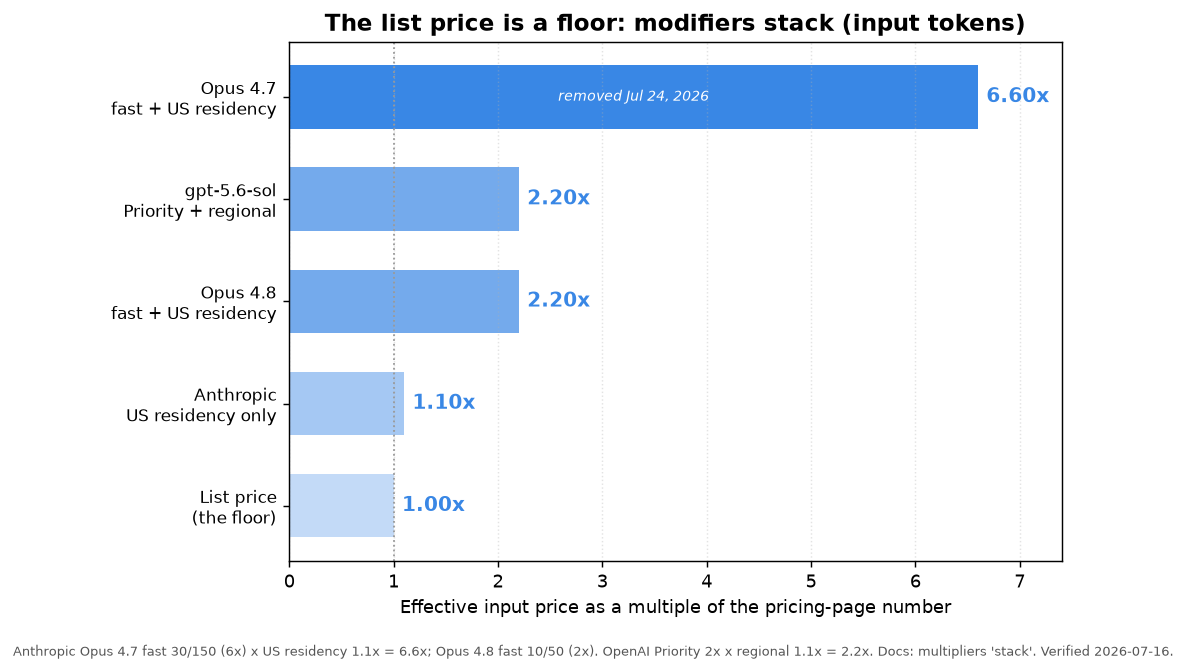
Opus 4.7 fast mode is 6x list and stacks with US data residency for 6.6x. OpenAI Priority is 2x, +10% regional = 2.2x. The multiplier table nobody publishes, verified 2026-07-16. Opus 4.7 fast mode removed July 24.
The pricing page says Claude Opus 4.7 costs $5 per million input tokens. Turn on fast mode and it is $30. Add US data residency and it is $33, because the two multipliers stack, and the docs say so in writing. That is 6.6x the number you quoted your finance team, on a request that changed by two config flags and zero tokens. This is the multiplier table nobody publishes, verified 2026-07-16 against Anthropic's and OpenAI's live pricing pages.
One of these multipliers has a deadline. Fast mode for Opus 4.7 is removed on July 24, 2026, eight days out.
TL;DR
- Anthropic Opus 4.7 fast mode is $30/$150 per million tokens, exactly 6x the $5/$25 list. Stack US data residency (1.1x) and you pay $33/$165, or 6.6x list.
- The successor is far tamer: Opus 4.8 fast mode is $10/$50, only 2x. So the 6x era ends when Opus 4.7 fast mode is removed on July 24, 2026.
- OpenAI does the same with different names: Priority processing is exactly 2x, regional data residency is +10%, and together they bill 2.2x the list price of gpt-5.6-sol.
The one table nobody prints
Effective input and output prices once you turn a modifier on, with the multiple-of-list beside each. Every figure below is the provider's own number, verified 2026-07-16 from the Anthropic pricing docs and OpenAI pricing docs.
| Configuration | Input $/MTok | Output $/MTok | Multiple of list |
|---|---|---|---|
| Opus 4.7 list | $5.00 | $25.00 | 1.00x |
| Opus 4.7 + US residency | $5.50 | $27.50 | 1.10x |
| Opus 4.7 fast mode | $30.00 | $150.00 | 6.00x |
| Opus 4.7 fast + US residency | $33.00 | $165.00 | 6.60x |
| Opus 4.8 fast mode | $10.00 | $50.00 | 2.00x |
| Opus 4.8 fast + US residency | $11.00 | $55.00 | 2.20x |
| gpt-5.6-sol list | $5.00 | $30.00 | 1.00x |
| gpt-5.6-sol Priority | $10.00 | $60.00 | 2.00x |
| gpt-5.6-sol Priority + regional | $11.00 | $66.00 | 2.20x |
Why they stack, in Anthropic's own words
This is not an inference on our part. Anthropic's pricing page states, on prompt caching, "These multipliers stack with other pricing modifiers, including the Batch API discount and data residency." On fast mode it repeats it: "Fast mode pricing stacks with other pricing modifiers," and lists prompt caching and data residency as the modifiers that apply on top.
So the modifiers compose by multiplication, not addition. The three live ones on the Claude API:
- Fast mode (research preview): an absolute premium price. Opus 4.7 is $30/$150, which is 6x the $5/$25 base. Opus 4.8 is $10/$50, which is 2x.
- Data residency:
inference_geo: "us"applies a 1.1x multiplier across every token category, including input, output, cache writes, and cache reads, for Opus 4.6, Sonnet 4.6, and later. - Prompt caching: a 5-minute cache write is 1.25x base input, a 1-hour write is 2x, and a cache read is 0.1x.
Put them together on Opus 4.7 fast mode with US residency, and even the "cheap" line items inflate. A 1-hour cache write, normally 2x the $5 base, becomes 2x the $30 fast-mode input, then 1.1x for residency: $66 per million tokens, or 13.2x the base input price you started from. We wrote a whole teardown on how mid-session cache-write churn burns money at standard rates; fast mode multiplies that wound.
OpenAI, same idea, different labels
OpenAI does not call it fast mode. It calls the speed premium Priority processing, and it is exactly 2x standard rates: gpt-5.6-sol goes from $5/$30 to $10/$60. Its data-residency equivalent is a 10% regional uplift, applied to models released on or after March 5, 2026. Stack both and gpt-5.6-sol bills $11/$66, or 2.2x the list price. OpenAI's cache writes are 1.25x, the same shape as Anthropic's 5-minute write.
Notably, OpenAI has no live equivalent of the 6x Opus 4.7 premium. Its worst-case stack on a current frontier model is 2.2x. After July 24, so is Anthropic's.
What it does to a real bill
Take one request with 50,000 input tokens and 15,000 output tokens, roughly the shape of a heavy agent step, and price it under each configuration. Per 1,000 such requests:
| Configuration | Per request | Per 1,000 requests |
|---|---|---|
| Opus 4.7 list | $0.625 | $625 |
| Opus 4.7 fast + US residency | $4.125 | $4,125 |
| Opus 4.8 fast + US residency | $1.375 | $1,375 |
| gpt-5.6-sol list | $0.700 | $700 |
| gpt-5.6-sol Priority + regional | $1.540 | $1,540 |
The jump from Opus 4.7 list to Opus 4.7 fast with residency is $0.625 to $4.125, which is 6.6x, an extra $3,500 per 1,000 requests. If a service sets speed: "fast" and inference_geo: "us" as global defaults and no one revisits them, that is the bill, whether the request was a hard reasoning task or a health-check ping. This is the same "why is my bill higher than the pricing page" surprise we mapped for the Anthropic tokenizer change, which quietly adds ~30% more tokens on these same models. The tokenizer inflates the token count; these multipliers inflate the per-token price. They also stack.
The honest part: you are buying something
None of this is a trick. Fast mode buys genuinely lower latency, which matters for interactive and agent cost-per-token-sensitive loops where a human or a downstream step is waiting. Priority processing buys throughput and tail-latency headroom under load. Data residency buys a compliance guarantee that keeps inference inside US borders, which for some teams is not optional. These are real products at real prices.
The problem is not that the premiums exist. It is that the pricing page shows the floor and the modifiers live three sections down, and they compound silently. Two flags set once at integration time can run 2.2x to 6.6x forever.
Two more edges worth knowing:
- Fast mode cannot stack with Batch. Anthropic's Batch API 50% discount is not available with fast mode; they are mutually exclusive. You pick latency or you pick the discount.
- Managed Agents ignore these modifiers. Anthropic's Managed Agents sessions do not apply the batch discount, the fast-mode premium, or the data-residency multiplier, because those are Messages API request fields. Different billing surface, different rules.
Defusing it before July 24
- Audit your defaults now. Grep your codebase for
speed,fast, andinference_geo. If any are set globally, confirm every call path actually needs them. A per-request decision beats a per-service default. - If you are on Opus 4.7 fast mode, plan the migration. It is removed July 24, 2026. Opus 4.8 fast mode is 2x instead of 6x for the same speed benefit, so the move is a price cut, not a compromise. As of June 29, 2026, Opus 4.6 fast requests already run at standard speed and standard price.
- Route the flags, not just the model. The cheapest fix is sending only the requests that need low latency to fast mode, and everything else to standard. That is a model routing decision on a per-request basis, and it is exactly the kind of call a gateway makes for you. Price your own request shapes across list, fast, and residency before you hard-code anything.
FAQ
Do the multipliers really multiply, or add?
Multiply. Anthropic's docs state the modifiers "stack." Opus 4.7 fast mode (6x) times US residency (1.1x) is 6.6x, not 6.1x. OpenAI Priority (2x) times regional (1.1x) is 2.2x.
When does Opus 4.7 fast mode go away?
July 24, 2026. After that the highest Opus fast-mode multiplier is Opus 4.8's 2x (2.2x with residency). Opus 4.6 fast mode already runs at standard rates as of June 29, 2026.
Is fast mode worth 6x?
For a latency-critical interactive path, sometimes. For batch or background work, almost never, and fast mode cannot use the Batch API's 50% discount anyway. Decide per request, not per service.
Does US data residency really touch every price?
Yes. The 1.1x applies to input, output, cache writes, and cache reads alike, on Opus 4.6, Sonnet 4.6, and later. Requests to earlier models that include inference_geo return a 400 error.
How do I see which premium I am paying?
Check the request fields you send (speed, inference_geo on Anthropic; the Priority and regional flags on OpenAI) against the effective rates in the table above. The full July 2026 price list has the base rates these multipliers sit on top of.
Does caching help or hurt under fast mode?
Both. Cache reads are still 0.1x of base, so caching a fast-mode prefix still saves versus re-sending it, but the cache write and read are computed on the fast-mode price, so the absolute numbers are larger. We worked the break-even in prompt caching break-even across providers.
Vynaris is an OpenAI-compatible inference gateway that routes each request to the cheapest right-sized model and shows its receipts, per-request, including which modifiers a call actually needs. One base URL swap. Get an API key at [vynaris.com](https://vynaris.com) and model your own fast-mode and residency exposure in the [calculator](https://vynaris.com/calculator). Prices in this post verified 2026-07-16; we will add an Updated banner after the July 24 fast-mode removal.