
Blog · · Updated · By Dhrumil Barot, Founder
Opus 5 vs Fable 5 vs Opus 4.8: cost per task across five effort settings
Opus 5 and Opus 4.8 share $5/$25; Fable 5 is a flat 2x above. What sets your bill is the effort dial: a 5.3x cost-per-task spread. When Fable 5 actually earns its premium. Verified 2026-07-25.
Pick by the effort setting, not the sticker. Claude Opus 5 and Opus 4.8 share an identical $5/$25 rate, so at equal tokens they cost the same to the cent; Fable 5 sits a flat 2x above at $10/$50. What separates the three on your bill is how many output tokens each needs to close a task, and on Opus 5 that is a dial you set. Prices verified 2026-07-25.
This is the durable verdict table. For the same-day launch forensics (what changed on the pricing page and who should repoint today), see the Opus 5 re-route analysis. Here we answer the standing question: given a task, which model and which effort setting is cheapest, and when does the premium model actually earn its price.
Verdict table
Per-token rates are live-verified. Cost per task uses one representative shape (18,000 input tokens fixed, output scaling with effort) so the columns are directly comparable. The effort-to-token map is an editable assumption, not a measured Anthropic figure; swap your own trace medians in.
| Model | Rate (in / out per 1M) | Task @ low | Task @ medium | Task @ high | Task @ max | Pick it when |
|---|---|---|---|---|---|---|
| Opus 5 | $5 / $25 | $0.145 | $0.228 | $0.365 | $0.565 | Default. Cheapest at any matched effort |
| Opus 4.8 | $5 / $25 | $0.145 | $0.228 | $0.365 | $0.565 | Only if pinned for eval stability |
| Fable 5 | $10 / $50 | $0.290 | $0.455 | $0.730 | $1.130 | It closes the task ≥2 effort notches lower |
Two facts fall straight out of the rates. Opus 5 and Opus 4.8 are the same line; there is no cost reason to stay on 4.8 except reproducibility of a frozen eval. And Fable 5 is a clean +100% over Opus 5 at every rung, because $10/$50 is exactly 2x $5/$25 on both input and output. Fable 5 is never cheaper at the same effort. It can only win by needing less.
The effort dial is the real variable
On Opus 5, one flat sticker produces a 5.3x cost-per-task spread: $0.107 at minimal effort to $0.565 at max, on the same 18,000-token input. The output tokens (the model's reasoning plus answer) are what move, and effort is what moves them.
| Effort | Output tokens (assumed) | Opus 5 / 4.8 task | Fable 5 task |
|---|---|---|---|
| minimal | 700 | $0.107 | $0.215 |
| low | 2,200 | $0.145 | $0.290 |
| medium | 5,500 | $0.228 | $0.455 |
| high | 11,000 | $0.365 | $0.730 |
| max | 19,000 | $0.565 | $1.130 |
The practical read: the distance between minimal and max on a single model (5.3x) dwarfs the distance between two adjacent models at the same setting (2x). Teams shopping models while leaving effort on default are optimizing the smaller lever. Right-sizing the effort per task class is worth more than the model swap, and it is a config line, not a migration.
When Fable 5 actually wins
Because Fable 5 costs 2x at matched effort, it only comes out ahead when its capability lets you run a lower setting to reach the same answer. The crossover is exact.
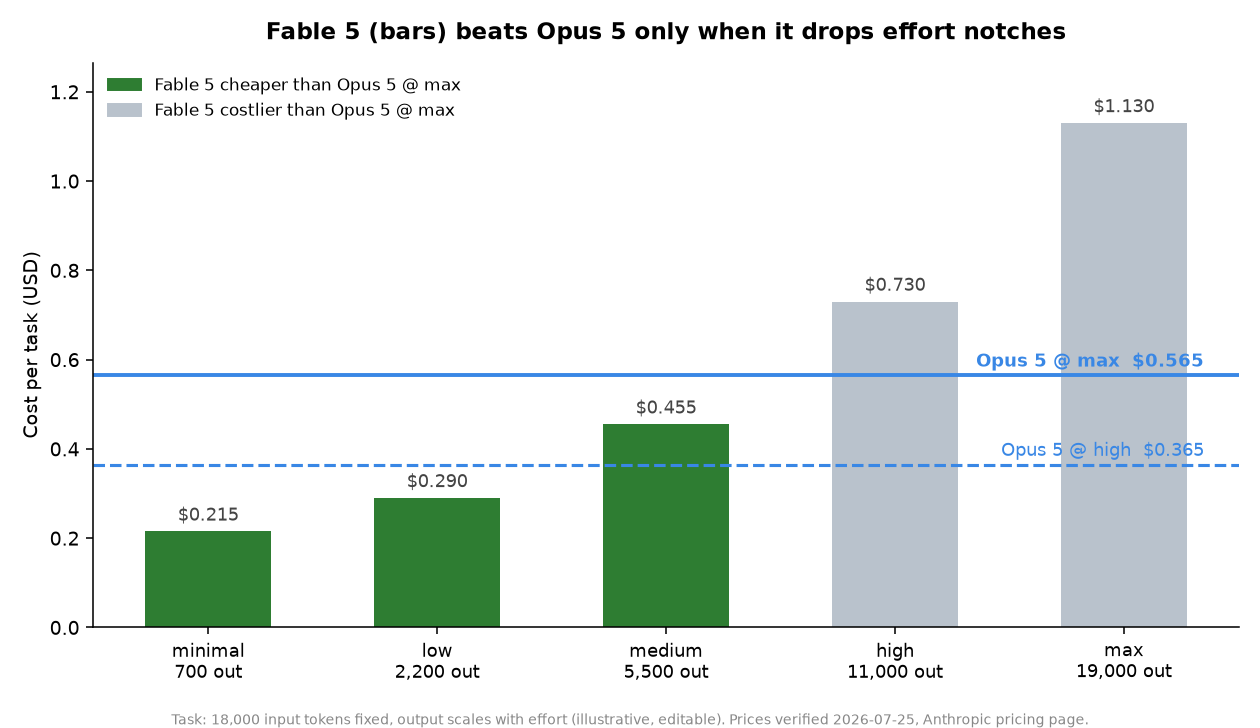
- Fable 5 at medium ($0.455) beats Opus 5 at max ($0.565) by 19.5%, if Fable 5 settles at medium what Opus 5 needs max effort to settle.
- Fable 5 at low ($0.290) beats Opus 5 at high ($0.365) by 20.5%, the same rule one tier down.
- Fable 5 at high ($0.730) loses to Opus 5 at max ($0.565) by 29.2%. Matched or near-matched effort always favors Opus 5.
The break-even in tokens is concrete: to tie Opus 5 at max, Fable 5 must reach the answer in 7,700 output tokens against Opus 5's 19,000, a 59% token cut at equal quality. On ground-truth-hard work (a subtle migration, a proof, a multi-file refactor where a shorter correct pass beats a longer hedged one) a frontier model can clear that bar, and Fable 5 earns its premium. On routine work it will not, and you are paying 2x for headroom you do not use. The only way to know which regime your traffic is in is to measure output tokens per task on both, which is exactly what the cost calculator is for: plug the break-even token count and watch the verdict flip.
Fast mode changes the comparison, not the ranking
Opus 5 offers fast mode at $10/$50, roughly 2.5x the default speed at 2x the price. That sticker is identical to Fable 5 standard. So if latency forces you onto Opus 5 fast, price it against a Fable 5 standard call, not against Opus 5 standard: a fast Opus 5 task at high effort costs $0.730, the same as Fable 5 at high. Opus 4.8 also has fast mode at $10/$50; Opus 4.7 lost it (a speed: "fast" request now errors), so 4.7 is not a fast-path option at all. Fast mode is not available with the batch API.
The discounts stack identically, so they do not change the pick
Prompt caching and batch apply the same multipliers to all three models, so they scale every column without reordering it:
- Prompt caching: cache reads are 0.1x base input on each model. On the high-effort Opus 5 task, moving 14,000 of 18,000 input tokens to cache-read drops it from $0.365 to $0.302 (-17.3%). The same 0.1x applies to Fable 5, so the 2x gap holds.
- Batch: a flat 0.5x on input and output for all three. Opus 5 high-effort batched is $0.183 (-50%). Fable 5 batched is still exactly 2x that.
Caching and batch are cost-per-token levers you pull after you have picked the model and effort, not instead of it. They compound with the effort decision; they do not replace it.
Which to run, by task class
- High-volume, low-stakes (classification, extraction, routing pre-checks): Opus 5 at minimal or low effort, cached. Fable 5 here is pure waste. Consider dropping to Sonnet 5 or Haiku 4.5 entirely; the six-model coding-agent breakdown shows how far down the ladder most steps can go.
- Standard production reasoning: Opus 5 at medium or high. This is where the free upgrade from Opus 4.8 lands and where most traffic belongs.
- Ground-truth-hard, correctness-critical: A/B Opus 5 at max against Fable 5 at medium/high on your hardest 10%. Keep Fable 5 only where it clears the 59% token break-even at equal quality.
- Frozen evaluation harnesses: pin Opus 4.8 for reproducibility; the price is identical, so there is no cost penalty for stability.
For the full cross-provider rate sheet, see the July 2026 LLM price list; for how Anthropic's frontier tier compares against the cheaper open-weight and OpenAI options on a matched task, the GLM-5.2 vs Opus 4.8 vs GPT-5.5 breakdown. Treat the effort setting as a model-routing decision that lives inside each model, not just a choice between models.
FAQ
Is Opus 5 cheaper than Fable 5? At the same effort setting, yes, exactly half, because $5/$25 is a clean 2x below Fable 5's $10/$50 on both input and output. Fable 5 only wins if its capability lets you run a lower effort or fewer retries to reach the same answer.
Is there any cost difference between Opus 5 and Opus 4.8? None. Identical input, output, cache, and batch rates. The only reason to stay on 4.8 is holding a frozen eval fixed; otherwise Opus 5 is a free upgrade.
How much does the effort setting move the bill? On our representative shape, 5.3x from minimal to max on the same model and the same sticker. That spread is larger than the 2x gap between Opus 5 and Fable 5, which is why effort is the first thing to tune.
When is Fable 5 worth the premium? When it closes a task at least two effort notches lower than Opus 5 needs; concretely, a ~59% output-token cut at equal quality to tie Opus 5 at max. That happens on genuinely hard, correctness-critical work, not on routine traffic.
Do caching and batch change which model to pick? No. Both apply the same multipliers to all three models, so they scale every cost proportionally without reordering the ranking. Pick model and effort first, then apply caching and batch.
Where do the per-task numbers come from? Our own arithmetic on live-verified 2026-07-25 sticker prices, with an editable effort-to-token assumption. Third-party trackers reported per-task figures in the same direction; we could not page-verify them, so none feed the numbers here.
Sources
- Anthropic pricing (Opus 5 and Opus 4.8 $5/$25, Fable 5 $10/$50, fast mode $10/$50, batch and cache multipliers), verified live 2026-07-25: https://platform.claude.com/docs/en/about-claude/pricing
- Anthropic, Claude Opus 5 launch announcement (2026-07-24; effort settings, fast mode ~2.5x speed at 2x price): https://www.anthropic.com/news/claude-opus-5
- All arithmetic:
claude-opus-5-same-sticker-as-opus-48-reroute-cost-math-math.py, assumptions editable inline.
Related: Opus 5 re-route analysis · July 2026 LLM price list · GLM-5.2 vs Opus 4.8 vs GPT-5.5