
Blog · · Updated · By Dhrumil Barot, Founder
Self-hosting LLMs on Apple Silicon: 1.09M tokens/day to beat GPT-5.6 Luna
A dedicated 64GB M4 Max needs 1.09M accepted output tokens/day to beat GPT-5.6 Luna in a 4:1 workload. Prices verified 2026-08-21.
A dedicated 64GB M4 Max needs about 1.09 million accepted output tokens per day to beat GPT-5.6 Luna on token spend in our base case. At 100,000 output tokens/day, local inference costs $21.35 per 4M-input/1M-output bundle versus Luna's $2.00. Prices verified 2026-08-21.
TL;DR
- The worked Mac costs $3,499. We allocate $63.18/month after a 35% residual value over three years, plus $0.72/month of idle electricity.
- MLX measures 1,753.90 prompt tokens/second and 113.33 generated tokens/second for a 4-bit Qwen3 30B MoE model on a 64GB M4 Max. Our 4:1 input/output mix converts that to 90.05 effective output tokens/second, or a 7.78M/day ceiling.
- Existing hardware flips the answer. With no new capital charge, the incremental electricity in this model is $0.0528 per 4M input plus 1M output. The hard part becomes quality, reliability and operator time, not power.
Verdict table
| Decision case | Local cost or crossover | Verdict |
|---|---|---|
| New 64GB M4 Max, 100k output tokens/day | $21.35 per 4M input + 1M output | API wins on token spend |
| New 64GB M4 Max, 1M output tokens/day | $2.18 per bundle | GPT-5.6 Luna still wins at $2.00 |
| New 64GB M4 Max, measured full-load ceiling | $0.327 per bundle | Local wins if demand stays full and quality holds |
| Break-even versus GPT-5.6 Luna | 1.09M accepted output tokens/day | Needs 14.06% of measured capacity continuously |
| Break-even versus Gemini 3.5 Flash-Lite | 584k/day | Needs 7.51% of measured capacity |
| Existing suitable Mac | $0.0528 incremental electricity per bundle | Local wins on marginal token dollars |
This is not a model-quality equivalence claim. A local 30B mixture-of-experts model and a managed API have different capabilities, safety behavior, context handling and service guarantees. The table answers one narrower question: how much steady work amortizes the Mac?
What we computed
We model one inference workload with four input tokens for each output token. One comparison bundle therefore contains 4M input tokens and 1M output tokens.
The local model is Qwen3-30B-A3B-Instruct-2507-4bit. MLX's public benchmark reports 18.20GB of memory use, 70.71 on MMLU Pro, 1,753.90 prompt tokens/second and 113.33 generation tokens/second. It ran on a 64GB M4 Max with a 2,048-token prompt and 128 generated tokens.
That benchmark is a clean capacity receipt, not a production promise. It does not measure concurrent users, long contexts, request startup, failures or your prompts.
Editable assumptions
| Input | Base value | Status |
|---|---|---|
| Mac Studio, 16-core CPU, 40-core GPU, 64GB, 512GB | $3,499 | Live Apple price |
| Useful life | 36 months | Editable assumption |
| Residual value after month 36 | 35% or $1,224.65 | Editable assumption; $3,499 × 35% |
| Monthly capital charge | $63.18 | ($3,499 − $1,224.65) / 36 |
| Active wall power | 100W | Editable conservative assumption |
| Idle wall power | 5.5W | Apple measurement at 115V |
| U.S. residential electricity | $0.1811/kWh | EIA 2026 year-to-date average |
| Input/output token ratio | 4:1 | Editable workload assumption |
| Month length | 30 days | Accounting convention |
| Local acceptance relative to API | 100% base; 75% sensitivity | Editable quality assumption |
We exclude financing, tax, networking, storage, monitoring and operator time. Add them if the Mac is a service, not a workstation under someone's desk.
From two throughput numbers to one daily ceiling
Prompt and generation throughput cannot be averaged. The 4:1 workload spends time in both phases:
seconds per output token
= 4 / 1,753.90 prompt tok/s + 1 / 113.33 generation tok/s
= 0.011105 seconds

effective output throughput
= 1 / 0.011105
= 90.05 output tok/s

daily ceiling
= 90.05 × 86,400
= 7,780,685 output tokens/day
That ceiling assumes the benchmark rate persists around the clock. A queue that arrives for two hours each evening cannot amortize twenty-four hours of capacity unless work can wait.
API price per identical token bundle
The API side separates input and output prices. We use Standard short-context rates with no cache discount.
| API model | Input / 1M | Output / 1M | 4M input + 1M output |
|---|---|---|---|
| GPT-5.6 Luna | $0.20 | $1.20 | $2.00 |
| Gemini 3.5 Flash-Lite | $0.30 | $2.50 | $3.70 |
| Gemini 3.7 Flash | $0.75 | $3.75 | $6.75 |
| GPT-5.6 Terra | $2.00 | $12.00 | $20.00 |
The formula is 4 × input price + output price. Change the ratio in the saved script or put your own usage into the Vynaris calculator before buying hardware.
The tokens/day break-even
The Mac's fixed monthly line is $63.90: $63.18 of capital and $0.72 of idle power. Producing one comparison bundle adds $0.0528 of electricity above idle.
break-even accepted output tokens/day
= fixed monthly cost / (API bundle cost − local variable cost)
× 1,000,000 / 30| API baseline | API bundle | Break-even output/day | Measured capacity needed |
|---|---|---|---|
| GPT-5.6 Luna | $2.00 | 1,093,762 | 14.06% |
| Gemini 3.5 Flash-Lite | $3.70 | 583,949 | 7.51% |
| Gemini 3.7 Flash | $6.75 | 318,011 | 4.09% |
| GPT-5.6 Terra | $20.00 | 106,771 | 1.37% |
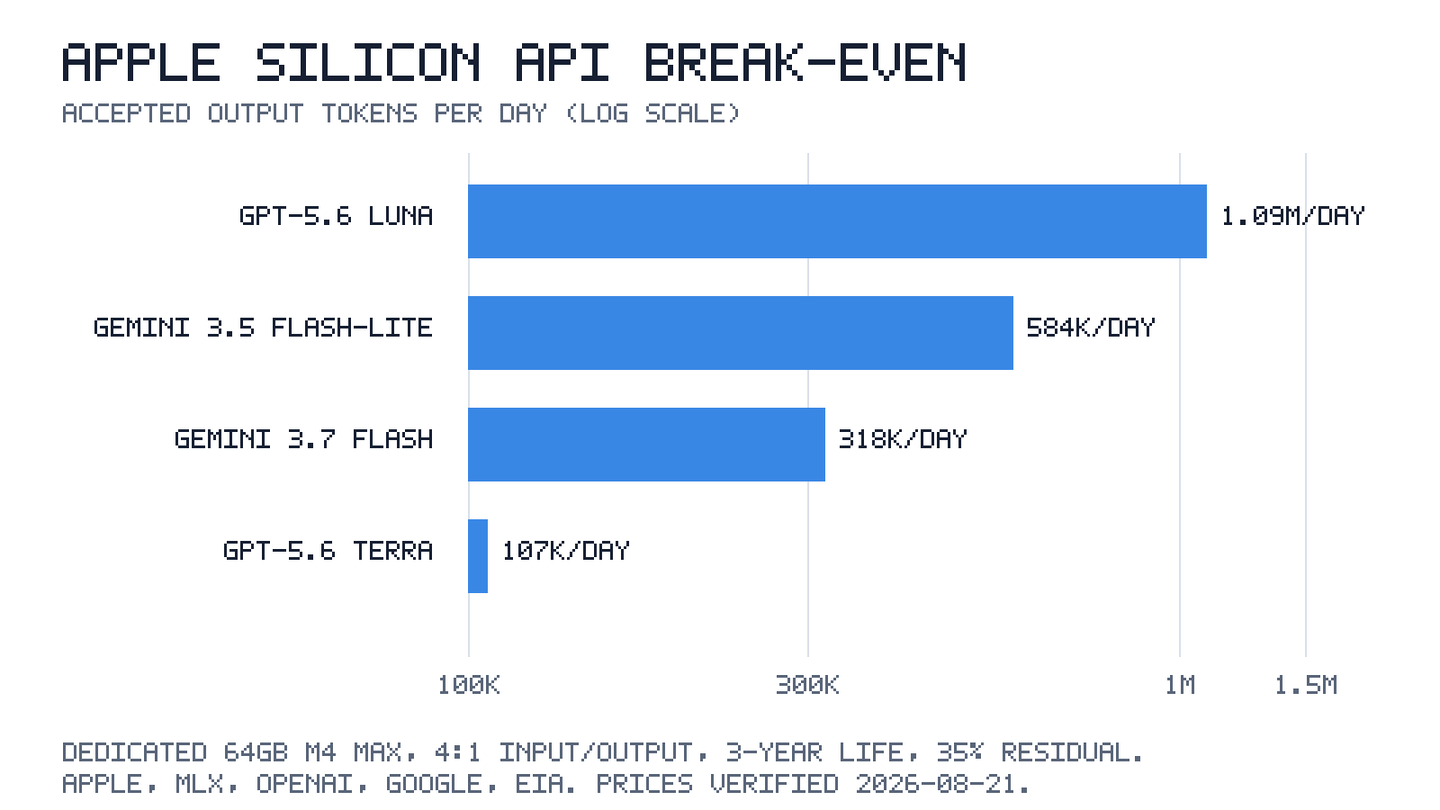
The tenfold spread is the point. “Self-hosting break-even” has no single answer. It moves with the API alternative. Comparing local inference only with a flagship API makes the Mac look profitable at 107k output tokens/day. Comparing it with Luna requires 1.09M/day.
Our earlier cloud GPU self-hosting audit found the same fixed-capacity trap. The hardware sticker matters less than the fraction of paid capacity that produces accepted work.
Residual value moves the answer by 2.5x
The Mac remains an asset. Pretending its month-36 value is zero overstates local cost. Pretending it keeps most of its value understates wear and model obsolescence.
| Residual value after three years | Net capital consumed | Luna break-even output/day |
|---|---|---|
| 0% | $3,499.00 | 1,676,100 |
| 35% | $2,274.35 | 1,093,762 |
| 60% | $1,399.60 | 677,806 |
Use a resale quote if you have one. Otherwise, keep the range. The conclusion survives the uncertainty: a new machine needs sustained six- or seven-figure daily output to beat cheap API tokens.
Quality-driven retries are capacity, not just tokens
The local benchmark reports MMLU Pro, not success on your workload. Suppose only 75% of local outputs meet the same acceptance bar as the API. Each accepted output token then requires 1.333 local output tokens.
The Luna crossover stays near 1.10M accepted tokens/day because electricity is small. Yet the Mac must generate 1.47M raw output tokens/day. Required utilization rises from 14.06% to 18.91%.
This is why cost per token is the wrong final denominator. Measure accepted tasks, schema-valid outputs, human overrides or test passes. Our token efficiency versus task-cost analysis shows how retries can reverse a sticker-price result.
Existing hardware changes the decision
If the suitable Mac already exists and would otherwise sit idle, its purchase cost is sunk for this decision. The incremental local line falls to $0.0528 per bundle in our power model. That is 97.4% below Luna's $2.00 bundle.
Do not turn that marginal result into “local is free.” Someone must patch the runtime, monitor failures, manage disk, protect the endpoint and recover from sleep or reboots. The hardware also has an opportunity cost if inference blocks other work.
The honest tradeoff is privacy and control versus operational burden. Local inference can keep prompts on the device and cap the token invoice. APIs buy elasticity, parallelism, model upgrades and an external service boundary. Choose the constraint you actually need.
Batching and latency can flip the operational verdict
The MLX result is a single published benchmark shape. Batch inference may improve device occupancy, but we have no public batch result for this exact setup. We therefore do not credit a batching multiplier.
Interactive traffic also cares about latency, not daily totals. A device can have spare daily capacity and still queue bursts badly. The relevant engineering check is the throughput-versus-latency tradeoff at your concurrency and context length.
Run three tests before buying:
- Replay representative prompts on the exact local quantization.
- Grade accepted outcomes against the API baseline.
- Load-test p50 and p99 latency at the arrival pattern you expect.
If the local lane clears all three, route steady, privacy-sensitive bulk to it. Keep an API fallback for bursts and tasks that fail the local quality gate. That model routing split avoids forcing one deployment choice onto every request.
Where this model can be wrong
The biggest uncertainty is not electricity. It is workload equivalence. The API model may need fewer output tokens, fewer retries, or less review. The local model may be fully adequate for a narrow classification job and inadequate for code or long-context reasoning.
The throughput receipt also uses a 2,048-token prompt and 128-token generation. Longer contexts can reduce speed. Concurrency can change both throughput and tail latency. The $3,499 Mac price is current, while its month-36 resale value is an assumption.
Treat 1.09M tokens/day as a reproducible boundary for this input table, not a universal purchasing rule.
FAQ
Does a 7.78M-token daily ceiling make this setup suitable for interactive traffic?
No. Daily capacity can hide queues. Interactive suitability depends on time to first token, generation speed under concurrent load and p99 latency. The public MLX run supplies a single benchmark shape, not those service-level measurements.
What happens if the API gets prompt-cache hits?
The API bundle gets cheaper, so the self-hosting crossover moves upward. Our table uses uncached Standard input rates on purpose. Apply the provider's cache-read price only to the prefix that actually repeats. Local prefix reuse could also improve throughput, but this benchmark does not publish that comparison.
Can free solar power make a new Mac win at low volume?
It helps less than the hardware allocation. Removing all electricity would erase $0.72 of monthly idle cost and $0.0528 per bundle. It would not erase the $63.18 monthly capital charge. Power matters at sustained load; depreciation dominates at low utilization.
Should we substitute a cheaper Mac configuration?
Only with a benchmark from that exact chip and memory configuration. The 4-bit model uses 18.20GB in the published run, but fitting in memory does not prove equal throughput. A lower purchase price helps the numerator while a slower generation rate hurts available capacity. Measure both before changing the row.
Sources
- Apple Mac Studio configuration, exact 64GB M4 Max configuration and $3,499 price read 2026-08-21.
- MLX-LM benchmarks, Qwen3-30B-A3B-Instruct-2507 4-bit memory, MMLU Pro, prompt and generation rates read 2026-08-21.
- OpenAI API pricing, GPT-5.6 Luna and Terra Standard short-context rates verified 2026-08-21.
- Google Gemini API pricing, Gemini 3.5 Flash-Lite and Gemini 3.7 Flash Standard rates verified 2026-08-21.
- U.S. Energy Information Administration, Electric Power Monthly, 2026 year-to-date residential electricity price read 2026-08-21.
- Reproducible arithmetic:
artifacts/self-hosting-vs-api-apple-silicon-token-break-even-math.py.
Further reading: Qwen3.6 fidelity-adjusted cost shows how retry rates change self-hosted cost per correct task and separates controlled tool-call failures from illustrative rates.