
Blog · · Updated · By Dhrumil Barot, Founder
The open-weights discount has fine print: GLM 5.2 concurrency, latency and self-hosting break-even
GLM 5.2 is 35% cheaper on OpenRouter than z.ai, and self-hosting beats the API only above ~16M output tokens/day. Break-even math verified 2026-07-15.
GLM 5.2 costs 15-25% of frontier per token, but two facts decide whether you actually pocket that: where you buy it, and whether you self-host. Across ~25 OpenRouter providers the aggregate price is $0.90 in / $2.84 out per 1M tokens, 35% below z.ai's own $1.40 / $4.40. And self-hosting the open weights only beats the API above roughly 16 million output tokens a day per GPU node — a bar most teams never clear. Prices verified 2026-07-15. Here is the math, with every input editable.
TL;DR
- The cheapest GLM 5.2 is not first-party. OpenRouter's ~25-provider aggregate ($0.9044 in / $2.842 out per 1M) is 35% below z.ai's first-party $1.40 / $4.40. On a blended agentic workload that is $1.03/1M against $1.59/1M.
- Self-hosting break-even is high. At a $3/hr GPU node versus z.ai's $4.40/1M output, you must push 16.4M output tokens/day, every day, just to tie the API. Against the cheaper OpenRouter price the bar rises to 25.3M/day.
- That break-even demands serious concurrency. Tying a $3/hr node means sustaining ~189 output tokens/second around the clock — hundreds of tokens/sec, which only large concurrent batches produce. A lightly loaded GPU loses to the API and carries all the ops.
What we computed, and why
The open-weights pitch is seductive: download the weights, run them on your own GPUs, escape the per-token bill. The "AI margin collapse" argument on Hacker News takes it further, noting that a downloadable model matching frontier quality turns the labs' ~90% inference gross margin into a liability. We wanted the boring version of that story: at what point does owning or renting GPUs actually cost less than paying for GLM 5.2 by the token, and how often do teams reach it?
Two decisions sit before "self-host or not," and the first one is free money most people skip: which GLM 5.2 endpoint you buy. We priced both, then built a break-even model for self-hosting with every assumption exposed so you can drop in your own hardware quote. The companion comparison, GLM 5.2 vs Opus 4.8 vs GPT-5.5, covers the per-token discount versus frontier models; this post is about capturing it without lighting money on fire.
Where you buy GLM 5.2 changes the bill by 35%
Same weights, different host, different price. z.ai serves GLM 5.2 first-party; roughly 25 third-party providers also serve it through OpenRouter, and the aggregate comes in materially cheaper.
| Source | Input $/1M | Output $/1M | Blended (agentic 15:1) | Blended (chat 1:1) |
|---|---|---|---|---|
| z.ai first-party | $1.40 | $4.40 | $1.59 | $2.90 |
| OpenRouter aggregate (~25 providers) | $0.9044 | $2.842 | $1.03 | $1.87 |
Prices verified 2026-07-15. The OpenRouter aggregate is 35% below z.ai on both input and output tokens. On an input-heavy agentic shape (15 input tokens per output token) that is a blended $1.03/1M versus $1.59/1M; on a balanced chat shape, $1.87 versus $2.90.
The catch is that "aggregate" hides a spread. Those ~25 providers do not all charge the mean, and they do not all run the model the same way. Price, throughput, context length, and quantization vary provider to provider, so the cheapest listing may cap your context window, throttle throughput, or serve a quantized build that shifts quality. The aggregate is the right number for a budgeting estimate; the specific provider you pin in production is the number that actually bills you. Read the per-provider throughput and context columns before routing volume, and treat first-party z.ai as the quality-and-SLA baseline you are trading against.
Either way, the headline for most teams is this: you can often get GLM 5.2 cheaper than z.ai's own price without touching a GPU. That reframes the self-hosting question — you are not racing the $4.40 output price, you are racing something closer to $2.84.
Self-hosting break-even: the formula, then the table
A GPU node costs the same per hour whether it is flat out or idle. Rent it and you pay the hourly rate; own it and you amortize the capital plus power over its life. Either way it is a fixed cost per hour. The API is the opposite: pure variable cost per token, zero when idle. So self-hosting is a bet that you can keep the node busy enough that its fixed cost, spread over the tokens you push, beats the API's per-token price.
Anchor on output tokens: they are the pricier token and the unit GPU throughput is quoted in. The break-even is one line of arithmetic:
self-host $/output-token = (node $/hr x 24) / (output tokens per day)
beats the API when:  output tokens/day  >  24 x node$/hr / API output price
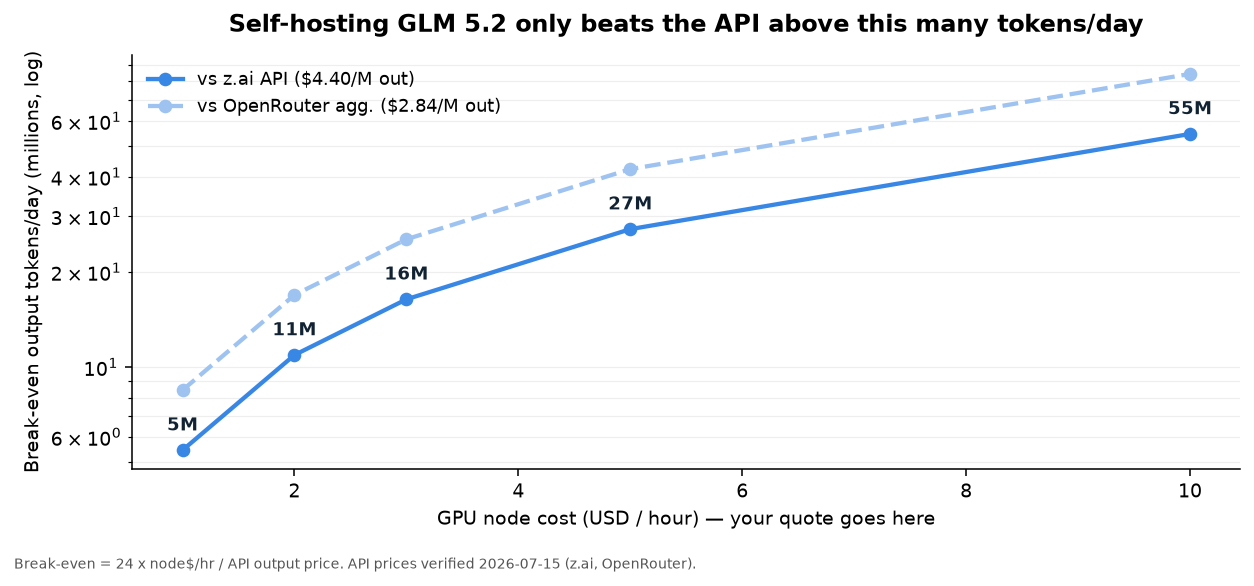
That threshold is the whole story. Below it the API is cheaper and carries zero operations; above it the node's fixed cost amortizes. Here is the break-even output-tokens/day for a range of node prices, against both GLM 5.2 API anchors:
| GPU node $/hr | Break-even vs z.ai ($4.40/1M) | Break-even vs OpenRouter ($2.84/1M) |
|---|---|---|
| $1 | 5.45M tok/day | 8.44M tok/day |
| $2 | 10.91M tok/day | 16.89M tok/day |
| $3 | 16.36M tok/day | 25.33M tok/day |
| $5 | 27.27M tok/day | 42.22M tok/day |
| $10 | 54.55M tok/day | 84.45M tok/day |
Node $/hr is the editable input — plug your own rental or amortized-ownership quote. API prices are live-verified 2026-07-15. The reading is blunt: to beat the cheaper OpenRouter price on a modest $3/hr node, you must generate 25 million output tokens a day, every day, from that one node. Miss the threshold and you paid for a GPU to lose to an API.
The break-even hides a throughput problem
Tokens per day is an abstraction; the physical constraint is tokens per second sustained. Convert the break-even and the difficulty shows up:
| GPU node $/hr | Sustained output tok/s to tie z.ai |
|---|---|
| $1 | 63 tok/s |
| $3 | 189 tok/s |
| $5 | 316 tok/s |
A single mid-tier GPU serving one request at a time produces roughly 30-80 output tokens/second on a model this size. Reaching 189 or 316 tokens/second sustained means running large concurrent batches — many simultaneous requests packed onto the card so its compute stays saturated. That is achievable in a high-traffic production service and close to impossible for bursty or low-concurrency workloads. The break-even table assumes you can keep the node fed 24 hours a day; a service that is busy for eight hours and quiet for sixteen effectively triples its real break-even.
The utilization form makes the sensitivity explicit. For a capable batched node sustaining 289 tokens/second at a $3/hr cost, break-even utilization against z.ai is 66%: keep it that busy and self-hosting wins, drop below and the API is cheaper. This is where the hardware argument re-enters. martinalderson's margin-collapse post reports AMD accelerators delivering roughly 2.75x more tokens per dollar than Nvidia Blackwell on GLM-class inference. Take that at face value as one editable input and the break-even utilization on the same node falls from 66% to 24% — a very different proposition, and the strongest case for self-hosting on the table. We cite it rather than endorse it: it is a public claim, not a figure we reproduced, and your throughput per dollar depends on your exact silicon, quantization, and serving stack.
The same denominator problem appears in our audit of Neon and Castform's 100x-cheaper retrieval claim: GPU dollars per hour become dollars per request only after measured throughput and utilization enter the equation.
What it means for routing
For the large majority of teams, the sequence is: use the API, shop the provider, skip the GPUs.
- Default to the API, and shop it. The OpenRouter aggregate is 35% under z.ai. Capture that before you consider anything else, and pin a provider whose throughput and context length match your workload rather than chasing the lowest sticker. Prompt caching compounds the win on repeated prefixes; GLM 5.2's cached input is $0.26/1M first-party, and a cache hit on a stable agentic prefix removes most of the input cost regardless of who hosts it.
- Self-host only past the threshold, with eyes open. If you genuinely push tens of millions of output tokens a day at high, steady concurrency, self-hosting can win — especially on cheaper-per-token hardware. Budget for the ops it adds: on-call, model updates, eval pipelines, capacity headroom, and the residual-value and power assumptions baked into your amortized $/hr.
- Right-size before you re-platform. The biggest lever is usually not self-hosting; it is sending the easy majority of calls to GLM 5.2 and reserving a frontier model for the hard minority. That right-sizing and model routing move captures most of the open-weights discount with none of the GPU operations. Our router savings audit shows how much of the advertised saving actually survives contact with a real workload.
If you want to see where your own token volume lands against these break-even lines, drop your tokens/day and node cost into the calculator before you sign a GPU lease.
Caveats, and where this model is deliberately simple
- Output-only anchor. We priced break-even on output tokens because that is the constrained resource and the unit throughput is quoted in. A full model bills input too; on input-heavy agentic loops the self-host case is a little stronger than the output-only table shows, because you also avoid paying input tokens. The direction of the conclusion does not change.
- Node $/hr is a placeholder, on purpose. We did not assert a specific 2026 GPU rental price, because it moves weekly and depends on region, commitment, and hardware generation. The table is a function of your quote; the arithmetic is fixed, the input is yours.
- The AMD 2.75x figure is cited, not reproduced. It comes from a public post and materially improves the self-host case. Treat it as one editable input and measure your own tokens-per-dollar before betting on it.
- Aggregate hides variance. The OpenRouter number is a mean across providers with real differences in throughput, context, and quantization. Budget with the aggregate; bill with the specific provider you pin.
- Quality is not priced here. This post is about cost to serve GLM 5.2, not whether GLM 5.2 clears your quality bar. That question belongs in the comparison against Opus 4.8 and GPT-5.5.
Sources
- z.ai GLM-5.2 pricing (input $1.40, cached input $0.26, output $4.40 per 1M), verified 2026-07-15: https://docs.z.ai/guides/overview/pricing
- OpenRouter GLM-5.2 aggregate ($0.9044 in / $2.842 out per 1M across ~25 providers), verified 2026-07-15: https://openrouter.ai/z-ai/glm-5.2
- Community context and the AMD 2.75x-per-token claim (cited input, not reproduced): "GLM 5.2 and the coming AI margin collapse", HN 693 points / 469 comments, 2026-07: https://martinalderson.com/posts/the-upcoming-ai-margin-collapse-part-1-glm-5-2/
- Break-even math script: reproducible from the formula and assumptions above.
Prices change. We re-verify every figure in this post monthly and stamp updates. Numbers are current as of 2026-07-15.
Want to know whether your workload clears the self-hosting break-even, or whether the API wins? Vynaris is an OpenAI-compatible gateway that routes each request to the cheapest right-sized model and shows the per-request cost. One base URL swap. Get an API key at vynaris.com.