
Blog · · By Dhrumil Barot, Founder
OpenTelemetry LLM Tracing: Spans, Tokens and Cost in Python
OpenTelemetry LLM tracing in Python: instrument OpenAI-style calls with GenAI semantic conventions, record tokens and cost per request. Tested 2026-11-22.
TL;DR: Install opentelemetry-instrumentation-openai-v2, call OpenAIInstrumentor().instrument(), and every chat call becomes a chat <model> span with gen_ai.usage.input_tokens and gen_ai.usage.output_tokens. Token counts are not dollars, so add a cost attribute yourself: computed from a price table, or read from the x-vynaris-cost-usd header if you call models through Vynaris. We ran every snippet below on 2026-11-22; one dependency pin is needed today, and it is in step 1.
Try it: point the same instrumented OpenAI client at https://api.vynaris.com/v1 and each span can carry the exact cost of the request that produced it. Get a Vynaris API key.
OpenTelemetry LLM tracing means recording each model call as a span that follows the OpenTelemetry GenAI semantic conventions: span name {gen_ai.operation.name} {gen_ai.request.model}, span kind CLIENT, required attributes gen_ai.operation.name and gen_ai.provider.name, and token usage in gen_ai.usage.*. Any OTLP backend (Jaeger, Grafana Tempo, Honeycomb, Datadog) can then show latency, tokens and cost per call next to the rest of your traces. Two things changed in 2026 that most guides miss: the GenAI conventions moved to their own repository, open-telemetry/semantic-conventions-genai, in May 2026, and the newest opentelemetry-util-genai releases break the current OpenAI instrumentation, so you need a pin.
What are the OpenTelemetry GenAI semantic conventions?
The OpenTelemetry GenAI semantic conventions are the agreed attribute names for spans, metrics and events that describe calls to generative AI models. Every attribute is still marked Development, so names can change between releases. The old pages in the main semantic-conventions repository now say they are "no longer maintained in this repository".
These are the attributes an inference span carries, from client-inference.md:
| Attribute | Requirement | Example |
|---|---|---|
| gen_ai.operation.name | Required | chat, generate_content |
| gen_ai.provider.name | Required | openai, gcp.vertex_ai |
| gen_ai.request.model | Conditionally required | gpt-6.2-sol |
| gen_ai.response.model | Recommended | model that actually answered |
| gen_ai.usage.input_tokens | Recommended | 3000 (includes cached tokens) |
| gen_ai.usage.output_tokens | Recommended | 500 |
| gen_ai.usage.cache_read.input_tokens | Recommended when non-zero | 2500 |
| gen_ai.usage.reasoning.output_tokens | Recommended when non-zero | 120 |
| gen_ai.input.messages | Opt-In | the prompt, as structured parts |
There is no cost attribute in the conventions. That gap is what step 5 fills.
What you need
- Python 3.10 or later (the instrumentation requires it).
openai2.x. We tested 2.54.0; the 3.x SDK uses a different HTTP library.opentelemetry-sdk1.45.2 andopentelemetry-exporter-otlp-proto-http1.45.2.opentelemetry-instrumentation-openai-v22.4b0 (released 2026-05-01) withopentelemetry-util-genai0.4b0.- An OTLP endpoint, or nothing at all if you start with the console exporter.
How do I trace LLM calls with OpenTelemetry in Python?
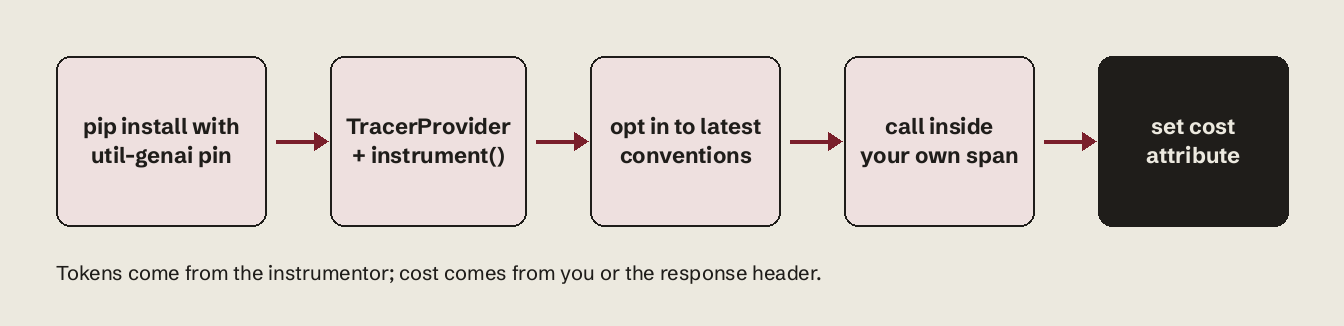
Five steps, each verified with a run on 2026-11-22.
Step 1: Install the packages with the working pin
pip install "openai<3" httpx opentelemetry-sdk opentelemetry-exporter-otlp-proto-http \
  opentelemetry-instrumentation-openai-v2 "opentelemetry-util-genai==0.4b0"
Without the last pin, pip installs opentelemetry-util-genai 1.3b0 (2026-10-23), and the import fails with ModuleNotFoundError: No module named 'opentelemetry.util.genai.instruments'. We hit the same error with 1.2b0. Version 0.4b0, released the same day as the instrumentation, works.
Step 2: Set up a tracer provider and the instrumentor
from opentelemetry import trace
from opentelemetry.sdk.trace import TracerProvider
from opentelemetry.sdk.trace.export import BatchSpanProcessor, ConsoleSpanExporter
from opentelemetry.instrumentation.openai_v2 import OpenAIInstrumentor

provider = TracerProvider()
provider.add_span_processor(BatchSpanProcessor(ConsoleSpanExporter()))
trace.set_tracer_provider(provider)

OpenAIInstrumentor().instrument()
Call instrument() before you create the client. It patches the OpenAI SDK, so any client, including one pointed at another OpenAI-compatible base URL, is traced.
Step 3: Turn on the current conventions
export OTEL_SEMCONV_STABILITY_OPT_IN=gen_ai_latest_experimentalWithout it, the span carries the older gen_ai.system: openai. With it, we got gen_ai.provider.name: openai, the attribute the current conventions require. If you already use this variable for other opt-ins, append ,gen_ai_latest_experimental.
Step 4: Make a call inside your own span
from openai import OpenAI

client = OpenAI(base_url="https://api.vynaris.com/v1", api_key="VYNARIS_KEY")
tracer = trace.get_tracer("support-bot")

with tracer.start_as_current_span("support.reply") as span:
    raw = client.chat.completions.with_raw_response.create(
        model="gpt-6.2-sol",
        messages=[{"role": "user", "content": "Summarise this ticket: ..."}],
    )
    resp = raw.parse()
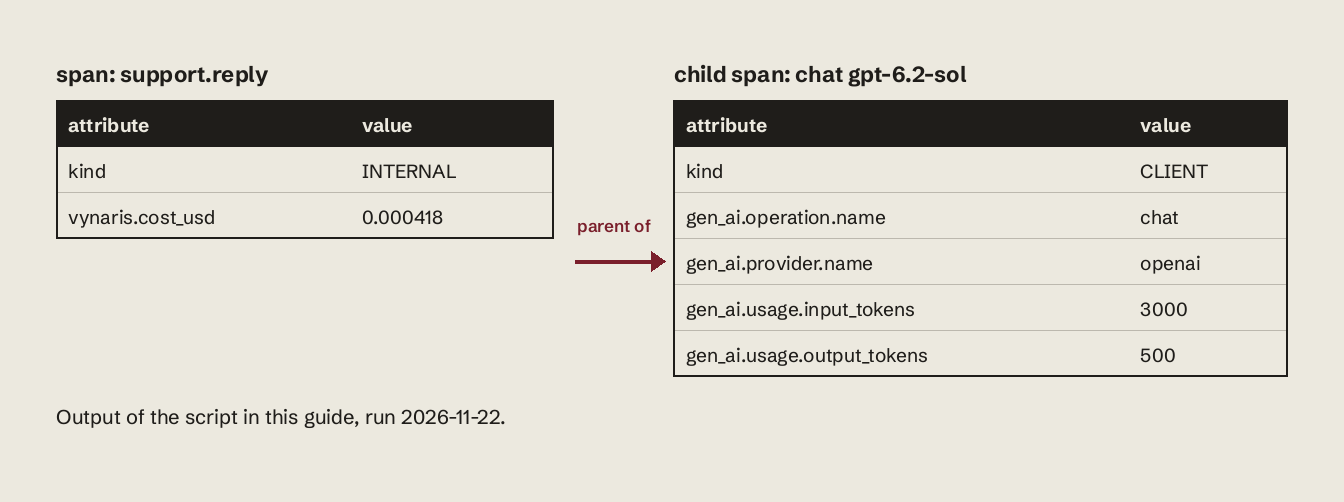
The instrumentor creates a child span named chat gpt-6.2-sol with kind CLIENT, and in our run it set gen_ai.request.model, gen_ai.response.model, gen_ai.response.id, gen_ai.response.finish_reasons, gen_ai.usage.input_tokens: 3000 and gen_ai.usage.output_tokens: 500. with_raw_response keeps the HTTP headers, which step 5 uses.
Step 5: Record the cost on the span
How do I record token usage and cost on each span? Tokens are already there from step 4. For cost you have two options.
Option A, compute it from a price table you maintain:
# USD per 1M tokens, Standard tier, verified 2026-11-22
PRICES = {"gpt-6.2-sol": (2.00, 10.00), "claude-sonnet-5.5": (2.00, 10.00), "gemini-3.8-flash": (0.75, 3.75)}

inp, out = PRICES[resp.model]
cost = (resp.usage.prompt_tokens * inp + resp.usage.completion_tokens * out) / 1_000_000
span.set_attribute("app.llm.cost_usd", cost)
For 3,000 input and 500 output tokens on gpt-6.2-sol that is (3,000 x $2 + 500 x $10) / 1,000,000 = $0.011. The catch: cached tokens, batch discounts and price changes all make this number drift from your invoice. Google's Gemini 3.8 Flash price, for example, doubles on 2027-01-01.
Option B, read the billed cost from the response. Vynaris returns it on every response as headers, documented in the Vynaris docs: x-vynaris-request-id, x-vynaris-served-model, x-vynaris-cost-usd, x-vynaris-baseline-usd and x-vynaris-saved.
span.set_attribute("vynaris.cost_usd", float(raw.headers["x-vynaris-cost-usd"]))
span.set_attribute("vynaris.served_model", raw.headers["x-vynaris-served-model"])
span.set_attribute("vynaris.request_id", raw.headers["x-vynaris-request-id"])
This is the charge for that request, so your traces add up to your ledger without a price table to maintain. Use your own namespace (app. or vynaris.) for these: the gen_ai. prefix is reserved for the conventions.
Export to a backend
Swap the console exporter for OTLP and set the endpoint:
from opentelemetry.sdk.resources import Resource
from opentelemetry.exporter.otlp.proto.http.trace_exporter import OTLPSpanExporter

provider = TracerProvider(resource=Resource.create({"service.name": "support-bot"}))
provider.add_span_processor(BatchSpanProcessor(OTLPSpanExporter()))
export OTEL_EXPORTER_OTLP_ENDPOINT=http://localhost:4318Datadog LLM Observability, for one, says it accepts spans that follow GenAI conventions from OpenTelemetry 1.37 onward (Datadog docs). Group by gen_ai.request.model and sum your cost attribute to get spend per model.
How to verify it worked
- Run the script with the console exporter. You should see two spans:
support.reply(INTERNAL) andchat gpt-6.2-sol(CLIENT). - Check the child span has
gen_ai.usage.input_tokensandgen_ai.usage.output_tokensthat matchresp.usage. - Check the parent span has your cost attribute and it is not 0.
- With the opt-in set, check for
gen_ai.provider.nameinstead ofgen_ai.system.
Should prompts and completions be captured in traces?
Not by default, and the instrumentation agrees: message content is off unless you set OTEL_INSTRUMENTATION_GENAI_CAPTURE_MESSAGE_CONTENT. With the latest conventions on, the values are span_only, event_only or span_and_event; true is the legacy value. Prompts often hold customer data, so turning this on copies that data into your tracing backend with its own retention and access rules.
A middle path from the same package: OTEL_INSTRUMENTATION_GENAI_COMPLETION_HOOK=upload with OTEL_INSTRUMENTATION_GENAI_UPLOAD_BASE_PATH set to a bucket (needs pip install "opentelemetry-util-genai[upload]"). Content goes to storage you control, and the span keeps a reference (gen_ai.input.messages_ref).
Common errors and fixes
| Error | Cause | Fix |
|---|---|---|
| No module named 'opentelemetry.util.genai.instruments' | util-genai 1.x installed | pin opentelemetry-util-genai==0.4b0 |
| No module named 'httpx' on import | openai 3.x installed, which no longer ships httpx | use openai<3 and install httpx |
| Span shows gen_ai.system, not gen_ai.provider.name | old conventions are the default | set OTEL_SEMCONV_STABILITY_OPT_IN=gen_ai_latest_experimental |
| No spans at all | instrument() ran after the client was built, or no tracer provider set | instrument first, set the provider before any call |
FAQ
Does OpenTelemetry record LLM cost?
No. The GenAI conventions record tokens, not money. Add a cost attribute in your own namespace, computed from prices or taken from a gateway response header.
Does this work with Claude or Gemini?
The OpenAI instrumentation traces any call made through the OpenAI SDK. Through Vynaris, Claude and Gemini models answer on the same OpenAI-compatible endpoint, so the same spans appear. Note that gen_ai.provider.name then reads openai, because it names the client, not the model maker.
Are the GenAI semantic conventions stable?
No. Every attribute is marked Development as of 2026-11-22, which is why the opt-in variable exists.
What is the difference between spans and the GenAI metrics?
Spans describe one call. Metrics such as gen_ai.client.operation.duration (a histogram in seconds) and the token-usage metrics aggregate across calls, which is cheaper for dashboards. See the GenAI metrics spec.
For the money side, see how to track LLM API costs, the Claude Code gateway guide and our OpenAI-compatible API providers list.
Put the real cost on every span
Token counts tell you how much a call used; the cost header tells you what it billed. Point your instrumented client at Vynaris and both land on the same trace. Get your Vynaris API key.