
Blog · 2026-07-29 · Vynaris Team
What a KYC/KYB onboarding agent costs per applicant: the 10% escalation floor, not the 48x model spread
A KYC/KYB onboarding agent costs $0.75-$0.85 per applicant across 6 models. The 10% human-escalation floor, not the 48x model spread, sets the bill.
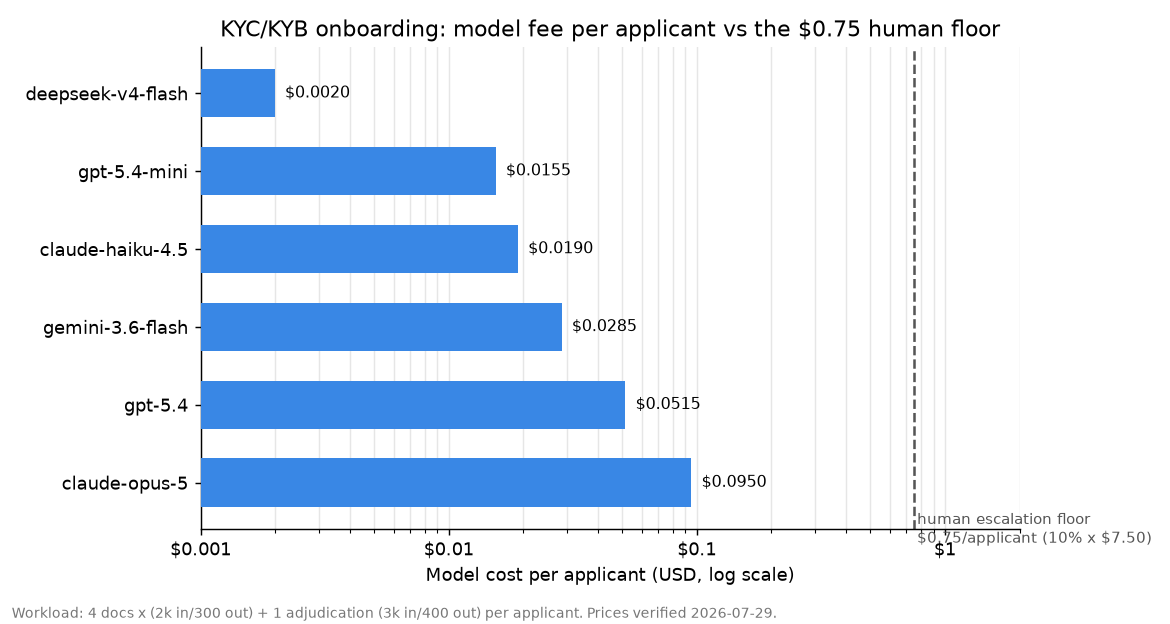
A KYC/KYB onboarding agent costs $0.75 to $0.85 per applicant onboarded across six models, a 1.12x spread, even though the models themselves span 48x, from $0.0020 to $0.095. Prices verified 2026-07-29. The reason the total barely moves: a 10% manual-escalation floor at $7.50 per reviewed case dominates every model fee. This is a reproducible model you can re-run with your own document count and escalation rate.
TL;DR
- Model fees run $0.0020 (deepseek-v4-flash) to $0.095 (claude-opus-5) per applicant, a 47.8x spread, but that entire spread is 0.3% to 11% of the bill.
- Add a 10% human-escalation floor at $7.50 per case and the total lands at $0.75 to $0.85 per applicant: a 1.12x spread. The compliance analyst, not the model, is the bill.
- The one place model choice pays: a more accurate adjudicator that cuts escalation by 1.24 percentage points pays for the entire jump from the cheapest model to Opus 5.
The workload (edit these)
One applicant onboarded is the outcome unit: you take an entity, extract its documents, adjudicate the results into an approve/refer/deny decision, and escalate the hard cases to a human. Unlike a single-document extraction job, KYC and KYB are multi-document per entity, and there is a decision call at the end that reads all the extractions together.
Assumption               Value                     Note
-----------------------  ------------------------  -----------------------------------------------------------------------------------------------
Documents per applicant  4                         passport, proof of address, registration, UBO filing
Extraction per doc       2,000 input / 300 output  one [function calling](https://vynaris.com/glossary/function-calling) pass to structured fields
Adjudication call        3,000 input / 400 output  combines the 4 extractions plus policy rules into a decision
Manual escalation rate   10%                       share of applicants a human analyst reviews
Human review             $7.50 / escalated case    $30/hr loaded analyst x 15 minutes
That gives 11,000 input and 1,600 output tokens per applicant on the model side, plus a $0.75-per-applicant human line once you amortize the 10% escalation over every applicant ($7.50 x 0.10). Every number here is yours to change.
The verdict, per applicant onboarded
Model                                                              Model fee  Total incl. 10% escalation  Model as % of bill
-----------------------------------------------------------------  ---------  --------------------------  ------------------
[deepseek-v4-flash](https://vynaris.com/models#deepseek-v4-flash)  $0.0020    $0.7520                     0.3%
[gpt-5.4-mini](https://vynaris.com/models#gpt-5-4-mini)            $0.0155    $0.7654                     2.0%
[claude-haiku-4.5](https://vynaris.com/models#claude-haiku-4-5)    $0.0190    $0.7690                     2.5%
[gemini-3.6-flash](https://vynaris.com/models#gemini-3-6-flash)    $0.0285    $0.7785                     3.7%
[gpt-5.4](https://vynaris.com/models#gpt-5-4)                      $0.0515    $0.8015                     6.4%
[claude-opus-5](https://vynaris.com/models#claude-opus-5)          $0.0950    $0.8450                     11.2%
The model line spans 47.8x. The total spans 1.12x. Switching from the most expensive model to the cheapest saves $0.093 per applicant while the human floor costs $0.75 on every one of them. Prices verified 2026-07-29.
Why the multi-doc shape is not the extraction workload you already priced
A single-invoice extraction job bills as one document in, one JSON object out, and the cost scales with document count. We priced that shape in the invoice extraction playbook, where the model was 1% to 9% of the bill and human exception review was the driver. KYC keeps that human-dominated shape but adds two things that invoice extraction does not have.
First, the cost per outcome is N_docs x extract + 1 x adjudicate + escalation_rate x human, not a flat per-document rate. Four documents plus one adjudication call is 11,000 input tokens against 1,600 out. Take the documents per applicant from four to eight and the model line rises from $0.019 to $0.033 on claude-haiku-4.5, while the total moves from $0.769 to $0.783: a 1.8% change. The document count is a lever on the model line and almost nothing on the bill.
Second, the adjudication call is where the context window fills. It re-reads all four structured extractions plus your policy rules to produce one decision. That is the call that decides whether an applicant clears automatically or goes to a human, which is the only decision in this pipeline that touches the number that matters.
The escalation floor is the bill
Run the arithmetic and the shape is stark. On claude-haiku-4.5 the model does the extraction and adjudication for $0.019 per applicant. The 10% who escalate cost $7.50 each in analyst time, which is $0.75 spread across every applicant. The human line is 39x the model line. Move to deepseek-v4-flash and the model drops to $0.002 while the human line stays at $0.75; the human is now 377x the model.
This is the same lesson the RAG support agent playbook reached from a different direction: when a human sits behind a fraction of the outcomes, their loaded cost sets the unit economics and the model tier is rounding. In KYC the fraction is your escalation rate, and the human is a compliance analyst whose time is expensive because the decision is regulated. The healthcare claims packet playbook prices the stricter sibling workload: 100% review plus a 50% Batch discount.
The one lever where model choice wins: escalation deflection
Here is where a more expensive model can lower your total, and it is not through cheaper tokens. It is through a better decision. If a stronger adjudicator makes a confident, correct call on more applicants, fewer go to a human, and the human line falls.
Each 1 percentage point of escalation you remove is worth $0.075 per applicant ($7.50 x 0.01). Compare that to the entire token premium of the most expensive model over the cheapest: $0.095 minus $0.002 is $0.093, which is 1.24 percentage points of escalation. So claude-opus-5 pays for its whole 48x token premium the moment its adjudication holds escalation at 8.76% instead of 10%, a drop of 1.24 points. If Opus holds escalation at 6% while deepseek-v4-flash runs at 10%, the totals are $0.545 versus $0.752, a 27.5% lower bill from the more expensive model.
The catch is that this only works if the adjudicator's confidence is calibrated. A model that escalates less because it hallucinates a clear decision on ambiguous applicants does not save you money; it moves the cost from an analyst's hour to a compliance failure, which is far more expensive than either. Measure the escalation reduction against a labeled set of known-hard applicants, not against the invoice.
Where routing changes the unit economics
The structure gives you a clean split. Extraction is mechanical: read a passport, emit fields. Adjudication is the judgment call that sets escalation. So route them separately.
Put the four extractions on deepseek-v4-flash at $0.0015 for all four, and the single adjudication call on claude-opus-5 at $0.025. The split model line is $0.0265 per applicant, 72% below the all-Opus model line of $0.095, while keeping the frontier adjudicator on the call that decides your escalation rate. You spend where the decision is and save where it is mechanical.
Fold in escalation and the routing pays twice. Split routing with the frontier adjudicator holding escalation at 6% totals $0.4765 per applicant, against $0.752 for an all-deepseek pipeline stuck at 10% escalation: 36.6% lower. You can pre-fill the per-applicant token shape in the calculator to see the split on your own document count.
The data-residency surcharge stacks, but it is small here
KYC is regulated, so many teams pin inference to a region. Anthropic charges a 1.1x multiplier on all token categories for US-only inference on Claude 4.6 and later models, and OpenAI has carried a comparable roughly 10% data residency surcharge since March 2026. We covered how these multipliers compound in the price multipliers post.
The surcharge lands on the token line only. On claude-opus-5 that turns $0.095 into $0.1045, up $0.0095. Because the token line is at most 11% of the applicant bill, a 10% surcharge on it moves the total by at most 1.2%. Residency is a real line item and you should budget it, but it does not reorder the table and it will never rival the human floor.
When this workload does not need a router
The honest tradeoff: if your escalation rate is set by policy rather than by model confidence, do not route and do not reach for a frontier model. Many KYC programs mandate human review for every applicant from a high-risk jurisdiction, or for every business above a revenue threshold, regardless of how confident the model is. When the escalation floor is a compliance rule, no adjudicator can lower it, the $0.75 line is fixed, and the cheapest competent extractor plus a cheap adjudicator is the correct answer. Run deepseek-v4-flash or claude-haiku-4.5 end to end and put your effort into the analyst workflow, because that is the bill.
Routing and a stronger adjudicator only pay when your escalation rate is discretionary, meaning the model's confidence actually decides who gets reviewed. Confirm which regime you are in before you optimize. Caching the static policy-and-schema prefix, which unlike a retrieval workload does repeat every applicant, cuts the model line about 22% through prompt caching, but 22% of an 11% line is a 1% total saving. Take it, do not architect around it.
Build notes
- Adjudication is the call to spend on. It sets your escalation rate, and escalation is 89% to 99% of the bill. Give it the better model and the full policy context; economize on the extraction passes.
- Watch documents per applicant, not per token. KYB entities can carry a dozen filings, but even at 8 documents the model line stays under 5% of the applicant bill. Doc-count optimization is not where the money is.
- Calibrate escalation, then measure it. A model that escalates less is only cheaper if it is correct on the applicants it clears. Track the false-clear rate on a labeled hard set; a single missed high-risk applicant costs more than a year of analyst hours.
FAQ
What does a KYC/KYB onboarding agent cost per applicant? In model fees, $0.0020 (deepseek-v4-flash) to $0.095 (claude-opus-5) per applicant, on a workload of 4 documents at 2,000 input / 300 output each plus one 3,000 / 400 adjudication call. Add a 10% human-escalation floor at $7.50 per case and the total is $0.75 to $0.85 per applicant. Prices verified 2026-07-29.
Why is the total spread only 1.12x when models span 48x? Because the human escalation line, $0.75 per applicant, dwarfs every model fee. The most expensive model is $0.095 and the cheapest is $0.002, a $0.093 gap that is small next to a $0.75 fixed human cost.
When is a more expensive model worth it? When its adjudication cuts your escalation rate. Each 1 percentage point of escalation removed is worth $0.075 per applicant, and the full premium of claude-opus-5 over deepseek-v4-flash equals 1.24 points. If the frontier model holds escalation 1.24 points lower, it is free; below that, it lowers the total.
Should I route extraction and adjudication separately? Usually yes, if escalation is discretionary. Extraction on deepseek-v4-flash plus adjudication on claude-opus-5 is $0.0265 on the model line, 72% below all-Opus, while keeping the frontier model on the call that sets escalation.
Does data residency change the answer? It adds about 10% to the token line for regulated US-only inference. Since the token line is at most 11% of the bill, that is at most a 1.2% change to the total. Budget it, but it does not reorder the models.
Sources
- Anthropic pricing (claude-opus-5 $5/$25, claude-haiku-4.5 $1/$5, cache read 0.1x, data-residency 1.1x for Claude 4.6+), captured 2026-07-29: https://platform.claude.com/docs/en/about-claude/pricing
- OpenAI API pricing (gpt-5.4 $2.50/$15, gpt-5.4-mini $0.75/$4.50), captured 2026-07-29: https://developers.openai.com/api/docs/pricing
- Google Gemini API pricing (gemini-3.6-flash $1.50/$7.50), captured 2026-07-29: https://ai.google.dev/gemini-api/docs/pricing
- DeepSeek API pricing (deepseek-v4-flash $0.14 in / $0.28 out), captured 2026-07-29: https://api-docs.deepseek.com/quick_start/pricing
- Cost model script and per-applicant arithmetic: from the assumptions table above.
Prices change. We re-verify every figure in this post monthly and stamp updates. Numbers here are current as of 2026-07-29.
The lesson from the model: a KYC/KYB onboarding bill is set by the human on the escalation, not the model on the tokens. The model spread is 48x and it moves the total 12%. Spend your model budget on the adjudicator that lowers escalation, route the extraction to the floor, and put the rest into the analyst queue that actually costs the money. Vynaris is an OpenAI-compatible gateway that routes per call, caches the static policy prefix, and shows the per-applicant cost so you watch the number that matters. One base URL swap. Get an API key at vynaris.com.