
Blog · 2026-08-05 · Vynaris Team
Healthcare Claims AI Cost: $34 to $343 per 1,000 Claim Packets with Batch
Batch inference costs $34-$343 per 1,000 claim packets, but six minutes of human review pushes the total to $4,034-$4,343.
A two-pass healthcare claims agent costs $34.25 to $342.50 per 1,000 claim packets across four Claude models with the Batch API. Add six minutes of human review at an assumed $40/hour, and the total tightens to $4,034 to $4,343. The model spread is 10x. The reviewed-outcome spread is 1.08x. Prices verified 2026-08-05.
TL;DR
- One claim packet uses 61,000 input and 1,500 output tokens across extraction and checklist passes. These are editable workload assumptions, not observed production data.
- Anthropic's Batch API halves every model line. The resulting cost is $0.03425 on Claude Haiku 4.5, $0.06850 on Claude Sonnet 5, $0.17125 on Claude Opus 5, and $0.34250 on Claude Fable 5.
- Six minutes of 100% human review at $40/hour adds $4.00 per packet. The model becomes 0.85% to 7.89% of the reviewed outcome.
- Put the extraction pass on Haiku and the checklist pass on Opus for $0.10125 per packet. That is 70.4% below all-Opus model cost while keeping the stronger model on the judgment step.
The workload model
One outcome is a reviewed claim or prior-authorization packet. The pipeline reads the packet twice for two different jobs.
The extraction pass reads 30,000 input tokens and emits 1,000 output tokens of structured fields. The checklist pass reads the original 30,000-token packet plus that 1,000-token extraction, then emits 500 tokens of missing-field, inconsistency, and follow-up flags.
Assumption            Value                  Why it is here
--------------------  ---------------------  ---------------------------------------------
Packet input          30,000 tokens          Illustrative multi-document claim packet
Extraction output     1,000 tokens           Structured claim and authorization fields
Checklist input       31,000 tokens          Original packet plus extracted fields
Checklist output      500 tokens             Exceptions and follow-up actions
Total model workload  61,000 in / 1,500 out  Two passes per packet
Human review          100%                   Explicit safety and operations assumption
Review time           6 minutes              Editable assumption
Loaded reviewer cost  $40/hour               Editable assumption
Processing mode       Batch                  Work can wait for the batch completion window
The public demand signal supports the shape, not the counts. Cenote's founders describe referral intake that combines OCR, LLM extraction, insurance verification, and a human when needed. We use a stricter 100% review assumption because this model prices a back-office assistant, not autonomous claim adjudication. No private claim data enters the calculation.
Verdict: cost per reviewed claim packet
Model                                                            Standard model cost  Batch model cost  Human review  Total with Batch  Model share
---------------------------------------------------------------  -------------------  ----------------  ------------  ----------------  -----------
[Claude Haiku 4.5](https://vynaris.com/models#claude-haiku-4-5)  $0.06850             $0.03425          $4.00         $4.03425          0.85%
[Claude Sonnet 5](https://vynaris.com/models#claude-sonnet-5)    $0.13700             $0.06850          $4.00         $4.06850          1.68%
[Claude Opus 5](https://vynaris.com/models#claude-opus-5)        $0.34250             $0.17125          $4.00         $4.17125          4.11%
[Claude Fable 5](https://vynaris.com/models#claude-fable-5)      $0.68500             $0.34250          $4.00         $4.34250          7.89%
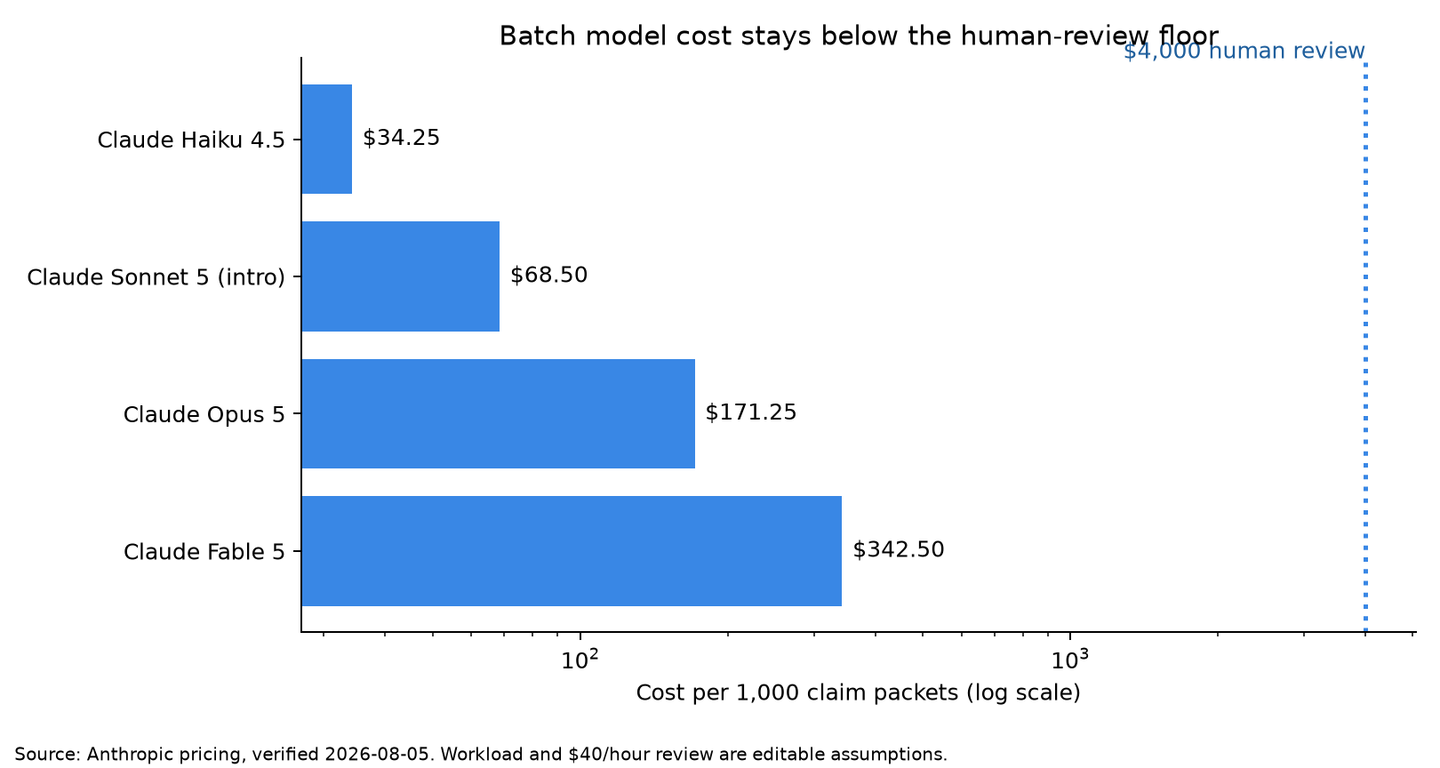
The per-1,000 outcome is easier to budget. Batch inference is $34.25 on Haiku, $68.50 on Sonnet, $171.25 on Opus, or $342.50 on Fable. Human review is $4,000 on the same volume. The human line is 11.7x larger than even Fable and 116.8x larger than Haiku.
This is the finding that matters: a 10x model-price spread moves the reviewed outcome by 7.6%. A reviewer minute moves it by $0.6667 per packet, almost twenty Haiku batch bills.
The arithmetic, one packet at a time
Anthropic lists standard prices per million tokens and a 50% Message Batches discount. The discount applies to input, output, and special tokens. We use no prompt caching in the base case because most of the 30,000-token packet is unique to one claim.
For Haiku, the standard calculation is:
61,000 x $1 input / 1,000,000 = $0.06100
 1,500 x $5 output / 1,000,000 = $0.00750
standard model cost                = $0.06850
Batch model cost, 50%              = $0.03425
human review, 6/60 x $40           = $4.00000
reviewed outcome                   = $4.03425
Fable uses $10 input and $50 output, exactly ten times the Haiku rates. Its Batch line is therefore $0.34250. The human line does not care which model ran first.
Use the calculator here to replace 61,000/1,500 with your packet distribution. Do not use a single average if packets range from a two-page claim to a hundred-page clinical record. Price percentiles separately.
Why Batch is the first lever
This workload is back-office and queueable. That makes batch processing a natural fit. The API cuts the model line 50% without changing the prompt, output, or chosen model.
At 1,000 packets, Batch saves $34.25 on Haiku, $68.50 on Sonnet, $171.25 on Opus, or $342.50 on Fable. Those are real dollars with no quality trade. They remain smaller than the $4,000 review line.
The operational catch is latency. Message Batches are asynchronous and can take up to the documented completion window. A prior authorization that must go out during the current shift may not tolerate that delay. Split queues by deadline. Batch the overnight and non-urgent backlog; keep same-shift exceptions on the standard API. We compare that decision across providers in the Batch API cost guide.
Route extraction and judgment separately
The two passes do not require the same model.
Extraction is constrained: read fields, normalize them, and emit structured outputs. The checklist pass must reason across the whole packet and decide what needs attention. That is the sensible place to pay for a stronger model.
Run extraction on Haiku Batch and checklist on Opus Batch:
Pass                      Model             Batch cost
------------------------  ----------------  ----------
Extract: 30k in / 1k out  Claude Haiku 4.5  $0.01750
Check: 31k in / 500 out   Claude Opus 5     $0.08375
Routed total                                $0.10125
All-Opus costs $0.34250. Routing saves $0.24125, or 70.4%, on the model line. All-Haiku remains cheaper at $0.03425, so the routed version only wins if Opus improves the checklist enough to save reviewer time or catch more costly exceptions.
The break-even is small. All-Opus costs $0.137 more than all-Haiku after Batch. Reviewer time costs $0.01111 per second at the assumed $40/hour. If Opus shortens review by 12.3 seconds, it pays for its full premium. That is a measurable evaluation target, not a quality adjective.
This mirrors the logic in our KYC/KYB onboarding playbook: spend on the decision that changes the human queue, not on mechanical extraction. The difference here is 100% review and Batch eligibility. KYC priced a 10% escalation floor; this claims model prices every packet passing a reviewer.
The human-review floor
The base assumption is six minutes of review for every packet. At $40/hour, that is $4.00. We chose a visible, editable assumption because public sources do not provide a universal reviewer wage or packet time.
The same crossover appears in our AI resume-screening cost model: the human audit assumption outweighs all five model lines. Different workflow, same budgeting mistake.
Sensitivity is simple:
Review time  Human cost at $40/hour  Haiku Batch total  Opus Batch total
-----------  ----------------------  -----------------  ----------------
3 minutes    $2.00                   $2.03425           $2.17125
6 minutes    $4.00                   $4.03425           $4.17125
10 minutes   $6.6667                 $6.70092           $6.83792
Every minute removed saves $0.6667. Moving the entire workload from Fable to Haiku saves $0.30825. Review workflow beats model shopping after less than half a minute.
That does not mean “pick the cheapest model.” It means evaluate models on the line that dominates the outcome. Measure reviewer seconds, exception recall, false-clear rate, and rework. A model that saves $0.30 in tokens and adds one minute of review loses $0.37 per packet.
Build notes specific to claims operations
- Keep page references with every extracted field. Reviewers need to jump to evidence, not re-read a 30,000-token packet.
- Separate missing data from contradictory data. The follow-up action differs, and a single generic confidence score hides that difference.
- Version the checklist. A policy change should not silently alter old packet results.
- Track LLM cost attribution at packet level. Two model calls and one review must reconcile to one outcome.
- Send only the minimum necessary data and use a provider setup appropriate for the data. Price is not the only procurement gate.
The token model omits OCR. The Cenote launch post describes OCR before LLM extraction. If your input arrives as scanned images, add transcription or OCR as its own line. Do not smuggle it into “LLM cost.” This article isolates the two language-model passes and reviewer time.
When this workload does not need a router
Skip routing when one low-cost model clears your checklist evaluation and reviewer time does not improve on a stronger model. Haiku Batch is $34.25 per 1,000 packets. A routing service built only to shave that line is ceremony.
Also skip Batch when the deadline is tighter than the completion window. Paying another $0.03425 for an immediate Haiku response is cheaper than missing a same-day submission.
Routing earns its keep only when packet difficulty is visible before inference or when the stronger checklist pass measurably reduces review. A simple rule based on packet size, document type, or missing-field count is enough. Do not build a second classifier if the first extraction already exposes those signals.
FAQ
What does a healthcare claims AI agent cost per claim packet? On the stated two-pass workload, Batch model cost is $0.03425 to $0.34250 per packet across Claude Haiku 4.5 through Claude Fable 5. Add six minutes of review at $40/hour and the total is $4.03425 to $4.34250.
Why does the agent read 61,000 input tokens? Extraction reads a 30,000-token packet. The checklist reads that packet again plus the 1,000-token extracted record, for 31,000 more. Total input is 61,000.
Does the Batch API change model quality? The published price discount changes processing mode and latency, not the selected model or prompt. It halves the priced token categories. Validate outputs as usual.
Should extraction and checklist use different models? Only if the stronger checklist reduces review or errors. Haiku extraction plus Opus checklist costs $0.10125, 70.4% below all-Opus, but all-Haiku is still cheaper.
What metric should decide the model? Reviewer seconds and exception accuracy. At $40/hour, 12.3 seconds of review pays for the full Batch premium from Haiku to Opus on this packet.
Sources
- Anthropic API pricing, captured 2026-08-05: Haiku 4.5, Sonnet 5, Opus 5, and Fable 5 token prices.
- Anthropic Message Batches documentation, captured 2026-08-05: 50% discount across usage categories and asynchronous processing.
- Cenote Launch HN, captured 2026-08-05: public workflow evidence for OCR, LLM extraction, insurance verification, and human involvement; 61 points and 52 comments.
All packet sizes, review minutes, and labor rates are shown assumptions. Replace them before using the totals in a budget.