
Blog · 2026-08-06 · Vynaris Team
AI Resume Screening Costs $0.03 to $0.61 per 100 Applicants
AI resume screening costs $0.0325-$0.6080 per 100 applicants on an editable shallow-pass, top-10 deep-pass, and bias-audit workload.
An AI resume-screening pipeline costs $0.0325 to $0.6080 per 100 applicants on this editable workload. Add a 20-applicant counterfactual audit and 30 minutes of human review, and the reviewer's assumed $30.00 costs at least 49x the model. Prices verified 2026-08-06.
TL;DR
- The model screens 100 resumes at 1,200 input and 150 output tokens each, then runs a 4,000/600 deep pass on the top 10.
- A bias-audit sample re-runs 20 resumes after identity cues are redacted. It adds 24,000 input and 3,000 output tokens.
- Total workload is 184,000 input tokens and 24,000 output tokens.
- Model cost ranges from $0.0325 on deepseek-v4-flash to $0.6080 on Claude Sonnet 5, an 18.7x spread.
- DeepSeek for shallow screening and audit, plus Sonnet for the top-10 deep pass, costs $0.1652. That is 72.8% below all-Sonnet.
- This is a budgeting model, not proof that automated screening is fair, accurate, or suitable for unsupervised hiring decisions.
The workload model
One outcome is 100 applicants screened against one job description. The pipeline has three stages: broad triage, a deeper top-10 review, and a counterfactual audit sample.
Every workload count below is an assumption. None comes from Vynaris traffic, a customer, or an applicant dataset. Public demand evidence for this exact cost question is thin. Treat the sheet as a budget you replace with measured token counts from a controlled evaluation.
Assumption                   Value                    Why it exists
---------------------------  -----------------------  ---------------------------------------
Applicants                   100                      Outcome unit
Shallow pass                 1,200 in / 150 out each  Resume, JD, rubric, score, and evidence
Deep-pass candidates         Top 10                   Editable shortlist rate of 10%
Deep pass                    4,000 in / 600 out each  Full evidence, gaps, and reviewer notes
Counterfactual audit sample  20 applicants            Re-run after redacting identity cues
Audit pass                   1,200 in / 150 out each  Same rubric and output as shallow pass
Human audit                  30 minutes at $60/hour   Editable review assumption
Batch discount               Not assumed              Keeps provider rows comparable
The counterfactual check compares whether scores or evidence change after names and other identity cues are removed. It does not certify fairness. A real validation program needs representative data, outcome analysis, documented human review, and legal guidance for the jurisdictions where the system runs.
This token shape is distinct from invoice extraction. Invoice extraction maps each document to one record. Resume screening fans 100 shallow calls into a selected top-10 deep pass, then pays for paired audit runs on a sample. Selection rate and audit rate are the cost levers.
Verdict: cost per 100 applicants
Model                                                                      Shallow 100  Deep top 10  Audit 20  Total / 100  Per applicant
-------------------------------------------------------------------------  -----------  -----------  --------  -----------  -------------
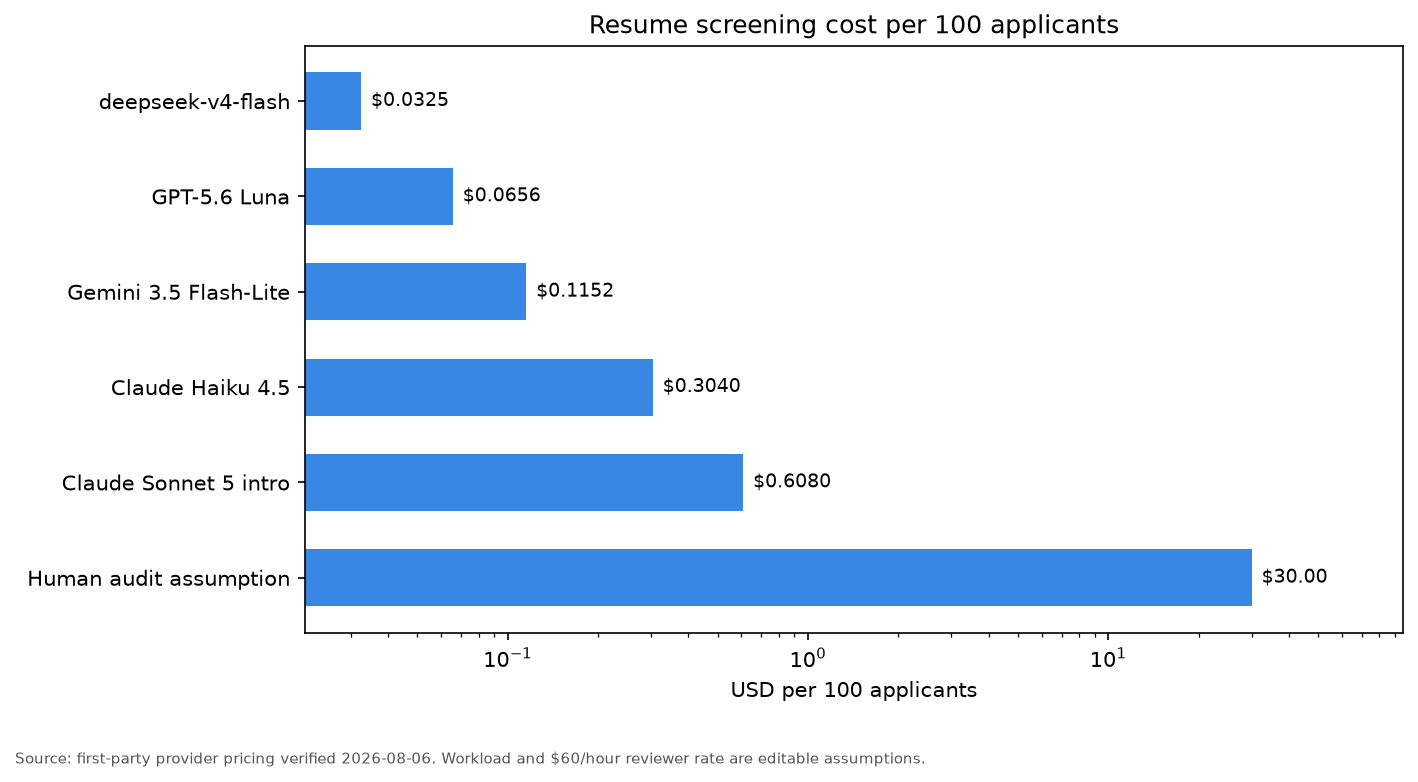
[deepseek-v4-flash](https://vynaris.com/models#deepseek-v4-flash)          $0.0210      $0.0073      $0.0042   $0.0325      $0.0003
[GPT-5.6 Luna](https://vynaris.com/models#gpt-5-6-luna)                    $0.0420      $0.0152      $0.0084   $0.0656      $0.0007
[Gemini 3.5 Flash-Lite](https://vynaris.com/models#gemini-3-5-flash-lite)  $0.0735      $0.0270      $0.0147   $0.1152      $0.0012
[Claude Haiku 4.5](https://vynaris.com/models#claude-haiku-4-5)            $0.1950      $0.0700      $0.0390   $0.3040      $0.0030
[Claude Sonnet 5](https://vynaris.com/models#claude-sonnet-5) intro        $0.3900      $0.1400      $0.0780   $0.6080      $0.0061
The standard prices per 1M input/output tokens are $0.14/$0.28 for DeepSeek, $0.20/$1.20 for Luna, $0.30/$2.50 for Flash-Lite, $1/$5 for Haiku, and $2/$10 for Sonnet. Anthropic canceled Sonnet's scheduled 2026-09-01 increase. Updated 2026-08-14.
The arithmetic behind $0.0325
The pipeline runs 120 shallow-shaped calls: 100 original screens and 20 audit reruns. Ten candidates also receive the deep pass.
deepseek-v4-flash per 100 applicants

Shallow: 100 x (1,200 x $0.14 + 150 x $0.28) / 1M = $0.02100
Deep:     10 x (4,000 x $0.14 + 600 x $0.28) / 1M = $0.00728
Audit:    20 x (1,200 x $0.14 + 150 x $0.28) / 1M = $0.00420
Total                                                        = $0.03248
Rounded total                                                = $0.0325
Sonnet uses the same 184,000 input and 24,000 output tokens:
184,000 x $2 / 1M + 24,000 x $10 / 1M = $0.6080Use the cost calculator here with your measured batch totals. If your parser counts PDFs, scanned pages, or attachments separately, add those preprocessing costs outside the model line.
The audit is cheap in tokens and expensive in judgment
The 20 counterfactual reruns add $0.0042 on DeepSeek or $0.0780 on Sonnet. That is 12.8% to 12.9% of the final model bill. The audit repeats one-sixth of all shallow-shaped calls.
The human review assumption is different:
30 minutes / 60 x $60 per hour = $30.00 per 100 applicantsThat $30.00 is 924x the DeepSeek bill and 49.3x the Sonnet bill. Switching models changes less than $0.58 per batch. Cutting the audit reviewer from 30 to 29 minutes saves $1.00, more than the full all-Sonnet model line.
This does not make human review wasteful. It makes the cost hierarchy visible. The audit exists to find score instability, weak evidence, and rubric failures before they affect more applicants. Automating the audit comparison can reduce clerical work, but a model grading another model does not become independent oversight.
The honest tradeoff: if you cannot fund a representative evaluation and human review, do not deploy an automated rejection gate. The cheap token bill is not permission to skip the expensive part.
Shortlist depth is the controllable model lever
The top-10 deep pass adds $0.0073 on DeepSeek and $0.1400 on Sonnet. Changing the shortlist rate moves that line directly.
Deep-pass candidates  DeepSeek total  Sonnet total
--------------------  --------------  ------------
0                     $0.0252         $0.4680
5                     $0.0288         $0.5380
10                    $0.0325         $0.6080
20                    $0.0398         $0.7480
30                    $0.0470         $0.8880
Going from 10 to 30 deep reviews adds $0.0146 on DeepSeek or $0.2800 on Sonnet. That is still small beside reviewer time. Set shortlist depth from recall on a labeled evaluation set, not from the token price.
The shallow stage should emit structured outputs: rubric scores, quoted evidence, missing requirements, and an abstain flag. A single free-form recommendation is harder to audit and easier to over-trust.
Where routing changes the unit economics
Run all shallow screens and audit reruns on DeepSeek. Send only the top 10 to Sonnet for deeper evidence review.
Stage            Model              Cost / 100
---------------  -----------------  ----------
Shallow 100      deepseek-v4-flash  $0.0210
Audit reruns 20  deepseek-v4-flash  $0.0042
Deep pass 10     Claude Sonnet 5    $0.1400
Routed total                        $0.1652
The routed total is 72.8% below all-Sonnet and 5.09x all-DeepSeek. The extra $0.1327 over all-DeepSeek buys a stronger model only on the selected tail.
Model routing earns that premium only if the deep pass improves evidence quality or saves reviewer time. If Sonnet changes no hiring decision and saves no minutes, all-DeepSeek wins on cost. Test that claim on labeled cases before turning it into policy.
Build notes for resume screening
- Store the rubric version with each result. A changed JD should not silently rewrite old scores.
- Require evidence spans from the resume for every positive and negative criterion. Reviewers need receipts, not confidence adjectives.
- Keep protected attributes out of routing features. Route on document shape or uncertainty, not identity.
- Track LLM cost attribution per applicant across shallow, deep, and audit calls.
- Use batch processing only when the hiring queue can tolerate asynchronous completion. We excluded discounts from the verdict table.
- Treat scanned-resume OCR as a separate bill and failure mode.
- Log abstentions and parser failures. A missing score is safer than a fabricated qualification.
- Keep the job rubric stable enough for prompt caching, but do not assume a cache hit until the provider usage object reports one.
The quality gate matters more than cost per token. Measure shortlist recall, evidence correctness, score changes after redaction, reviewer override rate, and time per reviewed batch. Model price belongs beside those metrics, not above them.
What this model bill excludes
The verdict table isolates language-model inference. It excludes resume parsing, OCR, applicant-tracking-system integration, storage, observability, evaluation labels, security review, and applicant appeals.
Keep a separate ledger line for each stage. A parser failure that sends a blank resume into the model is an ingestion problem. A well-parsed resume with an unsupported score is an evaluation problem. A reviewer who cannot reach the quoted evidence has a workflow problem. Model routing fixes none of them.
The same separation applies to the job description. Converting an unstructured JD into a stable rubric is product work, not free prompt text. Have a hiring owner approve the criteria before the first applicant is scored. Store that approved version beside every result. Otherwise a recruiter can change one sentence in the JD and make the old and new scores incomparable.
This boundary matters because the model bill is tiny. Once inference falls below a dollar per batch, the cheapest model is rarely the biggest economic decision. Reliability, review time, and accountable operations decide whether the system saves money or merely produces inexpensive risk.
For another two-stage workflow where human review dominates inference, see the healthcare claims cost playbook. For the general rule on pricing models by corrected outcome rather than API call, see the LLM evaluation harness.
When this workload does not need a router
Skip routing when one cheap model clears the evaluation and reviewers do not gain time from the stronger deep pass. At $0.0325 per 100 applicants, building a routing service only to shave model spend is ceremony.
Skip the LLM entirely when deterministic knockout rules cover the job's actual requirements. Work authorization, required license, location, or an applicant's explicit answers may be handled more transparently with validated form fields. Do not ask a language model to infer facts the candidate never supplied.
Do not automate rejection when the evaluation set is thin, the rubric is subjective, or no human owns appeals. A $0.0003 per-applicant model bill makes experimentation cheap. It does not make decisions low-risk.
FAQ
What does AI resume screening cost per 100 applicants? On this 184,000-input and 24,000-output-token workload, $0.0325 on deepseek-v4-flash to $0.6080 on Claude Sonnet 5.
What is included in the workload? One shallow screen for all 100 applicants, a deeper pass for the top 10, and counterfactual reruns for 20 audited applicants.
How much does the bias-audit sample add? The model reruns add $0.0042 on DeepSeek or $0.0780 on Sonnet. The editable 30-minute human review adds $30.00.
Should the strongest model screen every resume? Not by default. The model premium pays only if it improves evidence, shortlist recall, or reviewer time. Measure those outcomes on labeled cases.
Can this system reject applicants automatically? This cost model does not establish that such use is accurate, fair, or compliant. Keep humans accountable for consequential decisions and obtain jurisdiction-specific guidance.
Sources
- OpenAI API pricing, captured 2026-08-06: GPT-5.6 Luna standard short-context pricing at $0.20 input and $1.20 output per 1M tokens.
- Anthropic API pricing, re-verified 2026-08-14: Claude Haiku 4.5 at $1/$5; Claude Sonnet 5 at $2/$10 standard.
- Gemini API pricing, captured 2026-08-06: Gemini 3.5 Flash-Lite at $0.30/$2.50.
- DeepSeek API pricing, captured 2026-08-06: deepseek-v4-flash at $0.14 cache miss and $0.28 output.
All applicant counts, shortlist rates, token volumes, audit rates, reviewer minutes, and labor rates are shown assumptions. Replace them before using these totals in a hiring budget.