
Blog · · By Dhrumil Barot, Founder
GPT-4.1 Alternatives: 8 Replacements Ranked by Cost
The best GPT-4.1 alternative for most workloads is gpt-6-luna, OpenAI's named replacement, at $0.021 per 200K-token request vs $0.416. All 8 compared.
TL;DR: GPT-4.1 and GPT-4.1 mini shut down on the OpenAI API on 2027-01-14, and OpenAI names gpt-6-luna as the replacement for both. On a 200K-token prompt with a 2K-token answer, gpt-6-luna costs $0.021 against $0.416 on GPT-4.1 (95% less), and every option below keeps a context window of 1M tokens or more. Vynaris gives you one OpenAI-compatible endpoint and one bill to A/B the replacements on your own prompts before the cutoff. Prices verified 2026-11-23.
Try it: point your OpenAI client at https://api.vynaris.com/v1, send the same prompt to GPT-4.1 and a replacement, and compare the cost of each call. Get a Vynaris API key.
The best GPT-4.1 alternative for most workloads is gpt-6-luna: it is OpenAI's named replacement on the deprecations page, it has a 1,050,000-token context window (GPT-4.1 has 1,047,576), and it lists at $0.10 input and $0.50 output per 1M tokens. If you want to leave OpenAI, Claude Haiku 5.5, Gemini 3.1 Flash-Lite and DeepSeek's deepseek-flash all keep a 1M context and cost less than GPT-4.1 mini on long prompts. If GPT-4.1 was doing hard work for you, gpt-6.1-terra and Claude Sonnet 5.5 are the step-up options at roughly GPT-4.1's price.
Short list: GPT-4.1 alternatives at a glance
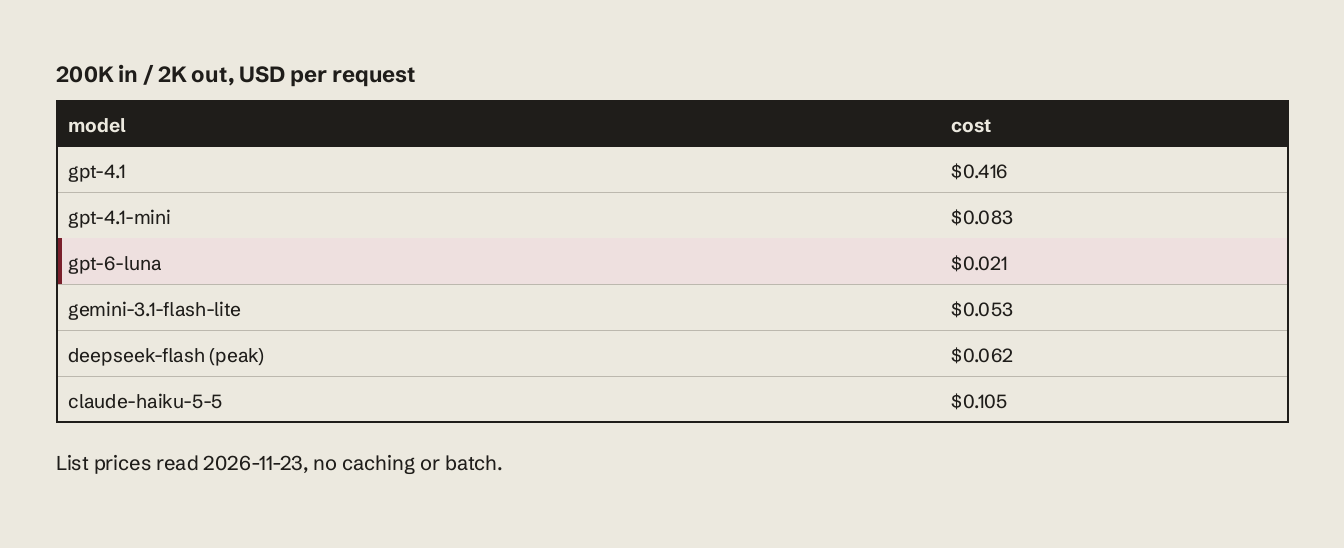
Cost per request is computed from each provider's list price, read 2026-11-23, for two request shapes GPT-4.1 users actually send: 200K input / 2K output, and 500K input / 2K output. No caching, no batch.
| # | Option | Input / output per 1M | 200K / 2K request | 500K / 2K request | Context |
|---|---|---|---|---|---|
| 1 | Vynaris (one key for the tests) | Provider list + 3% / 1% fee | List + fee | List + fee | Per model |
| 2 | gpt-6-luna | $0.10 / $0.50 (≤272K); $0.20 / $0.75 above | $0.021 | $0.1015 | 1,050,000 |
| 3 | gpt-6.1-terra | $1 / $5 (≤272K); $2 / $7.50 above | $0.210 | $1.015 | 1,050,000 |
| 4 | Claude Haiku 5.5 | $0.10 / $0.50 (≤100K); $0.50 / $2.50 above | $0.105 | $0.255 | 1M |
| 5 | Claude Sonnet 5.5 | $2 / $10 | $0.420 | $1.020 | 1M |
| 6 | Gemini 3.8 Flash | $0.75 / $3.75 (to 2026-12-31) | $0.158 | $0.383 | 1M |
| 7 | Gemini 3.1 Flash-Lite | $0.25 / $1.50 | $0.053 | $0.128 | 1M |
| 8 | DeepSeek deepseek-flash | $0.30 / $1.20 (peak) | $0.062 | $0.152 | 1M |
| ref | GPT-4.1 (shutting down) | $2.00 / $8.00 | $0.416 | $1.016 | 1,047,576 |
| ref | GPT-4.1 mini (shutting down) | $0.40 / $1.60 | $0.083 | $0.203 | 1,047,576 |
How we judged the alternatives
We ranked by four criteria, in this order:
- Cost per real request, not per token. A long GPT-4.1 prompt crosses price tiers on three of these models (luna and terra at 272K, Haiku at 100K), so per-token rates alone mislead.
- Context kept. GPT-4.1's main selling point was its 1,047,576-token window. Every option here keeps 1M or more.
- Migration effort. Same SDK and same API shape beats a new client library.
- Checkable source. Every price links to the provider's own page.
We did not run quality benchmarks for this page. Test quality on your own prompts (option 1 is how).
1. Vynaris: run the replacement test through one key
Vynaris is an OpenAI-compatible API: you change base_url to https://api.vynaris.com/v1 and keep your OpenAI SDK code. Pricing is the provider list price plus a fee of 3% until your monthly usage reaches $500, then 1% (pricing). GPT-4.1 is listed on vynaris.com/models at $2.00 / $8.00 with its 1M context.
What it does for this migration: you send the same production prompt to GPT-4.1 and to each candidate through one key and one prepaid balance, and read the provider cost of each call next to the other.
from openai import OpenAI

client = OpenAI(base_url="https://api.vynaris.com/v1", api_key="VYNARIS_KEY")
# Check exact model IDs on https://vynaris.com/models before running
for model in ["gpt-4.1", "<candidate model id>"]:
    r = client.chat.completions.create(
        model=model,
        messages=[{"role": "user", "content": open("prompt.txt").read()}],
    )
    print(model, r.usage.prompt_tokens, r.usage.completion_tokens)
What it does not do: it does not keep GPT-4.1 running past OpenAI's 2027-01-14 shutdown, and the fee makes every call slightly more than calling the provider directly. Check /models for which candidates are listed today; for any that is not, call that provider's API directly. Best for: teams that want to compare two or three replacements on live traffic without opening three provider accounts.
2. gpt-6-luna: OpenAI's named GPT-4.1 replacement
gpt-6-luna is the model OpenAI lists as the replacement for GPT-4.1, GPT-4.1 mini, GPT-4o and GPT-4o mini. It costs $0.10 input, $0.01 cached input and $0.50 output per 1M tokens for prompts up to 272K tokens; above that, input doubles to $0.20 and output rises to $0.75 (OpenAI pricing). Batch is $0.05 / $0.25.
- Context: 1,050,000 tokens, 128,000 max output (GPT-4.1 caps output at 32,768).
- Best for: anyone who wants the smallest code change and the lowest bill.
- Watch out: it is a reasoning model with
reasoning.effortdefaulting to medium, so it spends output tokens thinking that GPT-4.1 never did. On Chat Completions, function calling works only withreasoning_effortset tonone(model page).
Is gpt-6-luna cheaper than GPT-4.1?
Yes, by about 20x on input. A 200K / 2K request is $0.021 on gpt-6-luna and $0.416 on GPT-4.1. A 500K / 2K request lands in luna's long-context tier: $0.1015 against $1.016, still 90% less. The saving shrinks only if reasoning adds a lot of output: at $0.50 per 1M, even 20K extra reasoning tokens add $0.01.
3. gpt-6.1-terra: the step up inside OpenAI
gpt-6.1-terra costs $1 / $5 per 1M up to 272K input and $2 / $7.50 above, with the same 1,050,000 context and 128,000 output (model page). A 200K / 2K request is $0.210, half of GPT-4.1. At 500K it is $1.015, the same as GPT-4.1.
Best for: GPT-4.1 workloads where luna's answers fall short in your tests (multi-step extraction, long legal or code context). OpenAI also names terra as the replacement for gpt-5-mini.
4. Claude Haiku 5.5: cheapest non-OpenAI option under 100K
Claude Haiku 5.5 (claude-haiku-5-5) lists at $0.10 / $0.50 per 1M for prompts up to 100,000 tokens and $0.50 / $2.50 above, with a 1M context and 128K output (Anthropic models). Anthropic describes it as built "for high-volume, latency-sensitive tasks such as classification, extraction, and routing".
A 200K / 2K request is $0.105; a 500K / 2K request is $0.255. Note Anthropic's own pricing docs say its newer tokenizer produces about 30% more tokens for the same text, so budget on measured token counts, not on GPT-4.1's counts. The table above does not apply that 30%.
5. Claude Sonnet 5.5: same price band, stronger model
Claude Sonnet 5.5 (claude-sonnet-5-5) costs $2 / $10 per 1M, 1M context, 128K output. That is GPT-4.1's input price with a higher output price: $0.420 per 200K / 2K request against GPT-4.1's $0.416. Best for: teams that used GPT-4.1 as their strong model and want a non-OpenAI one at roughly the same bill. Anthropic's Batch API halves both rates.
6. Gemini 3.8 Flash: watch the 2027-01-01 price change
Gemini 3.8 Flash (gemini-3.8-flash) lists at $0.75 / $3.75 per 1M through 2026-12-31, then $1.50 / $7.50 from 2027-01-01 (Gemini pricing), with a 1M context. A 200K / 2K request is $0.158 now and $0.315 from January, two weeks before GPT-4.1 shuts down. It has a free tier for testing; on the free tier Google uses your data to improve its products, on the paid tier it does not. More in our Gemini API pricing guide.
7. Gemini 3.1 Flash-Lite: cheapest long-context option outside OpenAI
Gemini 3.1 Flash-Lite (gemini-3.1-flash-lite) costs $0.25 / $1.50 per 1M with no long-context tier, 1M context, and Batch at $0.125 / $0.75. A 500K / 2K request is $0.128, the cheapest non-OpenAI price in this list for that shape. Best for: bulk summarization and extraction over long documents where GPT-4.1 mini was the old default.
8. DeepSeek deepseek-flash: cheap off-peak, OpenAI-style API
DeepSeek's deepseek-flash (served by DeepSeek-V4.1-Flash-1017) has a 1M context and time-of-day pricing: $0.30 input / $1.20 output per 1M at peak, half that off-peak, and $0.006 per 1M for cache hits at peak (DeepSeek pricing). A 200K / 2K request is $0.062 at peak and $0.031 off-peak. DeepSeek's API follows the OpenAI request format. Best for: batch-style jobs you can schedule into the off-peak window. Check your data-residency rules first.
Which alternative keeps a 1M token context?
All eight do. gpt-6-luna and gpt-6.1-terra have 1,050,000 tokens; Claude Haiku 5.5, Claude Sonnet 5.5, Gemini 3.8 Flash, Gemini 3.1 Flash-Lite and deepseek-flash list 1M. What changes is price at length: luna and terra charge more above 272K input, Haiku above 100K. Gemini 3.1 Flash-Lite and DeepSeek have one rate at any length.
Which non-OpenAI models are a drop-in for GPT-4.1?
None is a pure model-ID swap on the OpenAI SDK unless you call it through an OpenAI-compatible endpoint. DeepSeek's API takes the OpenAI request format directly. Anthropic and Google have their own APIs. Through an OpenAI-compatible gateway like Vynaris, the swap is the model string, with the caveats in our guide to what breaks when you swap base URLs: tool-call formats, JSON mode and sampling parameters differ by provider.
How do I test a replacement before January 14, 2027?
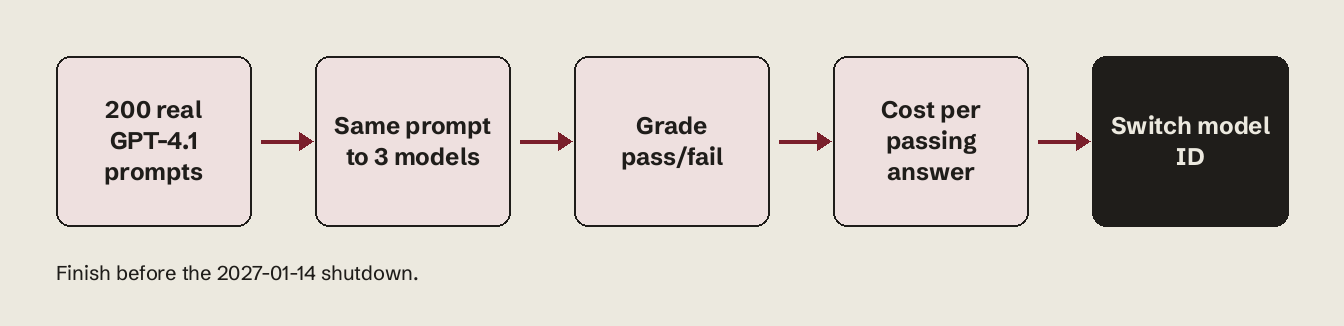
Run this in the next four weeks, not the last one:
- Pull 200 real prompts from your GPT-4.1 logs, including your longest.
- Send each to GPT-4.1 and two candidates (luna plus one more).
- Record input tokens, output tokens (including reasoning tokens) and latency per call.
- Grade answers on your own pass/fail rule: parsed JSON, correct field, human review.
- Compute cost per passing answer, not per call: a cheaper model that fails 20% of the time can cost more per good answer.
- Switch your production model ID and keep the old one in logs for comparison until 2027-01-14.
To log the cost of each call during the test, see how to track LLM API costs. For the GPT-4.1 rates themselves, see our GPT-4.1 price reference. Plug your own token counts into the Vynaris calculator.
How to choose a GPT-4.1 alternative
- Smallest change, lowest bill:
gpt-6-luna. Turnreasoning_efforttononeif you use function calling on Chat Completions. - Luna fails your tests:
gpt-6.1-terrainside OpenAI, Claude Sonnet 5.5 outside it. - Long documents, outside OpenAI: Gemini 3.1 Flash-Lite, or
deepseek-flashoff-peak. - Short prompts, outside OpenAI: Claude Haiku 5.5 under 100K tokens.
- Comparing several before choosing: run them through Vynaris on one key, then decide.
When not to bother with a gateway: if your test shows luna passes and you only call OpenAI, call OpenAI directly and skip the fee.
FAQ
What replaces GPT-4.1 after it shuts down?
OpenAI names gpt-6-luna as the replacement for both GPT-4.1 and GPT-4.1 mini, which shut down on 2027-01-14. GPT-4.1 nano already shut down on 2026-10-23, with gpt-5.6-luna as its replacement.
Is gpt-6-luna cheaper than GPT-4.1?
Yes. It lists at $0.10 / $0.50 per 1M tokens against $2.00 / $8.00. A 200K-input, 2K-output request costs $0.021 against $0.416.
What is the best GPT-4.1 mini alternative?
On price, gpt-6-luna ($0.021 vs $0.083 per 200K / 2K request). Outside OpenAI, Gemini 3.1 Flash-Lite ($0.053) and deepseek-flash at peak ($0.062) both beat GPT-4.1 mini.
Will my fine-tuned GPT-4.1 model keep working?
Fine-tuned models follow their base model's shutdown. OpenAI has closed fine-tuning to new users, so plan on prompting a replacement instead.
Does the replacement behave the same as GPT-4.1?
No. gpt-6-luna is a reasoning model with medium effort by default, so latency and output tokens rise unless you lower reasoning_effort. Test on your own prompts.
Price your GPT-4.1 migration: run the same requests on GPT-4.1 and its replacements through one OpenAI-compatible key and compare the cost of each. Get a Vynaris API key.