
Blog · · By Dhrumil Barot, Founder
Fastest LLM APIs: 5 Options Ranked by Tokens per Second
The fastest LLM API today is gpt-oss-120b on Cerebras at about 3,000 tokens/s. Five fast options ranked by provider speed, with price per 1M tokens.
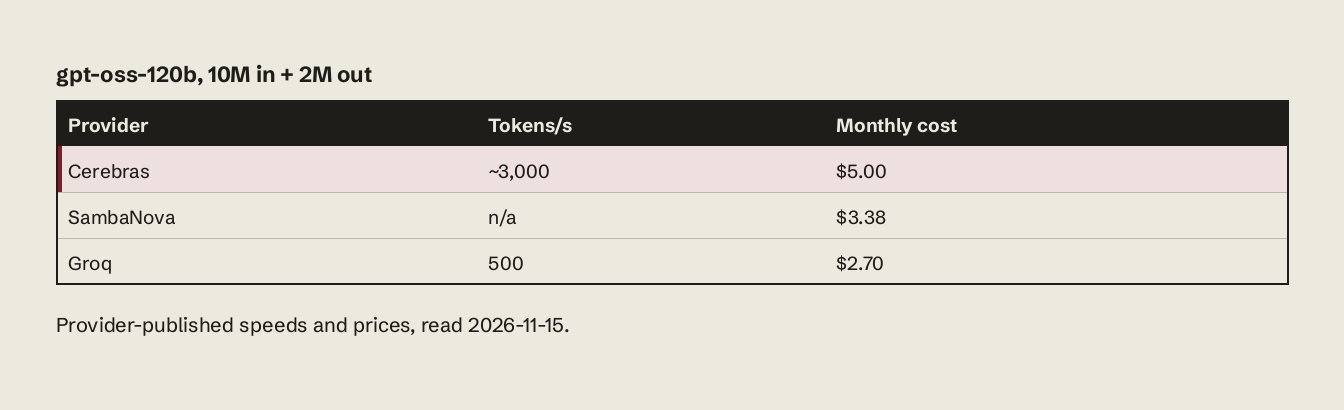
TL;DR: The fastest LLM API you can call today is gpt-oss-120b on Cerebras, at about 3,000 output tokens per second by Cerebras's own figure. Groq is next at 1,000 tokens/s on gpt-oss-20b and 500 on gpt-oss-120b. Speed costs money: the same 10M input plus 2M output tokens of gpt-oss-120b is $5.00 on Cerebras and $2.70 on Groq. Vynaris is listed first because it is the layer that shows you that price on every request, not because it is the fastest chip.
Try it: point your OpenAI client at https://api.vynaris.com/v1, send an exact model ID or auto, and read the cost receipt on every response. Get a Vynaris API key.
The fastest LLM model by published output speed is OpenAI's open-weight gpt-oss-120b served on Cerebras hardware (~3,000 tokens/s, $0.35 input and $0.75 output per 1M tokens). The fastest LLM API on a budget is gpt-oss-20b on Groq (1,000 tokens/s, $0.075 / $0.30). Mercury 3 from Inception Labs takes a different path: a diffusion model that writes tokens in parallel, priced at $0.10 / $0.35 at launch. Every speed here is the provider's own number, read on 2026-11-15, and each provider says real speed varies with prompt length and load.
How we judged speed
We ranked fast LLM APIs on four things, in this order:
- Output tokens per second: the provider's published figure for one model. This is throughput, how fast text streams once it starts.
- Time to first token (TTFT): how long before the first token arrives. Only one provider here publishes a number for it.
- Price per 1M tokens: input and output, from the provider's own pricing page, plus the cost of a fixed workload of 10M input and 2M output tokens a month.
- Is the model good enough for real work: tool calling, structured outputs and context window, from the provider's model docs.
We did not run our own benchmark. Every number below is the provider's published figure with its source link, so you can check it.
Summary table: speed and price
| Option | Model | Output speed (tokens/s) | In / out per 1M | 10M in + 2M out | Time for 1,000 output tokens |
|---|---|---|---|---|---|
| Vynaris | auto or exact model ID | Depends on the model served | Provider price + 3% (1% after $500/month) | Shown on each receipt | Depends on the model served |
| Cerebras | gpt-oss-120b | ~3,000 | $0.35 / $0.75 | $5.00 | 0.33 s |
| Cerebras | Qwen 3.8 27B | ~1,850 | $0.99 / $1.49 | $12.88 | 0.54 s |
| Groq | gpt-oss-20b | 1,000 | $0.075 / $0.30 | $1.35 | 1.0 s |
| Groq | gpt-oss-120b | 500 | $0.15 / $0.60 | $2.70 | 2.0 s |
| Groq | qwen3.8-27b | 450 | $0.80 / $4.00 | $16.00 | 2.2 s |
| SambaNova | gpt-oss-120b | Not published | $0.22 / $0.59 | $3.38 | Not published |
| Inception | Mercury 3 | Not published as a number | $0.10 / $0.35 (launch) | $1.70 | Not published |
Cost math: (10 x input price) + (2 x output price). Cerebras gpt-oss-120b: 10 x $0.35 + 2 x $0.75 = $5.00. Time math: 1,000 / tokens per second. Want your own token counts? Run them in the LLM cost calculator.
1. Vynaris
Vynaris is an OpenAI-compatible chat completions gateway at https://api.vynaris.com/v1. It is not an inference chip and does not publish its own tokens-per-second number. What it does for a speed decision: you can set model to auto and let the router pick, or send an exact model ID, and every response returns its own receipt as x-vynaris-* headers, including the model that served it and what it cost (Vynaris docs).
from openai import OpenAI

client = OpenAI(base_url="https://api.vynaris.com/v1", api_key="vyn_sk_live_XXXX")
resp = client.chat.completions.create(
    model="auto",
    messages=[{"role": "user", "content": "Summarize this ticket in one line."}],
)
print(resp.choices[0].message.content)
Best for: teams that want to see the cost of every fast call next to its result, instead of finding out on the monthly invoice.
Pricing: provider list price plus a 3% fee until your monthly usage reaches $500, then 1%. Prepaid top-ups from $20, and credit does not expire (Vynaris pricing).
Limits: Vynaris does not guarantee a speed tier. If your product needs a hard 3,000 tokens/s, call that provider's model and measure it.
2. Cerebras: fastest output speed
Cerebras runs models on its own wafer-scale chips. Its docs list gpt-oss-120b at about 3,000 tokens per second and Qwen 3.8 27B at about 1,850 (Cerebras model docs, Cerebras pricing).
- Pricing: gpt-oss-120b $0.35 input / $0.75 output per 1M tokens. Qwen 3.8 27B $0.99 / $1.49.
- Model features: gpt-oss-120b supports reasoning, streaming, structured outputs, tool calling and prompt caching. Context is 65k tokens on the free tier and 131k paid. Max output is 32k free and 40k paid.
- Rate limits: the free trial allows 5 requests per minute and 1M tokens per day. The developer tier allows 1K requests per minute and 500K uncached tokens per minute.
- Caveat: Cerebras states its performance comparisons "are based on third-party benchmarking or internal testing" and that speed "may vary depending on workload".
Best for: streaming chat and agents where the user is watching tokens appear.
3. Groq: fast and the cheapest per token
Groq runs models on its LPU chips and prints a speed column on its model list (Groq models).
- Speeds: gpt-oss-20b 1,000 tokens/s, llama-3.1-8b-instant 560, gpt-oss-120b 500, qwen3.8-27b 450, llama-3.3-70b-versatile 280.
- Pricing: gpt-oss-20b $0.075 / $0.30, gpt-oss-120b $0.15 / $0.60, qwen3.8-27b $0.80 / $4.00. The two Llama models are listed as Enterprise, contact sales.
- Limits: gpt-oss-120b has a 131,072-token context, 65,536 max completion tokens and 250K tokens per minute on the developer plan.
Best for: high-volume, short-output jobs (classification, extraction, routing) where 1,000 tokens/s is already fast enough and the bill matters more.
4. SambaNova: low price on the same model
SambaNova serves gpt-oss-120b at $0.22 input and $0.59 output per 1M tokens, and Meta-Llama-3.3-70B-Instruct at $0.60 / $1.20 (SambaNova pricing). Both have a 128k-token context (SambaNova models).
- Speed: SambaNova's model docs do not print a tokens-per-second figure, so we do not rank it on one. Measure it on your own prompts.
- Strength: the cheapest output price on gpt-oss-120b in this list ($0.59 per 1M).
Best for: teams already on gpt-oss-120b who want a second fast host for failover.
5. Inception Mercury 3: a diffusion model
Mercury 3 is a diffusion LLM: it produces many tokens in parallel instead of one at a time. Inception claims "sub-300ms time to first token" and "5-7x higher throughput" than speed-optimized models (Inception Labs).
- Pricing: $0.10 input / $0.35 output per 1M at launch (50% off the $0.20 / $0.70 list price) (Inception models).
- Model features: 1M-token context, 131,072 max output tokens, tool calling.
- Caveat: the speed claim is a ratio on a chart, not a tokens-per-second number in the docs.
Best for: latency-bound apps such as autocomplete and voice where TTFT matters more than peak throughput.
Which LLM API has the highest output tokens per second?
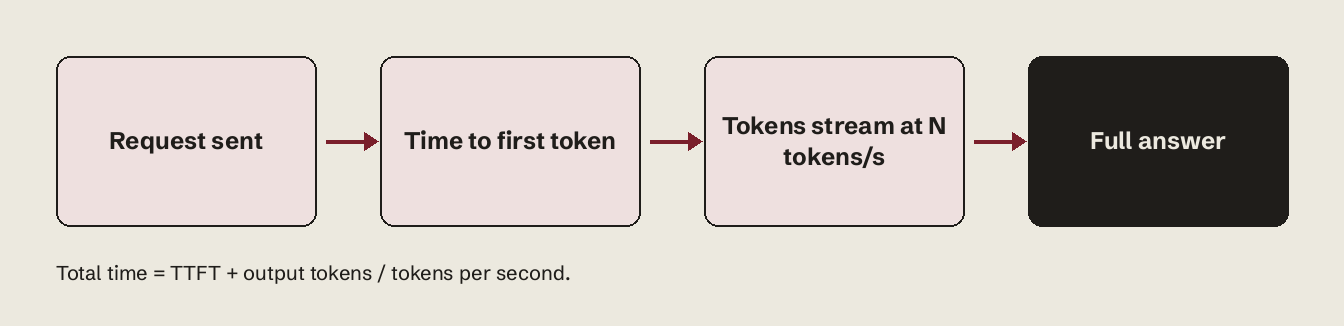
Cerebras has the highest published output speed: about 3,000 tokens per second on gpt-oss-120b. Groq's fastest listed model is gpt-oss-20b at 1,000 tokens/s. At those speeds a 1,000-token answer streams in 0.33 seconds on Cerebras and 1.0 second on Groq.
Is the fastest model also the cheapest?
No. The fastest option here is not the cheapest. On the same gpt-oss-120b model, Cerebras is 6x faster than Groq (3,000 vs 500 tokens/s) and costs 1.85x more on our workload ($5.00 vs $2.70). The cheapest fast option is Groq gpt-oss-20b at $1.35, a smaller model.
What is the difference between time to first token and throughput?
Time to first token is the wait before anything appears. Throughput (tokens per second) is how fast the rest arrives. A chat reply of 200 tokens is dominated by TTFT; a 5,000-token code file is dominated by throughput.
Which fast model is good enough for coding or agents?
For agents, pick a model with tool calling and structured outputs. gpt-oss-120b has both on Cerebras, and Mercury 3 lists tool calling. Small models such as llama-3.1-8b-instant are fast but weaker at multi-step tool use. Test your own task set before switching: a model that is 2x faster but needs a retry is slower in practice.
How do you measure LLM speed on your own prompts?
Provider numbers are a starting point. Measure TTFT and tokens per second on your own prompts, because input length and output length both change the result. This script works against any OpenAI-compatible endpoint, including Cerebras, Groq and Vynaris: change base_url, api_key and model.
import time
from openai import OpenAI

client = OpenAI(base_url="https://api.vynaris.com/v1", api_key="vyn_sk_live_XXXX")
start = time.perf_counter()
first = None
chunks = 0
stream = client.chat.completions.create(
    model="auto",
    messages=[{"role": "user", "content": "Write 300 words about caching."}],
    stream=True,
)
for event in stream:
    if event.choices and event.choices[0].delta.content:
        if first is None:
            first = time.perf_counter()
        chunks += 1
end = time.perf_counter()
print(f"TTFT {first - start:.2f}s, ~{chunks / (end - first):.0f} chunks/s")
Chunks are close to tokens but not identical on every provider, so for an exact count read usage.completion_tokens from a non-streamed call. Run each model 10 times at the hour your users are active and compare medians, not the best run. A provider that is fast at 3 a.m. can be slower under daytime load.
How to choose
- You need the fastest streaming output: Cerebras gpt-oss-120b.
- You need low cost at high volume: Groq gpt-oss-20b or gpt-oss-120b.
- You need low first-token latency: test Inception Mercury 3.
- You need to see what each fast call costs and switch models without changing code: Vynaris. We recommend starting here, sending the exact model ID you picked above, and reading the receipt on every request.
Related reading: OpenAI compatible API providers compared, how cost per token changed over time, Grok 4 Fast pricing, and the model list.
FAQ
What is the fastest LLM right now?
By published output speed, gpt-oss-120b on Cerebras at about 3,000 tokens per second (read 2026-11-15). Provider figures vary with prompt length and load.
Is Groq faster than Cerebras?
Not on published numbers. On gpt-oss-120b, Groq lists 500 tokens/s and Cerebras about 3,000. Groq is cheaper on that model: $0.15 / $0.60 vs $0.35 / $0.75 per 1M tokens.
Are fast LLM APIs OpenAI compatible?
Yes. Cerebras, Groq, SambaNova and Inception all serve a chat completions endpoint, and Vynaris uses the OpenAI format at https://api.vynaris.com/v1.
Do speed numbers include reasoning tokens?
Output tokens per second counts every generated token, including reasoning tokens on models like gpt-oss-120b. A high reasoning effort means more tokens before the answer, so a slower total time.
Next step: send your fast model through one endpoint and see what every call costs. Get a Vynaris API key.
Related articles
- Best Uncensored LLM APIs in 2026: 6 Hosted Options Compared
- Best LLM for Math: 6 Models Ranked by Score and Cost
- OpenClaw Models: 10 Best, Ranked by Cost per Task
- Kimi K3 API: Pricing, Access Options, and Reduced-Refusal Workflows (2026)
- Built-in tools are 92% of a Luna agent bill: web search, grounding and code execution