
Blog · · By Dhrumil Barot, Founder
Anthropic vs OpenAI vs Google: API Cost per Task Compared
Anthropic vs OpenAI vs Google: Gemini is cheapest per task at every tier, Claude and GPT tie on list price. Batch, caching and limits, verified 2026-11-22.
TL;DR: On list price, Google is the cheapest of the three at every tier, and Anthropic and OpenAI charge the same $2 / $10 per 1M tokens for their mid-tier models (Claude Sonnet 5.5 and gpt-6.2-sol). All three take 50% off for batch jobs; they differ on caching, rate limits and dated price rises. Vynaris puts all three vendors behind one OpenAI-compatible endpoint, so you can price the same task on each before you commit. Prices verified 2026-11-22.
Try it: point your OpenAI client at https://api.vynaris.com/v1, send one real prompt to a Claude, GPT and Gemini model, and read the cost of each request. Get a Vynaris API key.
Anthropic vs OpenAI vs Google, compared as API vendors: for a support-style task with 3,000 input and 500 output tokens, 1,000 tasks cost $11.00 on Claude Sonnet 5.5, $11.00 on gpt-6.2-sol and $4.13 on Gemini 3.8 Flash at today's intro price. At the budget tier, Claude Haiku 5.5 and gpt-6-luna both come to $0.55 per 1,000 tasks. At the top, Claude Fable 5.2 and gpt-6.2-astra both cost $44.00, while Gemini 4 Argon costs $11.00 until 2026-11-30 and $22.00 from 2026-12-01. Most pages ranking for this query still compare GPT-5.4, Claude Opus 4.6 and Haiku 4.5; those lineups and prices are gone.
Comparison table: Anthropic vs OpenAI vs Google API
Standard tier, text, USD per 1M tokens unless noted. Verified 2026-11-22 on each vendor's pricing page.
| Criterion | Vynaris (one endpoint) | Anthropic | OpenAI | Google (Gemini API) |
|---|---|---|---|---|
| Top model, input / output | provider price + 3% | Claude Fable 5.2 $8 / $40 | gpt-6.2-astra $8 / $40 | Gemini 4 Argon $2 / $10 (to 2026-11-30), $4 / $20 after |
| Mid model, input / output | provider price + 3% | Claude Sonnet 5.5 $2 / $10 | gpt-6.2-sol $2 / $10 | Gemini 3.8 Flash $0.75 / $3.75 (to 2026-12-31) |
| Budget model, input / output | provider price + 3% | Claude Haiku 5.5 $0.10 / $0.50 | gpt-6-luna $0.10 / $0.50 | Gemini 3.1 Flash-Lite $0.25 / $1.50 |
| Batch discount | passes through provider price | 50% on input and output | 50% (gpt-6.2-sol $1 / $5) | 50% (3.1 Flash-Lite $0.125 / $0.75) |
| Cache read, mid model | provider price + 3% | $0.10 (0.05x) | $0.10 (0.05x) | $0.075 + storage per hour |
| Cache write | provider price + 3% | 1.25x (5 min) or 2x (1 hour) | $2.50 (30 min) or $5.00 (12 hours) on sol | storage $0.50 per 1M tokens per hour on 3.8 Flash |
| Free tier | no | no | no | yes on Flash and Flash-Lite, not Argon |
| Entry limits | prepaid from $20, no overages | Start tier: 4,000 RPM per 5.5 model, $500/month cap | $5 in credit purchases for the $500/month tier | free tier, then paid billing |
| Training on your data | no training by Vynaris | not on API traffic by default | not on API traffic by default | Yes on free tier, No on paid tier |
Sources: Anthropic pricing, OpenAI pricing, Gemini API pricing, Vynaris pricing, all read 2026-11-22. gpt-6-luna Standard price read 2026-11-16; today the page lists its Flex price of $0.05 / $0.25, which is half that.
What does Vynaris do for an Anthropic vs OpenAI vs Google decision?
Vynaris is an OpenAI-compatible gateway at https://api.vynaris.com/v1 that serves models from Anthropic, OpenAI and Google, among others, through one API key and one prepaid balance. For this decision it does three concrete things:
- One client for all three. You keep the OpenAI SDK, change the base URL, and switch vendors by changing the model ID. No second SDK for Claude or Gemini.
- A receipt per request. From the Vynaris pricing page: "The response headers and exportable ledger show the model, provider cost, Vynaris fee, and final charge." That is the per-task number this article computes by hand, measured on your own prompts.
- Known fee, no surprise bill. "Provider list price + 3% / 1%": 3% until your monthly usage reaches $500, then 1%. Top-ups start at $20 and requests stop when the balance reaches zero.
What it does not do: it does not lower a vendor's list price, and the fee is a cost on top. If you already know which single vendor you want, a direct account is cheaper by that 3%.
from openai import OpenAI

client = OpenAI(base_url="https://api.vynaris.com/v1", api_key="VYNARIS_KEY")
prompt = [{"role": "user", "content": "Summarise this ticket in two lines: ..."}]

# Check exact model IDs on https://vynaris.com/models before running
for model in ["claude-sonnet-5.5", "gpt-6.2-sol", "gemini-3.8-flash"]:
    r = client.chat.completions.create(model=model, messages=prompt)
    print(model, r.usage.prompt_tokens, r.usage.completion_tokens)
Which is cheapest per task: Anthropic, OpenAI or Google?
Google is cheapest per task at every tier on list price, and Anthropic and OpenAI tie. The task below is one support reply: 3,000 input tokens (system prompt, ticket, history) and 500 output tokens. 1,000 tasks = 3M input and 0.5M output tokens.
| Tier | Model | Input cost | Output cost | Per 1,000 tasks | Via Vynaris (+3%) |
|---|---|---|---|---|---|
| Top | Claude Fable 5.2 | 3 x $8 = $24.00 | 0.5 x $40 = $20.00 | $44.00 | $45.32 |
| Top | gpt-6.2-astra | 3 x $8 = $24.00 | 0.5 x $40 = $20.00 | $44.00 | $45.32 |
| Top | Gemini 4 Argon (from 2026-12-01) | 3 x $4 = $12.00 | 0.5 x $20 = $10.00 | $22.00 | $22.66 |
| Mid | Claude Sonnet 5.5 | 3 x $2 = $6.00 | 0.5 x $10 = $5.00 | $11.00 | $11.33 |
| Mid | gpt-6.2-sol | 3 x $2 = $6.00 | 0.5 x $10 = $5.00 | $11.00 | $11.33 |
| Mid | Gemini 3.8 Flash (to 2026-12-31) | 3 x $0.75 = $2.25 | 0.5 x $3.75 = $1.875 | $4.13 | $4.25 |
| Budget | Claude Haiku 5.5 | 3 x $0.10 = $0.30 | 0.5 x $0.50 = $0.25 | $0.55 | $0.57 |
| Budget | gpt-6-luna | 3 x $0.10 = $0.30 | 0.5 x $0.50 = $0.25 | $0.55 | $0.57 |
| Budget | Gemini 3.1 Flash-Lite | 3 x $0.25 = $0.75 | 0.5 x $1.50 = $0.75 | $1.50 | $1.55 |
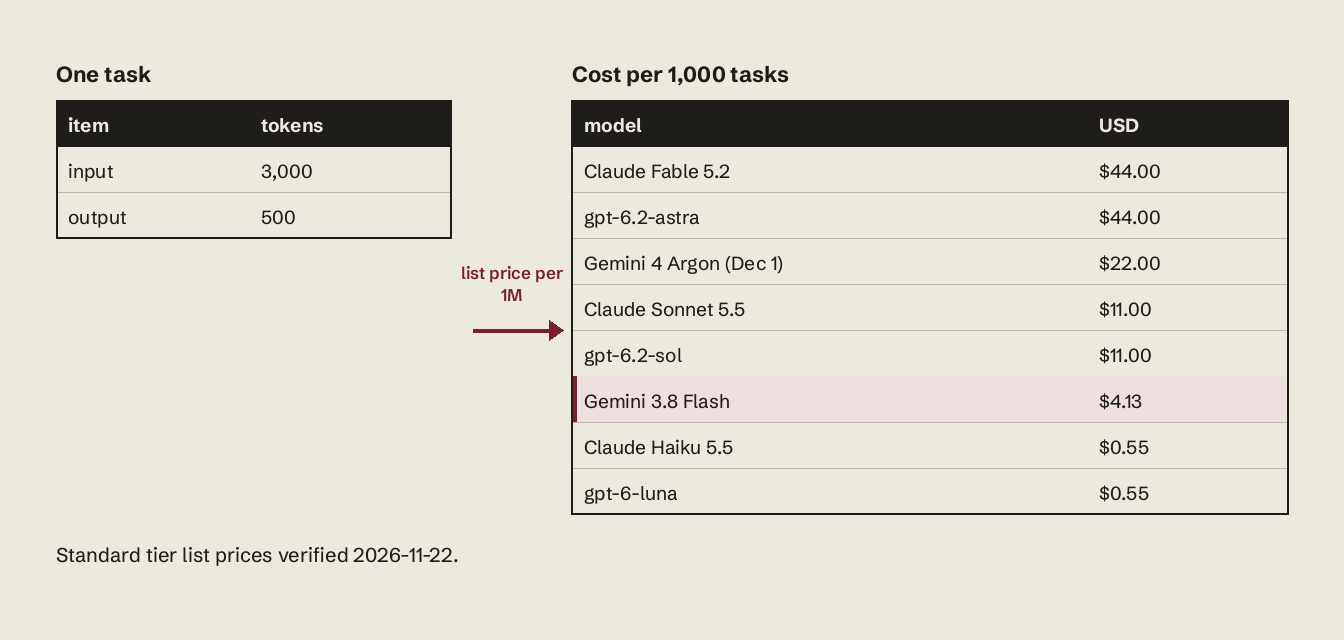
Three things change these numbers in practice:
- Tokenizers differ. Anthropic states that Claude 4.7 and later produce about 30% more tokens for the same text. The same prompt can bill 3,900 input tokens on Claude where it bills 3,000 elsewhere, which turns Sonnet 5.5's $11.00 into roughly $14.30 at the same output length. Measure on your own text.
- The budget tier is not the same model class. Gemini 3.1 Flash-Lite costs more per task than Haiku 5.5 here, but Haiku 5.5's $0.10 input price only holds for prompts up to 100,000 tokens; above that it is $0.50 / $2.50.
- Google's prices are dated. Gemini 4 Argon doubles on 2026-12-01 and Gemini 3.8 Flash doubles to $1.50 / $7.50 on 2027-01-01, which makes the mid-tier task $8.25 instead of $4.13.
Put your own token counts in the LLM cost calculator to see where your workload lands.
How do batch and prompt caching discounts differ between the three?
Batch is the same everywhere: 50% off input and output for asynchronous jobs. Caching is where the three differ.
Batch. Anthropic's Batch API gives "a 50 percent discount on both input and output tokens". OpenAI lists Batch at half of Standard (gpt-6.2-sol $1 / $5). Google lists Batch at half too (Gemini 3.1 Flash-Lite $0.125 / $0.75, Gemini 3.8 Flash $0.375 input). Our support task on Batch drops to $5.50 per 1,000 on Sonnet 5.5 or gpt-6.2-sol. OpenAI also still sells Flex, a cheaper slow lane, but it is in beta, being wound down and won't be added to new models. Our guide to the OpenAI Batch API has the setup.
Caching. Say 2,500 of the 3,000 input tokens are a fixed system prompt that is cached:
| Model | Uncached input | Cached input | Output | Per 1,000 tasks |
|---|---|---|---|---|
| Claude Sonnet 5.5 | 0.5 x $2 = $1.00 | 2.5 x $0.10 = $0.25 | $5.00 | $6.25 + writes |
| gpt-6.2-sol | 0.5 x $2 = $1.00 | 2.5 x $0.10 = $0.25 | $5.00 | $6.25 + writes |
| Gemini 3.8 Flash | 0.5 x $0.75 = $0.375 | 2.5 x $0.075 = $0.1875 | $1.875 | $2.44 + storage |
The write side is the difference:
Anthropic  cache write = 1.25x input (5-minute TTL) or 2x input (1-hour TTL); read 0.05x on Sonnet 5.5 and Opus 5.5
OpenAI     cache write = $2.50 (30-minute) or $5.00 (12-hour) per 1M on gpt-6.2-sol; read $0.10
Google     cache read  = $0.075 per 1M on 3.8 Flash, plus storage $0.50 per 1M tokens per hour
Google     Gemini 4 Argon = implicit caching only, explicit caching not supported
A 2,500-token prompt kept in Google's cache for 24 hours costs 0.0025 x $0.50 x 24 = $0.03 in storage, so storage only matters for very large cached contexts. Anthropic says a 5-minute cache pays for itself after one read and a 1-hour cache after two. For agents, where cache reads dominate, see cache reads dominate agent costs.
Which vendor has the most generous rate limits for a new account?
Anthropic publishes the clearest numbers for a new paid account; Google is the only one with a free tier.
- Anthropic. On the Start tier, Claude Opus 5.5, Sonnet 5.5 and Haiku 5.5 each get 4,000 requests per minute, 2,000,000 input tokens per minute and 400,000 output tokens per minute. Start has a $500 monthly spend cap ($1,000 on Build, $200,000 on Scale). At the cap the API returns HTTP 429 until 00:00 UTC on the 1st of next month (Anthropic rate limits).
- OpenAI. Limits rise with usage tiers; $5 in total credit purchases moves an account to a tier with a $500 monthly usage limit (OpenAI rate limits).
- Google. Gemini 3.8 Flash and 3.1 Flash-Lite have a free tier, which no Claude or GPT model offers. The catch, from Google's own pricing table: "Used to improve our products" is Yes on the free tier and No on the paid tier. Gemini 4 Argon has no free tier.
Our OpenAI API pricing, Claude API pricing and Gemini API pricing references list every model.
Data terms and regional pricing
All three charge more to pin where inference runs. Anthropic bills US-only inference (inference_geo) at 1.1x on Claude 4.6 and later. OpenAI adds 10% for regional data-residency endpoints on models released on or after 2026-03-05. On Google's Vertex AI, non-global endpoints cost 10% more than global. If you need data to stay in one region, add that 10% to every number above.
When should a team use more than one of them?
Use one vendor when one model passes your quality bar at a price you accept. A gateway fee adds cost there and gives nothing back.
Use more than one when:
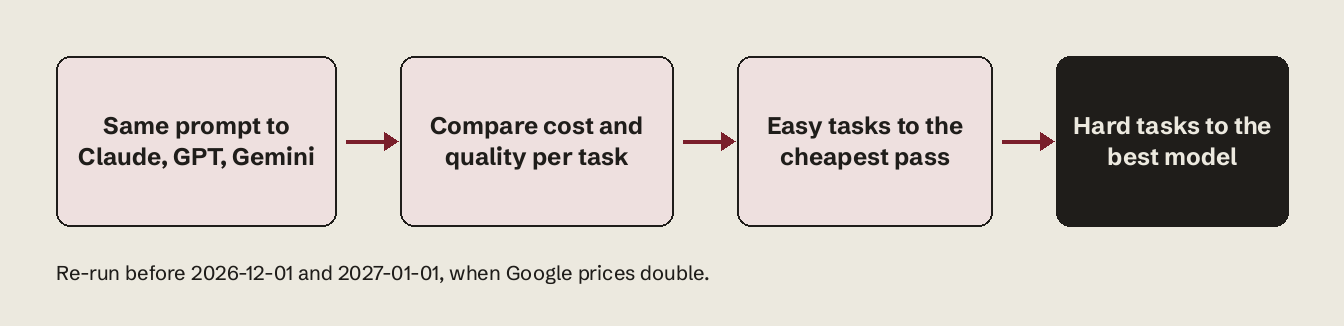
- Tasks differ in difficulty. Send classification to a $0.55-per-1,000 model and hard reasoning to a $11.00 one, instead of everything to the expensive one.
- A dated price rise hits. Argon's 2026-12-01 doubling and 3.8 Flash's 2027-01-01 doubling are reasons to have a second vendor tested before the date.
- You need a fallback. A 429 at Anthropic's spend cap or an outage stops a single-vendor app. A second vendor keeps it answering.
See when not to use an LLM router for the break-even math.
Which one should you pick?
- Choose Vynaris if you have not settled on a vendor or want more than one: one OpenAI-compatible key, a cost on every response, provider price + 3% (1% after $500 a month).
- Choose Anthropic if Claude passes your evals and you want published per-model rate limits and the cheapest cache reads on Sonnet 5.5 and Opus 5.5 (0.05x input).
- Choose OpenAI if you need the Batch and Flex lanes together today, or long cache lifetimes (12-hour writes).
- Choose Google if price per task decides it, or you want a free tier for prototyping and accept that free-tier data is used to improve Google's products.
FAQ
Is Claude more expensive than GPT?
Not on list price at the same tier. Claude Sonnet 5.5 and gpt-6.2-sol both cost $2 / $10 per 1M tokens, and Claude Haiku 5.5 and gpt-6-luna both cost $0.10 / $0.50. Claude's newer tokenizer produces about 30% more tokens for the same text, so per task it can cost more.
Is Gemini cheaper than Claude and GPT?
Yes, per task at every tier on today's list prices. Our 1,000-task support workload costs $4.13 on Gemini 3.8 Flash against $11.00 on Sonnet 5.5 or gpt-6.2-sol. That rises to $8.25 when 3.8 Flash's intro price ends on 2027-01-01.
Do all three offer a batch discount?
Yes. Anthropic, OpenAI and Google all take 50% off input and output for batch jobs that can wait.
Which API has a free tier?
Only Google's, on Gemini 3.8 Flash and Gemini 3.1 Flash-Lite. Google uses free-tier data to improve its products; paid-tier data is not used.
Can I use Claude and Gemini with the OpenAI SDK?
Yes, through a gateway. With Vynaris you set base_url to https://api.vynaris.com/v1 and change the model name; see our list of OpenAI-compatible API providers.
Price your own task on all three
The table above is one workload shape. Yours has different prompt and output lengths, and those decide the winner. Send your real prompts to Claude, GPT and Gemini through one endpoint and read the provider cost on every response. Get your Vynaris API key.