
Blog · · By Dhrumil Barot, Founder
Best Claude Model: 5 Picks by Cost per Task (Compared)
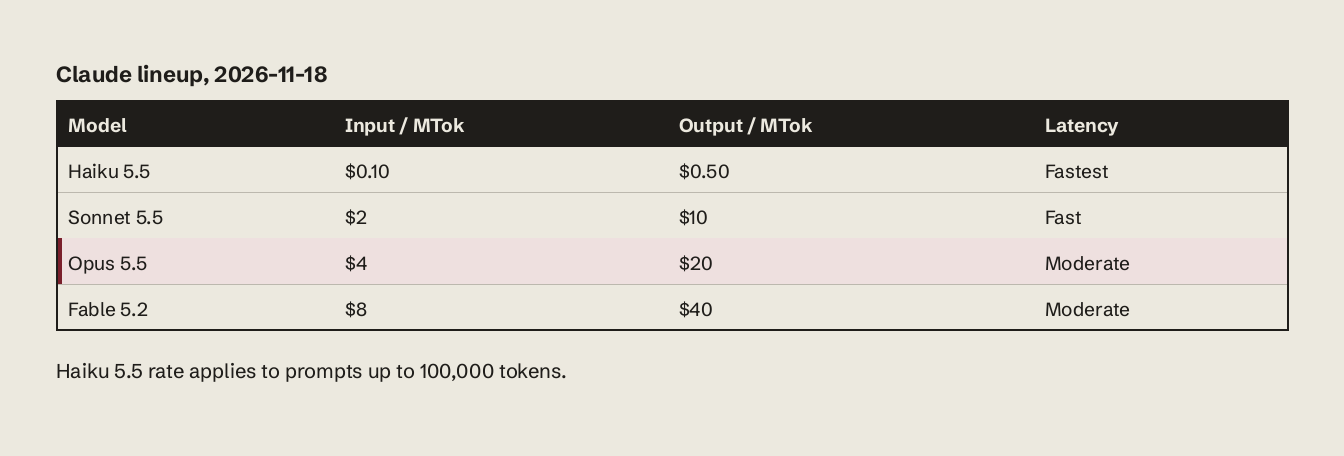
The best Claude model for most work is Claude Opus 5.5 at $4/$20 per MTok. Sonnet 5.5, Haiku 5.5 and Fable 5.2 win on cost or depth. Prices verified 2026-11-18.
TL;DR: The best Claude model for most API work is Claude Opus 5.5 ($4 input / $20 output per million tokens), and Anthropic itself says to start there. Claude Sonnet 5.5 ($2 / $10) is the best value for everyday coding, Claude Haiku 5.5 (from $0.10 / $0.50) is the cheapest, and Claude Fable 5.2 ($8 / $40) is for the hardest long-horizon work. If your traffic mixes easy and hard calls, Vynaris routes each request to the cheapest model that passes, so you don't have to pick one.
Get my API key: point your client at https://api.vynaris.com/v1, set model to auto, and every response carries a receipt with the model that served it and what it cost.
Prices verified 2026-11-18 against the Anthropic pricing docs. The best Claude model depends on the job: on a representative task of 10,000 input and 1,000 output tokens, Haiku 5.5 costs $0.0015, Sonnet 5.5 $0.03, Opus 5.5 $0.06 and Fable 5.2 $0.12. That is an 80x spread from bottom to top. Anthropic's models overview says: "If you're unsure which model to use, start with Claude Opus 5.5 for most workloads." Use Fable 5.2 only when your evals on Opus 5.5 at higher effort still fall short. Most top-ranking guides still list Sonnet 5 and Haiku 4.5; this page uses the November 2026 lineup, including Fable 5.2, which costs 20% less than Fable 5.1.
How we judged
We ranked each option on four criteria a buyer can check:
- Cost per task, not per token. We price two workloads: a short task (10,000 in / 1,000 out) and a coding-agent step (50,000 in / 5,000 out).
- Fit for the job as Anthropic describes it in its choosing a model guide.
- Limits: context window, max output, latency and default effort.
- How much model-picking work it leaves to you.
On the fourth criterion, a router beats any single model when your requests vary in difficulty. That is why it ranks first. If every request you send is hard, skip to option 2.
Summary table: which Claude model is best?
| Option | Input / Output per MTok | Short task cost | Coding step cost | Best for |
|---|---|---|---|---|
| 1. Vynaris (model auto) | Served model's price, shown per request | Varies by route | Varies by route | Mixed traffic, one endpoint |
| 2. Claude Opus 5.5 | $4 / $20 | $0.06 | $0.30 | Default for most workloads, agentic coding |
| 3. Claude Sonnet 5.5 | $2 / $10 | $0.03 | $0.15 | Everyday coding, analysis, content |
| 4. Claude Haiku 5.5 | $0.10 / $0.50 | $0.0015 | $0.0075 | Classification, extraction, subagents |
| 5. Claude Fable 5.2 | $8 / $40 | $0.12 | $0.60 | Hours-long agents, deep research |
Derivation for the coding step on Opus 5.5: 50,000 x $4 / 1M = $0.20, plus 5,000 x $20 / 1M = $0.10, total $0.30. Uncached list prices. Plug your own token counts into the LLM cost calculator.
1. Vynaris: auto-routing across Claude models
Vynaris is an OpenAI and Anthropic-compatible gateway. You keep your SDK, prompts and tool definitions, swap the base URL, and set model to auto. Per the Vynaris homepage, each request starts in a quality-safe frontier pool, and a cheaper model becomes eligible only after exact-version eval evidence clears the quality gate.
What it does for this exact question:
- No single pick. Hard requests stay on a frontier model; easy ones (field extraction, ticket classification) route down.
- Receipts. Every request logs which model served it, what it cost and what the direct price was. The log is exportable, so you can check the math.
- One line of migration:
from openai import OpenAI
import os

client = OpenAI(
    base_url="https://api.vynaris.com/v1",  # was https://api.openai.com/v1
    api_key=os.environ["VYNARIS_API_KEY"],
)
resp = client.chat.completions.create(
    model="auto",
    messages=[{"role": "user", "content": "Classify this ticket: refund not received"}],
)
Best for: apps where most calls are simple and a minority need Opus-level reasoning.
Pricing: you pay for the model that served each request, shown on its receipt. See Vynaris for current rates.
Where it stops: the cheaper route is not always a Claude model; Vynaris may route to open models such as Qwen or Llama. If you need Claude on every call for compliance or consistency, pin the model, or call Anthropic directly. If every request truly needs Fable 5.2, a router saves you nothing. We covered that case in when not to use an LLM router.
2. Claude Opus 5.5: the best default
Claude Opus 5.5 (claude-opus-5-5) is Anthropic's recommended starting point. The selection matrix lists it for "Complex agentic coding and enterprise work": multihour autonomous coding agents, large refactors, vision-heavy workflows and computer use.
- Pricing: $4 input / $20 output per MTok; cache hits $0.20; 5-minute cache writes $5 (source).
- Limits: 1M-token context, 128K max output, moderate latency.
- Detail we verified: default effort is medium and adaptive thinking is always on. Raising effort is often a better lever than switching to Fable.
Best for: teams that want one model and good results without tuning.
3. Claude Sonnet 5.5: best value for everyday coding
Claude Sonnet 5.5 (claude-sonnet-5-5) costs half of Opus 5.5 and is faster. Anthropic positions it for "Speed and capability for everyday coding, agent, and enterprise workloads": code generation, data analysis, content creation and agentic tool use.
- Pricing: $2 / $10 per MTok; cache hits $0.10.
- Limits: 1M context, 128K output, fast latency, default effort high.
- Detail we verified: at $0.15 per coding step, Sonnet 5.5 runs 1,000 agent steps for $150, against $300 on Opus 5.5.
Best for: code completion, edits, reviews and most interactive agents. Our Sonnet 5 price increase analysis covers the previous generation's pricing.
4. Claude Haiku 5.5: the cheapest Claude model
Claude Haiku 5.5 (claude-haiku-5-5) is the fastest and cheapest current model. Anthropic lists it for real-time apps, high-volume processing and subagent tasks.
- Pricing: $0.10 / $0.50 per MTok for prompts up to 100,000 tokens; $0.50 / $2.50 above that; cache hits from $0.01.
- Limits: 1M context, 128K output, fastest latency, default effort medium.
- Detail we verified: the 100,000-token threshold matters. A 150,000-token prompt pays 5x the input rate, so chunk long documents if you can.
Best for: classification, extraction, routing and subagents. Anthropic's own efficiency-first approach starts here and upgrades only when evals fail.
Is it the cheapest Claude model? Yes. Through the Batch API, which gives 50% off input and output, it drops to $0.05 / $0.25. Older models such as Haiku 4.5 ($1 / $5) now cost 10x more than Haiku 5.5. Full rates for every model are in our Claude API pricing reference.
5. Claude Fable 5.2: the most capable model for everyone
Claude Fable 5.2 (claude-fable-5-2) is Anthropic's most capable model open to all customers. Its sibling Claude Mythos 5.2 has the same capabilities and price but is only for organizations verified through programs such as the Cyber Verification Program.
- Pricing: $8 / $40 per MTok; 5-minute cache writes $10; cache hits $0.20. That is 20% under Fable 5.1 ($10 / $50).
- Limits: 1M context, 128K output, moderate latency, default effort high.
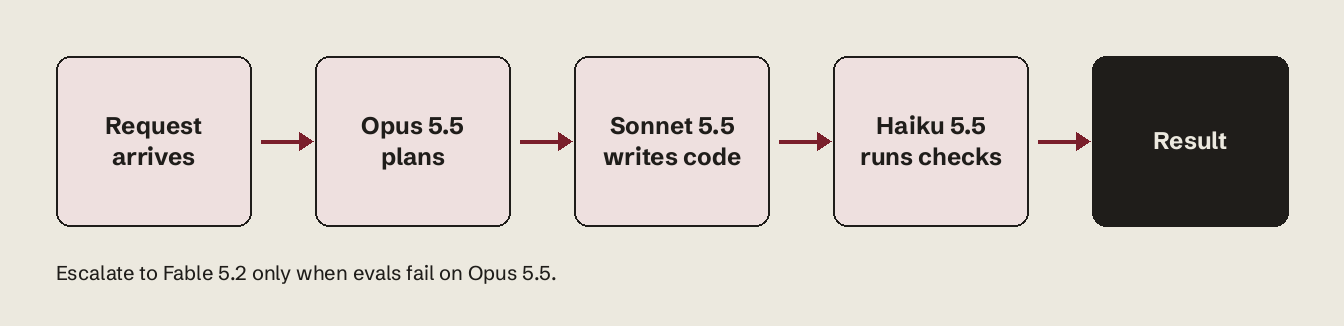
- Detail we verified: Anthropic recommends it "when your evals on Claude Opus 5.5 at higher effort still fall short", for agent sessions that run for hours and multistep deep research.
Best for: long-horizon agents where a wrong step costs more than tokens. Our Fable 5.1 vs Opus 5 token efficiency test shows when the expensive model is cheaper per finished task.
Which Claude model is best for coding?
Claude Opus 5.5 is the best Claude model for agentic coding; Claude Sonnet 5.5 is the best value for everyday coding. Use Opus 5.5 for multihour autonomous agents and large refactors. Use Sonnet 5.5 for completions, edits and reviews at half the price. A common pattern is to plan with Opus and execute with Sonnet or Haiku, which is what we cover in route the plumbing, keep the planner.
Is Opus worth the price over Sonnet?
Opus 5.5 is worth it when Sonnet 5.5 needs more than twice the tokens or retries to finish a task. Opus costs exactly 2x Sonnet per token on input and output. So if Sonnet takes three attempts where Opus takes one, Opus is cheaper per finished task. On short, well-specified tasks Sonnet usually finishes first try, and Opus is wasted money.
| Coding step outcome | Sonnet 5.5 cost | Opus 5.5 cost | Cheaper |
|---|---|---|---|
| Both succeed first try | $0.15 | $0.30 | Sonnet |
| Sonnet needs 2 tries | $0.30 | $0.30 | Tie |
| Sonnet needs 3 tries | $0.45 | $0.30 | Opus |
When should I use Haiku?
Use Haiku 5.5 when the task is narrow and repeated: classifying support tickets, extracting fields, tagging, routing requests, or running as a subagent. Don't use it for open-ended reasoning or multi-file code changes. Test it against your own prompts first; Anthropic's advice is to start with Haiku, evaluate, and upgrade only for specific capability gaps.
How to choose
Answer two questions. First, does difficulty vary across your requests? Take a support bot that sends 90 easy lookups for each 10 hard refund cases. On the short-task numbers above, 100 calls on Opus 5.5 cost $6.00; sending the 90 lookups to Haiku 5.5 instead costs $0.135 plus $0.60, or $0.735. That gap is option 1's case. Second, if difficulty is uniform, how hard is the typical request? Pick the lowest tier that passes your evals: Haiku 5.5 for narrow repeated work, Sonnet 5.5 for everyday code and content, Opus 5.5 for agentic coding, and Fable 5.2 only after Opus fails at higher effort.
Whichever you pick, build a small eval set from your real prompts. Anthropic calls a good evaluation set "the most important step" in choosing a model.
FAQ
What is the best Claude model right now?
Claude Opus 5.5 for most workloads, per Anthropic's own docs. Claude Fable 5.2 is the most capable model open to all customers, at twice the price.
Is Claude Fable 5.2 better than Opus 5.5?
Fable 5.2 is more capable on demanding reasoning and long-horizon agent work. It costs $8 / $40 per MTok against $4 / $20, so it pays off only when Opus 5.5 fails your evals.
What is the difference between Fable 5.2 and Mythos 5.2?
They have the same capabilities and the same price. Mythos 5.2 is only for organizations verified through Anthropic programs such as the Cyber Verification Program.
Do all Claude models have the same context window?
Yes. Fable 5.2, Opus 5.5, Sonnet 5.5 and Haiku 5.5 all have a 1M-token context window and 128K max output.
How long will these models be available?
Anthropic lists retirement no sooner than 2027-09-22 for Opus 5.5, 2027-09-28 for Sonnet 5.5, 2027-10-07 for Haiku 5.5 and 2027-11-09 for Fable 5.2.
Can I use more than one Claude model in the same app?
Yes. Anthropic recommends combining models, for example a strong model for planning and cheaper ones for execution. A router such as Vynaris does this per request.
Stop picking one model
The best Claude model for a request depends on the request. Get my API key, change one base_url, set model to auto, and check every routing decision on its receipt.
Sources
- Anthropic: Pricing, captured 2026-11-18
- Anthropic: Models overview, captured 2026-11-18
- Anthropic: Choosing a model, captured 2026-11-18