
Blog · 2026-07-28 · Vynaris Team
What an ambient clinical scribe costs per patient visit: the data-residency floor and the 100%-sign-off math
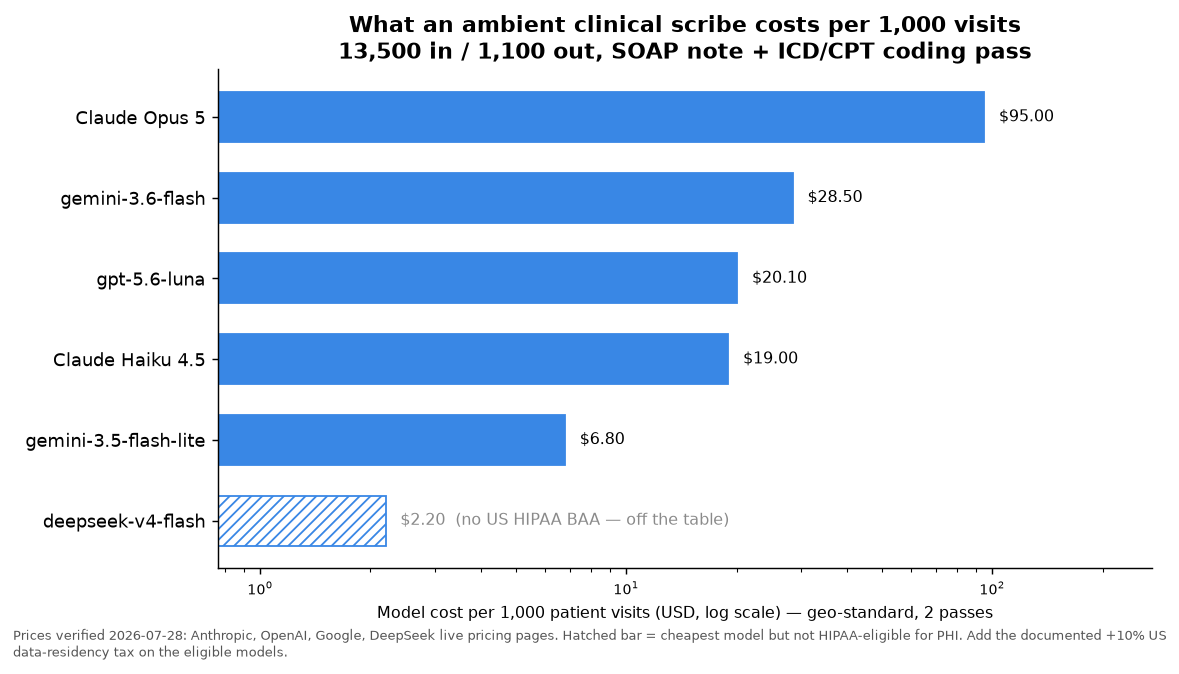
An ambient AI clinical scribe costs $2.20-$95 per 1,000 visits across six models (verified 2026-07-28). The cheapest model can't legally touch PHI, and the model fee is under 2% of a visit once a clinician signs the note. The data-residency floor and 100%-sign-off math, per visit.
An ambient AI clinical scribe costs $2.20 to $95.00 per 1,000 patient visits in model fees, a 43x spread across six models, with prices verified 2026-07-28. Two facts break the usual cost advice before you pick a model. The cheapest model on the list cannot legally touch the data, and the model fee is under 2% of what one visit actually costs once a clinician signs the note. This is a reproducible cost model, per visit, you can re-run with your own numbers.
TL;DR
- Geo-standard model fees run $2.20 to $95.00 per 1,000 visits across six models on a 13,500-token-in, 1,100-token-out, two-pass workload. Prices verified 2026-07-28.
- The cheapest line, deepseek-v4-flash at $2.20, is off the table for protected health information: no US HIPAA business associate agreement. The cheapest model a US scribe can actually run is gemini-3.5-flash-lite at $6.80 per 1,000 visits.
- Every note gets 100% clinician sign-off, roughly 2 minutes at a $150/hour loaded rate, or $5.00 of human time per visit. The priciest compliant model, Claude Opus 5 with US residency, is $0.1045, which is 2.05% of that. The lever is clinician-minutes, not tokens.
The finding, before the model
An ambient scribe listens to a patient encounter, then does two things. First it writes a SOAP note from the visit transcript. Then a second pass reads that note and suggests ICD-10 and CPT codes for billing. That two-pass shape, note plus coding, is the workload. It has three properties that flip the advice you would use on a generic summarizer.
First, the data is regulated. A scribe processes protected health information, so the provider needs a US HIPAA business associate agreement and, for many buyers, a guarantee that inference stays on US soil. That requirement sets a floor under the menu: the very cheapest model is disqualified on compliance, not price.
Second, the clinician stays in the loop on every single note. Unlike a meeting summary nobody legally owns, a clinical note is a medical-legal document a licensed provider must review and attest. That review time is part of the per-visit cost, and it dwarfs the model fee.
Third, the note is wanted now, at the point of care, not next morning. So the Batch API discount that halves a summarizer's bill does not apply here. A scribe is near-real-time by definition.
We built this from public pricing only. No product data. Every token count below is an assumption you can edit, and every price is from a provider's live page, captured 2026-07-28.
The workload (edit these)
One patient visit is the outcome unit: one ambient-recorded encounter, one signed note, one set of suggested codes.
Assumption           Value                                                             Note
-------------------  ----------------------------------------------------------------  --------------------------------------------------
Visit transcript in  12,000 [input tokens](https://vynaris.com/glossary/input-tokens)  ~15-20 min of ambient encounter audio, transcribed
SOAP note out        800 [output tokens](https://vynaris.com/glossary/output-tokens)   pass 1: the progress note
Coding pass in       1,500 input tokens                                                pass 2: the generated note plus a coding rubric
Coding pass out      300 output tokens                                                 pass 2: structured ICD-10 / CPT suggestions
Total per visit      13,500 in / 1,100 out                                             two passes, one visit
Clinician sign-off   ~2 min at $150/hour = $5.00                                       100% of notes reviewed and attested
Latency              near-real-time                                                    at the point of care, so not batch-eligible
Two numbers drive the model bill: the 12,000-token transcript is 89% of the input and is unique to every visit, and the coding pass adds a second, smaller call on top of the note. Everything else is rounding. But the number that drives the visit bill is the last row, the clinician minute, and it is 50 to 2,000 times larger than the model fee.
The model fee, six models
Same workload, same cost-per-token math, six scribe-grade models, geo-standard base rates. Prices verified 2026-07-28.
Model                                                                      Per visit  Per 1,000 visits  HIPAA BAA available
-------------------------------------------------------------------------  ---------  ----------------  -------------------
[deepseek-v4-flash](https://vynaris.com/models#deepseek-v4-flash)          $0.0022    $2.20             No
[gemini-3.5-flash-lite](https://vynaris.com/models#gemini-3-5-flash-lite)  $0.0068    $6.80             Yes (Vertex)
[Claude Haiku 4.5](https://vynaris.com/models#claude-haiku-4-5)            $0.0190    $19.00            Yes
[gpt-5.6-luna](https://vynaris.com/models#gpt-5-6-luna)                    $0.0201    $20.10            Yes
[gemini-3.6-flash](https://vynaris.com/models#gemini-3-6-flash)            $0.0285    $28.50            Yes (Vertex)
[Claude Opus 5](https://vynaris.com/models#claude-opus-5)                  $0.0950    $95.00            Yes
The geo-standard spread is 43x, from $2.20 to $95.00 per 1,000 visits. On any other workload you would stop reading here and pick the bottom row. On this one you cannot, and the reason is the whole point of the post.
The residency floor: the real tax is not the 1.1x
Regulated buyers reach for data residency: keep inference inside US borders under a signed agreement. Two providers publish an exact surcharge for it. Anthropic charges a 1.1x multiplier on Claude 4.6 and later when you set inference_geo: "us", and routes 4.5-generation models such as Claude Haiku 4.5 through regional endpoints at the same 10% premium. OpenAI adds a 10% regional uplift on models released on or after 2026-03-05, which covers gpt-5.6-luna. The multiplier stacks on every token category, the same composition we mapped in the price-multipliers stack.
Model             Geo-standard / visit  US-residency / visit  Residency tax / visit
----------------  --------------------  --------------------  ---------------------
Claude Haiku 4.5  $0.0190               $0.0209               $0.0019
gpt-5.6-luna      $0.0201               $0.0221               $0.0020
Claude Opus 5     $0.0950               $0.1045               $0.0095
Read the tax column, then forget it. Ten percent of a bill this small is a fifth of a cent to a cent per visit. The residency surcharge is real, and it is immaterial to your total cost.
The residency requirement, on the other hand, is the most expensive line item nobody prices. It deletes deepseek-v4-flash, the $2.20 option, from the menu entirely, because there is no US HIPAA business associate agreement behind it. So the honest "cost of residency" is not the 1.1x you pay. It is the 3x you lose by being floored at $6.80 instead of $2.20 per 1,000 visits, and the discipline of only ever calling providers that will sign a BAA. Gemini's residency path runs through Vertex AI regional endpoints under a BAA, and its first-party pricing page publishes no token multiplier, so price the residency version at Vertex regional rates before you commit.
The 100% sign-off floor: where the money actually is
Here is the number that ends the model-shopping. Every scribe note is reviewed and attested by a licensed clinician. Call that 2 minutes at a $150/hour loaded cost, so $5.00 of human time per visit.
Model (US residency where offered)  Cost / visit  Share of the per-visit cost
----------------------------------  ------------  ---------------------------
Claude Opus 5                       $0.1045       2.05%
gpt-5.6-luna                        $0.0221       0.44%
Claude Haiku 4.5                    $0.0209       0.42%
The most expensive compliant model, at full US-residency price, is 2% of what the visit costs once you count the clinician. The sensible pick is under half a percent. The 43x model spread that looked decisive three paragraphs ago is noise against a $5.00 human floor.
That floor also inverts the routing question. On a summarizer, the model is a rounding error against the minutes the summary saves, so you buy the cheapest model that clears quality. Here the clinician is in the per-visit cost, so a better note that shortens the review is worth real money. Work the break-even: Claude Opus 5 costs $0.0836 per visit more than Claude Haiku 4.5 at US-residency rates, and a clinician-second is worth $0.0417 at $150/hour. So if the pricier model's cleaner note trims about 2 seconds off the clinician's review, it is already net cheaper than the budget model. Price your own transcript and note sizes before you lock a model in.
Where routing changes the unit economics, and where it doesn't
Routing still has a job here, but it is a quality-and-latency job wearing a cost costume. Two moves are defensible.
Split the passes across models. The SOAP note is the hard, quality-critical pass, and the coding pass is a shorter, more structured task. You can run the note on a stronger model and the codes on a cheaper one. Because the coding pass is only 1,500 in and 300 out, moving it from Claude Opus 5 to Claude Haiku 4.5 saves about $0.012 per visit, which is real at volume but still a rounding error against the sign-off minute.
Route on visit type. A routine follow-up and a complex new-patient consult are not the same note. You know the encounter type before the model runs, so you can send simple visits to a cheap model and reserve the stronger model for the complex tail. That is a weighted average on a free up-front signal, not the double-spend of a confidence cascade. But notice what it buys: it lifts quality on the hard visits, and it barely moves a bill that is already 2% of the visit cost.
Build notes
A token model does not capture the constraints that actually decide a scribe.
- Compliance is a hard gate, not a slider. No BAA means the model does not exist for this workload, whatever its price. Confirm the agreement and the US-inference path before you benchmark a single note. This is why the cheapest model on the chart is drawn hollow.
- Near-real-time kills the batch discount. The clinician wants the note before the next patient, so you pay on-demand rates. If any part of your pipeline can wait, like an overnight coding-audit re-run, batch that pass and keep the interactive note on-demand. We worked the batch trade-off in when latency is free.
- Caching helps the coding rubric, not the transcript. The transcript is unique per visit and uncacheable. The static coding rubric and note template are the same on every call, so prompt caching that small shared prefix shaves a little off the coding pass. It is a minor line, not a strategy.
- Transcription quality gates everything. The 12,000-token input is only as good as your speech-to-text over crosstalk and clinical terms. Diarization errors cost clinician review time, which is the expensive resource, so spend there before you shave tokens. The context window also caps how long an encounter you can pass in one call before you chunk and merge.
When this workload does not need a router
The honest tradeoff: if one compliant model writes notes your clinicians trust with a short review, run it flat and skip the router. At gemini-3.5-flash-lite you are at $6.80 per 1,000 visits, and the model fee is already 0.1% of the sign-off cost. A model routing layer earns its keep only if your complex visits measurably need a stronger frontier model and your routine ones do not, so the split shortens clinician review where it counts. Route to buy back clinician minutes on the hard tail, never to shave a token bill that is already 2% of the visit. This is the mirror image of the meeting summarizer, where batch was the lever and caching was noise. Here residency is the gate and clinician-minutes are the lever.
FAQ
What does an ambient clinical scribe cost per patient visit? In model fees, $0.0022 to $0.095 per visit across deepseek-v4-flash through Claude Opus 5, on a 13,500-input, 1,100-output, two-pass workload. Per 1,000 visits that is $2.20 to $95.00 geo-standard, a 43x spread. Add a documented 10% US data-residency surcharge on the compliant models. Prices verified 2026-07-28.
Why can't I just use the cheapest model? Because a scribe processes protected health information, and the cheapest listed model, deepseek-v4-flash, has no US HIPAA business associate agreement. The cheapest model a US scribe can legally run is gemini-3.5-flash-lite at $6.80 per 1,000 visits, roughly 3x the disqualified option.
How much is the data-residency tax? The published surcharge is 1.1x, so about a fifth of a cent to a cent per visit on the models that publish one. That is immaterial. The real cost of the residency requirement is losing access to the cheapest non-compliant models, not the multiplier.
Should I pay for a more expensive model? Often yes, and for an unusual reason. Every note gets 100% clinician sign-off, so a cleaner note that trims about 2 seconds of review pays for the jump from Claude Haiku 4.5 to Claude Opus 5. Choose on note quality and review time, because the clinician-minute is 98% of the visit cost.
Does the Batch API help a scribe? No. The note is needed at the point of care, so the workload is near-real-time and pays on-demand rates. Batch only helps a non-interactive side pass, such as an overnight coding audit, not the live note.
Sources
- Anthropic pricing (Claude Opus 5 $5/$25, Claude Haiku 4.5 $1/$5,
inference_geo: "us"1.1x on Claude 4.6+, regional endpoints +10% on 4.5-generation models, Batch API 50%, cache read 0.1x), captured 2026-07-28: https://platform.claude.com/docs/en/about-claude/pricing - OpenAI pricing (gpt-5.6-luna $1/$6, regional data-residency +10% on models released on or after 2026-03-05), captured 2026-07-28: https://developers.openai.com/api/docs/pricing
- Google Gemini API pricing (gemini-3.6-flash $1.50/$7.50, gemini-3.5-flash-lite $0.30/$2.50), captured 2026-07-28: https://ai.google.dev/gemini-api/docs/pricing
- DeepSeek API pricing (deepseek-v4-flash $0.14/$0.28, no batch tier), captured 2026-07-28: https://api-docs.deepseek.com/quick_start/pricing
- Cost model script and per-visit arithmetic: from the assumptions table above.
Prices change. We re-verify every figure in this post monthly and stamp updates. Numbers here are current as of 2026-07-28.
The lesson from the model: a scribe's bill is not set by the token spread you can see on a pricing page. It is set by a compliance gate that deletes the cheapest option, and by a clinician minute that makes the surviving 43x spread a rounding error. Pick the cheapest model with a signed BAA that your clinicians trust with a short review, run it near-real-time, and spend your engineering effort on transcript quality and note accuracy, because those buy back the minute that actually costs money. Vynaris is an OpenAI-compatible gateway that routes each request to the cheapest right-sized model, keeps compliant models on a compliant path, and shows the per-visit cost so you watch the number that matters. One base URL swap. Get an API key at vynaris.com.