
Blog · 2026-07-27 · Vynaris Team
What a meeting summarizer costs per meeting-hour: the 42x spread the Batch API halves and caching can't touch
A meeting summarizer costs $1.90-$80 per 1,000 meeting-hours across 5 models. The Batch API halves it; caching saves just 2.8%. Prices verified 2026-07-27.
A meeting-transcript summarizer costs between $1.90 and $80.00 per 1,000 meeting-hours in model fees, a 42x spread across five models, with prices verified 2026-07-27. Two levers move that number, and they are not the two you use everywhere else. The daily digest tolerates 24-hour latency, so the Batch API's flat 50% cut applies cleanly. But prompt caching, the lever that dominates coding agents, saves 2.8% here, because every transcript is unique and there is no repeated prefix to cache. This is a reproducible cost model, per meeting-hour, you can re-run with your own numbers.
The finding, before the model
A summarizer reads one meeting transcript and writes one summary plus a list of action items. That is the whole workload: a big one-time input, a small output, once per meeting. The token shape has two properties that flip the usual advice.
First, the input is a fresh transcript every time. There is no stable system prefix worth caching, so prompt caching buys almost nothing: 2.8% on Claude Haiku 4.5, and trying harder makes it worse. Second, most summaries are consumed as a next-morning digest, not live during the call, so a 24-hour turnaround is fine. That makes the whole job Batch API-eligible, and batch is a clean 50% off input and output on the providers that offer it.
So the summarizer is the mirror image of an agent loop. There, caching is decisive and batch is impossible because the user is waiting. Here, batch is decisive and caching is a rounding error. Get those two facts right and the model-choice question mostly disappears, because the model fee is 0.01% to 0.4% of the human minutes each summary saves.
We built this from public pricing only. No product data. Every token count below is an assumption you can edit, and every price is from a provider's live page, captured 2026-07-27.
The workload (edit these)
One meeting-hour is the outcome unit: roughly sixty minutes of multi-speaker conversation, transcribed, summarized once.
Assumption                Value                                                             Note
------------------------  ----------------------------------------------------------------  ------------------------------------------------
Transcript in             12,000 [input tokens](https://vynaris.com/glossary/input-tokens)  ~1 hour of multi-speaker speech-to-text
Summary out               600 [output tokens](https://vynaris.com/glossary/output-tokens)   the narrative recap
Action items out          200 output tokens                                                 extracted tasks and owners
Output per meeting-hour   800 output tokens                                                 summary + actions in one call
Fixed instruction prefix  500 tokens                                                        the only cacheable text (persona + format rules)
Latency tolerance         24 hours                                                          a next-morning digest, so batch-eligible
Human time saved          ~20 min at $60/hour = $12–$20                                     editable; the value the summary replaces
One number drives the whole bill: the 12,000-token transcript is 96% of the input and it is different for every meeting. You cannot amortize it across meetings, and you should not split it across calls (shown below). The output is small and fixed. This is a one-shot, input-heavy, latency-relaxed shape, which is why the levers differ from an interactive product.
The model fee, five models
Same workload, same cost-per-token math, five summarization-grade models, on-demand and via the Batch API. Prices verified 2026-07-27.
Model                                                                      On-demand / 1k hours  Batch / 1k hours  Batch saving
-------------------------------------------------------------------------  --------------------  ----------------  ------------
[deepseek-v4-flash](https://vynaris.com/models#deepseek-v4-flash)          $1.90                 $1.90             no Batch API
[gemini-3.5-flash-lite](https://vynaris.com/models#gemini-3-5-flash-lite)  $5.60                 $2.80             50%
[Claude Haiku 4.5](https://vynaris.com/models#claude-haiku-4-5)            $16.00                $8.00             50%
[gemini-3.6-flash](https://vynaris.com/models#gemini-3-6-flash)            $24.00                $12.00            50%
[Claude Opus 5](https://vynaris.com/models#claude-opus-5)                  $80.00                $40.00            50%
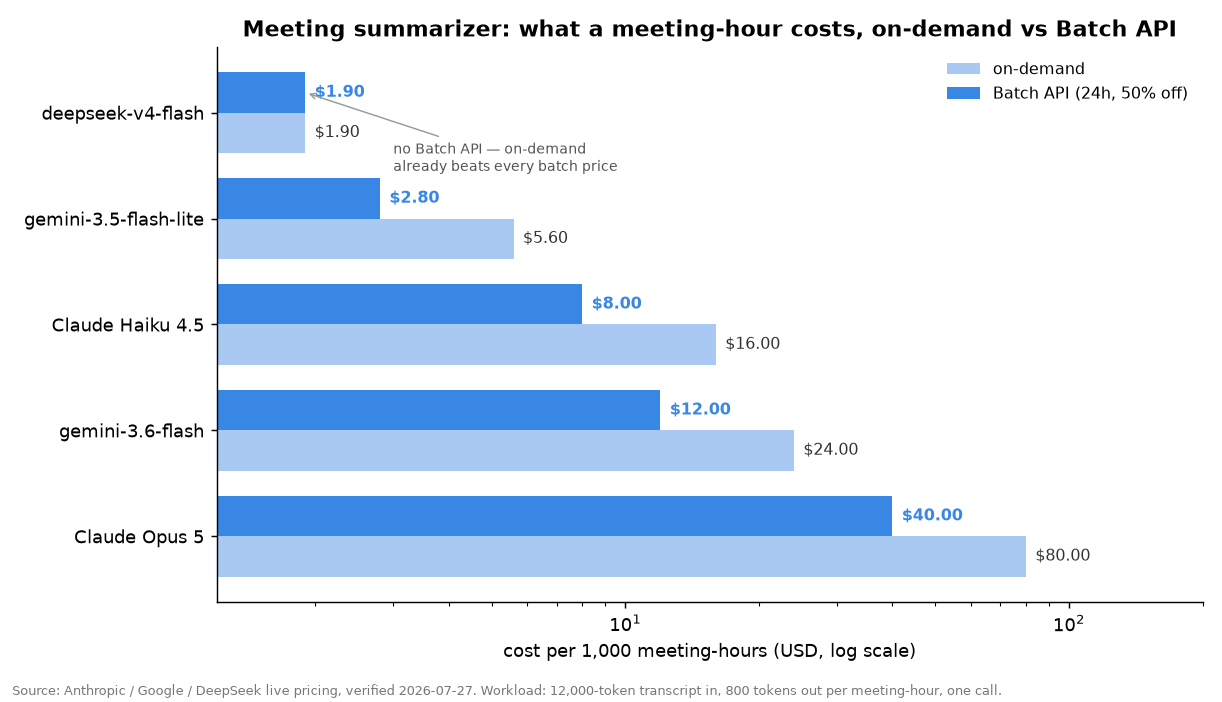
The on-demand spread is 42x, from $1.90 to $80.00 per 1,000 meeting-hours. The Batch API takes an exact 50% off input and output on the four providers that offer it, so batch preserves the ranking and halves every line.
One row breaks the pattern. deepseek-v4-flash has no Batch API and no off-peak schedule as of 2026-07-27, so its on-demand price is its only price. It does not need one: at $1.90 per 1,000 meeting-hours it already undercuts every other model's batch price, including gemini-3.5-flash-lite's batched $2.80. The cheapest model wins without the discount everyone else depends on.
Why caching does almost nothing here
Caching a large static prefix is decisive when you re-send it every call. A summarizer does not have one. The transcript changes every meeting, and it is 96% of the input. The only stable text is the ~500-token instruction block, so caching it is the whole prize, and it is small.
Approach (Claude Haiku 4.5)                   Cost / meeting-hour
--------------------------------------------  -------------------
One call, no cache                            $0.0160
One call, cache the 500-token prefix          $0.0155 (2.8% off)
Two calls (summary, then actions), no cache   $0.0280
Two calls, cache the transcript between them  $0.0202
Read the bottom two rows before you get clever. A tempting idea is to split the job into two calls, one for the summary and one for the action items, and cache the transcript so the second call reads it cheaply. It backfires. The cache write costs 1.25x the input price on the first call, and that premium alone ($0.0202 for the two-call cached version) is more than doing the whole thing in a single uncached call ($0.0160). The transcript is read once no matter what, so the cheapest path is one call, no caching. Spend the engineering hour somewhere else.
Where routing changes the unit economics, and where it doesn't
Routing here has a property most LLM workloads lack: you know the input size before you spend a token. Transcript length is a free, up-front signal, so you can send short standard meetings to a cheap model and reserve a stronger model for long or high-stakes ones. There is no confidence classifier to run and no retry, so this is a weighted average, not the double-spend of a confidence-gated cascade.
Take 1,000 meeting-hours where 80% are standard (12k-token transcripts) and 20% are long (40k-token, multi-track sessions) that you want on a better model for quality:
Tier                   Model (batch)          Cost
---------------------  ---------------------  --------------------
80% standard (12k in)  gemini-3.5-flash-lite  $0.0028 / hour
20% long (40k in)      gemini-3.6-flash       $0.0330 / hour
**Routed blended**                            **$8.84 / 1k hours**
That routed blend is 26% below running every meeting on gemini-3.6-flash batch ($12.00) and 78% below all-Opus 5 batch ($40.00). But notice what routing bought: it went up-model on the hard 20% to protect quality, and it still cost more than the flat cheap option. Running everything on gemini-3.5-flash-lite batch is $2.80 per 1,000 hours, and deepseek-v4-flash on-demand is $1.90. Both beat the routed $8.84. So routing a summarizer is a quality decision wearing a cost costume: it earns its keep only if your long meetings genuinely need the stronger model. If a single cheap model clears your quality bar, route nothing. Run your own transcript length and output size through the calculator, which takes the per-meeting-hour input and output counts directly.
When the model cost is a rounding error
Here is the number that should end most of these debates. One summarized meeting-hour removes maybe 20 minutes of a person writing notes by hand. At a $60/hour loaded cost that is $20 of human time saved per meeting-hour.
Model (on-demand)  Cost / meeting-hour  Share of the $20 saved
-----------------  -------------------  ----------------------
Claude Opus 5      $0.0800              0.40%
Claude Haiku 4.5   $0.0160              0.08%
deepseek-v4-flash  $0.0019              0.01%
The most expensive model on the list, at full on-demand price, is four-tenths of one percent of the value it produces. The cheapest is one-hundredth of one percent. The gap between them, 42x in model fees, is the gap between $0.0019 and $0.08 against a $20 baseline. It is noise. What is not noise is whether people trust the summary enough to stop reading the transcript. That is a quality-and-accuracy question, not a price question, and it is where your effort belongs.
Build notes
A token model does not capture the constraints that actually decide a summarizer.
- Latency is the switch that turns batch on or off. A next-morning digest is batch-eligible, so take the 50% cut. But if the product shows the summary live as the call ends, you are on-demand and you lose the discount. Decide this per surface: batch the digest, pay on-demand for the live view.
- Transcript quality gates everything upstream. The 12,000-token input is only as good as your speech-to-text. Diarization errors and dropped words cost you re-runs and reader trust, both worth far more than any per-token saving. The context window also caps how long a meeting you can summarize in one call before you must chunk-and-merge, which adds output tokens for the merge pass.
- One call, structured output. Ask for the summary and the action items in a single response with a defined schema. Splitting them doubles the transcript read and, as shown above, caching does not rescue it.
- DeepSeek's cache-hit tier is a red herring here. Its $0.0028 cached input rate needs a repeated prefix, which a summarizer does not have. Price it at the cache-miss $0.14 input, which is what a unique transcript pays.
When this workload does not need a router
The honest tradeoff: if one cheap model summarizes your meetings well enough, do not build a router. At gemini-3.5-flash-lite batch you are at $2.80 per 1,000 meeting-hours, and deepseek-v4-flash is $1.90 with no batch machinery at all. A length-based router only pays off when your long or high-stakes meetings measurably need a stronger model and your short ones do not, so the split protects quality without paying frontier prices on every transcript. If your meetings are uniform, or if the frontier model does not produce a summary your users trust more, the router is complexity with no payoff. Route to protect quality on the hard tail, never to shave a bill that is already a rounding error.
FAQ
What does a meeting summarizer cost per meeting-hour? In model fees, $0.0019 to $0.08 per meeting-hour across deepseek-v4-flash through Claude Opus 5, on a workload of 12,000 input and 800 output tokens. Per 1,000 meeting-hours that is $1.90 to $80.00 on-demand, a 42x spread. Prices verified 2026-07-27.
Does the Batch API help a summarizer? Yes, more than anything else. A next-morning digest tolerates 24-hour latency, so the Batch API's flat 50% cut on input and output applies. It halves every model's bill on the four providers that offer it. deepseek-v4-flash has no batch tier but is cheap enough on-demand to beat every batched price.
Why doesn't caching help? Because every transcript is unique. Caching pays off when you re-send a large stable prefix, and a summarizer has none: the transcript is 96% of the input and changes each meeting. Caching the small fixed instruction block saves 2.8%, and splitting the job to reuse the transcript via cache costs more than one plain call.
Which model should I pick? The cheapest one that clears your quality bar. The model fee is 0.01% to 0.4% of the human minutes each summary saves, so the 42x price spread barely touches your ROI. Choose on summary accuracy and reader trust, then take batch and the cheapest acceptable model.
When is routing worth it? Only when long or high-stakes meetings need a stronger model than your short ones. Because you know transcript length before you call, you route on a free signal with no retry cost, but the routed blend still costs more than a flat cheap model. Route for quality on the hard tail, not for savings.
Sources
- Anthropic pricing (Claude Haiku 4.5, Claude Opus 5, Batch API 50% discount, cache read 0.1x, 5-minute cache write 1.25x), captured 2026-07-27: https://platform.claude.com/docs/en/about-claude/pricing
- Google Gemini API pricing (gemini-3.6-flash, gemini-3.5-flash-lite, Batch API 50% off), captured 2026-07-27: https://ai.google.dev/gemini-api/docs/pricing
- DeepSeek API pricing (deepseek-v4-flash, no batch tier), captured 2026-07-27: https://api-docs.deepseek.com/quick_start/pricing
- Cost model script and per-meeting-hour arithmetic: from the assumptions table above.
Prices change. We re-verify every figure in this post monthly and stamp updates. Numbers here are current as of 2026-07-27.
The lesson from the model: a summarizer's bill is set by two levers most teams reach for in the wrong order. Batch the job, because latency is relaxed; skip caching, because the transcript is unique; and stop agonizing over a model fee that is a rounding error against the time each summary gives back. Vynaris is an OpenAI-compatible gateway that batches what can wait, routes long transcripts to a stronger model only when quality needs it, and shows the per-meeting-hour cost so you watch the number that matters. One base URL swap. Get an API key at vynaris.com.