
Blog · 2026-08-06 · Vynaris Team
News-monitoring LLM cost: $0.20-$1.64 per 1,000 articles
A next-day news-monitoring digest costs $0.2012-$1.6350 per 1,000 articles on Batch. At 30% duplicates, embedding dedupe cuts 17.3%-28.3%. Prices verified 2026-08-06.
A next-day news-monitoring digest costs $0.2012 to $1.6350 per 1,000 ingested articles on this editable Batch workload. At a 30% duplicate rate, embedding dedupe cuts the bill 17.3% to 28.3%. On GPT-5.6 Luna, dedupe stops paying below 12.5% duplicates. Prices verified 2026-08-06.
TL;DR
- The pipeline embeds 1,000 articles, drops an assumed 30% as duplicates, extracts 700 unique items, then writes one daily digest.
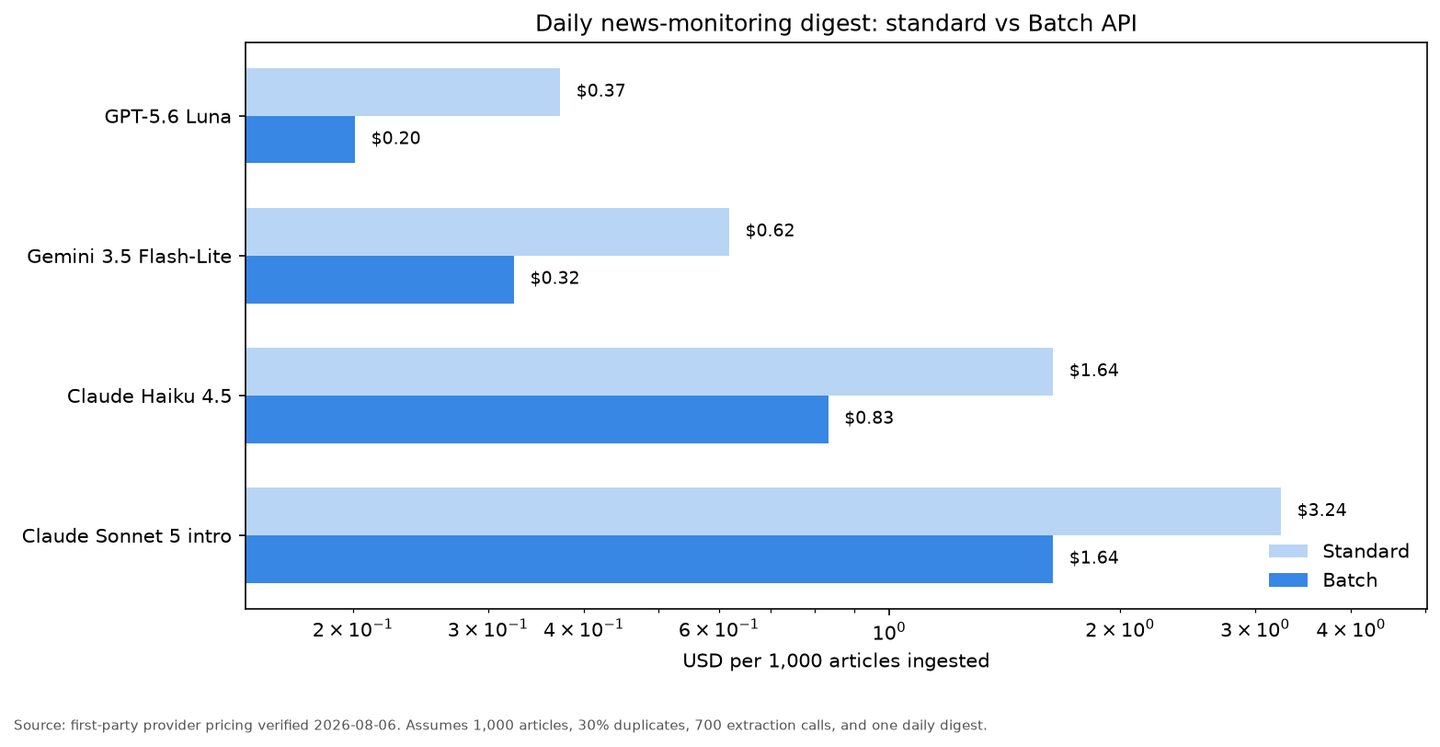
- Batch cost spans $0.2012 on GPT-5.6 Luna to $1.6350 on Claude Sonnet 5. The same pipeline at standard rates costs $0.3724 to $3.2400.
- Dedupe breaks even at 12.5% duplicates on Luna Batch, 7.3% on Gemini 3.5 Flash-Lite, 2.7% on Claude Haiku 4.5, and 1.3% on Sonnet 5.
- Routing Luna extraction to a Sonnet digest costs $0.2280. That is 13.3% above all-Luna and 86.1% below all-Sonnet.
The workload model
One outcome is a digest built from 1,000 articles ingested during a day. This is a next-day editorial or market-intelligence product, not a breaking-news alert.
Every volume below is an assumption. None comes from Vynaris traffic, a customer feed, or a measured monitoring product. Replace each count with tokenizer output from your own corpus.
Assumption            Value                                        Why it exists
--------------------  -------------------------------------------  --------------------------------------------------
Articles ingested     1,000/day                                    Outcome unit
Clean article length  1,500 tokens each                            Text after boilerplate removal
Embedding pass        1,500 tokens per article                     Near-duplicate detection before generation
Duplicate rate        30%                                          Editable assumption, leaving 700 unique articles
Extraction pass       1,500 input / 150 output per unique article  Entities, event, date, evidence, topic and novelty
Daily digest          20,000 input / 2,000 output                  Selected briefs plus editorial instructions
Embedding model       text-embedding-3-small at $0.02/1M           Same listed price on the Batch endpoint
Delivery window       Within 24 hours                              Makes all generation calls Batch-eligible
The 20,000-token digest input assumes a selection step sends a bounded set of briefs, not all 105,000 extracted output tokens. A deterministic ranker can select by source priority, novelty score and topic quota. Sending every brief into one final prompt would be a different workload.
This shape is distinct from our voice-of-customer mining playbook. That pipeline extracts every conversation, then pays an embedding and cluster-rollup overhead. News monitoring embeds first. Its dedupe stage avoids extraction calls, so duplicate rate has a measurable break-even.
It also differs from regulatory change-detection monitoring. That workload re-reads the same instrument daily and saves on sparse no-change output plus optional prefix cache. This one prices fresh-article volume where embedding dedupe decides how many extraction calls you pay for.
It also differs from the Batch API comparison. That article explains the discount. This one prices an outcome where batching and pre-generation dedupe interact.
Verdict: cost per 1,000 articles
The verdict uses Batch rates because no user waits on an individual article. Standard totals are included to show the latency trade.
Model                                                                      Standard $/1M in/out  Batch $/1M in/out  Standard total  Batch total  Batch per article
-------------------------------------------------------------------------  --------------------  -----------------  --------------  -----------  -----------------
[GPT-5.6 Luna](https://vynaris.com/models#gpt-5-6-luna)                    $0.20 / $1.20         $0.10 / $0.60      $0.3724         $0.2012      $0.000201
[Gemini 3.5 Flash-Lite](https://vynaris.com/models#gemini-3-5-flash-lite)  $0.30 / $2.50         $0.15 / $1.25      $0.6185         $0.3243      $0.000324
[Claude Haiku 4.5](https://vynaris.com/models#claude-haiku-4-5)            $1.00 / $5.00         $0.50 / $2.50      $1.6350         $0.8325      $0.000833
[Claude Sonnet 5](https://vynaris.com/models#claude-sonnet-5) intro        $2.00 / $10.00        $1.00 / $5.00      $3.2400         $1.6350      $0.001635
Sonnet 5 prices above are now standard. Anthropic canceled the scheduled 2026-09-01 increase, so Batch stays $1/$5. The table excludes feed licensing, crawling, storage, vector search, human review and delivery infrastructure. Updated 2026-08-14.
The arithmetic behind $0.2012
After dedupe, chat volume is 1,070,000 input tokens and 107,000 output tokens. The embedding pass processes 1,500,000 tokens.
GPT-5.6 Luna Batch costs $0.10 per 1M input and $0.60 per 1M output tokens:
Embed:  1,000 x 1,500 x $0.02 / 1M                  = $0.0300
Extract:  700 x (1,500 x $0.10 + 150 x $0.60) / 1M = $0.1680
Digest:         (20,000 x $0.10 + 2,000 x $0.60) / 1M = $0.0032
Total                                                     = $0.2012
Sonnet uses the same volumes at $1/$5 Batch:
Embed $0.0300 + extract $1.5750 + digest $0.0300 = $1.6350Use the cost calculator for the generation volume with your chosen model. Add the embedding line separately: articles multiplied by embedded tokens multiplied by $0.02 per million.
The monthly model line is $6.0360 on Luna Batch or $49.0500 on Sonnet Batch for 30 daily runs. Those figures are 30 times the daily totals, not observed spend.
Embedding dedupe needs a break-even, not faith
Without dedupe, Luna Batch extracts all 1,000 articles and writes the same digest for $0.2432. The dedupe pipeline costs $0.2012 including its $0.0300 embedding bill. Net saving is $0.0420, or 17.3%.
The break-even equation is simple:
duplicate articles needed = embedding bill / extraction cost per article
Luna: $0.0300 / $0.000240 = 125 articles = 12.5%
Batch model Extraction cost skipped per duplicate Break-even duplicates Saving at 30% duplicates
--------------------- ------------------------------------- --------------------- ------------------------
GPT-5.6 Luna $0.000240 12.5% 17.3%
Gemini 3.5 Flash-Lite $0.000413 7.3% 22.4%
Claude Haiku 4.5 $0.001125 2.7% 27.0%
Claude Sonnet 5 $0.002250 1.3% 28.3%Cheap generation raises the dedupe bar. At a 10% duplicate rate, embedding makes the Luna pipeline 2.5% more expensive than extracting everything. At 20%, it saves 7.4%. At 60%, it saves 46.9%.
Do not estimate duplicate rate by eyeballing headlines. Measure candidate pairs, set a similarity threshold, then audit false merges. A false duplicate can remove the only article carrying a correction or local detail. The right semantic search threshold is an editorial-quality choice before it is a cost-per-token choice.
Where routing changes the unit economics
Use Luna Batch for 700 structured extracts. Use Sonnet 5 Batch only for the final digest.
Stage                        Model                   Cost
---------------------------  ----------------------  -------
Embed 1,000 articles         text-embedding-3-small  $0.0300
Extract 700 unique articles  GPT-5.6 Luna Batch      $0.1680
Write one digest             Claude Sonnet 5 Batch   $0.0300
Routed total                                         $0.2280
The routed path costs $0.0268 more than all-Luna. That is a 13.3% premium. It remains 86.1% below all-Sonnet because the stronger model sees one bounded digest prompt, not 700 articles.
Model routing earns the extra 2.68 cents only if the final digest improves on a blind editorial review. If Luna produces an equally usable digest, all-Luna wins. If extraction quality is the failure, routing only the final writer fixes the wrong stage.
Build notes for a news-monitoring pipeline
- Strip navigation, cookie text and related-story widgets before tokenization. Boilerplate inflates both embedding and extraction.
- Run dedupe before generation. Store the retained article and every suppressed source URL so editors can inspect a cluster.
- Emit structured outputs for event date, entities, claim, evidence span, source and novelty score.
- Keep a vector database window across days. Same-day dedupe misses syndicated stories republished tomorrow.
- Separate breaking alerts from the daily digest. Alerts need a synchronous path; the digest can use batch processing.
- Validate source text against prompt injection. An article can contain instructions aimed at the summarizer; treat feed content as untrusted data.
- Sample suppressed clusters and extracted briefs. Cheap automation without an audit loop silently narrows coverage.
Audit the evidence path, not just the prose
A fluent digest can hide upstream failures. Review dedupe, extraction and synthesis separately. Each stage needs labeled examples because clean prose does not prove the source set was complete.
For dedupe, store both sides of every suppressed pair with the similarity score and threshold version. Review false merges separately from missed duplicates. False merges are more dangerous: they erase a source before extraction and leave no visible error in the digest. Give corrections, primary reporting and regional editions explicit protection rules if they routinely look similar to syndicated copies.
For extraction, keep the evidence span next to every structured claim. An editor should be able to open the retained article, locate the quoted text and reject a field without regenerating the rest. Score missing qualifiers, wrong dates and entity collisions independently. One aggregate accuracy rate would conceal the errors that create bad alerts.
For the digest, compare model outputs blind. Remove model names and costs, then grade coverage, duplication, factual support and edit minutes. Routing the final writer is justified only when that review moves. A nicer tone alone is not a reason to add a second provider.
Version the prompt, dedupe threshold and source-priority rules with every run. When the digest changes, you need to know whether the model changed or the evidence funnel changed. That lineage is more useful than another dashboard of token totals.
When this workload does not need a router
Skip a router when one cheap model clears both extraction and digest review. The entire Luna Batch line is $0.2012 per 1,000 articles. Multi-provider orchestration can cost more in engineering time than it saves in tokens.
Skip embedding dedupe below the measured break-even. On Luna, a 10% duplicate feed costs $0.2492 with embeddings versus $0.2432 when every article is extracted. Exact URL or content-hash dedupe is cheaper for byte-identical syndication.
Skip Batch when the product promises breaking alerts. OpenAI documents a completion window of up to 24 hours. A morning digest can wait; an earnings warning cannot.
The honest tradeoff: a cheaper digest can be worse than useless if dedupe collapses distinct reporting or extraction drops qualifiers. Model cost is under $1.64 here. Editorial trust is the scarce resource. Optimize the false-merge and omission rates before chasing another few cents.
FAQ
What does a news-monitoring LLM digest cost per 1,000 articles? On this workload, $0.2012 on GPT-5.6 Luna Batch to $1.6350 on Claude Sonnet 5 Batch pricing.
When does embedding dedupe save money? At more than 12.5% duplicates on Luna Batch, 7.3% on Flash-Lite, 2.7% on Haiku and 1.3% on Sonnet. These thresholds use a 1,500-token article and text-embedding-3-small at $0.02 per 1M tokens.
Should extraction and digest writing use the same model? Start that way. Route only the final digest if blind review shows a stronger writer is worth $0.0268 more per daily run.
Can the whole workload use Batch? Yes for a next-day digest. No for breaking alerts or any surface with a same-session latency promise.
Does this include news licensing and crawling? No. The model covers embedding, extraction and one digest. Feed licenses, fetch infrastructure, storage, search and human editing sit outside the total.
Sources
- OpenAI API pricing, captured 2026-08-06: GPT-5.6 Luna at $0.20/$1.20 per 1M standard input/output tokens.
- OpenAI Batch API guide, captured 2026-08-06: 50% lower cost and completion within 24 hours.
- OpenAI text-embedding-3-small model page, captured 2026-08-06: $0.02 per 1M input tokens, including the listed Batch price.
- Anthropic Batch processing, re-verified with pricing 2026-08-14: Haiku 4.5 at $0.50/$2.50 Batch and Sonnet 5 at $1/$5.
- Gemini API pricing, captured 2026-08-06: Gemini 3.5 Flash-Lite standard $0.30/$2.50 and Batch $0.15/$1.25.
Demand for this exact use case is inference-only. We found no qualifying community engagement signal for its token volumes or duplicate rate. The assumptions above are a reproducible budget model, not market evidence.