
Blog · 2026-08-06 · Vynaris Team
Regulatory LLM monitoring: $0.026-$0.26 per regulation / month
Daily regulatory change detection costs $0.0261-$0.2557 per regulation/month on this Batch workload. At 10% change days, sparse no-change outputs cut Luna 24.2% vs full daily rewrites. Prices verified 2026-08-06.
Tracking one regulation with daily LLM change detection costs $0.0261 to $0.2557 per month on this editable Batch workload. At a 10% change-day rate, sparse no-change outputs cut the Luna bill 24.2% versus rewriting a full summary every day. Prompt-cache the stable prior text on DeepSeek and the same month drops to $0.0192. Prices verified 2026-08-06.
TL;DR
- Outcome unit: one regulation checked daily for 30 days, plus four weekly rollups.
- Preferred model cost spans $0.0261 on GPT-5.6 Luna Batch to $0.2557 on Claude Sonnet 5 Batch pricing (9.80x). deepseek-v4-flash standard sits at $0.0336.
- The unique lever is sparse output: no-change days emit 20 tokens instead of a 500-token rewrite. Input still runs every day.
- Route Sonnet only onto change days and keep Luna elsewhere: $0.0422 per regulation / month, 83.5% below all-Sonnet.
The workload model
This is overnight compliance monitoring, not a breaking-news desk. A crawler or feed drops the latest text for each tracked instrument. The model compares it to yesterday's retained version, emits a structured change record when something moved, and otherwise returns a tiny no-change receipt. Once a week, a rollup prompt turns the week's change records into a brief for counsel or ops.
Every volume below is an assumption. None comes from Vynaris traffic, a customer corpus, or a measured compliance product. Replace each count with tokenizer output from your own regulation set.
Assumption               Value                      Why it exists
-----------------------  -------------------------  ----------------------------------------------------------
Regulations in the unit  1                          Outcome = per regulation tracked / month
Calendar days checked    30                         Overnight Batch window, not business-day only
Daily check input        5,000 tokens               New text + prior fingerprint + instructions
Change-day output        200 tokens                 Structured diff: section, effect, effective date, citation
No-change output         20 tokens                  Near-zero status receipt
Change-day rate          10%                        Editable; 3 change days and 27 no-change days
Weekly rollups           4 × 20,000 in / 1,000 out  Counsel-facing brief from retained change records
Delivery window          Next morning               Makes daily checks and rollups Batch-eligible
At 10% change days the month totals 230,000 input tokens and 5,140 output tokens. A naive "rewrite the full summary every day" baseline keeps the same 230,000 input tokens but raises output to 19,000. Sparse detection does not shrink the input floor. It shrinks generation.
This shape is distinct from our news-monitoring digest playbook. News monitoring embeds fresh articles, then pays extraction on the unique set. Regulatory monitoring re-reads the same instrument. The durable levers are change-rate and optional prompt caching on the stable prior text, not embedding dedupe.
It also differs from the doc-maintenance agent playbook. That workload is gated by merge triggers against a large repo prefix. This one pays a daily check even when nothing changed.
Verdict: cost per regulation / month
Preferred totals use Batch rates where the provider publishes a 50% Batch schedule. DeepSeek lists cache-hit and cache-miss standard rates only, so its preferred column is standard.
Model                                                                      Preferred $/1M in/out  Mode      Sparse total  Always-summarize  Sparse saving
-------------------------------------------------------------------------  ---------------------  --------  ------------  ----------------  -------------
[GPT-5.6 Luna](https://vynaris.com/models#gpt-5-6-luna)                    $0.10 / $0.60          Batch     $0.0261       $0.0344           24.2%
[deepseek-v4-flash](https://vynaris.com/models#deepseek-v4-flash)          $0.14 / $0.28          Standard  $0.0336       $0.0375           10.3%
[Gemini 3.5 Flash-Lite](https://vynaris.com/models#gemini-3-5-flash-lite)  $0.15 / $1.25          Batch     $0.0409       $0.0583           29.7%
[Claude Haiku 4.5](https://vynaris.com/models#claude-haiku-4-5)            $0.50 / $2.50          Batch     $0.1279       $0.1625           21.3%
[Claude Sonnet 5](https://vynaris.com/models#claude-sonnet-5) intro        $1.00 / $5.00          Batch     $0.2557       $0.3250           21.3%
Sonnet 5 prices above are now standard. Anthropic canceled the scheduled 2026-09-01 increase, so Batch stays $1/$5. The table excludes gazette licensing, HTML cleanup, storage, alerting and human review. Updated 2026-08-14.
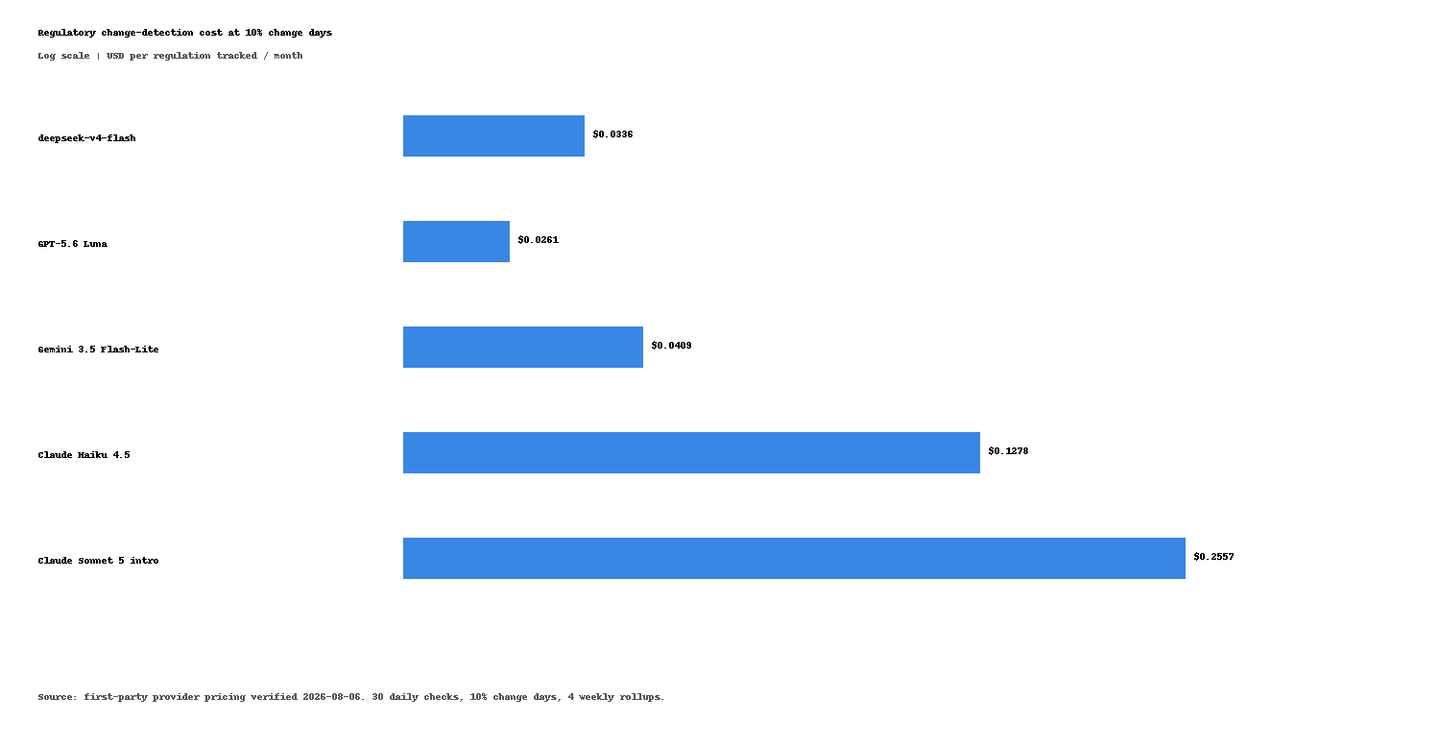
A 100-regulation portfolio on the same assumptions is $2.6084 on Luna Batch, $3.3639 on deepseek-v4-flash, and $25.5700 on Sonnet 5 Batch. Those figures are 100 times the unit totals, not observed spend.
The arithmetic behind $0.0261
GPT-5.6 Luna Batch at $0.10 / $0.60 per 1M tokens:
Daily checks:  30 x (5,000 x $0.10 + out x $0.60) / 1M
  change days:     3 x (5,000 x $0.10 + 200 x $0.60) / 1M = $0.0019
  no-change days: 27 x (5,000 x $0.10 +  20 x $0.60) / 1M = $0.0138
Weekly rollups: 4 x (20,000 x $0.10 + 1,000 x $0.60) / 1M   = $0.0104
Total                                                      = $0.0261
Sonnet uses the same volumes at $1 / $5 Batch:
Daily $0.1557 + weekly $0.1000 = $0.2557Use the cost calculator with your measured change-day mix. Swap the output count when your no-change receipt is larger than 20 tokens.
Sparse output needs a change-rate, not faith
Always rewriting a 500-token summary costs $0.0344 on Luna Batch. Sparse detection costs $0.0261. Net saving is $0.0083, or 24.2%.
Most of the bill is still input. At a 0% change rate Luna costs $0.0258. At 100% change days it costs $0.0290. Crossing the entire change-rate range moves Luna by only $0.0032. The daily 5,000-token check is the floor.
Change-day rate  Luna Batch  Sonnet Batch  deepseek-v4-flash  Luna vs always-summarize
---------------  ----------  ------------  -----------------  ------------------------
0%               $0.0258     $0.2530       $0.0335            25.1%
5%               $0.0259     $0.2544       $0.0336            24.6%
10%              $0.0261     $0.2557       $0.0336            24.2%
25%              $0.0266     $0.2598       $0.0339            22.8%
50%              $0.0274     $0.2665       $0.0342            20.4%
100%             $0.0290     $0.2800       $0.0350            15.7%
Do not invent a change rate from a compliance calendar. Count real days with a material edit over a quarter, then set the assumption. A false no-change receipt is worse than a few extra output tokens: it hides an effective-date move from the weekly brief.
Where routing and caching change the unit economics
Route Claude Sonnet 5 Batch onto the three change days only. Keep GPT-5.6 Luna Batch on no-change days and on the weekly rollup.
Stage                  Model                  Cost
---------------------  ---------------------  -------
3 change-day diffs     Claude Sonnet 5 Batch  $0.0180
27 no-change receipts  GPT-5.6 Luna Batch     $0.0138
4 weekly rollups       GPT-5.6 Luna Batch     $0.0104
Routed total                                  $0.0422
The routed path is 61.9% above all-Luna and 83.5% below all-Sonnet. Model routing earns the premium only if blind review shows Sonnet catches material edits Luna misses. Escalating the weekly brief instead of the change days costs $0.1157. That path spends Sonnet tokens on a long synthesis that a cheap model may already handle.
DeepSeek's listed cache-hit input price is $0.0028 per 1M tokens against a $0.14 cache-miss rate. If 70% of each daily check is a stable prior-text prefix, the month falls to $0.0192. That is 42.8% below DeepSeek's uncached $0.0336 and below Luna Batch. News articles rarely repeat enough for that prefix to stay hot. Regulation text does.
Build notes for a change-detection pipeline
- Hash the normalized text before calling the model. Byte-identical days should skip generation entirely and never appear on the token bill.
- Keep the prior version and the new version as separate spans. Ask for structured outputs: changed section, change type, effective date, citation span, confidence.
- Treat feed HTML as untrusted. Strip scripts and injected instructions before tokenization.
- Store every no-change receipt with the hash and model version. Auditors need proof the check ran, not only the change log.
- Prefer overnight batch processing for the daily sweep. Keep a synchronous path only for instruments with same-day legal deadlines.
- Cap the weekly rollup input. Send retained change records, not thirty full regulation bodies. A rollup that re-ingests every source file is a different token budget.
- Sample change days and no-change days separately. Aggregate accuracy hides silent misses on quiet instruments.
Audit the evidence path, not just the prose
A fluent weekly brief can hide a week of false no-change receipts. Review detection and synthesis as separate loops.
For detection, keep the before/after spans next to every emitted change. Counsel should open the cited section and reject a field without regenerating the month. Score missed effective dates and over-flagged punctuation edits independently. One cost-per-token dashboard will not show either failure mode.
For rollups, compare model briefs blind. Remove model names and costs, then grade coverage against the retained change log. Routing the weekly writer is justified only when that review moves. A nicer tone alone is not a reason to add a second provider.
Version the prompt, normalization rules and change taxonomy with every run. When the brief changes, you need to know whether the model changed or the detector changed.
When this workload does not need a router
Skip a router when one cheap model clears both change detection and the weekly brief. The entire Luna Batch line is $0.0261 per regulation / month. Multi-provider orchestration can cost more in engineering time than it saves in tokens.
Skip daily LLM checks when a cryptographic hash of normalized text is enough. Call the model only on hash misses. That path sits outside this table and is usually cheaper.
Skip Batch when counsel needs same-session alerts for emergency amendments. OpenAI documents a Batch completion window of up to 24 hours. A morning digest can wait; a same-day enforcement notice cannot.
The honest tradeoff: sparse no-change receipts save cents, not dollars, at this volume. A silent miss on an effective-date change is the real cost. Optimize false-negative rate before chasing another $0.0083.
FAQ
What does regulatory LLM change detection cost per regulation per month? On this workload, $0.0261 on GPT-5.6 Luna Batch to $0.2557 on Claude Sonnet 5 Batch pricing. deepseek-v4-flash standard costs $0.0336, or $0.0192 with a 70% daily cache hit assumption.
How much does sparse output save versus rewriting every day? 24.2% on Luna Batch at a 10% change-day rate ($0.0261 vs $0.0344). The saving shrinks as change days rise because output converges toward the always-summarize baseline.
Should change detection and the weekly brief use the same model? Start that way. Escalate only change days if blind review shows a stronger model is worth the jump from $0.0261 to $0.0422.
Can the whole workload use Batch? Yes for next-morning monitoring. No for same-session emergency alerts.
Does this include gazette licensing and human review? No. The model covers daily checks and four weekly rollups. Source licenses, fetch infrastructure, storage and counsel time sit outside the total.
Sources
- DeepSeek API pricing, captured 2026-08-06: deepseek-v4-flash cache-miss input $0.14, cache-hit input $0.0028, output $0.28 per 1M tokens.
- OpenAI API pricing, captured 2026-08-06: GPT-5.6 Luna at $0.20/$1.20 per 1M standard input/output tokens.
- OpenAI Batch API guide, captured 2026-08-06: 50% lower cost and completion within 24 hours.
- Anthropic pricing, re-verified 2026-08-14: Haiku 4.5 at $1/$5 and Sonnet 5 at $2/$10 standard; Batch listed at 50% off.
- Gemini API pricing, captured 2026-08-06: Gemini 3.5 Flash-Lite standard $0.30/$2.50 and Batch $0.15/$1.25.
Demand for this exact use case is inference-only. We found no qualifying community engagement signal for its token volumes or change-day rate. The assumptions above are a reproducible budget model, not market evidence.