
Blog · · By Dhrumil Barot, Founder
LLM Operations (LLMOps): Definition, Stack and Cost Math
LLM operations (LLMOps) is the work of running LLM apps in production: evals, prompt versions, routing, observability and cost control, with open-source tools and a worked cost example.
TL;DR: LLM operations (LLMOps) is the set of practices for running large language model applications in production: evaluating outputs, versioning prompts, routing and falling back between models, tracing every call, and controlling API cost. Vynaris covers the routing and cost-control jobs with one OpenAI-compatible endpoint and a cost on every response; open-source tools such as promptfoo and Langfuse cover evals, prompts and tracing. In the worked example below, the five jobs cut a 300,000-request monthly bill from $1,500 to $236.40.
Try it: point your OpenAI client at https://api.vynaris.com/v1 and every response tells you which model served it and what it cost. Get a Vynaris API key.
LLMOps is a subset of MLOps focused on applications built on large language models, usually called through an API rather than trained in-house. AWS describes MLOps, FMOps and LLMOps as three branches of DevOps with the same goal of automating quality and efficiency (AWS). In practice, for a team calling gpt-6-luna or Claude, the job is less about training and more about five questions: is the output good, which prompt produced it, which model should serve it, what happened on this call, and what did it cost.
What is LLMOps and how is it different from MLOps?
LLMOps is MLOps adapted to models you mostly do not train. MLOps centres on training pipelines, feature stores and a model registry. LLMOps centres on prompts, evaluation of free-text output, provider choice and per-token cost.
| Area | MLOps | LLMOps |
|---|---|---|
| Main artifact | Trained model weights | Prompt + model ID + parameters |
| Unit of change | Retrain and redeploy | Edit a prompt or switch a model string |
| Testing | Accuracy on a labelled test set | Evals on free-text output, often with an LLM judge |
| Cost driver | GPU hours for training | Input and output tokens per request |
| Vendor risk | Low, you own the model | Model deprecations and price changes |
| Monitoring | Data drift, accuracy | Latency, refusals, hallucinations, cost per task |
Vendor risk is concrete: OpenAI's deprecations page lists GPT-4.1 and GPT-4.1 mini as shutting down on 2027-01-14. An LLMOps team needs a tested replacement before that date.
Why does LLMOps matter? A concrete scenario
A support team ships a ticket classifier on gpt-6.1-terra. In month one it handles 300,000 tickets. Nobody versioned the prompt, nobody has evals, and the bill is $1,500. Someone edits the prompt to fix one category, and accuracy on another category drops; there is no test to catch it. The same team with LLMOps in place would have caught the regression in CI and paid less than a sixth of that bill for the same traffic.
What are the core components of an LLMOps stack?
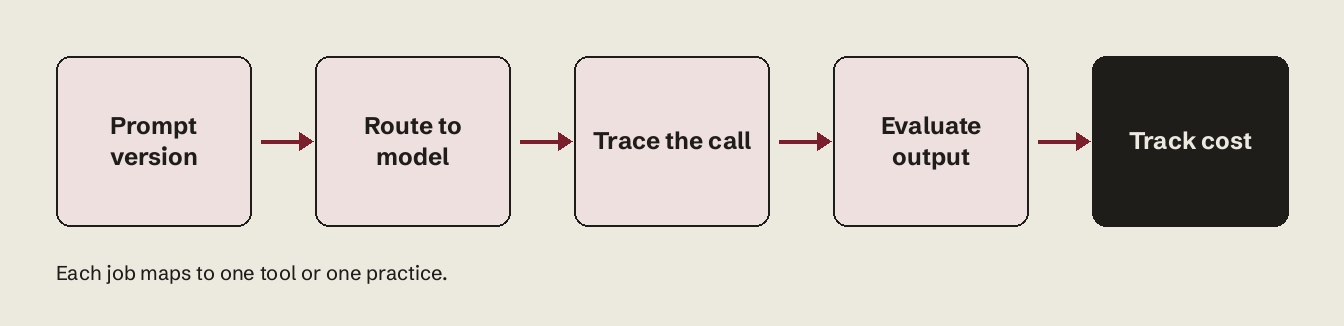
An LLMOps stack has five components. Each one answers one production question.
- Evaluation. Test prompts against a fixed set of inputs before every change. Use when any prompt or model changes.
- Prompt versioning. Store prompts with versions so every response can be traced to the exact text that produced it.
- Routing and fallback. Send each request to the cheapest model that passes its eval, and to another provider when one fails.
- Observability. Trace every call: input, output, latency, tokens, model, errors.
- Cost control. Know the cost of every call and every feature, and stop spend before it surprises you.
Google Cloud's guide groups similar work under data management, deployment and monitoring (Google Cloud). The five jobs above are the subset that matters when you call hosted models.
Which open-source tools cover each LLMOps job?
| Job | Vynaris | Open-source option | What it does |
|---|---|---|---|
| Routing | OpenAI-compatible endpoint, full model pool and automatic routing | LiteLLM | Calls 100+ LLM APIs in OpenAI format |
| Cost control | Provider cost, fee and final charge in headers and CSV ledger | LiteLLM, Langfuse | Cost tracking per call |
| Observability | Per-request receipts | Langfuse, Arize Phoenix | Traces, built on OpenTelemetry (Langfuse) |
| Evaluation | Not offered | promptfoo, Phoenix | Declarative test configs in CI |
| Prompt versioning | Not offered | Langfuse | Prompt management with versions |
Sources, read 2026-11-24: promptfoo (MIT, about 27.6K GitHub stars), Langfuse (about 37.8K stars), Arize Phoenix (about 12.4K stars), LiteLLM (about 63.8K stars). LiteLLM is self-hosted: you run and patch the proxy. For traces in a standard format, the OpenTelemetry GenAI semantic conventions now live in their own repository (OpenTelemetry).
A minimal promptfoo eval that runs in CI:
# promptfooconfig.yaml
prompts:
  - "Classify this support ticket as billing, bug or other: {{ticket}}"
providers:
  - openai:gpt-6-luna
  - openai:gpt-6.1-terra
tests:
  - vars: { ticket: "I was charged twice this month" }
    assert:
      - type: contains
        value: billing
  - vars: { ticket: "The export button crashes the app" }
    assert:
      - type: contains
        value: bug
What are the benefits and phases of LLMOps?
The benefits of LLMOps are fewer silent regressions, lower cost per task and faster model swaps. AWS lists versioning, observability and control as the main benefits, and Google Cloud adds performance, scalability, risk reduction and efficiency. In our five-job frame they map like this:
| Benefit | Job that delivers it | Measurable result |
|---|---|---|
| Fewer regressions | Evaluation in CI | Prompt edits fail the build before users see them |
| Lower cost | Routing, caching, cost tracking | $1,500 to $236.40 in the example below |
| Faster model swaps | Routing through one endpoint | A deprecation becomes a model-string change plus an eval run |
| Faster debugging | Observability | Every bad answer links to its prompt version and trace |
The phases follow the life of a feature: pick a model (discovery), adapt it with prompts, retrieval or fine-tuning (customization), then ship and watch it (deployment and monitoring). AWS uses the same three stages (AWS). The loop restarts each time a provider ships a cheaper model: GPT-6 Luna, released 2026-09-22, costs half of GPT-5.6 Luna on input, which only pays off for teams whose evals can approve the switch.
What does Vynaris do for LLM operations?
Vynaris handles two of the five jobs: routing and cost control. From the Vynaris pricing page:
- One endpoint, many models. "Full model pool + automatic routing" through an "OpenAI-compatible API". Switching a model is a change of model string.
- A receipt per call. "The response headers and exportable ledger show the model, provider cost, Vynaris fee, and final charge."
- A hard spend stop. "Requests stop when your available balance reaches zero."
- Known price. "Provider list price + 3% / 1%": 3% until monthly usage reaches $500, then 1%.
What it does not do: evals and prompt versioning. Pair it with promptfoo for evals and Langfuse for prompts and traces.
from openai import OpenAI

client = OpenAI(base_url="https://api.vynaris.com/v1", api_key="VYNARIS_KEY")
r = client.chat.completions.with_raw_response.create(
    model="gpt-6-luna",  # check exact IDs on https://vynaris.com/models
    messages=[{"role": "user", "content": "Classify: I was charged twice"}],
)
print(r.headers)  # model, provider cost, fee and final charge
How do you control LLM API cost in production? A worked example
Cost control is routing plus caching plus measurement. Here is the classifier from the scenario, 300,000 requests a month, 3,000 input and 400 output tokens each. Prices from the gpt-6-luna and gpt-6.1-terra model pages, read 2026-11-24.
| Step | Setup | Monthly cost |
|---|---|---|
| 1 | All traffic on gpt-6.1-terra ($1.00 / $5.00) | $1,500.00 |
| 2 | All traffic on gpt-6-luna ($0.10 / $0.50) | $150.00 |
| 3 | 90% Luna, 10% escalated to Terra | $285.00 |
| 4 | Step 3, with a 2,000-token cached prefix on Luna ($0.01) | $236.40 |
| 5 | Step 4 through Vynaris (3% fee on first $500) | $243.49 |
The arithmetic for step 4: a Luna call costs 1,000 × $0.10/1M + 2,000 × $0.01/1M + 400 × $0.50/1M = $0.00032; 270,000 calls cost $86.40. A Terra call costs $0.005; 30,000 calls cost $150.00. Total $236.40.
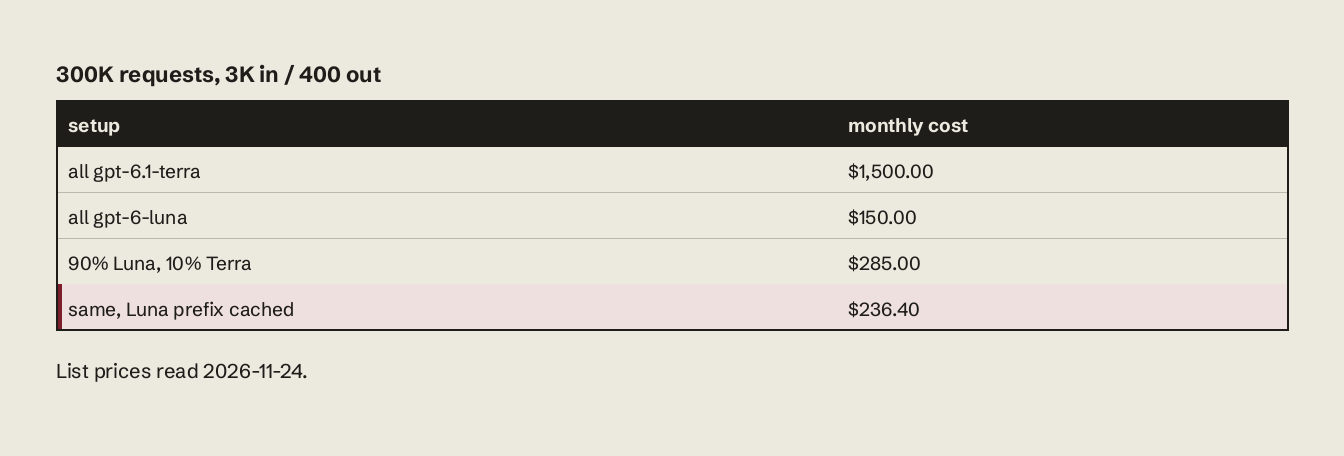
Step 2 is cheapest, but only if Luna passes the eval on every category. Step 3 is the realistic answer: evals decide which tickets escalate. Put your own token counts into the LLM cost calculator, and see the prompt caching examples for prompt layouts that keep the prefix cached.
LLMOps vs AIOps vs FMOps
AIOps means using AI to run IT operations, such as alert triage; it is not about running LLMs. FMOps, in AWS's usage, covers all foundation models, including image generation. LLMOps is the text-model slice of FMOps.
Pitfalls
- Evals after launch. Without a test set, every prompt edit is a guess. Write 20 cases before shipping.
- One model for everything. Most traffic can run on a model 10x cheaper; check with evals.
- Ignoring the 272K line. On OpenAI's GPT-6 models, prompts over 272K input tokens bill the whole request at 2x input and 1.5x output.
- Missing deprecations. Track provider deprecation pages; GPT-4.1 ends on 2027-01-14.
- Batch work on real-time endpoints. OpenAI's Batch API costs 50% of Standard.
FAQ
What is LLMOps?
LLMOps (large language model operations) is the practice of running LLM applications in production: evaluation, prompt versioning, routing, observability and cost control.
What is the difference between LLMOps and MLOps?
MLOps manages models you train; LLMOps manages prompts, providers and per-token cost for models you mostly call through an API.
Which open-source tools are used for LLMOps?
promptfoo for evals, Langfuse for prompt management and tracing, Arize Phoenix for observability and evals, and LiteLLM as a self-hosted gateway.
How do you reduce LLM API cost?
Route easy requests to a cheaper model that passes your evals, cache repeated prompt prefixes, use batch processing for offline work, and measure cost per call. Our OpenAI API pricing guide lists current rates.
Do I need an LLMOps platform?
Not at first. A gateway with per-call cost, a prompt file in git and a promptfoo config in CI cover the five jobs for a small team.
Route and price every LLM call from one endpoint: Get a Vynaris API key.