
Blog · · By Dhrumil Barot, Founder
GPT-4o Token Cost: $2.50/$10 per 1M and What Replaces It
GPT-4o costs $2.50 per 1M input and $10 per 1M output tokens. It shuts down 2027-01-14; GPT-6 Luna does the same job for $0.10/$0.50.
TL;DR: GPT-4o token cost is $2.50 per 1M input tokens, $1.25 per 1M cached input tokens and $10 per 1M output tokens. OpenAI has deprecated it and shuts it down on 2027-01-14, so every gpt-4o call needs a new model within eight weeks. Vynaris shows the provider cost of every request, so you can price the replacement on your own prompts. Prices verified 2026-11-19.
Try it: point your OpenAI client at https://api.vynaris.com/v1, send your GPT-4o prompts to GPT-4o and to its replacements, and read what each one cost. Get a Vynaris API key.
GPT-4o costs $2.50 input and $10.00 output per 1M tokens, according to the official GPT-4o model page, which now marks the model "Deprecated". One token of input is $0.0000025 and one token of output is $0.00001. A request with 10,000 input tokens and 2,000 output tokens costs $0.045. GPT-4o mini is $0.15 / $0.60. The listed replacement for both, gpt-6-luna, costs $0.10 / $0.50. Most pages ranking for this query are calculators that show the price but not the shutdown date.
GPT-4o and GPT-4o mini prices per 1M tokens
| Model | Input | Cached input | Output | Context | Max output | Status (read 2026-11-19) |
|---|---|---|---|---|---|---|
| gpt-4o | $2.50 | $1.25 | $10.00 | 128,000 | 16,384 | Deprecated, shuts down 2027-01-14 |
| gpt-4o-mini | $0.15 | $0.075 | $0.60 | 128,000 | 16,384 | Deprecated, shuts down 2027-01-14 |
| gpt-4o-2024-05-13 | snapshot | snapshot | snapshot | 128,000 | n/a | Shut down |
Sources: the GPT-4o and GPT-4o mini model pages, read 2026-11-19. Both models take text and image input and return text, with an Oct 01, 2023 knowledge cutoff.
The per-token values GPT-4o bills:
gpt-4o       input    $0.0000025    per token  ($2.50 / 1,000,000)
gpt-4o       cached   $0.00000125   per token  ($1.25 / 1,000,000)
gpt-4o       output   $0.00001      per token  ($10.00 / 1,000,000)
gpt-4o-mini  input    $0.00000015   per token  ($0.15 / 1,000,000)
gpt-4o-mini  output   $0.0000006    per token  ($0.60 / 1,000,000)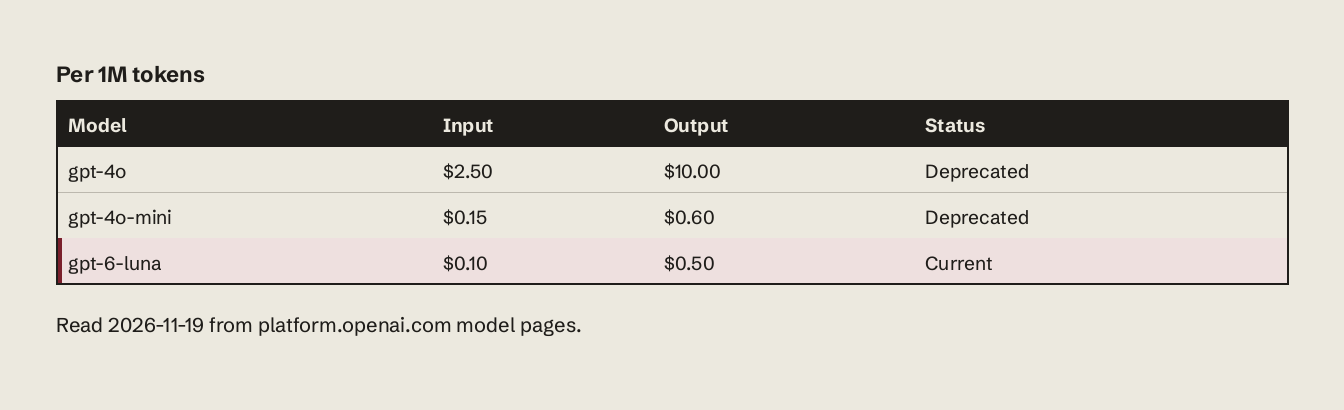
How do you calculate GPT-4o cost per request?
Multiply input tokens by $2.50 and output tokens by $10, then divide by 1,000,000. Cached input tokens bill at $1.25 instead of $2.50.
cost = (uncached_in x 2.50 + cached_in x 1.25 + out x 10.00) / 1,000,000

10,000 in, 2,000 out:   (10,000 x 2.50 + 2,000 x 10.00) / 1M = $0.045
1,500 in, 300 out:      (1,500 x 2.50 + 300 x 10.00) / 1M    = $0.00675
Output is 4x the input price, so a prompt that returns long answers costs far more than its input size suggests. Put your own token counts into the LLM cost calculator.
How Vynaris helps you price GPT-4o and its replacement
Vynaris is an OpenAI-compatible gateway at https://api.vynaris.com/v1. For a GPT-4o migration that means:
- Same client, new model. Keep the OpenAI SDK and change the base URL and
model. GPT-4o, GPT-4o mini and GPT-4.1 are on the Vynaris model list. - Cost per request, not per token. "The response headers and exportable ledger show the model, provider cost, Vynaris fee, and final charge." That gives you the old-vs-new cost on your real prompts.
- Pricing: provider list price + 3% until monthly usage reaches $500, then 1%. Prepaid top-ups from $20, and no overages: requests stop when the balance reaches zero (Vynaris pricing).
What it does not do: if you only want to call one OpenAI model, calling OpenAI directly is cheaper by the routing fee. Vynaris earns its 1-3% when you compare replacements on live traffic before the shutdown.
Is GPT-4o still available in the API?
Yes, until 2027-01-14. The OpenAI deprecations page lists:
| Shutdown date | Models | Listed replacement | Notice date |
|---|---|---|---|
| 2027-01-14 | GPT-4o (gpt-4o-2024-08-06, gpt-4o-2024-11-20) | gpt-6-luna | 2026-10-14 |
| 2027-01-14 | GPT-4o mini (gpt-4o-mini-2024-07-18) | gpt-6-luna | 2026-10-14 |
The same page also lists gpt-4o-audio, gpt-4o-realtime, gpt-4o-mini-realtime, gpt-4o-mini-audio and gpt-4o-mini-tts as deprecated. "Shutdown" means the model no longer accepts requests through the standard API, so code still sending model="gpt-4o" after that date gets an error.
What is cheaper than GPT-4o for the same task?
GPT-6 Luna is cheaper than GPT-4o on input ($0.10 vs $2.50) and output ($0.50 vs $10). GPT-6.1 Terra ($1 / $5) is the mid-priced option. GPT-4.1 ($2 / $8) is cheaper too, but it shuts down on the same day as GPT-4o.
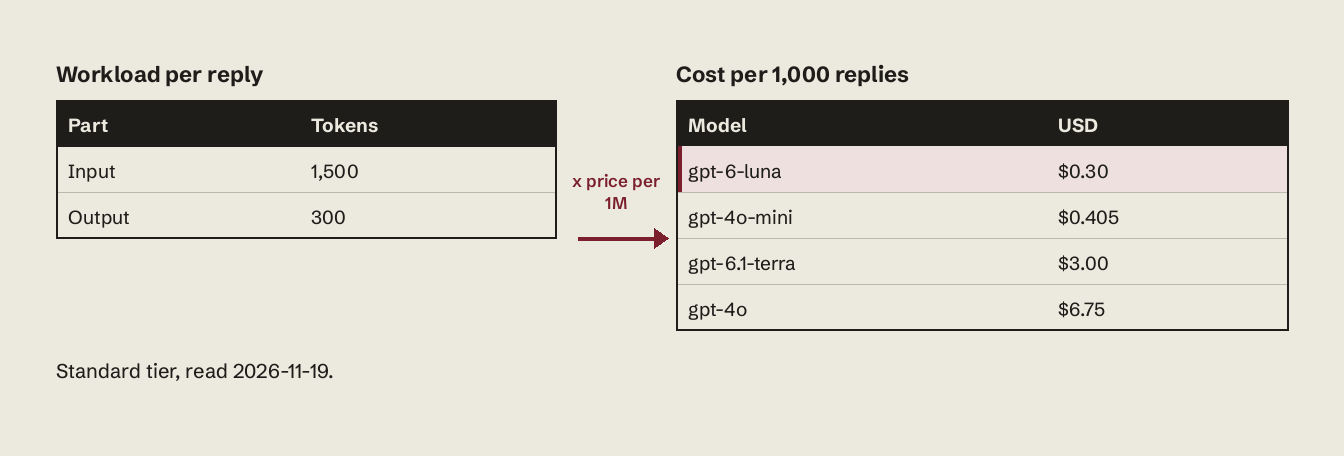
Take a typical GPT-4o job, a support chat reply: 1,500 input tokens (system prompt plus history) and 300 output tokens.
| Model | Input cost | Output cost | Per 1,000 replies | Status |
|---|---|---|---|---|
| gpt-6-luna | $0.150 | $0.150 | $0.30 | Current |
| gpt-4o-mini | $0.225 | $0.180 | $0.405 | Shuts down 2027-01-14 |
| gpt-6.1-terra | $1.500 | $1.500 | $3.00 | Current |
| gpt-4.1 | $3.000 | $2.400 | $5.40 | Shuts down 2027-01-14 |
| gpt-4o (cached prefix) | $2.250 | $3.000 | $5.25 | Shuts down 2027-01-14 |
| gpt-4o | $3.750 | $3.000 | $6.75 | Shuts down 2027-01-14 |
Derivation for GPT-4o: 1,000 x 1,500 = 1.5M input tokens x $2.50 = $3.75, plus 1,000 x 300 = 0.3M output tokens x $10 = $3.00, total $6.75. The cached row assumes 1,200 of the 1,500 input tokens hit the cache: 0.3M x $2.50 + 1.2M x $1.25 = $2.25. GPT-6 Luna: 1.5 x $0.10 + 0.3 x $0.50 = $0.30, which is 96% less than GPT-4o. GPT-6 Luna and GPT-6.1 Terra prices are from OpenAI API pricing and the GPT-6 Luna model page; GPT-4.1 is from its model page, read 2026-11-16.
For other providers, see our cheapest LLM API page and the full OpenAI API pricing guide.
How do you switch code off gpt-4o?
Change the model string and set reasoning to none. GPT-6 Luna defaults reasoning.effort to medium, and reasoning tokens bill as output, which can erase the saving on short replies. On Chat Completions, GPT-6 Luna supports function calling only with reasoning_effort set to none.
from openai import OpenAI

PRICE = {"input": 0.10, "cached": 0.01, "output": 0.50}  # gpt-6-luna, USD per 1M, read 2026-11-19

client = OpenAI()  # or OpenAI(base_url="https://api.vynaris.com/v1", api_key=...)
resp = client.responses.create(
    model="gpt-6-luna",           # was: gpt-4o
    reasoning={"effort": "none"}, # GPT-4o never reasoned; don't pay for it now
    input="Reply to this customer in two sentences: 'Where is my refund?'",
)
u = resp.usage
cached = u.input_tokens_details.cached_tokens
cost = ((u.input_tokens - cached) * PRICE["input"] + cached * PRICE["cached"]
        + u.output_tokens * PRICE["output"]) / 1_000_000
print(f"{u.input_tokens} in, {u.output_tokens} out = ${cost:.7f}")
The same switch as a raw request:
curl https://api.openai.com/v1/responses \
  -H "Authorization: Bearer $OPENAI_API_KEY" \
  -H "Content-Type: application/json" \
  -d '{"model": "gpt-6-luna", "reasoning": {"effort": "none"}, "input": "Where is my refund?"}'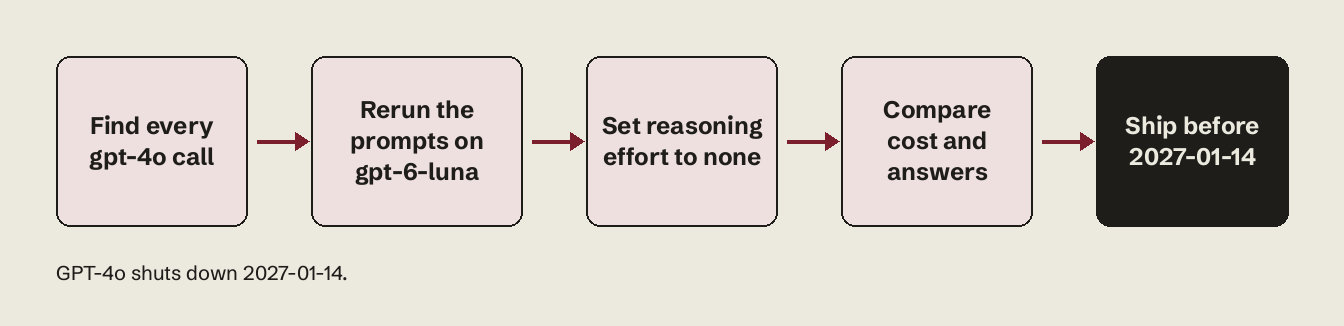
Context goes up too: GPT-4o has a 128,000-token window, GPT-6 Luna has 1,050,000. Batch on GPT-6 Luna is $0.05 / $0.25, half the standard price; see our OpenAI Batch API guide and prompt caching examples.
The tradeoff: GPT-6 Luna is not a clone of GPT-4o. Prompts tuned for GPT-4o's style may answer longer or differently, and image-input jobs need their own test. Measure tokens per reply on 100 real prompts before switching everything.
FAQ
How much does GPT-4o cost per 1M tokens?
$2.50 per 1M input tokens, $1.25 per 1M cached input tokens and $10 per 1M output tokens, on OpenAI's standard tier, read 2026-11-19.
Is GPT-4o still available in the API?
Yes, but it is deprecated. OpenAI shuts down gpt-4o-2024-08-06 and gpt-4o-2024-11-20 on 2027-01-14 and lists gpt-6-luna as the replacement. The older gpt-4o-2024-05-13 snapshot is already shut down.
What is cheaper than GPT-4o for the same task?
GPT-6 Luna at $0.10 / $0.50 runs a 1,500-in, 300-out reply for $0.30 per 1,000 versus $6.75 on GPT-4o. GPT-4o mini ($0.15 / $0.60) is also cheaper but shuts down the same day as GPT-4o.
How much does GPT-4o mini cost?
$0.15 per 1M input tokens, $0.075 cached and $0.60 output, with a 128,000-token context window. It is deprecated with shutdown on 2027-01-14.
Why does GPT-4o output cost more than input?
OpenAI prices GPT-4o output at 4x input ($10 vs $2.50). Long answers drive the bill: in the support-reply example, 300 output tokens cost $3.00 per 1,000 replies, close to the $3.75 for 1,500 input tokens. Our earlier GPT-3.5 Turbo pricing post shows the same pattern.
Price the replacement on your own prompts
GPT-4o has eight weeks left in the API. Send your GPT-4o prompts and the replacement candidates through one endpoint, read the cost on every response, and pick with numbers. Get your Vynaris API key.
Related articles
- GPT-3.5 Turbo Pricing: $0.50/$1.50 per 1M and Its Successor
- GPT-4o mini Transcribe vs GPT-4o Transcribe for Hindi: $0.18/hour and 8.3 WER points better
- GPT-5.5 Pro API: $30/$180 per 1M vs GPT-5.5, Per Task
- GPT-6 Astra's Pareto split: 10% fewer output tokens, 75% higher cost per task than Sol
- Claude Sonnet 5 is still $2/$10: correcting our false 50% price-increase report
- AI materials discovery costs $22.50–$764.71 per valid candidate