
Blog · · Updated · By Dhrumil Barot, Founder
AI materials discovery costs $22.50–$764.71 per valid candidate
AI materials-discovery model fees range from $22.50 to $764.71 per computational candidate in a public 65M-token scenario. Prices verified 2026-08-17.
An AI materials-discovery agent costs $22.50 to $764.71 in model fees per computationally valid candidate in a 65M-token scenario. The cheapest line is GPT-5.6 Luna, not the benchmark leader. Only GPT-5.6 Sol produced a synthesis-plausible route, and the public data cannot reveal its full cost. Prices verified 2026-08-17.
TL;DR
- Discovered Materials reports 30M to 100M tokens per run. At the 65M midpoint with 75% input and 25% output, live input token cost and output token cost put model fees between $29.25 on GPT-5.6 Luna and $1,300 on Claude Fable 5.
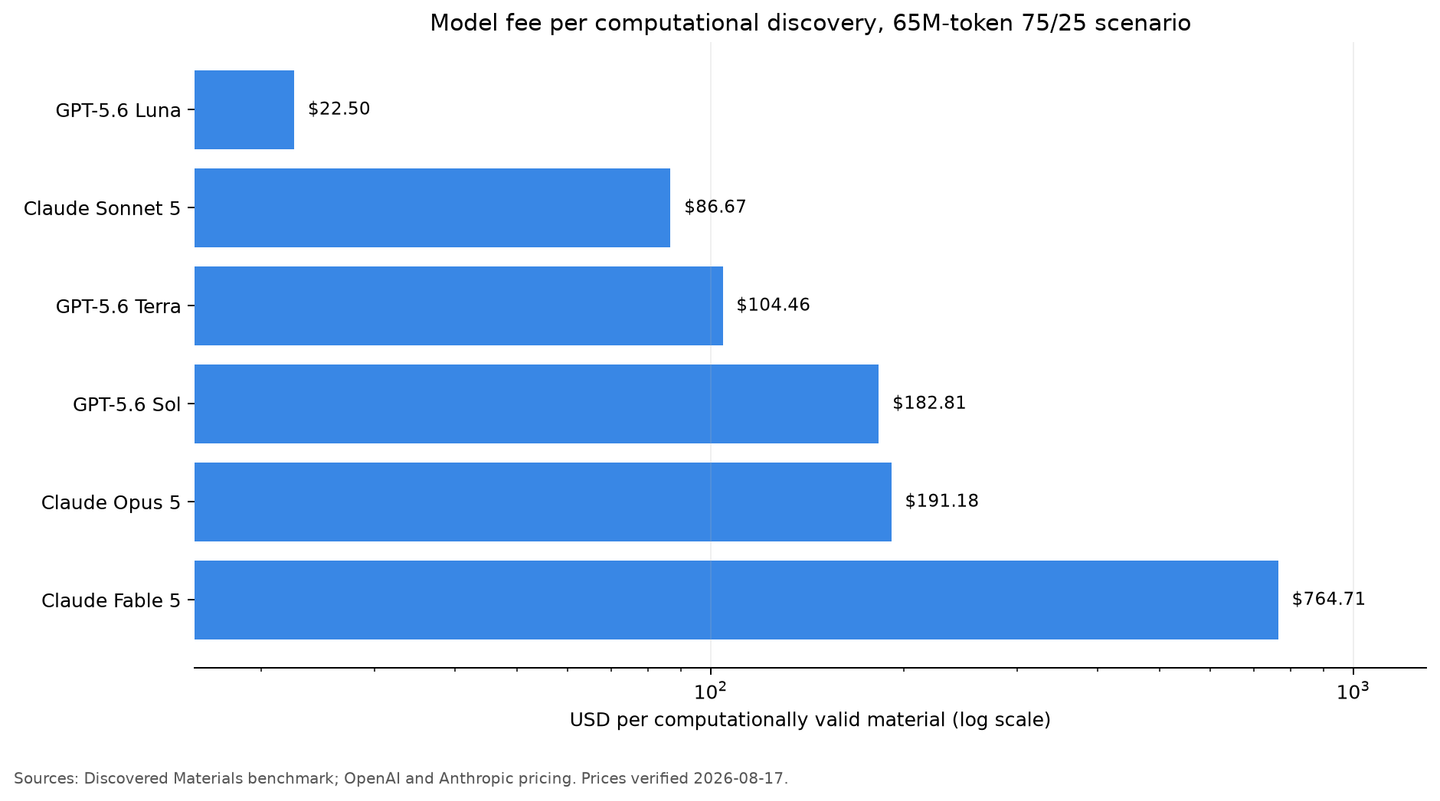
- Divide each run by the benchmark's computational discoveries per run. The result spans $22.50 to $764.71 per valid material, a 34x spread.
- The benchmark found more than 500 computational candidates but only one plausible synthesis route. Its run count and token traces are unpublished. Any exact cost per plausible route would be invented.
Prices verified 2026-08-17. This verdict uses current standard API list prices and the same editable 65M-token shape for each model.
| Model | Input / output per 1M | Computational candidates / run | 65M-token run | Cost / computational candidate |
|---|---|---|---|---|
| GPT-5.6 Luna | $0.20 / $1.20 | 1.3 | $29.25 | $22.50 |
| Claude Sonnet 5 | $2 / $10 | 3.0 | $260.00 | $86.67 |
| GPT-5.6 Terra | $2 / $12 | 2.8 | $292.50 | $104.46 |
| GPT-5.6 Sol | $5 / $30 | 4.0 | $731.25 | $182.81 |
| Claude Opus 5 | $5 / $25 | 3.4 | $650.00 | $191.18 |
| Claude Fable 5 | $10 / $50 | 1.7 | $1,300.00 | $764.71 |
Luna wins this price-normalized table because its rate is tiny. Sol wins the benchmark's candidate count. Those are different claims. The benchmark does not establish that swapping models preserves scientific value, safety, or synthesis quality.
The public workload, without a fictional token split
Material Discovery Bench runs a long-horizon AI agent with repeated tool use. It proposes semiconductor materials and screens them with computational tools. A valid candidate must satisfy several property constraints and dynamic stability. The public leaderboard reports seven models, more than 500 discoveries, and 30M to 100M tokens per run.
The page does not publish each run's cost per token, input/output split, or run count. Those omissions matter. Output is six times the input price on every model in our table. A run with 10% output and one with 50% output can have the same total tokens and very different bills.
We therefore use a scenario, not a disguised measurement.
| Assumption | Value | Status |
|---|---|---|
| Total tokens / run | 65M | midpoint of the public 30M–100M range: (30 + 100) / 2 |
| Input share | 75% = 48.75M | editable assumption; not published by the benchmark |
| Output share | 25% = 16.25M | editable assumption; not published by the benchmark |
| Candidate yield | model-specific leaderboard value | public computational discoveries per run |
| API tier | standard, uncached | live provider list price |
| Lab cost | excluded | physical work takes hours and often costs hundreds per run, but no exact bill is published |
The formula is direct:
run cost = input MTok × input price + output MTok × output price
cost per computational candidate = run cost / computational candidates per run
For Sol, that is 48.75 × $5 + 16.25 × $30 = $731.25 per run. Divide by 4.0 candidates to get $182.81. Change the 48.75M/16.25M shape in the calculator before using this figure in a budget.
Kimi K3 appears in the benchmark at 2.0 computational discoveries per run. We excluded it from the dollar ranking because this run did not obtain a current first-party price receipt. A missing price is not permission to borrow an aggregator's number.
Output share moves the answer by more than token volume suggests
Hold each run at 65M total tokens. Sweep the output share from 10% to 50%. The table shows dollars per computational candidate.
| Model | 10% output | 25% output | 50% output |
|---|---|---|---|
| GPT-5.6 Luna | $15.00 | $22.50 | $35.00 |
| Claude Sonnet 5 | $60.67 | $86.67 | $130.00 |
| GPT-5.6 Terra | $69.64 | $104.46 | $162.50 |
| GPT-5.6 Sol | $121.88 | $182.81 | $284.38 |
| Claude Opus 5 | $133.82 | $191.18 | $286.76 |
| Claude Fable 5 | $535.29 | $764.71 | $1,147.06 |
Output share nearly doubles the Luna result and more than doubles the Fable result across this range. Total tokens alone are not a cost model. Capture billable input and output separately for every run.
The synthesis-plausible denominator breaks the neat table
The benchmark reports one plausible synthesis route among more than 500 computational discoveries. Sol produced it. That does not mean Sol produces one plausible route per run. The public page gives no total run count and no token trace for the successful run.
We can prove only a floor. A Sol run uses at least 30M total tokens. Even the impossible best case, all input and no output, costs 30 × $5 = $150. Under our 75/25 scenario, one Sol run costs $337.50 at 30M tokens and $1,125 at 100M. The real benchmark-wide token cost per plausible route is higher than the $150 floor because the suite ran other attempts.
Physical validation is another bill. The researchers say experiments take hours and often cost hundreds of dollars per run. They do not publish a lab invoice or a successful synthesis result. We keep that cost outside the token model.
This distinction changes the product decision. A computational candidate is a screening outcome. A plausible synthesis route is a human-reviewed plan worth attempting. A manufactured material is a third outcome that the benchmark has not claimed. Collapsing them into one success rate would turn a useful benchmark into marketing arithmetic.
Where routing can change the unit economics
Model routing makes sense only if the research loop has separable stages. Cheap models might explore broadly. A frontier model could validate the short list. The benchmark does not report such a routed run, so the following is a break-even test.
Put 80% of the 65M tokens on Luna and 20% on Sol. Keep the 75/25 input/output shape. The blended price becomes $2.61 per 1M tokens, and the run costs $169.65. That is 77% below an all-Sol run, $169.65 versus $731.25.
The routed system must still yield 0.928 computational candidates per run to beat Sol's $182.81 per candidate. That threshold is 169.65 / 182.81. Above it, routing wins on token cost per computational outcome. Below it, the cheap exploration stage destroyed enough yield to erase the saving.
Do not copy the 80/20 split into production. Instrument stage-level tokens and accepted outcomes first. Then run both pipelines through an eval harness. Price is the numerator. Scientific yield is the denominator.
Build notes for a 100M-token research loop
- Keep a durable state store. A long run cannot rely on one context window. Summarize hypotheses, tool outputs, rejected materials, and reviewer decisions outside the prompt.
- Set a stopping rule before dispatch. The source documents repeated calls and model fatigue near the end of long runs. Reserve the budget before each call, as in this hard-spend-cap design.
- Deduplicate structures before expensive screening. A model in the study submitted variants of the same material. Novelty checks belong at the tool boundary, not in the prompt.
- Separate compute validity from lab safety. A computational pass must never auto-approve a physical recipe. Human review is part of the outcome definition.
- Watch request length, not only cumulative tokens. Provider long-context surcharges apply per request. A 100M-token run can avoid them with short calls, or trigger them repeatedly with large prompts. The distinction is covered in the long-context surcharge analysis.
When this workload does not need a router
Do not route if one model already clears the scientific and safety gates at an acceptable cost. The cheapest model in the table is not automatically the cheapest research system. Lower candidate yield, more invalid structures, or extra human review can erase a $700 token saving quickly.
Skip routing when stages cannot be evaluated independently. If the validation model must reread the entire search history, the handoff recreates the token bill. Also skip it for one-off runs where the engineering and evaluation work costs more than the model spread.
The honest tradeoff is blunt: Sol costs $182.81 per computational candidate in our midpoint scenario, eight times Luna's $22.50. Yet Sol produced the benchmark's only synthesis-plausible route. Until a routed pipeline preserves that outcome, cheaper tokens are evidence of a smaller invoice, not better discovery economics.
Where Vynaris fits
Vynaris can meter each stage, attach the provider rate used at dispatch, and route only after a quality gate. The implementation path is in the docs. Current platform fees and API-key signup are on pricing. It cannot supply the missing scientific denominator. Your eval must do that.
FAQ
How much does an AI materials-discovery agent cost per valid candidate?
In the 65M-token, 75% input / 25% output scenario, $22.50 to $764.71 in model fees per computationally valid material across six models. The range is 34x. It excludes lab work.
Which model is cheapest per computational discovery?
GPT-5.6 Luna at $22.50 in the midpoint scenario. It produces 1.3 computational discoveries per run in the public benchmark. Sol produces 4.0 but costs $182.81 per candidate.
What is the cost per synthesis-plausible candidate?
The exact figure is unknowable from the published data. The suite found one plausible route, but it does not publish the total run count or token traces. The only defensible Sol token-cost floor is $150. A 30M–100M Sol run costs $337.50–$1,125 under the article's 75/25 scenario.
Does a 100M-token run trigger long-context pricing?
Not by itself. Cumulative run tokens and per-request prompt length are different. Many short calls can total 100M tokens without one giant prompt. Log both meters.
Should materials-discovery teams use an LLM router?
Only when stages have measurable quality gates. An 80% Luna / 20% Sol illustration costs $169.65 per 65M-token run. It must retain at least 0.928 computational discoveries per run to beat all-Sol cost per candidate.
Sources
- Discovered Materials, Material Discovery Bench: 30M–100M tokens per run, model leaderboard, more than 500 computational discoveries, one plausible synthesis route, recipe review and workload method. Captured 2026-08-17.
- OpenAI API pricing: GPT-5.6 Sol $5/$30, Terra $2/$12 and Luna $0.20/$1.20 per 1M input/output tokens. Captured 2026-08-17.
- Anthropic API pricing: Claude Sonnet 5 $2/$10, Opus 5 $5/$25 and Fable 5 $10/$50 per 1M input/output tokens. Captured 2026-08-17.
Prices change. Recheck the provider pages before approving a research budget. The reproducible script and CSV use the assumptions printed above.