
Blog · · Updated · By Dhrumil Barot, Founder
We rebuilt Echo's "1/3 the cost of Fable" claim: what a mixture of open-weight models actually costs per task
A committee running GLM-5.2 and Kimi K2.7 Code plus a cheap combiner costs $0.0231 per task vs $0.0700 for one Claude Fable 5 call, 67% cheaper. We rebuild Echo's '1/3 the cost' claim on prices verified 2026-07-24, and find the saving is a participant count that runs out near 8 members.
A model committee that runs GLM-5.2 and Kimi K2.7 Code on the same request, then merges their answers with a cheap combiner, costs $0.0231 per task against a single Claude Fable 5 call at $0.0700. That is 33.0% of the frontier price, so the viral "one-third the cost" headline reproduces exactly on live prices verified 2026-07-24. The catch the headline skips: a committee pays for every member plus the merge on every request, so the saving is a participant count, and it runs out around eight members.
TL;DR
- Echo's actual 2-model panel (GLM-5.2 + Kimi K2.7 Code) plus a GLM-5.2 combiner costs $0.0231 per task versus $0.0700 for one Fable 5 call on a 2,000-in / 1,000-out task. That is 67.0% cheaper, the "1/3 the cost" claim, and it checks out.
- An ensemble bill is
sum(participants) + one combiner pass. It grows with every member you add. Against Fable 5 the committee stays cheaper until about 8 participants ($0.0708, where it crosses the single-call line). Against a cheaper frontier baseline like Claude Opus 4.8 ($0.0350/task) the break-even is only about 4 participants, and the same 2-model panel saves 34.0%, not 67%. - The two design choices that decide everything: the frontier baseline you compare against, and the combiner. Swap the cheap GLM combiner for a Fable 5 combiner and the committee costs $0.1031, 47% more than just calling Fable once. Prices verified 2026-07-24.
What we computed and why
The top cost-native post on Hacker News this week is Echo, "Fable-level results at 1/3 the cost using open-weight models" (248 points, 119 comments, read 2026-07-24). Echo is an ensemble: it sends one request to several open-weight models at once, lets each answer, and combines the outputs into a final answer through an OpenAI-compatible API. The pitch is frontier quality for a third of the money.
The quality claim is not ours to settle. The cost claim is. We rebuilt the per-task bill from first-party pricing pages, reproduced the one-third figure, then pushed on it to find where it stops being true. Every dollar below comes from a provider's live page (captured 2026-07-24) or the arithmetic shown. No Vynaris traffic, no internal data.
The structure sets the cost formula. A committee is parallel-combine: N models each read the request, then a combiner reads their outputs and merges. So the bill is the sum of all N inferences plus one aggregation pass, a different shape from a cascade or from task-type routing. We cover that contrast near the end.
The workload (edit these)
| Assumption | Value | Note |
|---|---|---|
| Representative task | 2,000 input tokens / 1,000 output tokens | one substantive reasoning answer |
| Frontier baseline | Claude Fable 5 at $10 / $50 per 1M | the single call the committee replaces |
| Alt baseline | Claude Opus 4.8 at $5 / $25 per 1M | a cheaper frontier you might have used |
| Panel | GLM-5.2 $1.40 / $4.40, Kimi K2.7 Code $0.95 / $4.00 | Echo's two open-weight members |
| Combiner | GLM-5.2 reading the prompt + every member's output | merges the panel into one answer |
| Third participant | DeepSeek v4-flash $0.14 / $0.28 | a near-free member for the sensitivity |
A single Fable 5 call on this task costs (2,000 x $10 + 1,000 x $50) / 1,000,000 = $0.0700. That is the number every committee below is measured against. A single Opus 4.8 call costs (2,000 x $5 + 1,000 x $25) / 1,000,000 = $0.0350. Prices verified 2026-07-24.
The receipt for "one-third"
Echo's real panel is two models. Each reads the same 2,000-token prompt and writes a 1,000-token answer. The combiner then reads the original prompt plus both answers, 4,000 input tokens, and writes the merged 1,000-token result.
| Line item | Calculation | Cost per task |
|---|---|---|
| GLM-5.2 participant | (2,000 x $1.40 + 1,000 x $4.40) / 1M | $0.0072 |
| Kimi K2.7 Code participant | (2,000 x $0.95 + 1,000 x $4.00) / 1M | $0.0059 |
| GLM-5.2 combiner | (4,000 x $1.40 + 1,000 x $4.40) / 1M | $0.0100 |
| Committee total | $0.0231 | |
| One Fable 5 call | (2,000 x $10 + 1,000 x $50) / 1M | $0.0700 |
$0.0231 / $0.0700 = 0.330. The committee is 33.0% of a Fable 5 call, so 67.0% cheaper. The headline is real. Note the shape of the bill: the combiner ($0.0100) is the single largest line, larger than either model it is merging, because it reads everything the panel produced. Hold that thought.
The saving is a participant count
The formula generalizes. With N open-weight members at the panel-average unit cost of $0.00655 per task, and a GLM-5.2 combiner whose input grows by one 1,000-token answer per added member:
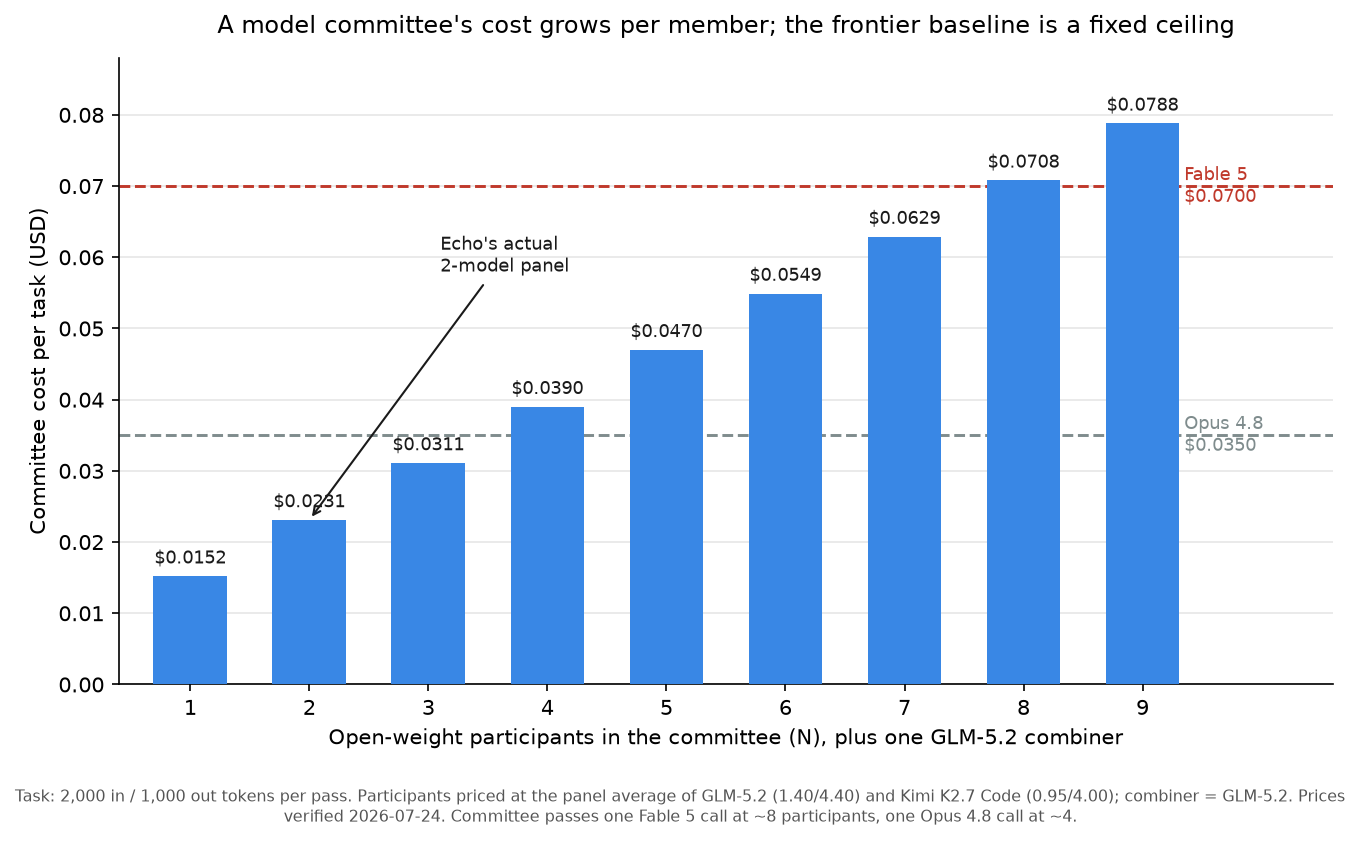
committee(N) = 0.00795 * N + 0.00720Each added member costs its own inference plus the combiner reading its output. The fixed $0.0072 is the combiner's floor (the prompt in, the merged answer out). Run that against both frontier baselines:
| Participants N | Committee $/task | Saving vs Fable 5 | Saving vs Opus 4.8 |
|---|---|---|---|
| 1 | $0.0152 | 78.4% | 56.7% |
| 2 (Echo's panel) | $0.0231 | 67.0% | 34.0% |
| 3 | $0.0311 | 55.6% | 11.3% |
| 4 | $0.0390 | 44.3% | -11.4% |
| 5 | $0.0470 | 32.9% | -34.1% |
| 6 | $0.0549 | 21.6% | -56.9% |
| 7 | $0.0629 | 10.2% | -79.6% |
| 8 | $0.0708 | -1.1% | -102.3% |
The committee crosses the single-Fable-call line at about 8 members: solving 0.00795 N + 0.0072 = 0.0700 gives N = 7.9. Below eight members you pay less than one Fable call; at eight you pay slightly more, and the "committee" has quietly become the expensive option it was supposed to beat. Every extra member buys a vote at the cost of eroding the saving. Drop your own token shape into the calculator to find where your committee crosses.
The baseline you pick decides the headline
The "one-third" number is anchored to Fable 5, the most expensive baseline on the board at $50 per 1M output. Compare the same 2-model committee against Opus 4.8 instead, at half the output price, and the saving falls from 67.0% to 34.0%. The committee did not change. The comparison did.
This is the first honest caveat. A committee's advertised saving is only as large as the model you claim you would otherwise have run. If your real alternative was already Opus 4.8, or a mid-tier model, the ensemble is a modest win, and past four members against Opus 4.8 it loses money outright (the -11.4% at N=4 in the table). "1/3 the cost" is true against the priciest frontier call and shrinks against every cheaper one.
The combiner is the whole game
The combiner is the largest line in the receipt because it reads the entire panel's output. That makes its price the lever that decides whether the committee saves anything at all. Keep it cheap (GLM-5.2 here) and the model works. Reach for a frontier combiner to guarantee a high-quality merge and the economics invert.
Price the same 2-model panel with a Fable 5 combiner reading the prompt plus both answers:
| Committee variant | Combiner cost | Committee total | vs one Fable call |
|---|---|---|---|
| GLM-5.2 combiner | $0.0100 | $0.0231 | 0.33x (67.0% cheaper) |
| Fable 5 combiner | $0.0900 | $0.1031 | 1.47x (47% more expensive) |
A Fable 5 combiner alone costs $0.0900, already more than a single Fable 5 call, before the panel is even counted. The committee lands at $0.1031, 47% more expensive than just asking Fable 5 the question once. If you need a frontier model to merge the answers, you have no ensemble saving, because you are paying for a full frontier inference plus a panel of cheaper ones. The judge that combines has to be cheap or the whole structure is upside down.
Adding cheap members barely helps
The panel's premium members and the combiner dominate the bill, so throwing a near-free model into the committee does little. Add DeepSeek v4-flash as a third participant. Its own inference costs (2,000 x $0.14 + 1,000 x $0.28) / 1,000,000 = $0.0006, essentially free. But it still feeds a 1,000-token answer into the combiner, and the 3-model committee lands at $0.0251, a saving of 64.2% versus Fable, down from 67.0% for two members. A free voter is not free once its output has to be read and merged. Cheaper members widen the panel's diversity, not its savings.
How this differs from cascade and task-type routing
The parallel-combine bill is what makes ensemble math its own thing, and it is worth separating from the two routing patterns it gets confused with.
A cascade is sequential. A cheap model answers first, a confidence gate decides, and only the unsure fraction escalates to a premium model. Its saving is an escalation rate, and its hidden cost is a double-spend on the escalated calls, not a combiner. We worked that through in the confidence-gated cascade cost math. A cascade pays two models on some calls; a committee pays every model on every call plus a merge.
Task-type routing sends each request to exactly one model based on its type, so there is no multi-inference bill at all, only a classifier. That is the pattern in the coding-agent model-routers savings math. It saves by never paying for a second model, the opposite of a committee, which pays for several on purpose.
So three patterns, three break-evens: routing has no per-request penalty, a cascade breaks even on escalation rate, and an ensemble breaks even on participant count. We audited inflated vendor savings the same way in the router savings claims audit, and the underlying frontier-vs-open-weight gap is the subject of GLM-5.2 vs Opus 4.8 vs GPT-5.5 cost per task.
Where the cost math is necessary but not sufficient
- Quality is assumed, not proven. The whole comparison rests on "Fable-level results." The Hacker News thread's own skeptics flagged benchmark-validity questions (GPQA Diamond ground truth) and prior art (OpenRouter Fusion, Sakana Fugu). If the committee is not actually frontier-quality, you are pricing the wrong baseline. The metric that settles it is cost per correct answer, not cost per task, and that needs an eval on your own data, not a leaderboard.
- Subsidized prices. GLM-5.2 and Kimi K2.7 Code first-party rates may be promotional. Another skeptic on the thread noted a subsidized plan makes any saving moot. We verified today's prices; they carry the risk of a hike, and self-hosting flips the math to hardware amortization (see the GLM-5.2 self-hosting break-even).
- Latency. A committee runs at the speed of its slowest member plus the combiner, a real constraint we did not price. Separately, Fable 5's newer tokenizer produces about 30% more tokens for the same text, so on a fixed-text basis the frontier call is pricier still, which widens the committee's edge rather than narrows it.
When NOT to run a committee
- Your real baseline is not the priciest frontier model. If you would otherwise run a mid-tier model, the ensemble saving is small and turns negative fast as members grow. Compare against your actual alternative, not the most expensive one.
- The merge needs a frontier combiner. If cheap models cannot reliably combine the panel and you need a top model to aggregate, you have lost the saving before you start. Just call the frontier model once.
- More than a handful of members. Every member adds its inference and a combiner read. Past the break-even count (about eight here against Fable, four against Opus 4.8) the committee is the expensive option.
- Low volume. The orchestration, the combiner prompt, and the eval to prove quality are engineering. On a few thousand tasks a month the build cost swamps the per-task saving.
Doing this on Vynaris
The formula above is all you need to model a committee yourself; this section is the paid shortcut, clearly labeled. Vynaris is an OpenAI-compatible gateway that can run an ensemble behind one base URL and report each member's and the combiner's cost per request against the single-frontier-call baseline, so you see whether your committee is below the line or has drifted past its break-even count. See the docs and pricing.
FAQ
What does a mixture-of-open-weight-models actually cost per task? On a 2,000-in / 1,000-out task, Echo's GLM-5.2 + Kimi K2.7 Code panel with a GLM-5.2 combiner costs $0.0231, versus $0.0700 for one Claude Fable 5 call. That is 67.0% cheaper, prices verified 2026-07-24.
Is the "1/3 the cost" claim true? Yes, against a Fable 5 baseline: the committee is 33.0% of a single Fable call. Against a cheaper frontier like Opus 4.8 ($0.0350/task) the same panel saves 34.0%, not 67%. The claim depends on comparing to the most expensive frontier model.
Why does the saving run out? A committee pays for every member plus a combiner pass on every request, so committee(N) = 0.00795 N + 0.0072. It crosses a single Fable 5 call at about 8 members and a single Opus 4.8 call at about 4.
What is the biggest line in the bill? The combiner, because it reads every member's output. A cheap combiner (GLM-5.2) keeps the ensemble 67% cheaper; a Fable 5 combiner makes the committee 47% more expensive than one Fable call.
How is this different from a cascade? A cascade is sequential and escalates only unsure calls, so its break-even is an escalation rate. A committee is parallel and pays for everyone plus a merge, so its break-even is a participant count. See the cascade cost math.
Sources
- Hacker News, "Echo: Fable-level results at 1/3 the cost using open-weight models" (248 points / 119 comments, read 2026-07-24): https://news.ycombinator.com/item?id=49026810
- Anthropic pricing (Claude Fable 5 $10/$50, Opus 4.8 $5/$25), captured 2026-07-24: https://platform.claude.com/docs/en/about-claude/pricing
- z.ai pricing (GLM-5.2 $1.40/$4.40, cached input $0.26), captured 2026-07-24: https://docs.z.ai/guides/overview/pricing
- Kimi pricing (Kimi K2.7 Code $0.95/$4.00, cache-hit $0.19), captured 2026-07-24: https://platform.kimi.ai/docs/pricing/chat-k27-code
- DeepSeek pricing (v4-flash $0.14/$0.28), captured 2026-07-24: https://api-docs.deepseek.com/quick_start/pricing
- Cost model script and all per-task arithmetic: derived from the assumptions table above.
Prices change. We re-verify every figure in this post monthly and stamp updates. Numbers here are current as of 2026-07-24.
The lesson: a model committee is not one-third the cost because open-weight models are cheap. It is one-third the cost because the panel is small and the combiner is cheaper than the frontier call it replaces. Count the members, price the combiner, and pick the right baseline, or the committee quietly becomes the expensive option.