
Blog · · Updated · By Dhrumil Barot, Founder
Which LLM calls a cheaper model could handle: a $6 detection recipe
Find the share of LLM traffic a cheaper model handles just as well for ~$6 in detection. Route it and cut a 100k-call bill 45-54%. Prices verified 2026-07-21.
You can find the share of your LLM traffic that a cheaper model would answer just as well in an afternoon, using local, open-source tools and your own request logs, for about $6 in detection cost. On a 100,000-call-per-month workload, routing the downroutable share off a frontier model cuts the bill 45% to 54% with prices verified 2026-07-21. The catch nobody mentions: the free offline estimate is a population prior, not your quality bar, and it can overstate your real savings by 38%. This is the recipe to measure it honestly.
The finding, before the tooling
The most-discussed cost thread on Hacker News this week is titled "I burned all my tokens researching how to save tokens" (171 points, 207 comments, read 2026-07-21). The joke lands because detection feels expensive: to know which calls a cheap model handles, it seems you must re-run everything on every model. You do not. You sample. Replay a few hundred logged prompts on a candidate cheap model, judge whether the answers match, and extrapolate. That costs a few dollars once, against savings that recur every month. Below we run the whole loop on live prices and show where the free estimate lies to you.
We use public sources only: your own OpenAI-style logs, the MIT-licensed detector Frugon, and provider pricing captured 2026-07-21. Every number is either from a live pricing page or derived in the arithmetic shown.
The workload (edit these)
| Assumption | Value | Note |
|---|---|---|
| Calls per month | 100,000 | your production API volume |
| Input per call | 1,500 input tokens | prompt plus context |
| Output per call | 500 output tokens | the completion |
| Baseline model | gpt-5.6-sol | the frontier model you run today |
| Downroutable share | to be measured | the whole point of the recipe |
At $5 per million input tokens and $30 per million output, the baseline runs $0.0225 per call, or $2,250 per month. The recipe finds how much of that you can move to a cheaper model without users noticing.
Step 1: capture your calls as JSONL
Frugon reads one JSON object per line in OpenAI request/response shape, using the usage token counts when present and falling back to its own tokenizer when absent:
{"model": "gpt-5.6-sol", "request": {"messages": [...]}, "response": {"choices": [{"message": {"content": "..."}}]}, "usage": {"prompt_tokens": 1500, "completion_tokens": 500}, "timestamp": "2026-07-21T14:22:01Z"}If you already log requests and responses, export a month to logs.jsonl. If you do not, Frugon can sit in front of your API as a logging proxy and write the file for you:
frugon capture --out ./logs.jsonl --port 8787 --upstream https://api.openai.comPoint your client's base URL at the proxy for a representative window, then stop. You now have a real sample of your traffic, not a synthetic benchmark.
Step 2: get the offline estimate (free)
The analyze command applies an offline easy-versus-hard split heuristic and recommends routing the easy calls to cheaper candidates, without executing any model:
frugon analyze ./logs.jsonl --candidates gpt-5.4-mini,haiku-4.5,deepseek-v4-flash --report out.htmlThis is fast and free, and it is where most people stop. They should not. Frugon's quality tiers come from the LMArena leaderboard and its savings bands from RouteLLM research, which the tool itself describes as "population priors drawn from public leaderboards". A prior is an average over everyone else's traffic. Your distribution of prompts is not the average, so treat this number as a hypothesis to test, not a result.
Step 3: validate on a judged sample (a few dollars)
Turn the estimate into a measurement. Replay a sample of the logged prompts on the candidate cheap model, then judge whether each cheap answer matches the baseline answer you already have in your logs. Frugon's --measure and --judge flags do this; you can also script it directly:
frugon analyze ./logs.jsonl --candidates gpt-5.4-mini --measure --judgeThe judge is an LLM-as-judge: feed it the prompt, the baseline answer, and the cheap answer, and ask which is acceptable. This is the "effective cost per judged success" the top HN commenter argued for, rather than routing blindly to the cheapest model. Here is what that detection run costs on 1,000 sampled calls, priced 2026-07-21.
| Detection step | Tokens | Cost |
|---|---|---|
| Replay 1,000 prompts on gpt-5.4-mini | 1,500 in / 500 out each | $3.38 |
| Judge 1,000 pairs on Haiku 4.5 | 2,700 in / 50 out each | $2.95 |
| Baseline answers (already in your logs) | — | free |
| Total, one-time | $6.32 |
The baseline answers are historical, so you pay nothing to obtain them. The whole measurement is $6.32. Against the savings below, it pays back in about six hours of routed traffic. This is the answer to "I burned all my tokens researching how to save tokens": sampling turns detection from an open-ended token furnace into a fixed $6 line item.
Step 4: re-price the savings on live rates
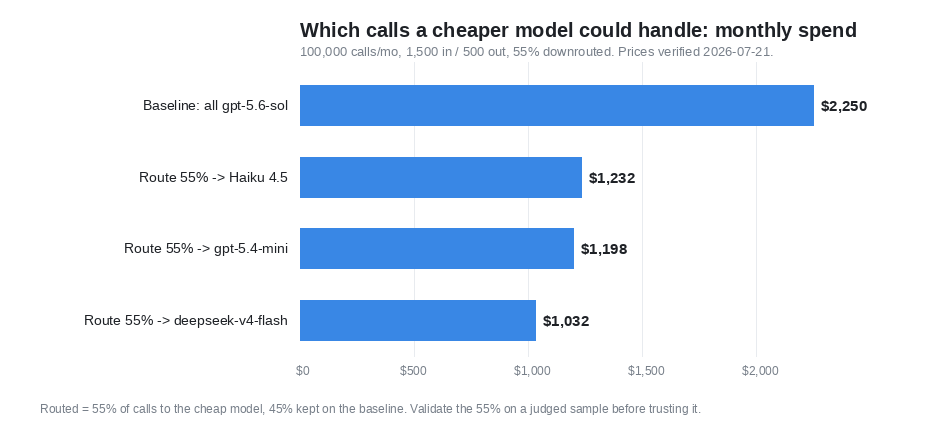
Now compute what the measured downroutable share actually saves, on today's prices. Route the easy calls to a cheap model and keep the hard ones on the baseline. Prices verified 2026-07-21.
| Cheap target | Per call | Routed $/mo at 55% | Saved vs $2,250 |
|---|---|---|---|
| Haiku 4.5 | $0.00400 | $1,232.50 | 45.2% |
| gpt-5.4-mini | $0.00337 | $1,198.12 | 46.8% |
| deepseek-v4-flash | $0.00035 | $1,031.75 | 54.1% |
deepseek-v4-flash is 64x cheaper per call than the baseline, so even downrouting a bit past half your traffic to it lands a 54% cut. The savings scale with the share you can move, which is exactly why measuring that share honestly matters more than picking the cheap model.
Why the free estimate lies, quantified
The offline heuristic and the judged sample often disagree, and the gap is money. Suppose analyze flags 55% of your traffic as downroutable, but your judged sample confirms only 40% actually clear your quality bar.
| Source | Downroutable share | Monthly saving (route to gpt-5.4-mini) |
|---|---|---|
| Offline heuristic (prior) | 55% | $1,051.88 |
| Judged sample (measured) | 40% | $765.00 |
Believing the prior overstates your savings by $286.88 a month, 38% too high. It also overstates quality: the 15 points of traffic the heuristic called easy and the judge rejected are the calls that would have shipped worse answers to users. The judged number is both the honest savings and the safe routing set. Run your own token shape and downroutable share through the calculator to see your version of this table.
The sensitivity that decides everything
Savings track the downroutable share almost linearly, so the measurement in Step 3 is the whole ballgame.
| Downroutable share | Routed $/mo (gpt-5.4-mini) | Saved |
|---|---|---|
| 30% | $1,676.25 | 25.5% |
| 45% | $1,389.38 | 38.2% |
| 55% | $1,198.12 | 46.8% |
| 70% | $911.25 | 59.5% |
A workload where 70% of calls are routine FAQ answers saves 59.5%; one where only 30% are simple saves 25.5%. Same tools, same prices, very different economics, and you cannot know which you have without measuring. This is the model-routing discipline we applied to real coding traffic in the coding-agent model-routers savings post and stress-tested against inflated vendor claims in the router savings claims audit.
The honest tradeoffs
- The offline estimate is a starting point, not a verdict. Its quality tiers are public-leaderboard averages. Your prompts decide your real downroutable share, and only a judged sample on your own logs measures it. Skipping the judge is how you ship quality regressions you labeled as savings.
- A dated price table goes stale silently. Frugon's prices are "synced 2026-07-02 from the LiteLLM registry". Claude Sonnet 5 proves the point: Anthropic first scheduled a 2026-09-01 increase, then canceled it and made $2/$10 standard. A stale table can now overstate the route. Re-price on the live page before you trust any savings figure, which is the same monthly re-verification we run on the production prompt-caching numbers. Updated 2026-08-14.
- The judge itself can be wrong. An LLM judge has its own error rate. Spot-check a slice of its verdicts by hand, and prefer a judge at least as strong as your baseline for the calls where being wrong is expensive.
- Route on the task, not the average. A prompt class that looks easy in aggregate can contain a hard tail. Segment by prompt type before routing, so a cheap model handles the genuinely routine slice and never sees the edge cases.
When chasing this is not worth it
The break-even is a volume question. Routing 40% of calls to gpt-5.4-mini saves about $0.00765 per call. A single engineer-hour to wire and test the routing, at a $100 blended rate, pays back at roughly 13,000 calls. Below that lifetime volume, the labor to build the router costs more than the tokens it saves, and the right move is to pay the bill and spend the hour elsewhere. This is the real lesson under the "burned all my tokens" joke: detection is cheap, but acting on it is engineering, and engineering only pays back above a volume you should compute first. If you run millions of calls a month, this recipe is close to free money. If you run a few thousand, it is a hobby.
Doing this on Vynaris
The DIY path above genuinely works; this section is the paid shortcut, clearly labeled. Vynaris is an OpenAI-compatible gateway that runs the detection loop continuously instead of once: it scores each call's downroutability, routes the easy share to a cheaper model at live prices, keeps a judged sample running so the split stays honest as your traffic drifts, and reports the per-call cost and the realized savings. You get the measured number, not the prior, without maintaining the harness. One base URL swap. See the docs and pricing.
FAQ
How do I know which LLM calls a cheaper model could handle? Log your calls in OpenAI JSONL format, run an offline analyzer like the MIT-licensed Frugon to get a candidate easy/hard split, then validate it by replaying a sample on the cheap model and judging the answers against your logged baseline responses. The judged share is your true downroutable fraction.
How much can routing to a cheaper model save? On a 100,000-call month at 1,500 input and 500 output tokens, moving 55% of traffic off gpt-5.6-sol saves 45% to 54% depending on the cheap target, from $2,250 to between $1,032 and $1,233 per month. Prices verified 2026-07-21.
What does the detection itself cost? About $6.32 one-time to validate on a 1,000-call sample, because your baseline answers are already logged; you only pay to replay the sample on the cheap model ($3.38) and judge the pairs ($2.95). It pays back in about six hours of routed traffic.
Why not just trust the free offline estimate? Because it is a population prior from public leaderboards, not a measurement of your prompts. In the worked example it claimed 55% downroutable where a judged sample confirmed 40%, overstating monthly savings by 38% and mislabeling quality regressions as wins.
When is it not worth routing? Below roughly 13,000 lifetime calls, where a single $100 engineer-hour to build the router costs more than the tokens it saves. Low-volume workloads should pay the bill and skip the harness.
Sources
- Frugon (MIT), the local detector, commands and input format: https://github.com/Rodiun/frugon
- HN discussion "I burned all my tokens researching how to save tokens", 171 points / 207 comments, read 2026-07-21: https://news.ycombinator.com/item?id=48967355
- Anthropic pricing (Haiku 4.5, Sonnet 5 $2/$10 standard), re-verified 2026-08-14: https://platform.claude.com/docs/en/about-claude/pricing
- OpenAI API pricing (gpt-5.6-sol, gpt-5.4-mini), captured 2026-07-21: https://developers.openai.com/api/docs/pricing
- DeepSeek API pricing (v4-flash), captured 2026-07-21: https://api-docs.deepseek.com/quick_start/pricing
- Cost model script and per-call arithmetic: from the assumptions table above.
Prices change. We re-verify every figure in this post monthly and stamp updates. Numbers here are current as of 2026-07-21.
The lesson from the recipe: finding which calls a cheaper model could handle is a $6 measurement, not a research project, as long as you sample instead of exhaustively replay, judge instead of trust a prior, and re-price on live rates instead of a dated table.