
Blog · · Updated · By Dhrumil Barot, Founder
MiMo Token Plan vs pay-as-you-go: the 87.1% quota break-even
MiMo Max beats pay-as-you-go only above 87.1% monthly quota use. Lite and Standard remain more expensive even when every credit is consumed.
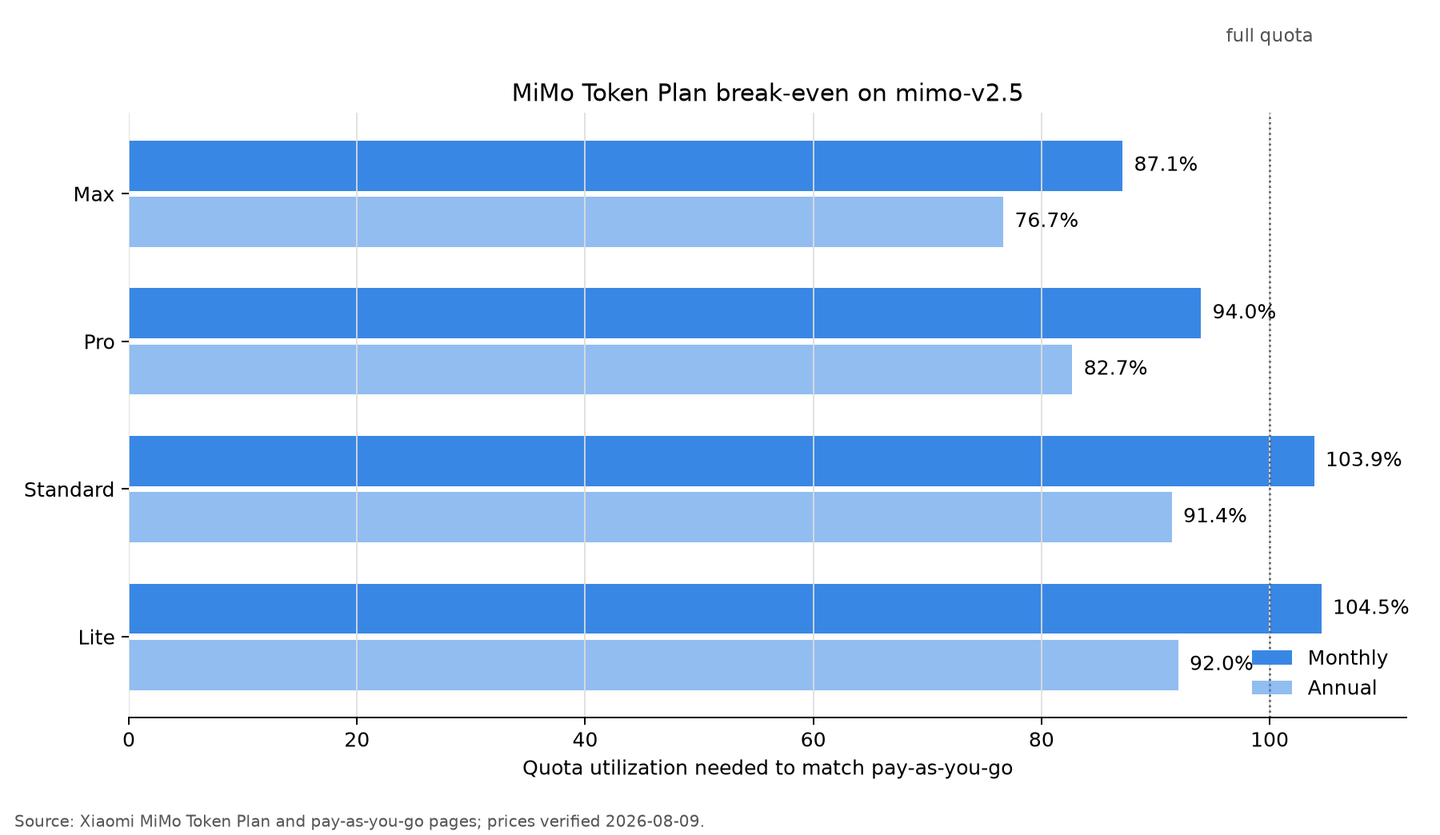
MiMo Max beats pay-as-you-go on mimo-v2.5 only after 87.1% of its monthly credits are used. Lite and Standard never break even at list price: full utilization still costs 4.5% and 3.9% more than the equivalent API usage. The annual plans move those lines to 92.0%, 91.4%, 82.7%, and 76.7%.
Prices verified 2026-08-09.
TL;DR
- Xiaomi's monthly MiMo Token Plan costs $6, $16, $50, or $100 for 4.1B, 11B, 38B, or 82B credits.
- On mimo-v2.5 pay-as-you-go pricing, every 1B plan credits buys exactly $1.40 of API usage. That is true for cache-hit input, cache-miss input, and output.
- Monthly Lite and Standard require 104.5% and 103.9% utilization to break even. Pro needs 94.0%. Max needs 87.1%.
- Annual billing is 12% below twelve monthly payments. Its break-even points are 92.0%, 91.4%, 82.7%, and 76.7%.
- A 0.8x nighttime consumption coefficient improves the plan. The package still works only in approved programming tools. It cannot power custom backends or non-coding automation.
Verdict table
| Plan | Monthly price | Monthly credits | Pay-go value at 100% use | Break-even utilization | Verdict |
|---|---|---|---|---|---|
| Lite | $6 | 4.1B | $5.74 | 104.5% | API is cheaper at every usage level |
| Standard | $16 | 11B | $15.40 | 103.9% | API is cheaper at every usage level |
| Pro | $50 | 38B | $53.20 | 94.0% | Plan wins only near full use |
| Max | $100 | 82B | $114.80 | 87.1% | Best monthly break-even |
This table answers the purchasing question. Buy monthly Max only when a coding workload can consume at least $100 of the plan's $114.80 pay-go equivalent. Lite and Standard are convenience products at list price, not API discounts.
Why cache mix cancels on mimo-v2.5
The plan deducts 2 credits for each cache-hit input token, 100 for each cache-miss input token, and 200 for each output token. The API charges $0.0028, $0.14, and $0.28 per 1M tokens for those categories.
Normalize each category to 1B credits:
cache hit:  1B / 2 credits/token   = 500M tokens x $0.0028/MTok = $1.40
cache miss: 1B / 100 credits/token =  10M tokens x $0.14/MTok   = $1.40
output:     1B / 200 credits/token =   5M tokens x $0.28/MTok   = $1.40
That equality is the useful finding. A better cache hit rate reduces total token-plan consumption and the API bill in the same proportion. It does not rescue an underused subscription. The plan's credit conversion already mirrors the cost per token.
The monthly break-even formula is:
plan price / (credit quota in billions x $1.40)
For Max, $100 / (82 x $1.40) = 87.108%. For Lite, $6 / (4.1 x $1.40) = 104.53%. A break-even above 100% means the plan cannot beat API pricing before its quota ends.
Use the LLM cost calculator here to price your actual input tokens, cached input, and output tokens. Then compare that monthly API total with the plan price. Do not convert Xiaomi's estimated “rounds” into spend; the page does not publish a token shape for a round.
Annual plans are the real discount
Annual quotas are exactly twelve times the monthly quotas. Annual prices are 88% of twelve monthly payments: $63.36, $168.96, $528, and $1,056. That 12% price reduction lowers every break-even by the same proportion.
| Plan | Annual price | Annual credits | Pay-go value at 100% use | Break-even utilization |
|---|---|---|---|---|
| Lite | $63.36 | 49.2B | $68.88 | 92.0% |
| Standard | $168.96 | 132B | $184.80 | 91.4% |
| Pro | $528 | 456B | $638.40 | 82.7% |
| Max | $1,056 | 984B | $1,377.60 | 76.7% |
The annual Max plan is the strongest list-price deal. It still requires $1,056 of a $1,377.60 API-equivalent quota. If usage stops at half the quota, pay-as-you-go costs $688.80 and wins by $367.20.
Annual Lite illustrates the lock-in problem. It beats the API after 92.0% utilization, but a developer must predict a year of usage to capture an 8.0% maximum saving. Model prices, tools, and workloads can change inside that year. The saving is small relative to the forecasting risk.
Xiaomi also offers a one-time 12% first-purchase discount on a package. Applied to monthly Max, it lowers the first month's break-even from 87.1% to 76.7%. That is the annual ratio because both discounts multiply price by 0.88. It is an acquisition offer, not the recurring unit economics.
Nighttime usage changes the denominator
Calls between 00:00 and 08:00 Beijing time, or 16:00 to 24:00 UTC, consume credits at a 0.8x coefficient. The same coding work therefore uses 20% fewer plan credits during that window.
If every Max-plan call qualifies, the day-rate-equivalent break-even falls from 87.1% to 87.1% x 0.8 = 69.7% of nominal quota. Combine the one-time 12% purchase discount with all-night usage and the first-month line becomes 61.3%. Real workloads will sit between the day and night extremes.
The API page does not advertise a matching nighttime token discount. That makes scheduling batchable coding work the plan's clearest advantage. Interactive work in India also fits the window awkwardly: 21:30 to 05:30 IST. The discount is valuable only if the work can move there.
mimo-v2.5-pro has slightly more value per credit
The Pro model uses 2.5 credits per cache-hit input token, 300 per cache miss, and 600 per output token. Its API rates are $0.0036, $0.435, and $0.87 per 1M tokens.
One billion plan credits therefore maps to $1.44 of cache-hit usage and $1.45 of cache-miss or output usage. That is 2.9% to 3.6% more API value per credit than mimo-v2.5's $1.40.
For monthly Max, the Pro model moves the break-even from 87.1% to 84.1% to 84.7%, depending on token mix. Monthly Lite and Standard still need more than 100% at list price. Model choice does not turn a lightly used plan into a bargain.
This is a sticker comparison, not a quality verdict. A stronger model can reduce retries or human review enough to justify a higher cost per task. Xiaomi publishes no public task-quality equivalence between the two models on each buyer's coding workload.
The operational constraints matter more than 3 percentage points
Token Plan credits are not ordinary API balance. Xiaomi says they can be used only through programming tools such as OpenClaw and OpenCode. Custom application backends, automated scripts, and clearly non-coding requests are prohibited. The platform may suspend service or ban a plan API key for misuse.
Service stops when quota is exhausted. The plan does not draw from bonus balance automatically. A user must upgrade or switch to the regular API. Only one package can be active, downgrades are unavailable mid-term, and Max cannot be upgraded further.
Unused credits receive no refund. That makes variance expensive. A workload forecasting $110 of monthly API use may still lose on Max if one quiet month leaves half the credits idle.
Our earlier MiMo inference-system cost audit explains why the cheap cache-hit rate needs measured prompt caching, not a copied provider average. The agent workflow forecast shows how to bound calls, retries, and growing history before committing to a quota.
Honest tradeoff: when not to buy the plan
Use pay-as-you-go when monthly coding volume is below the break-even, demand is spiky, or the same credentials must serve a backend. The API charges only for tokens used and keeps non-coding automation inside the intended product.
Use the Token Plan when coding volume is stable, approved tools cover the workflow, and measured consumption clears the line with margin. Max has the best monthly economics. Annual Max is cheaper again, but it exchanges flexibility for a year-long commitment.
Do not buy Lite or Standard at monthly list price to save token money. They do not. Buy them only if subscription packaging is worth the small premium.
FAQ
At what utilization does MiMo Max beat pay-as-you-go?
Monthly Max breaks even at 87.1% of its 82B credits on mimo-v2.5. Annual Max breaks even at 76.7% of 984B credits.
Does a higher cache-hit rate make the plan cheaper than the API?
Not on mimo-v2.5. Credit weights and API rates are proportional across hit, miss, and output tokens. Cache mix therefore cancels in the plan-versus-API comparison.
Are Lite and Standard cheaper than API usage?
Not at monthly list price. Their full quotas are worth $5.74 and $15.40 at pay-go rates, below their $6 and $16 prices.
Can the Token Plan power a production application backend?
No. Xiaomi restricts the quota to programming tools and prohibits custom backends, automated scripts, and clearly non-coding scenarios.
What happens when credits run out?
Service stops. The user must upgrade the package or switch to a regular pay-as-you-go API key.
Sources
- Xiaomi MiMo Token Plan, captured 2026-08-09: package prices, quotas, credit weights, discounts, exhaustion behavior, refunds, and usage restrictions.
- Xiaomi MiMo API pricing, captured 2026-08-09: current model IDs and overseas hit, miss, output, ASR, and web-search prices.
- Luo Fuli's Token Plan post, captured 2026-08-09: public demand signal only, not a price receipt.
All arithmetic is reproducible in the accompanying Python script. No Vynaris traffic, customer, or routing data is used.