
Blog · · Updated · By Dhrumil Barot, Founder
Reasoning effort is a price dial: GPT-5.6 cost per task by effort, and when Luna beats Terra
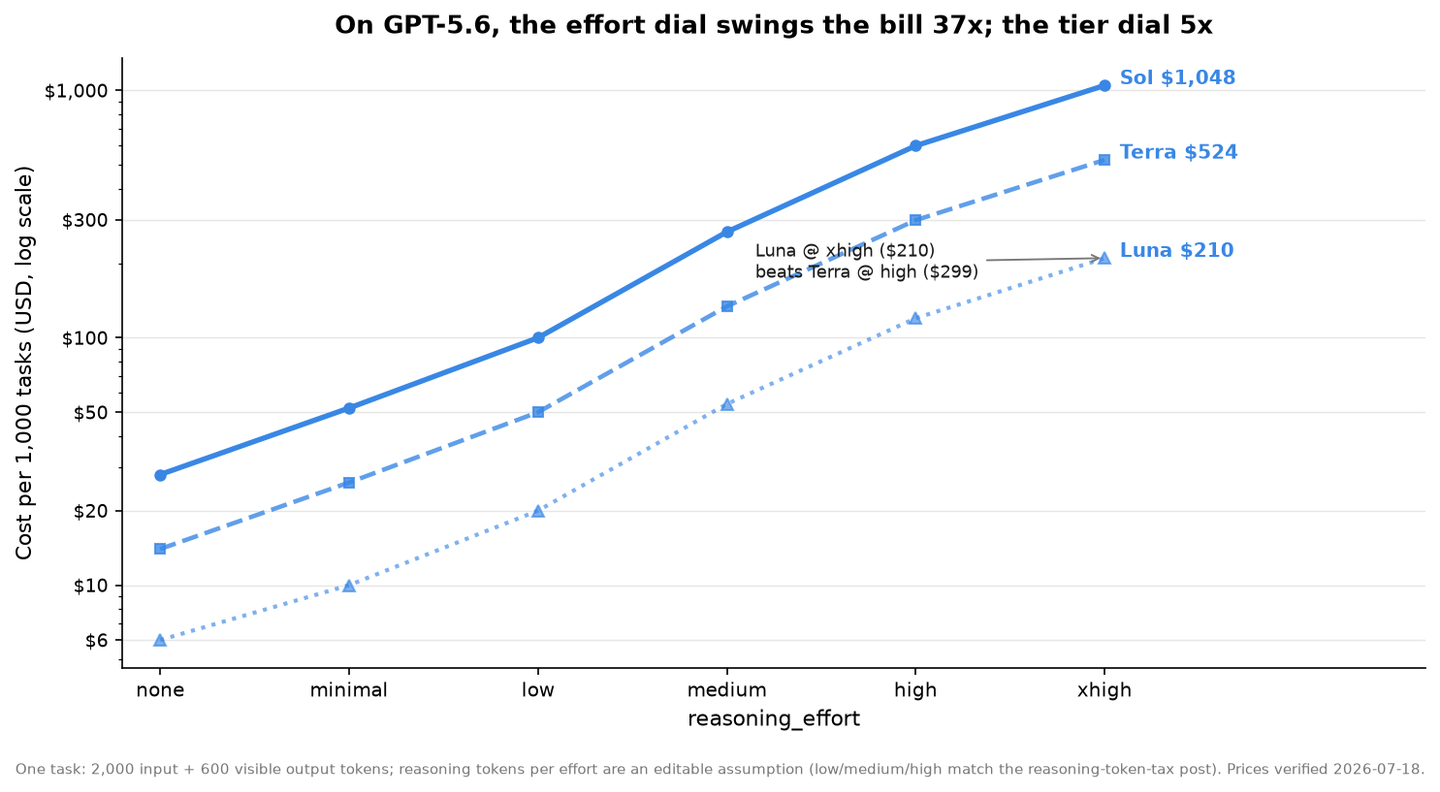
On GPT-5.6 the same task costs $28 per 1,000 runs at reasoning_effort=none and $1,048 at xhigh on Sol, a 37x swing from one config field. Tier choice moves it only 5x. We price every effort level across Sol, Terra and Luna, and find where Luna beats Terra. Prices verified 2026-07-18.
On GPT-5.6, the same task costs $28 per 1,000 runs at reasoning_effort=none and $1,048 at xhigh on the Sol tier. That is a 37x swing from one config field, and it happens because effort scales the model's invisible reasoning tokens, which are billed at the output rate. Switching Sol to Luna at a fixed effort moves the same task only 5x. The effort dial is the bigger lever. Prices verified 2026-07-18.
Most cost write-ups stop at the tier: Sol vs Terra vs Luna, $5/$30 vs $2.50/$15 vs $1/$6 per million tokens. That is the sticker you see. The dial you do not see is reasoning_effort, and on a thinking model it decides how many tokens the model spends before it writes a single visible word. This post prices one task at every effort level across all three GPT-5.6 tiers, from a public pricing page and one editable assumptions table. Nothing here is measured from inside any product.
TL;DR
- On the Sol tier, one reasoning task costs $28 per 1,000 at `none` and $1,048 at `xhigh`, a 37x swing. The tier choice at a fixed effort (Sol to Luna) is only a 5x swing. Effort moves the bill harder than the tier.
- Luna at Extra High undercuts Terra at High: $120 to $210 per 1,000 tasks versus $299, which is 30% to 60% cheaper depending on how many more tokens Luna spends. A smaller tier at a higher effort can cost less than a bigger tier at a lower effort.
- At
higheffort, reasoning tokens are 95% of the per-task bill on Sol. You budget from the visible answer and pay for the part you never see. Cap it withmax_output_tokens.
What we computed and why
GPT-5.6 exposes six reasoning settings: none, minimal, low, medium, high, and xhigh. OpenAI's own guide is blunt about the billing: reasoning tokens "are billed as output tokens," they are "not visible via the API," and a task can generate "anywhere from a few hundred to tens of thousands of reasoning tokens." That is the whole cost story. Effort does not change the per-token price. It changes the token count, on the most expensive line of the invoice.
So the useful question is not "which tier is cheapest." It is "for a task that needs thinking, how much does turning the effort dial cost, and can a cheaper tier at a higher effort beat a pricier tier at a lower one." Both are decisions a router or a config flag makes on every call. Neither shows up on a pricing table.
The assumptions (editable)
One representative reasoning task. The visible shape is fixed; the reasoning-token count per effort is our assumption, because OpenAI does not publish exact counts per level. The low, medium, and high rows reuse the exact thinking budgets from our reasoning-token tax post so the numbers reconcile across both; none, minimal, and xhigh extrapolate within OpenAI's documented range.
| Assumption | Value | Note |
|---|---|---|
| Visible input tokens | 2,000 | prompt + context |
| Visible output tokens | 600 | the answer you actually read |
| reasoning tokens: none | 0 | thinking off |
| reasoning tokens: minimal | 800 | a few hundred |
| reasoning tokens: low | 2,400 | matches reasoning-token-tax post |
| reasoning tokens: medium | 8,000 | matches reasoning-token-tax post |
| reasoning tokens: high | 19,000 | matches reasoning-token-tax post |
| reasoning tokens: xhigh | 34,000 | tens of thousands, upper range |
Cost per task = input tokens x input price + (visible output + reasoning tokens) x output price. The reasoning tokens ride the output rate. Prices per million tokens, verified 2026-07-18: gpt-5.6-sol $5/$30, gpt-5.6-terra $2.50/$15, gpt-5.6-luna $1/$6.
The grid: cost per 1,000 tasks by effort
effort    reasoning tok     Sol     Terra    Luna
------------------------------------------------
none                  0    $   28   $   14   $    6
minimal             800    $   52   $   26   $   10
low               2,400    $  100   $   50   $   20
medium            8,000    $  268   $  134   $   54
high             19,000    $  598   $  299   $  120
xhigh            34,000    $1,048   $  524   $  210
Read down any column. On Sol, moving from low to high takes the task from $100 to $598 per 1,000, a 6x jump, with no change of model and no change to the prompt. Read across any row and the tiers stay in a clean 5:2.5:1 ratio, because that is the output-price ratio and reasoning tokens dominate the bill. The dial you set in code changes the number more than the model you picked from the catalog.
Which dial moves the bill: effort or tier
Hold the tier at Sol and turn the effort dial from none to xhigh: the task goes from $28 to $1,048 per 1,000, a 37x range. Hold the effort at high and switch the tier from Sol to Luna: $598 to $120, a 5x range. On a thinking workload, effort is roughly seven times the lever the tier is.
This inverts the usual advice. "Route the cheap steps to a smaller model" is real and worth doing, but on a reasoning task you can leave the model exactly where it is and cut the bill 55% by dropping high to medium, or more than double it by nudging medium back to high. The reason is arithmetic: at high effort, 19,000 of the 19,600 output tokens are reasoning. The visible 600-token answer is a rounding error. You are buying thinking time by the token, and the effort field sets the meter.
| Sol tier, per 1,000 tasks | Cost | Reasoning share of bill |
|---|---|---|
| low | $100 | 72% |
| medium | $268 | 90% |
| high | $598 | 95% |
| xhigh | $1,048 | 97% |
The crossover: Luna at Extra High vs Terra at High
The sharpest routing move hides in the gap between tiers and efforts. A practitioner reported swapping GPT-5.6 Terra at High for Luna at Extra High and getting the same output quality at 2.5x less cost and 1.3x faster. We cannot verify their quality claim, and we do not try; we test the cost claim from list prices.
Terra at high runs 19,000 reasoning tokens and costs $299 per 1,000 tasks. Now put the work on Luna at xhigh. Two cases bound the answer:
comparison                                          cost/1k    vs Terra@high
---------------------------------------------------------------------------
Terra @ high   (19,000 reasoning tok)               $299         -
Luna  @ xhigh  (19,000 tok, equal thinking)         $120        2.50x cheaper
Luna  @ xhigh  (34,000 tok, thinks 1.8x longer)     $210        1.43x cheaper
If Luna at Extra High reaches the same answer with the same amount of thinking Terra used at High, the saving is exactly 2.5x, which is the raw output-price ratio ($15 vs $6) and matches the reported figure. If Luna needs to think about 1.8x longer to match Terra's quality, the extra reasoning tokens erode the gap to 1.43x, still 30% cheaper. So the community's 2.5x is the best case, and the honest range on list prices is 1.4x to 2.5x cheaper. The direction never flips: a smaller tier at a higher effort beats a bigger tier at a lower effort on this task, because the price cut per token is larger than the token-count penalty from thinking longer.
This is the moment to run your own token shape and effort levels through the calculator instead of trusting our task. The crossover point is entirely a function of how many more reasoning tokens the smaller tier needs to match the larger one, and only your evals can measure that.
What it means for routing
- Set effort per task class, not per app. A classification or extraction step needs
noneorminimal; a hard planning step may earnhigh. Defaulting the whole app tohighis the single most expensive line in most reasoning bills, and it is a one-word change to fix. - Try dropping the effort before dropping the tier. On a reasoning task,
hightomediumon the same model saves more (55%) than Sol to Terra at fixed effort (50%), and it keeps you on the tier you already validated. Change one variable at a time. - Use the crossover deliberately. When a task needs real thinking, a cheaper tier turned up to
xhighcan be both cheaper and, per the field report, faster than a pricier tier athigh. That only holds if the smaller tier actually reaches the same quality; measure it, do not assume it. - Budget from the reasoning tokens, not the answer. At
higheffort the visible answer is 3% of the cost. Any budget built from output length alone underestimates the bill by roughly 10x. This is the same trap we quantified in the reasoning-token tax, now with the effort field as the cause.
For the base per-tier task math without the effort variable, see our GPT-5.6 Sol vs Terra vs Luna breakdown; for every model's raw rates, the July 2026 price list.
Caveats and where we are wrong
- The reasoning-token counts are assumptions. OpenAI does not publish tokens-per-effort. We grounded
low/medium/highin a prior post and OpenAI's stated range, but your task's counts will differ, sometimes a lot. The dollar magnitudes are illustrative; the shape of the curve is the finding. Swap your measured counts into the script and rerun. - `none` and `minimal` are not free lunches. Turning effort down does not just save money; it changes what the model can do. A task that needs multi-step reasoning will fail at
none, and you will pay for the retries and the wrong answers that a cheap-first policy ships. The dial trades cost for capability, not cost for nothing. - `xhigh` can overrun your output ceiling. 34,000 reasoning tokens plus the answer can hit
max_output_tokensand truncate, which means you pay for the thinking and get no answer. Set the ceiling with headroom or the cheapest effort becomes the one that failed. - The crossover depends on quality parity we cannot see. Our 1.4x to 2.5x range assumes Luna at
xhighmatches Terra athigh. If it does not on your workload, the cheaper bill bought you a worse product. Prices are public; quality parity is yours to measure. - Latency is a separate axis. Effort raises token count, which usually raises latency too. The field report's "1.3x faster" is theirs, not ours; a pricing page cannot tell you which effort or tier is faster on your traffic.
FAQ
Does higher reasoning effort cost more even at the same model price? Yes. Effort does not change the per-token price; it changes how many reasoning tokens the model generates, and those bill at the output rate. On Sol, high costs about 6x more than low for the same task.
Are reasoning tokens billed at the input or output rate? The output rate. OpenAI's guide states reasoning tokens "are billed as output tokens." On Sol that is $30 per million, the most expensive line available.
Can a cheaper GPT-5.6 tier at high effort beat a pricier one at low effort? Yes, if the cheaper tier reaches the same quality. Luna at xhigh costs $120 to $210 per 1,000 tasks versus Terra at high at $299, so 1.4x to 2.5x cheaper on list prices, provided quality holds.
How do I stop reasoning tokens from blowing up the bill? Set reasoning_effort per task class instead of one global default, and cap total output with max_output_tokens. Reserve high effort for steps that measurably need it.
Why don't I see reasoning tokens in the response? They are hidden by design. They occupy the context window and appear in usage under output_tokens_details.reasoning_tokens, but never in the message body. You pay for them without reading them.
Sources
- OpenAI reasoning guide (effort levels none/minimal/low/medium/high/xhigh; reasoning tokens billed as output; "few hundred to tens of thousands"), verified 2026-07-18: https://developers.openai.com/api/docs/guides/reasoning
- OpenAI API pricing (gpt-5.6-sol/terra/luna input and output rates), verified 2026-07-18: https://developers.openai.com/api/docs/pricing
- Community crossover claim under test (Terra High to Luna Extra High), read 2026-07-18: https://x.com/cjzafir/status/2076050485354926355
- All arithmetic:
gpt-56-reasoning-effort-cost-per-task-dial-math.py, assumptions editable inline.
Related: The reasoning-token tax · GPT-5.6 Sol vs Terra vs Luna cost per task · July 2026 LLM price list