
Blog · · By Dhrumil Barot, Founder
Amazon Nova vs Claude: Bedrock Prices and Cost per Document
Nova Micro and Nova Lite cost less than Claude Haiku 5.5 on Bedrock, but Nova Pro costs 8x more per input token. Cost per 1,000 documents compared.
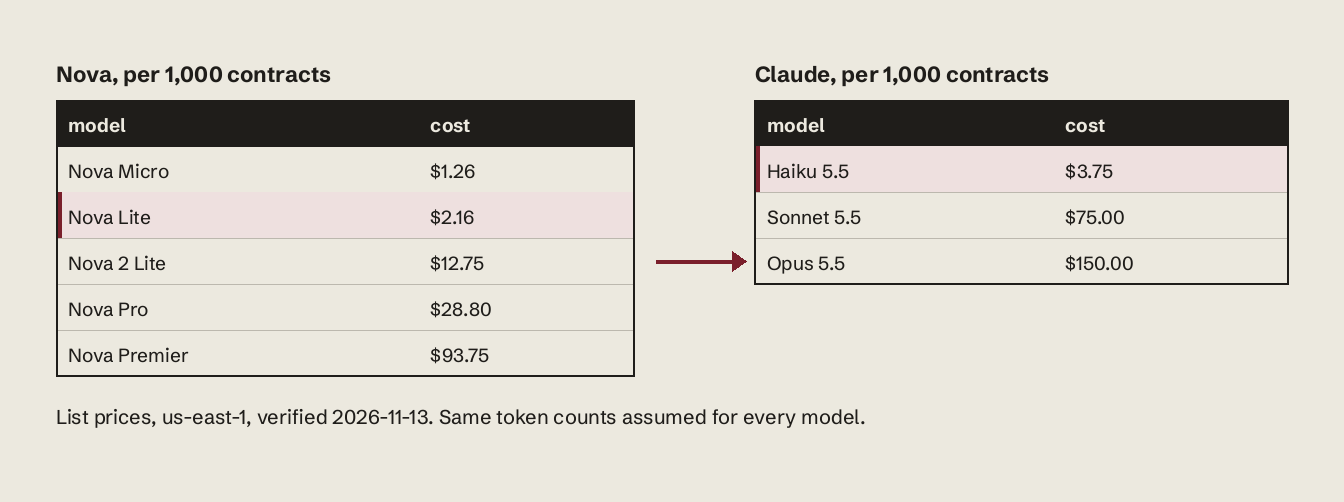
TL;DR: On Amazon Bedrock, Amazon Nova Micro and Nova Lite are the cheapest text models in this comparison, and Claude Haiku 5.5 is the cheapest Claude at $0.10 input and $0.50 output per 1M tokens. Nova Pro ($0.80 / $3.20) now costs 8x Haiku 5.5 per input token, so the old "Nova is the cheap option" rule only holds for Micro and Lite. Per 1,000 contracts of 30,000 tokens: Nova Lite $2.16, Claude Haiku 5.5 $3.75, Nova Pro $28.80, Claude Sonnet 5.5 $75.00.
Amazon Nova vs Claude comes down to which tier you compare. Nova Micro ($0.035 / $0.14 per 1M tokens) and Nova Lite ($0.06 / $0.24) undercut every Claude model on price. Claude Haiku 5.5 ($0.10 / $0.50) undercuts Nova 2 Lite, Nova Pro and Nova Premier. Claude Sonnet 5.5 ($2 / $10) is cheaper than Nova Premier ($2.50 / $12.50). All prices are us-east-1 list prices from the Amazon Nova pricing page and the Amazon Bedrock pricing page, verified 2026-11-13. For document processing, the cheap Nova tiers are enough for field extraction from clean documents. Claude has a larger output limit (128K vs 10K tokens on Nova v1) and a 1M context on every current model.
Amazon Nova vs Claude: the comparison table
This table compares the models a Bedrock user picks between. Prices are USD per 1M tokens at each model's cheapest standard on-demand endpoint: global cross-Region for Claude 5.5 and Nova 2 Lite, geo cross-Region or in-region for Nova Micro, Lite, Pro and Premier (they have no global price).
| Criterion | Nova Micro | Nova Lite | Nova 2 Lite | Nova Pro | Nova Premier | Claude Haiku 5.5 | Claude Sonnet 5.5 | Claude Opus 5.5 |
|---|---|---|---|---|---|---|---|---|
| Input per 1M | $0.035 | $0.06 | $0.30 | $0.80 | $2.50 | $0.10 (up to 100K prompt) | $2.00 | $4.00 |
| Output per 1M | $0.14 | $0.24 | $2.50 | $3.20 | $12.50 | $0.50 (up to 100K prompt) | $10.00 | $20.00 |
| Context window | 128K | 300K | 1M | 300K | 1M | 1M | 1M | 1M |
| Max output | 10K | 10K | 65,536 | 10K | 10K | 128K | 128K | 128K |
| Inputs | Text only | Text, image, video, docs | Text, image, video, docs | Text, image, video, docs | Text, image, video, docs | Text, image | Text, image | Text, image |
| Bedrock batch price | $0.0175 / $0.07 | $0.03 / $0.12 | $0.15 / $1.25 | $0.40 / $1.60 | $1.25 / $6.25 | Not listed | Not listed | Not listed |
| Cache read per 1M | 75% off input | 75% off input | $0.075 | $0.20 | n/a | $0.01 | $0.10 | $0.20 |
Sources: Nova context, output and document support from the Amazon Nova user guide and the Nova 2 user guide. Claude context and output from Anthropic's models overview. Claude Haiku 5.5 charges $0.50 / $2.50 when a prompt is over 100,000 tokens.
Is Amazon Nova cheaper than Claude on Bedrock?
Amazon Nova is cheaper than Claude only at the bottom of the range. Nova Micro and Nova Lite cost less than Claude Haiku 5.5 on both input and output. From Nova 2 Lite upward, the matching Claude model is cheaper or close:
- Nova Lite vs Claude Haiku 5.5: Nova Lite is 40% cheaper on input ($0.06 vs $0.10) and 52% cheaper on output ($0.24 vs $0.50).
- Nova 2 Lite vs Claude Haiku 5.5: Haiku 5.5 is 67% cheaper on input ($0.10 vs $0.30) and 80% cheaper on output ($0.50 vs $2.50), as long as the prompt stays under 100K tokens.
- Nova Pro vs Claude Haiku 5.5: Haiku 5.5 is 88% cheaper on input ($0.10 vs $0.80). This is the "nova pro vs claude" pairing most older comparisons were written about, when the small Claude cost $1 / $5 (Claude Haiku 4.5, still listed on Bedrock at that price).
- Nova Premier vs Claude Sonnet 5.5: Sonnet 5.5 is 20% cheaper on both input ($2.00 vs $2.50) and output ($10 vs $12.50).
Two endpoint details change the math. First, Claude on Bedrock costs 10% more on regional endpoints than on global ones; Anthropic's pricing page states that "regional and multi-region endpoints include a 10 percent premium over global endpoints". Haiku 5.5 becomes $0.11 / $0.55 if your data must stay in a US region. Nova 2 Lite has the same 10% gap ($0.30 global, $0.33 geo). Nova Micro, Lite, Pro and Premier are priced only on geo and in-region endpoints, so data residency costs them nothing extra. Second, Bedrock lists batch prices for every Nova model and none for the Claude 5.5 models, so for an overnight backlog Nova gets 50% off and Claude 5.5 on Bedrock does not.
What does a document job cost on Nova vs Claude?
A document job costs input tokens times the input price plus output tokens times the output price, multiplied by volume. We priced three job shapes at 1,000 documents each. The token counts are assumptions you should replace with your own; edit them in the table and recompute, or use the Vynaris cost calculator.
| Assumption | Invoice extraction | Contract review | Long filing Q&A |
|---|---|---|---|
| Input tokens per document (instructions + document) | 2,500 | 30,000 | 150,000 |
| Output tokens per document | 500 | 1,500 | 2,000 |
| Documents | 1,000 | 1,000 | 1,000 |
| Model | Invoice extraction | Contract review | Long filing Q&A |
|---|---|---|---|
| Nova Micro | $0.16 | $1.26 | Does not fit (128K) |
| Nova Lite | $0.27 | $2.16 | $9.48 |
| Claude Haiku 5.5 | $0.50 | $3.75 | $80.00 (over-100K rate) |
| Nova 2 Lite | $2.00 | $12.75 | $50.00 |
| Nova Pro | $3.60 | $28.80 | $126.40 |
| Claude Sonnet 5.5 | $10.00 | $75.00 | $320.00 |
| Nova Premier | $12.50 | $93.75 | $400.00 |
| Claude Opus 5.5 | $20.00 | $150.00 | $640.00 |
Worked example, Claude Haiku 5.5 on contract review: 1,000 x 30,000 = 30M input tokens x $0.10 = $3.00, plus 1,000 x 1,500 = 1.5M output tokens x $0.50 = $0.75, total $3.75. Nova Pro on the same job: 30M x $0.80 = $24.00 plus 1.5M x $3.20 = $4.80, total $28.80.
Three caveats keep this honest. Nova and Claude use different tokenizers, so the same contract is not the same token count on both; read inputTokens from the response usage on 20 real documents before trusting any table. Claude 5.5 models think adaptively (Haiku 5.5 defaults to medium effort per Anthropic's models overview), and Nova 2 Lite has thinking levels; thinking tokens bill as output, so a job with reasoning on costs more than the output row above. And price is not accuracy: a model that needs a retry on 1 document in 10 pays for that retry.
The 100K cliff on Claude Haiku 5.5
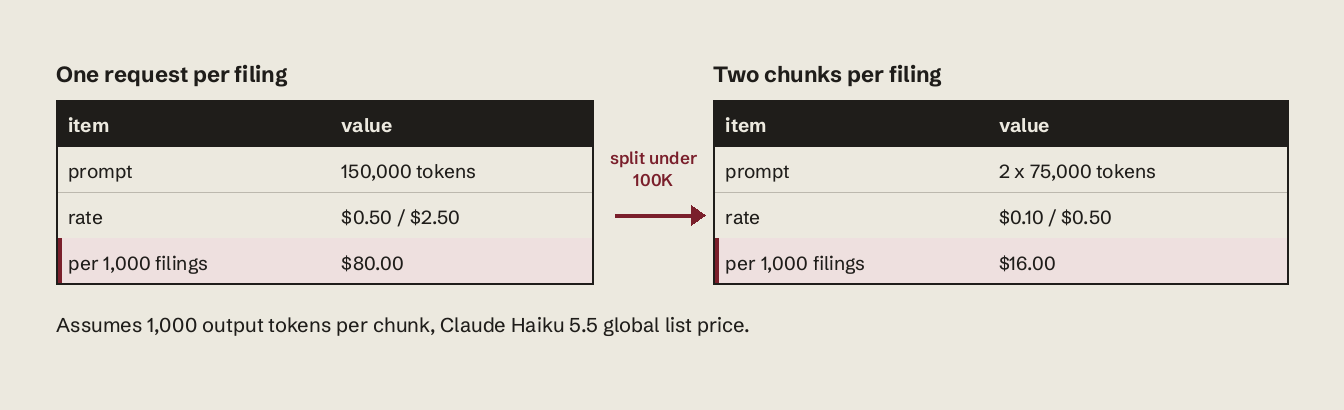
Claude Haiku 5.5 is priced per request by prompt length, and a prompt over 100,000 tokens pays $0.50 / $2.50 instead of $0.10 / $0.50, cache reads included. That is why the long filing column flips: Haiku 5.5 costs $80.00 per 1,000 filings, more than Nova 2 Lite at $50.00. Split each 150,000-token filing into two 75,000-token requests and Haiku 5.5 stays on the low rate: 150M input x $0.10 = $15.00 plus 2M output x $0.50 = $1.00, so $16.00 per 1,000. The tradeoff is that no single request sees the whole filing, which breaks questions that join facts across sections.
Which is better for document processing?
For document processing, pick by what the document job needs, not by vendor. We have not run an accuracy eval on these models, and we do not quote one here; run 50 to 100 of your own labeled documents through two candidates before committing.
The published specs point to clear fits:
- Clean, short documents with a fixed schema (invoices, receipts, forms): Nova Lite or Claude Haiku 5.5. Both cost under $1 per 1,000 invoices in the table above. Nova Micro is cheaper still but is text-only and does not take documents directly, per the Nova user guide, so you must extract the text first.
- Native file inputs: Nova Lite, Pro and Premier accept PDF, CSV, DOC, DOCX, XLS, XLSX, HTML, TXT and MD, and all of them take video too. That saves a parsing step for spreadsheets and Word files.
- Long outputs: Nova Micro, Lite, Pro and Premier stop at 10K output tokens. If the job writes a long redline or a full structured dump of a large document, Claude (128K) or Nova 2 Lite (65,536) is the fit.
- Long documents: Nova Pro and Lite cap at 300K tokens of context; Nova 2 Lite, Nova Premier and all Claude 5.5 models take 1M.
- Judgment-heavy review (contract risk, policy interpretation): this is where teams pay for Claude Sonnet 5.5 or Opus 5.5. Sonnet 5.5 costs $75 per 1,000 contracts in our model, 20x Haiku 5.5, so it should only see the documents that need it.
Anthropic itself positions Haiku 5.5 "for high-volume, latency-sensitive tasks such as classification, extraction, and routing". For more extraction math across providers, see our document extraction cost playbook.
Can you route between Nova and Claude?
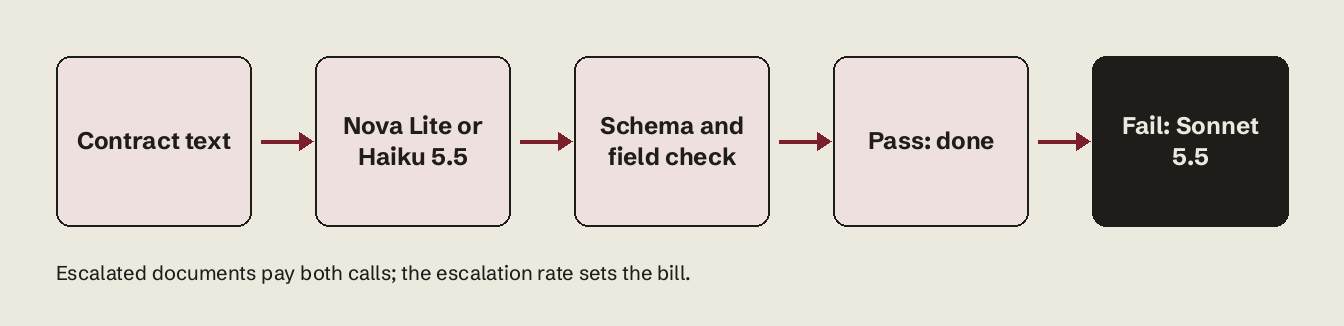
Yes, but not with Bedrock's built-in router. Bedrock Intelligent Prompt Routing only routes "between different foundational models within the same model family", and its current supported list is Nova Lite, Nova Pro and Meta Llama 3.x models, per the Bedrock prompt routing docs. It is also optimized for English prompts only. To mix Nova and Claude you route in your own code. The Bedrock Converse API takes the same request shape for both families, so a cascade is a few lines:
import json
import boto3

bedrock = boto3.client("bedrock-runtime", region_name="us-east-1")

CHEAP = "us.amazon.nova-lite-v1:0"           # Nova Lite inference profile
STRONG = "anthropic.claude-sonnet-5-5"       # Claude Sonnet 5.5 (Bedrock ID from Anthropic docs)
REQUIRED = {"party_a", "party_b", "term_months", "termination_notice_days"}

def ask(model_id, prompt):
    resp = bedrock.converse(
        modelId=model_id,
        messages=[{"role": "user", "content": [{"text": prompt}]}],
        inferenceConfig={"maxTokens": 1500, "temperature": 0},
    )
    text = resp["output"]["message"]["content"][0]["text"]
    return text, resp["usage"]  # inputTokens, outputTokens for your cost log

def extract(contract_text):
    prompt = "Return JSON with keys " + ", ".join(sorted(REQUIRED)) + ".\n\n" + contract_text
    text, usage = ask(CHEAP, prompt)
    try:
        data = json.loads(text)
        if REQUIRED <= data.keys() and all(data[k] not in (None, "") for k in REQUIRED):
            return data, CHEAP, usage
    except json.JSONDecodeError:
        pass
    text, usage = ask(STRONG, prompt)  # escalate only the failures
    return json.loads(text), STRONG, usage
The cost math for a cascade: every document pays the cheap call, and escalated documents also pay the strong call. With 20% of 1,000 contracts escalated to Sonnet 5.5, Nova Lite first costs $2.16 + 0.2 x $75.00 = $17.16, and Claude Haiku 5.5 first costs $3.75 + $15.00 = $18.75. Both are about 75% below sending everything to Sonnet 5.5 ($75.00), and both are cheaper than sending everything to Nova Pro ($28.80) if Nova Pro were your middle ground. The escalation rate decides it: at 50% escalation the Nova Lite cascade costs $39.66. Our LLM routing examples cover other gate types, such as confidence scores and schema checks.
If you would rather not maintain the gate, routing table and price updates yourself, Vynaris routes each request to the cheapest model that fits it across providers behind one OpenAI-compatible API, and logs the cost per request.
What context windows do Nova and Claude offer?
Claude Haiku 5.5, Sonnet 5.5 and Opus 5.5 all offer a 1M-token context window and 128K output tokens. Nova context depends on generation: Nova Micro 128K, Nova Lite 300K, Nova Pro 300K, Nova Premier 1M, and the Nova 2 models up to 1M with 65,536 output tokens.
| Model | Context window | Max output | Long-prompt price change |
|---|---|---|---|
| Nova Micro | 128K | 10K | None |
| Nova Lite | 300K | 10K | None |
| Nova Pro | 300K | 10K | None |
| Nova Premier | 1M | 10K | None |
| Nova 2 Lite | 1M | 65,536 | None |
| Claude Haiku 5.5 | 1M | 128K | 5x over 100K prompt tokens |
| Claude Sonnet 5.5 | 1M | 128K | None |
| Claude Opus 5.5 | 1M | 128K | None |
Anthropic's pricing page says Claude 4.6 and later models, except Haiku 5.5, bill the full 1M window at standard rates, so a 900K-token request costs the same per token as a 9K one on Sonnet 5.5.
How do prompt caching and batch change the comparison?
Prompt caching cuts the cost of a repeated prefix, such as a 6,000-token review playbook sent with every contract. On Bedrock the rules differ by family, per the Bedrock prompt caching docs:
- Claude 5.5 models: cache from 512 tokens, 5-minute or 1-hour TTL, reads at $0.01 (Haiku 5.5) or $0.10 (Sonnet 5.5) per 1M. Bedrock notes Sonnet 5.5 cache reads were cut 50% on 2026-10-07.
- Nova models: cache from 1K tokens, 5-minute TTL only, at most 20K cached tokens, reads at 75% off input. Nova's implicit caching is not billed as cache reads.
On the 6,000-token playbook, caching saves about $0.54 per 1,000 contracts on Haiku 5.5 (6M tokens x $0.09 saved per 1M) and $3.60 on Nova Pro (6M x $0.60). Even cached, Nova Pro stays above Haiku 5.5.
Batch is the bigger lever for backlogs. Nova Lite in batch prices the contract job at $1.08 per 1,000 and Nova 2 Lite at $6.38. Bedrock lists no batch rate for Claude 5.5, so Haiku 5.5 stays at $3.75; Anthropic's own Batch API gives 50% off if you can call it outside Bedrock. See AWS Bedrock pricing for every Bedrock tier, and Claude API pricing for the first-party rates.
Choose Nova if, choose Claude if
Choose Amazon Nova if:
- The job is high-volume extraction or classification on short, clean text and Nova Micro or Nova Lite passes your eval. Nothing in Claude's lineup is cheaper.
- You need data to stay in-region; Nova v1 has no regional premium.
- You process backlogs overnight; every Nova model has a Bedrock batch price.
- You want to fine-tune on Bedrock (Micro, Lite, Pro and Nova 2 Lite support it), or you need native DOCX, XLSX or video input.
Choose Claude if:
- You were about to pick Nova Pro or Nova 2 Lite for price: Claude Haiku 5.5 is cheaper per token, with a 1M context and 128K output.
- The job needs long outputs over 10K tokens.
- The job needs judgment that cheap tiers fail on, and you can afford Sonnet 5.5 for the hard slice.
- Your prompts repeat a prefix longer than 20K tokens, or reuse it after more than 5 minutes: Nova caps cached tokens at 20K with a 5-minute TTL, while Claude 5.5 offers a 1-hour TTL and reads at 0.05x to 0.1x of input.
Don't route if: your volume is under a few thousand documents a month. At $3.75 per 1,000 contracts on Haiku 5.5, the engineering time for a cascade costs more than it saves.
FAQ
Is Amazon Nova cheaper than Claude?
Only at the low end. Nova Micro ($0.035 / $0.14) and Nova Lite ($0.06 / $0.24) are cheaper than Claude Haiku 5.5 ($0.10 / $0.50). Nova 2 Lite, Nova Pro and Nova Premier cost more than the Claude model you would compare them with. Prices are Bedrock us-east-1 list prices verified 2026-11-13.
Is Nova Pro better than Claude Haiku?
Nova Pro costs 8x Claude Haiku 5.5 per input token and 6.4x per output token, and it has a smaller context window (300K vs 1M) and output limit (10K vs 128K). Nova Pro takes native document files and video, and you can fine-tune it on Bedrock. Test both on your own documents; we have not run an accuracy comparison.
Can Bedrock route between Nova and Claude automatically?
No. Bedrock Intelligent Prompt Routing only routes within one model family, and its supported list is Nova Lite, Nova Pro and Llama 3.x models. Route between Nova and Claude in your own code with the Converse API, or use a gateway that routes across providers.
Why does Claude Haiku 5.5 cost more on long documents?
Claude Haiku 5.5 charges $0.50 input and $2.50 output per 1M tokens when a prompt is over 100,000 tokens, five times its base rate. The threshold counts cached tokens too. Chunking documents below 100K tokens keeps the base rate.
Do Nova and Claude cost the same on every Bedrock endpoint?
No. Claude and Nova 2 Lite cost 10% more on regional and geo endpoints than on global ones. Nova Micro, Lite, Pro and Premier are only priced on geo and in-region endpoints, so data residency adds nothing for them.
Does Claude on Bedrock support batch inference?
The Bedrock pricing page lists batch prices for older Claude models such as Sonnet 4.6, Haiku 4.5 and Opus 5, but not for Claude Haiku 5.5, Sonnet 5.5 or Opus 5.5 as of 2026-11-13. All Nova models have batch prices at 50% off on-demand.