
Blog · 2026-08-05 · Vynaris Team
Outbound personalization costs $0.90 per 1,000 prospects on DeepSeek
Research + two email variants + 20% regen: $0.90 on deepseek-v4-flash to $17.60 on Sonnet 5 per 1,000 prospects. Prices verified 2026-08-05.
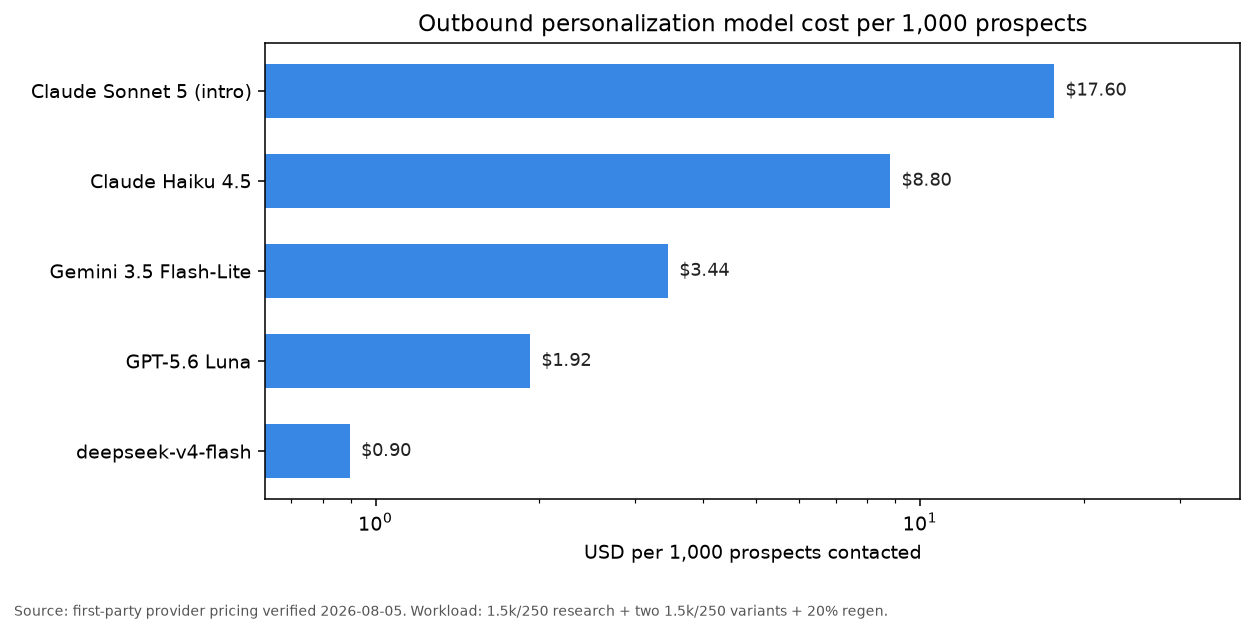
A research-plus-two-email outbound pipeline costs $0.8960 per 1,000 prospects on deepseek-v4-flash and $17.60 on Claude Sonnet 5. That is a 19.6x model spread on the same editable token shape. The research call is 31.3% of the bill. Prices verified 2026-08-05.
TL;DR
- Per prospect we model one 1,500/250 research call, two 1,500/250 email variants, and a 20% human-edit regeneration.
- Per 1,000 prospects that is 4.8M input tokens and 800k output tokens.
- Preferred model bills: $0.8960 deepseek-v4-flash, $1.9200 GPT-5.6 Luna, $3.4400 Gemini 3.5 Flash-Lite, $8.8000 Claude Haiku 4.5, $17.6000 Claude Sonnet 5.
- Routing DeepSeek drafts to Sonnet regenerations costs $1.9400, 89.0% below all-Sonnet.
- Dropping research or dropping the second variant both cut the DeepSeek bill to $0.6160. They are the same arithmetic because both calls share the 1,500/250 shape.
The workload model
The outcome unit is 1,000 prospects contacted with personalized email. Every token count below is an assumption. None comes from Vynaris traffic or customer data. Community cost threads for AI-SDR stacks are thin, so treat this as a budget model you edit, not an observed production receipt.
Assumption            Value             Why it exists
--------------------  ----------------  ----------------------------------------------
Prospects             1,000             Outcome unit
Research input        1,500 tokens      Public page notes, LinkedIn blurbs, CRM fields
Research output       250 tokens        Structured research brief
Email variants        2                 A/B or tone variants per prospect
Variant input         1,500 tokens      Brief + research notes + style instructions
Variant output        250 tokens        One email draft
Human-edit regen      20% of prospects  One rewrite after sales review
Regen input / output  1,500 / 250       Same shape as one variant call
Batch mode            Not assumed       Keeps provider rows comparable
This cell is distinct from HTML-to-schema extraction and invoice extraction. Those are one document to one structured object. Outbound multiplies a research brief into two drafts and pays a regeneration tax when humans edit. The outcome unit is contacted prospects, not parsed pages.
Verdict: model cost per 1,000 prospects
Model                                                                      Research  Two variants  20% regen  Total / 1k  Per prospect
-------------------------------------------------------------------------  --------  ------------  ---------  ----------  ------------
[deepseek-v4-flash](https://vynaris.com/models#deepseek-v4-flash)          $0.2800   $0.5600       $0.0560    $0.8960     $0.0009
[GPT-5.6 Luna](https://vynaris.com/models#gpt-5-6-luna)                    $0.6000   $1.2000       $0.1200    $1.9200     $0.0019
[Gemini 3.5 Flash-Lite](https://vynaris.com/models#gemini-3-5-flash-lite)  $1.0750   $2.1500       $0.2150    $3.4400     $0.0034
[Claude Haiku 4.5](https://vynaris.com/models#claude-haiku-4-5)            $2.7500   $5.5000       $0.5500    $8.8000     $0.0088
[Claude Sonnet 5](https://vynaris.com/models#claude-sonnet-5) (intro)      $5.5000   $11.0000      $1.1000    $17.6000    $0.0176
Prices are standard per-1M-token rates. DeepSeek is $0.14/$0.28. Luna is $0.20/$1.20. Flash-Lite is $0.30/$2.50. Haiku is $1/$5. Sonnet 5 is $2/$10; Anthropic canceled the scheduled 2026-09-01 increase. Updated 2026-08-14.
The arithmetic behind $0.90
Per prospect on deepseek-v4-flash:
Research:  (1500 x $0.14 + 250 x $0.28) / 1M = $0.000280
Variants:  2 x (1500 x $0.14 + 250 x $0.28) / 1M = $0.000560
Regen 20%: 0.2 x (1500 x $0.14 + 250 x $0.28) / 1M = $0.000056
Total / prospect = $0.000896

Per 1,000 prospects = $0.8960
Sonnet 5 on the same shape:
Research $0.0055 + variants $0.0110 + regen $0.0011 = $0.0176 / prospect
Per 1,000 = $17.6000
Use the cost calculator with the normalized per-prospect totals (4,800 in / 800 out including amortized regen), then multiply by 1,000. Keep the research and draft stages as separate lines so you can kill a stage without re-deriving the whole bill.
Research is optional spend, not free quality
Research is 31.3% of the DeepSeek bill ($0.2800 of $0.8960). Skipping it and sending two template-conditioned variants leaves $0.6160 per 1,000. Keeping research but shipping one variant also lands at $0.6160. Same dollars, different product choice.
Architecture                         DeepSeek / 1k  Sonnet 5 / 1k
-----------------------------------  -------------  -------------
Research + 2 variants + 20% regen    $0.8960        $17.6000
No research, 2 variants + 20% regen  $0.6160        $12.1000
Research + 1 variant + 20% regen     $0.6160        $12.1000
Pay for research only when the brief changes the email in a way your CRM fields cannot. If the "research" step restates the company name and industry already in Salesforce, you are buying tokens that do not change reply rate. Measure reply lift against the $0.2800 research line, not against vibes.
A practical test: take 200 prospects, run research+two-variants on 100 and CRM-merge templates on 100, hold the offer constant, and compare positive replies per dollar of model spend. If the researched arm wins by less than one extra reply per $0.28 of research, the research stage loses on unit economics even before you count enrichment engineering. That is the editable decision this playbook exists to force.
Two variants are not free either. The second draft doubles the variant line from $0.2800 to $0.5600 on DeepSeek. Keep the second variant only when you actually A/B send. Generating a "safer" unused draft that sales never selects is a silent 31.3% tax on the same shape as research.
Human-edit regeneration is a small model line
Regen rate  DeepSeek / 1k  Sonnet 5 / 1k
----------  -------------  -------------
0%          $0.8400        $16.5000
10%         $0.8680        $17.0500
20%         $0.8960        $17.6000
40%         $0.9520        $18.7000
60%         $1.0080        $19.8000
Moving from 0% to 60% regen adds $0.1680 on DeepSeek and $3.3000 on Sonnet. The model fee barely moves. Sales review time does. If a human spends two minutes editing each draft at a loaded $60/hour, that is $2.00 per prospect or $2,000 per 1,000. Even Sonnet's entire $17.60 model line is 0.88% of that review floor.
The honest tradeoff: do not optimize the regen token line while the review queue is the real bill. Optimize for fewer regenerations by tightening the style guide, not by shaving $0.05 of LLM inference cost.
Where routing changes the unit economics
One practical split runs research and both variants on DeepSeek, then sends only the 20% regenerations to Sonnet 5.
Component             Model              Cost / 1k
--------------------  -----------------  ---------
1,000 research calls  deepseek-v4-flash  $0.2800
2,000 variant calls   deepseek-v4-flash  $0.5600
200 regenerations     Claude Sonnet 5    $1.1000
Routed total                             $1.9400
Routed cost is 89.0% below all-Sonnet ($17.60) and 2.17x all-DeepSeek ($0.8960). The extra $1.0440 buys a stronger rewrite on the human-flagged tail. Model routing pays here only if Sonnet regenerations actually reduce the next human edit cycle. If humans rewrite Sonnet output at the same rate, you paid for a more expensive draft with the same review floor.
Build notes specific to outbound
- Attribute cost per prospect ID, not per API request. LLM cost attribution should roll research + variants + regen into one contacted-prospect unit.
- Emit structured outputs for research briefs. Free-form notes make the variant prompt unstable and inflate tokens.
- Keep style guides byte-stable if you use prompt caching. A daily-changing "voice tip" destroys cache hits on the shared prefix.
- Prefer batch processing for overnight list enrichment. Live SDR keystroke loops need the standard API.
- Cap research sources. Three URLs of boilerplate do not beat one CRM row with last-touch date.
- Store the human edit diff. If regenerations keep fixing the same clause, move that rule into the style guide and cut the 20% loop.
- Separate the enrichment fetch bill from the model bill. Proxy, scrape and Clearbit-class fees often exceed $0.90 per 1,000 before the first token is billed. Put them on their own ledger line or you will "optimize" DeepSeek while the enrichment invoice grows.
- Do not put live timestamps, random seeds or per-prospect UUIDs in the shared system prompt. Those fields belong in the user message so the stable prefix can cache.
- Cap output hard at about 250 tokens for both research and email. Unbounded "write a thoughtful note" instructions are how a $0.90 batch becomes a $9.00 batch without anyone changing the model.
Latency is usually irrelevant for overnight personalization. Quality constraints are not. Hallucinated job titles and invented funding rounds create reply risk that no cost-per-token table captures. Ground research fields against CRM or enrichment JSON before the variant call. A failed ground check should skip the LLM draft, not spend another 1,500 tokens apologizing.
When this workload does not need a router
Skip routing when a cheap model clears your sample set of 50 golden prospects and human edit rates stay under about 20%. At $0.90 per 1,000 prospects, further model optimization is noise next to list quality and offer clarity.
Also skip the LLM research step when your enrichment vendor already returns title, company, trigger event and a one-line reason-to-reach-out. Paying token stickers to paraphrase a Clearbit field is a vanity pipeline. The honest tradeoff is coverage: vendor fields miss niche triggers that a web research pass can catch, but only if you measure that lift.
For agent metering patterns that stop double-counting tool and model lines, see our dollars-per-call attribution how-to.
FAQ
What does LLM outbound personalization cost per 1,000 prospects? On this 1,500/250 research + two variants + 20% regen workload: $0.8960 on deepseek-v4-flash to $17.6000 on Claude Sonnet 5.
Is the research call worth it? It is 31.3% of the DeepSeek bill. Keep it only if it changes reply rate enough to beat the $0.2800 research line plus enrichment engineering time.
Does a stronger model fix low reply rates? Usually not at this token scale. Sonnet costs 19.6x DeepSeek here while human review still dominates. Test copy and targeting before paying the model premium.
When should I route regenerations to a frontier model? When the flagged 20% are hard personalization cases and the stronger rewrite reduces human minutes. Otherwise stay on one cheap model.
When should I avoid an LLM? When a template plus CRM merge fields already matches your best reply rate. Model spend cannot rescue a weak offer.
Sources
- OpenAI API pricing, captured 2026-08-05: GPT-5.6 Luna $0.20/$1.20 standard.
- Anthropic API pricing, re-verified 2026-08-14: Haiku 4.5 $1/$5; Sonnet 5 $2/$10 standard.
- Gemini API pricing, captured 2026-08-05: Gemini 3.5 Flash-Lite $0.30/$2.50 standard.
- DeepSeek API pricing, captured 2026-08-05: deepseek-v4-flash $0.14 cache miss / $0.28 output.
All prospect counts, token counts and regeneration rates are shown assumptions. Replace them before using the totals in a budget.