
Blog · 2026-08-05 · Vynaris Team
LLM localization cost: $0.05 to $0.60 per 10k words across 5 languages
Shipping 10k source words into 5 languages costs $0.05-$0.60 on a translate+QA workload. Language fan-out sets the bill; Batch halves OpenAI/Anthropic/Gemini. Prices verified 2026-08-05.
Shipping 10,000 source words into five target languages costs $0.0497 to $0.5950 in model fees on the stated translate-plus-QA workload. That is a 12.0x spread. The N-language multiplier and the QA pass set the bill; picking among budget models moves it less than adding languages. Prices verified 2026-08-05.
TL;DR
- One language uses 39,000 input and 16,000 output tokens: a 13k/13k translation call plus a 26k/3k QA call over source and translation. These are editable assumptions, not observed production data.
- Preferred cost for five languages is $0.0497 on deepseek-v4-flash, $0.0675 on GPT-5.6 Luna Batch, $0.2975 on Claude Haiku 4.5 Batch, and $0.5950 on Claude Sonnet 5 Batch at introductory rates.
- Batch API halves every OpenAI, Anthropic, and Gemini line. DeepSeek has no published Batch discount in this model, so its sticker stays full rate and still wins on raw dollars.
- Route Luna Batch on translation and Sonnet 5 Batch on QA for $0.2505 across five languages: 57.9% below all-Sonnet, 3.7x above all-Luna.
The workload model
The outcome unit is 10,000 source words shipped across N languages. Each language pays for a translation call and a QA call. That is the distinct lever versus one-shot summarization or single-document extraction: cost-per-token stickers only matter after you fix the per-language token shape and the fan-out N.
Assumption           Value                   Why it is here
-------------------  ----------------------  ------------------------------------
Source words         10,000                  Outcome unit
Source tokens        13,000                  ~1.3 tokens per English word
Translation output   13,000 tokens           Symmetric in≈out for prose
QA input             26,000 tokens           Source plus translation
QA output            3,000 tokens            Issues, glossary hits, rewrite flags
Tokens per language  39,000 in / 16,000 out  Translate + QA
Headline fan-out     N = 5                   Common product localization set
Processing mode      Batch where published   Offline localization tolerates delay
Public demand supports the shape, not the counts. The Lingo.dev Show HN describes compile-time LLM localization of React apps with aggressive caching and parallel calls. We price a plain translate-plus-QA pipeline so the arithmetic stays editable. No private localization corpus enters the calculation.
Verdict: cost per 10k words shipped (N = 5)
Model                                                                      Per language (std)  Per language (Batch)  N=5 preferred  Notes
-------------------------------------------------------------------------  ------------------  --------------------  -------------  ---------------------------
[deepseek-v4-flash](https://vynaris.com/models#deepseek-v4-flash)          $0.00994            n/a                   $0.0497        No Batch row; standard rate
[GPT-5.6 Luna](https://vynaris.com/models#gpt-5-6-luna)                    $0.02700            $0.01350              $0.0675        Batch 50%
[Gemini 3.5 Flash-Lite](https://vynaris.com/models#gemini-3-5-flash-lite)  $0.05170            $0.02585              $0.1293        Batch 50%
[Claude Haiku 4.5](https://vynaris.com/models#claude-haiku-4-5)            $0.11900            $0.05950              $0.2975        Batch 50%
[Gemini 3.6 Flash](https://vynaris.com/models#gemini-3-6-flash)            $0.17850            $0.08925              $0.4463        Batch 50%
[Claude Sonnet 5](https://vynaris.com/models#claude-sonnet-5)              $0.23800            $0.11900              $0.5950        Standard $2/$10
Preferred means Batch when the provider publishes a 50% Batch price, otherwise standard. The five-language preferred range is $0.0497 to $0.5950, a 12.0x spread.
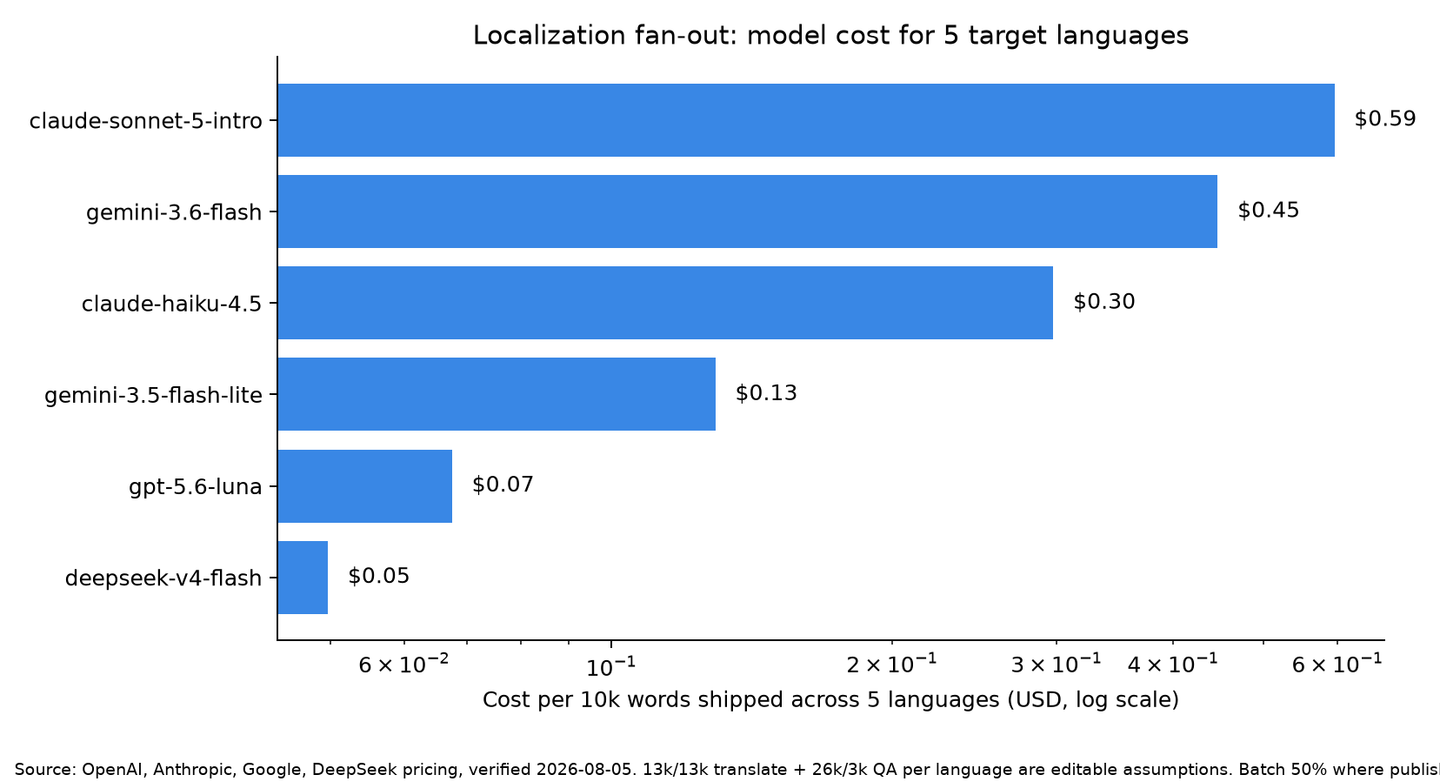
The arithmetic, one language at a time
For Luna Batch, translation is:
13,000 x $0.20 / 1,000,000 x 0.5 = $0.00130
13,000 x $1.20 / 1,000,000 x 0.5 = $0.00780
translate                              = $0.00910
QA on the same model:
26,000 x $0.20 / 1,000,000 x 0.5 = $0.00260
 3,000 x $1.20 / 1,000,000 x 0.5 = $0.00180
QA                                     = $0.00440
per language                           = $0.01350
N = 5                                  = $0.06750
DeepSeek at standard rates is cheaper still:
translate 13k/13k @ $0.14/$0.28 = $0.00546
QA 26k/3k @ $0.14/$0.28         = $0.00448
per language                      = $0.00994
N = 5                             = $0.04970
Sonnet 5 Batch is exactly 10x Haiku on this shape: $0.119 per language, $0.595 for five. Anthropic canceled the scheduled 2026-09-01 increase, so the previously forecast $0.8925 five-language bill will not arrive. Updated 2026-08-14.
Use the calculator with the five-language totals (195k in / 80k out) when you want a single blended sticker. For per-language budgeting, keep the 39k/16k shape and multiply by N.
Language fan-out dominates model shopping
N languages  deepseek-v4-flash  Luna Batch  Haiku Batch  Sonnet 5 Batch
-----------  -----------------  ----------  -----------  --------------
1            $0.0099            $0.0135     $0.0595      $0.1190
5            $0.0497            $0.0675     $0.2975      $0.5950
10           $0.0994            $0.1350     $0.5950      $1.1900
20           $0.1988            $0.2700     $1.1900      $2.3800
Doubling languages doubles the bill. Moving from Luna Batch to Haiku Batch at N=5 adds $0.2300. Adding five more languages on Luna adds $0.0675. Past about ten locales, cutting N or skipping QA on frozen UI strings beats upgrading the model tier.
This is the opposite of one-shot summarization, where a single call owns the outcome. Localization is a fan-out problem. Price it per language first. Model routing is optional until locale criticality or QA difficulty actually differs.
Where routing changes the unit economics
Translation is constrained generation. QA is judgment over source plus translation. They do not need the same model.
Pass               Model            Batch cost per language
-----------------  ---------------  -----------------------
Translate 13k/13k  GPT-5.6 Luna     $0.00910
QA 26k/3k          Claude Sonnet 5  $0.04100
Routed total                        $0.05010
N = 5 routed                        $0.25050
All-Sonnet Batch is $0.5950 for five languages. Routing saves $0.3445, or 57.9%. All-Luna remains cheaper at $0.0675, so the routed version only wins if Sonnet QA catches errors that Luna misses and those errors would otherwise ship or burn human review.
The honest comparison is not model vanity. It is QA precision versus human-fix minutes. If a bilingual reviewer costs $40/hour and finds issues Luna QA misses, every minute saved is worth $0.6667. The routed premium over all-Luna is $0.1830 for five languages, or about 16.5 seconds of that reviewer. Measure that before paying for Sonnet on every language.
The same split logic shows up in our document extraction playbook: cheap extraction, spend on the pass that changes the human queue. Here the human queue is linguistic QA, and the fan-out multiplier is new.
Build notes specific to localization
- Keep a frozen glossary and feed it into both calls. Glossary mismatches are cheaper to prevent than to re-translate.
- Do not cache a per-string timestamp or build ID in the stable prefix. Prompt caching only helps when the glossary and style guide stay byte-identical across jobs.
- Prefer batch processing for release trains. Live preview loops need the standard API; overnight locale packs do not.
- Attribute cost per language and per string bundle. LLM cost attribution should reconcile translate + QA to one shipped locale.
- Output should be structured outputs keyed by string ID, not free prose, or merge tooling will invent its own bill in engineer time.
- Tokenizer differences matter on long help centers. Claude 4.7+ models bill roughly 30% more tokens for the same text; if you move Sonnet/Haiku onto large docs, re-count rather than reusing the 13k assumption.
Cross-check sticker ranks against the dated table in LLM API pricing August 2026. Localization is output-heavy, so output price dominates more than on classification workhorses.
When this workload does not need a router
Skip routing when one cheap model clears your linguistic QA eval on the locales you ship. At N=5, DeepSeek is $0.0497 and Luna Batch is $0.0675. Building a router only to shave that gap is ceremony.
Also skip Batch when translators or PMs need interactive preview inside a minute. Paying the full Luna rate ($0.027 per language) for a same-session preview is cheaper than waiting on a batch window during copy review.
Routing earns its keep when QA quality is uneven by language family, when legal locales need a stronger judge, or when human review cost dwarfs the model line. A static rule by locale criticality is enough. Do not train a second classifier to decide Spanish versus Japanese if your release checklist already labels those locales.
FAQ
What does LLM localization cost per 10,000 words? On the stated translate-plus-QA shape, five languages cost $0.0497 on deepseek-v4-flash to $0.5950 on Claude Sonnet 5 Batch. One language is $0.0099 to $0.1190.
Why is input almost equal to output? Translation of prose is roughly length-preserving. We set 13k in and 13k out per language so the bill reflects that symmetry. Adjust if you compress marketing copy or expand technical docs.
What does the QA pass add? QA re-reads 26k tokens and emits 3k. On Luna Batch that is $0.0044 of the $0.0135 per-language total, about 33%. On DeepSeek it is $0.0045 of $0.0099, about 45%.
Does Batch change translation quality? The published 50% discount changes latency and price, not the model weights. Validate outputs the same way.
When does Sonnet beat Luna on this job? When Sonnet QA reduces human-fix time or shipped errors enough to cover the premium. At N=5 the routed premium over all-Luna is $0.1830.
Sources
- OpenAI API pricing, captured 2026-08-05: GPT-5.6 Luna $0.20/$1.20; Batch 50% vs synchronous APIs.
- Anthropic API pricing, re-verified 2026-08-14: Haiku 4.5 $1/$5, Sonnet 5 $2/$10 standard, Batch 50%.
- Gemini API pricing, captured 2026-08-05: Gemini 3.5 Flash-Lite $0.30/$2.50, Gemini 3.6 Flash $1.50/$7.50, Batch half of paid tier.
- DeepSeek API pricing, captured 2026-08-05: deepseek-v4-flash $0.14/$0.28 cache miss.
- Show HN: Localize React apps, captured 2026-08-05: public evidence for LLM localization pipelines; 89 points and 72 comments.
All word counts, token ratios, and N values are shown assumptions. Replace them before putting the totals in a budget.