
Blog · · By Dhrumil Barot, Founder
GPT-6 Astra catches 4% more code-review bugs than Sol at 2.5x the cost: the CodeRabbit evaluation
CodeRabbit's public evaluation: Astra caught 4% more labeled bugs than Sol at 2.5x the cost. The break-even is 2.5x more bugs per dollar. Neither overall nor cross-file gains clear it.
GPT-6 Astra costs $1.50 per 100k-input/10k-output code review versus $0.60 for GPT-5.6 Sol, a 2.5x premium. CodeRabbit's public evaluation reports Astra caught approximately 4% more labeled bugs overall and 20% more on harder cross-file reviews. The break-even threshold is 2.5x more bugs per dollar. Astra caught 1.04x overall and 1.20x cross-file. Neither clears 2.5x.
Prices verified 2026-09-06 from OpenAI's pricing page, Anthropic's pricing documentation, and CodeRabbit's evaluation blog (published 2026-09-04).
What CodeRabbit measured
CodeRabbit evaluated GPT-6 Astra against GPT-5.6 Sol and Claude Opus 5 on actionable bug coverage: how many labeled bugs a model catches through findings a developer can act on. Their metric is their own labeled-bug set, not a public benchmark. They disclose this explicitly.
The results, using unrounded values for relative gains:
| Comparison | Overall gain | Cross-file gain |
|---|---|---|
| Astra vs Sol | +4% | +20% |
| Astra vs Opus 5 | +22% | +33% |
The overall gain appears modest because the evaluation includes simpler reviews where a stronger model has less room to differentiate. The cross-file subset, where relevant information is distributed across the codebase, is where Astra's advantage grows.
CodeRabbit is careful to state these results describe one part of review performance. They do not establish an overall ranking, predict a team's defect rate, or promise the same gain on every pull request.
The cost table
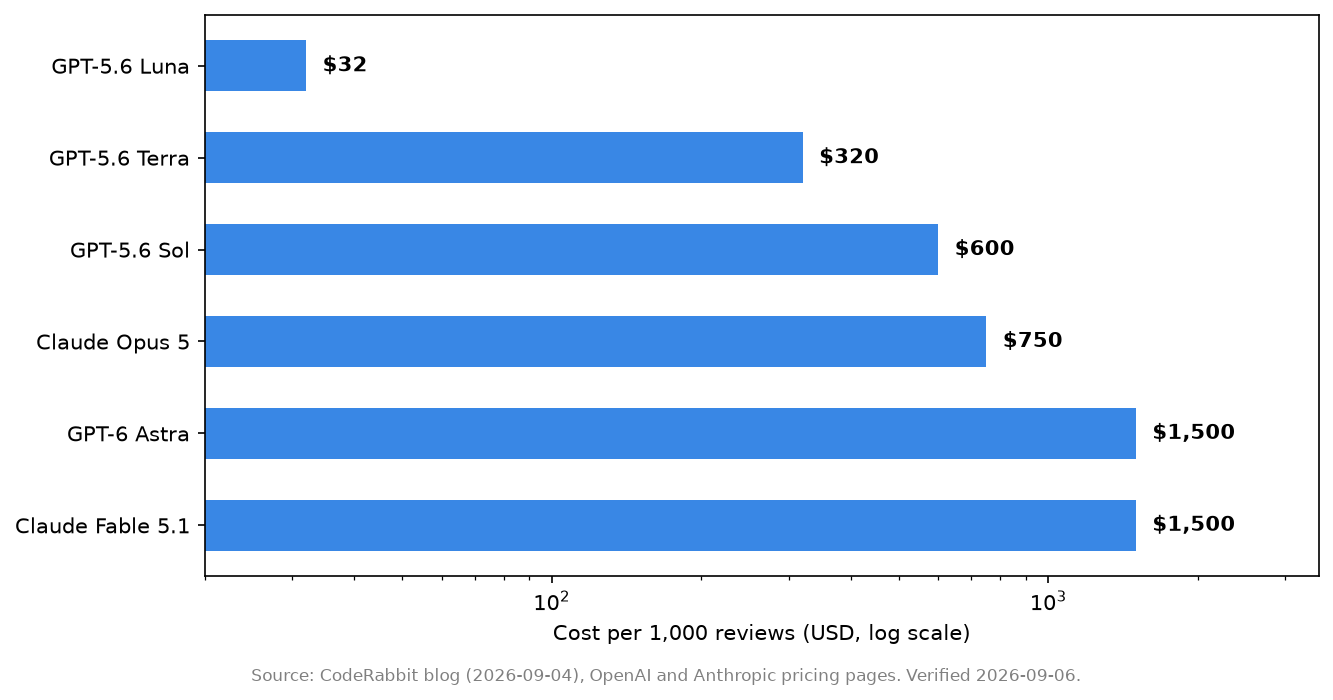
CodeRabbit's cost comparison uses 100,000 uncached input tokens and 10,000 billable output tokens, including reasoning tokens. Holding token usage constant makes published rates easier to compare. Actual task costs vary with usage.
| Model | Input / 1M tok | Output / 1M tok | Cost per review |
|---|---|---|---|
| GPT-5.6 Luna | $0.20 | $1.20 | $0.032 |
| GPT-5.6 Terra | $2.00 | $12.00 | $0.32 |
| GPT-5.6 Sol | $4.00 | $20.00 | $0.60 |
| Claude Opus 5 | $5.00 | $25.00 | $0.75 |
| GPT-6 Astra | $10.00 | $50.00 | $1.50 |
| Claude Fable 5.1 | $10.00 | $50.00 | $1.50 |
All figures use publicly listed Standard API prices, checked September 4, 2026 per CodeRabbit's blog and re-verified 2026-09-06. Sol's promotional pricing ($4/$20) is available at least through November 21, 2026. The example excludes caching, cache writes, tools, retries, and regional uplifts.
At fixed usage, Astra costs 2.5x Sol, 2.0x Opus 5, 4.7x Terra, and 47x Luna. Astra and Fable 5.1 share identical base rates. The calculator at vynaris.com reproduces these numbers for any token shape.
The buyer threshold: cost per bug caught
The sticker premium is 2.5x. For Astra to break even on cost per task, it must catch 2.5x as many bugs as Sol per dollar spent. That means 150% more bugs, not 4% more.
CodeRabbit does not publish absolute bug counts, so we cannot compute a dollar cost per bug. But the ratio is derivable without them. If Sol catches N bugs, Astra catches 1.04N overall and 1.20N on cross-file reviews. The cost-per-bug ratio is:
| Scenario | Cost-per-bug ratio (Astra / Sol) | Verdict |
|---|---|---|
| Overall | 2.40x | Astra costs 2.40x Sol per bug caught |
| Cross-file | 2.08x | Astra costs 2.08x Sol per bug caught |
Even on the harder cross-file subset where Astra shines, it still costs 2.08x Sol per bug caught. The 20% quality gain narrows the 2.5x cost gap, but does not close it.
Against Opus 5, the math shifts. Astra costs 2.0x Opus 5 at fixed usage. Against the 22% overall gain and 33% cross-file gain:
| Scenario | Cost-per-bug ratio (Astra / Opus 5) | Verdict |
|---|---|---|
| Overall | 1.64x | Astra costs 1.64x Opus 5 per bug |
| Cross-file | 1.50x | Astra costs 1.50x Opus 5 per bug |
Astra's advantage over Opus 5 is real but still does not reach break-even at fixed token usage.
Marginal cost per additional bug
If Sol catches 100 bugs on a review set, Astra catches 104 overall and 120 on cross-file reviews. The additional cost per review is $0.90 ($1.50 minus $0.60). The marginal cost per additional bug:
| Scenario | Extra bugs (per 100 Sol catches) | Marginal cost per extra bug |
|---|---|---|
| Overall vs Sol | 4 | $0.225 |
| Cross-file vs Sol | 20 | $0.045 |
| Overall vs Opus 5 | 22 | $0.034 |
| Cross-file vs Opus 5 | 33 | $0.023 |
On cross-file reviews against Opus 5, each additional bug Astra catches costs $0.023. That is cheap. But the baseline cost premium still makes Astra more expensive per bug caught overall.
What this means for routing
The buyer lesson is specific. CodeRabbit's evaluation provides a new public cost-per-outcome denominator: cost per additional bug caught. This is distinct from the token cost break-even we measured on DeepSWE, where Astra's 50% fewer output tokens nearly erased the 2.5x sticker.
On code review at fixed token usage, token efficiency does not help. The 100k input / 10k output shape is held constant. The only variable is bug coverage. And 4% more bugs does not justify 2.5x more cost.
Three routing implications follow.
First, if your code reviews are fixed-length (a diff plus context, sent once), Astra's reasoning effort advantage must translate to catching 2.5x more bugs. CodeRabbit's data says it catches 1.04x to 1.20x. Route to Sol or Terra.
Second, if your reviews involve cross-file dependencies where relevant context is scattered, Astra's 20% gain over Sol is the strongest case. But 2.08x cost per bug still favors Sol. The gap narrows but does not invert.
Third, against Opus 5, Astra's case is stronger. At 1.50x cost per bug on cross-file reviews, the premium is smaller. If your team already runs Opus 5, Astra's cross-file gains may justify the switch. Measure on your own reviews first.
We covered the same cost-per-successful-task inversion with Gemini 3.7 Flash: same sticker, lower cost per pass. The pattern repeats. The sticker price is not the cost per outcome. But here, unlike DeepSWE, the outcome gain is too small to invert the premium.
What this does not tell you
CodeRabbit's evaluation has limits they disclose clearly.
Their bug coverage metric is their own labeled-bug set. It is not a public benchmark like DeepSWE or ARC-AGI-3. The labeled bugs reflect their review workload, not yours. A model that catches more of their bugs may not catch more of yours.
The evaluation holds token usage constant. Real code reviews use different token counts per model. Astra may produce shorter outputs or fewer steps on some reviews, which would narrow the cost gap. CodeRabbit notes this: actual task costs vary with usage. OpenAI reports lower estimated task costs for Astra in some of its own evaluations despite higher token prices.
The 4% overall gain includes simpler reviews where models differentiate less. The cross-file subset is more informative for teams whose reviews involve distributed context, but it is a subset, not the full picture.
When this workload does not need a router
If your code reviews are bounded diffs with fixed context windows, the cheapest model that catches bugs reliably wins. Luna at $0.032 per review or Terra at $0.32 may catch fewer bugs, but at 47x and 4.7x lower cost respectively, the price-performance ratio favors running more reviews with a cheaper model over fewer reviews with Astra.
The case for Astra in code review is not cost savings. It is catching bugs that cheaper models miss on complex cross-file changes. Whether those bugs are worth $0.90 extra per review depends on your defect cost. If a missed cross-file bug costs more than $0.90 to find later, Astra pays for itself. If it does not, Sol is the better default.
We previously showed that Astra's 60% token reduction nearly erased the 2.5x sticker on DeepSWE. Code review is a different workload. Token efficiency does not apply when usage is held constant. The bug-coverage gain is the only lever, and 4% is not 150%.
FAQ
Is Astra better at code review than Sol?
CodeRabbit's evaluation says Astra caught 4% more labeled bugs overall and 20% more on cross-file reviews. Whether that translates to your codebase depends on your review difficulty distribution.
Does Astra cost 2.5x more per code review?
At fixed 100k input / 10k output tokens, yes: $1.50 versus $0.60. If Astra uses fewer tokens on your reviews, the gap narrows. CodeRabbit held usage constant to compare published rates.
What is the break-even for Astra in code review?
Astra must catch 2.5x as many bugs as Sol to tie on cost per bug. It caught 1.04x overall and 1.20x cross-file. Neither clears 2.5x.
Should I switch from Opus 5 to Astra for code review?
Astra's case is strongest against Opus 5: 1.50x cost per bug on cross-file reviews, with 33% more bugs caught. If your reviews involve cross-file dependencies, test Astra against Opus 5 on your own diffs.
Is CodeRabbit's bug coverage metric reliable?
It is their own labeled-bug set, not a public benchmark. They disclose this. Use it as directional evidence, not as a production routing decision. Run your own evaluation before switching models.
Sources
- CodeRabbit blog: GPT-6 Astra in code review — bug coverage gains and cost table, published 2026-09-04, verified 2026-09-06
- OpenAI pricing page — Sol $4/$20 promotional, Luna $0.20/$1.20, Terra $2/$12, verified 2026-09-06
- Anthropic pricing documentation — Fable 5.1 $10/$50, Opus 5 $5/$25, verified 2026-09-06
- Hacker News: GPT-6 Astra main thread — 2,219 points, 2,042 comments, verified 2026-09-06