
Blog · 2026-08-01 · Vynaris Team
Do LLM Routers Still Save Money After the Luna Price Cut?
GPT-5.6 Luna's 80% cut moved the budget default just above the price floor, collapsing the spread a down-routing LLM router can arbitrage by 87% and raising break-even from 91k to 769k tasks/mo. Prices verified 2026-08-01.
When GPT-5.6 Luna dropped 80% on 2026-07-30 to $0.20/$1.20 per 1M tokens, it moved the rational budget default down to a price that sits just above the raw floor. A down-routing LLM router earns its keep on the dollar spread between your default and the cheaper model it routes to. That spread just collapsed 87%, and the break-even volume rose 8.4x. Prices verified 2026-08-01.
TL;DR
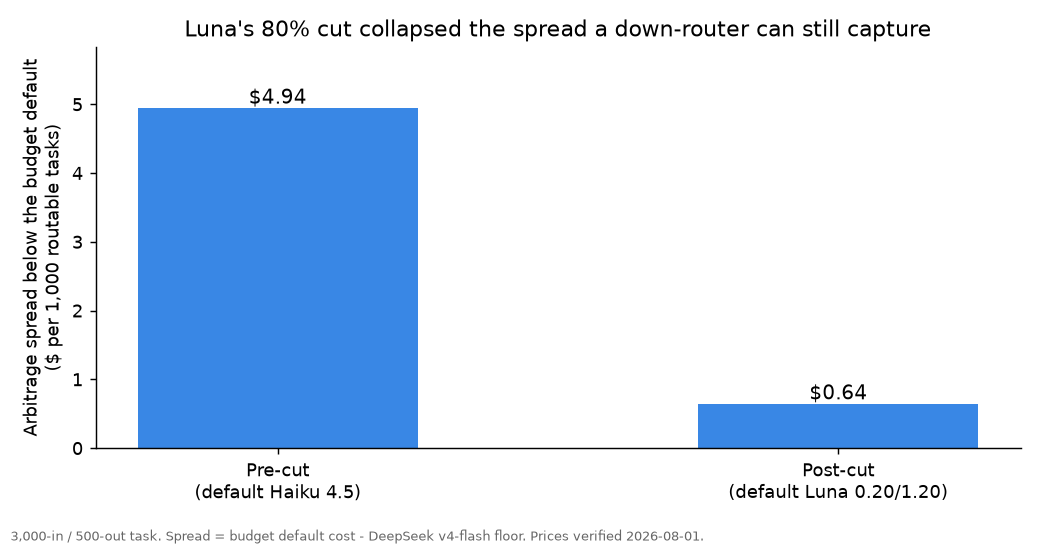
- The arbitrage spread a router can capture below a sane budget default fell from $0.00494 to $0.00064 per task on a 3,000-in / 500-out workload, a 7.7x collapse, because Luna now undercuts Haiku 4.5 roughly 5x on input and 4x on output.
- Break-even for a DIY router versus a single cheap default rose from about 91,000 to about 769,000 routable tasks per month. At 100,000 tasks/mo the router loses $348/mo net of upkeep.
- Against a premium default the spread is still huge: routing Opus 5 work down to Luna nets $0.02355 per task and breaks even at about 17,000 tasks/mo. The routing question did not die; it moved.
What a down-router actually sells
A down-routing router does model-routing in one direction: it reads a request, decides it is easy, and sends it to a cheaper model than your default. Its entire value is the money you keep by not paying the default rate. Write that as a per-task figure:
net_per_task = spread - misroute_rate * fallback_cost
where spread is the price gap between the default and the cheaper model, misroute_rate is the fraction of tasks the router sends to a model that stalls and has to be redone on the default, and fallback_cost is what that redo costs. Multiply by monthly volume, subtract the maintenance cost of running the router, and you have net savings.
The variable that moves under a price cut is spread. Everything else stays put. So the question after the Luna cut is narrow: how much room is left between a rational default and the floor a router would route down to?
Assumptions
Parameter          Value                                                                           Notes
-----------------  ------------------------------------------------------------------------------  ---------------------------------------------------------------------------------------------------------
Workload shape     3,000 [input tokens](https://vynaris.com/glossary/cost-per-token) / 500 output  classification, extraction, short generation: the tasks a down-router targets
Down-route floor   [DeepSeek](https://vynaris.com/glossary/deepseek) v4-flash $0.14/$0.28          the cheapest capable model in this ladder
Pre-cut default    Haiku 4.5 $1.00/$5.00                                                           cheapest sensible [frontier-lab](https://vynaris.com/glossary/frontier-model) budget model before the cut
Post-cut default   GPT-5.6 Luna $0.20/$1.20                                                        the cut moved the rational default here
Misroute rate      10%                                                                             a misrouted task is redone on the safe default
Routable fraction  100%                                                                            generous: every task is a down-route candidate
DIY router upkeep  $400/mo                                                                         loaded maintenance, editable in the script
Prices verified 2026-08-01 against the OpenAI, Anthropic, and DeepSeek pricing pages. Every figure below is recomputed in the published math script; nothing is hand-entered.
Per-task costs on the workhorse task
Model                    Per 1M (in/out)  Per task (3k/500)
-----------------------  ---------------  -----------------
DeepSeek v4-flash        $0.14 / $0.28    $0.00056
GPT-5.6 Luna (post-cut)  $0.20 / $1.20    $0.00120
Gemini 3.5 Flash-Lite    $0.30 / $2.50    $0.00215
Claude Haiku 4.5         $1.00 / $5.00    $0.00550
GPT-5.6 Luna (pre-cut)   $1.00 / $6.00    $0.00600
GPT-5.6 Terra            $2.00 / $12.00   $0.01200
Claude Opus 5            $5.00 / $25.00   $0.02750
The cut dragged Luna from $0.00600 per task to $0.00120, past Haiku 4.5 and Gemini Flash-Lite, into a slot just above the DeepSeek floor.
The spread collapse
A rational operator picks the cheapest capable budget model as the default, then a router can only save by going below it. Before the cut, the cheapest sane default was Haiku 4.5 at $0.00550. The router could route down to DeepSeek at $0.00056, a spread of $0.00494 per task. After the cut, the rational default is Luna itself at $0.00120. The same route down to DeepSeek now spans only $0.00064.
That is the whole story in one number: the spread shrank 7.7x, an 87% reduction. Luna did not just get cheaper; it ate most of the gap a router used to sell.
Break-even volume
Fold the 10% misroute rate in. When the router guesses wrong, the task is redone on the default, so the effective per-task gain is spread - 0.10 * default_cost:
Case                         Net gain/task  Break-even vs single default
---------------------------  -------------  ----------------------------
Pre-cut (default Haiku 4.5)  $0.00439       ~91,000 tasks/mo
Post-cut (default Luna)      $0.00052       ~769,000 tasks/mo
Break-even rose 8.4x. At 100,000 routable tasks per month post-cut, a DIY router nets 100,000 * $0.00052 - $400 = -$348/mo. Below roughly 769,000 tasks per month, defaulting every request to Luna and skipping the router wins after upkeep. The complexity of building and maintaining a request classifier does not pay for itself until you are running close to a million routable tasks a month against a budget default.
The lane where routing still wins
The cut did not kill routing. It relocated the profit. If quality forces a premium default, the spread down to Luna is large enough that routing clearly pays:
Premium default  Per task  Spread down to Luna  Net gain/task  Break-even
---------------  --------  -------------------  -------------  ----------------
Opus 5           $0.02750  $0.02630             $0.02355       ~17,000 tasks/mo
GPT-5.6 Sol      $0.03000  $0.02880             $0.02580       ~16,000 tasks/mo
Per 1,000 routable tasks, an all-Opus-5 default costs $27.50 while a down-router that lands 90% on Luna and redoes 10% on Opus costs $3.95, a gross delta of $23.55. That is 45x the $0.52 gross delta you get routing an all-Luna default down to DeepSeek. The economic logic of routing is intact wherever the default is expensive. It is only the below-a-cheap-default lane that the cut hollowed out.
Plug your own default, floor, and volume into the calculator to find where your router breaks even.
One honest tradeoff
This math treats a router as a pure cost play, which is the only frame in which a price cut changes the answer. It does not credit two things a router does that a single default cannot. First, a router is a hedge: when one provider changes pricing or degrades, routing lets you move traffic without a rewrite, and that optionality has real value that no per-task spread captures. Second, the routable fraction here is set to 100% for the generous case, but in practice you choose it, and the honest version of this analysis is that the fraction you can safely down-route is a judgment call, not a measured constant. If your safe fraction is low, even the premium-default lane shrinks toward the break-even line. We are not making a quality claim about any model; we are pricing the spread and leaving the routable fraction as your input.
What this is not
This is not the cache-churn argument, where a router that switches models mid-conversation throws away prompt caching discounts, which we costed in coding-agent model routers savings math. It is not the labor break-even question of whether the engineering time to build a router beats its token savings, covered in when token optimization is not worth it. And it is not the upfront-versus-mid-task mispricing of committing to a model before you know task difficulty, which we modeled in upfront vs mid-task routing mispricing. The lever here is new: a single provider's price cut compressing the spread that any down-router, however well built, has left to arbitrage below a sane default.
Sources
- OpenAI pricing (GPT-5.6 Luna $0.20/$1.20, Sol $5/$30, Terra $2/$12), verified 2026-08-01.
- Anthropic pricing (Haiku 4.5 $1/$5, Opus 5 $5/$25), verified 2026-08-01.
- DeepSeek pricing (v4-flash $0.14/$0.28), verified 2026-08-01.
- All derivations in the run's math script, output reproduced above.
The paid shortcut
The math above is everything you need to size this decision yourself; this section is the paid version, labeled as such. Vynaris is an OpenAI-compatible gateway: one base URL swap and you route across OpenAI, Anthropic, DeepSeek, and Gemini on your own difficulty signal, with realized down-route and misroute rates reported so you can see the spread you are actually capturing instead of assuming it. Get an API key at vynaris.com.
FAQ
Did the Luna cut make routing pointless? No. It hollowed out one lane, down-routing below an already-cheap default, and left the other lane, down-routing from a premium default, fully intact. If your quality bar forces Opus 5 or Sol as the default, a router that safely sends the easy fraction to Luna still nets over $23 per 1,000 tasks.
Why measure the spread against DeepSeek and not another cheap model? DeepSeek v4-flash is the lowest per-task price in this ladder at $0.00056, so it is the floor a rational down-router would route toward. Using a higher floor would show an even smaller spread, so DeepSeek is the most generous choice for the router's case.
Does the 10% misroute rate change the conclusion? It sharpens it. At 0% misroute the post-cut break-even is lower, but any realistic router misroutes some fraction, and each misroute is billed twice, cheap attempt plus the redo on the default. Raising the misroute rate pushes break-even higher and the below-a-cheap-default lane further underwater.
What if I run a mix of easy and hard tasks? Then you are in the premium-default lane for the hard share and the budget-default lane for the easy share. Route the hard-default traffic down to Luna where the spread is large, and default the already-cheap traffic straight to Luna without a router, because the spread below it no longer covers the upkeep.