
Blog · 2026-07-31 · Vynaris Team
What a first-pass contract-redlining agent costs per contract: 100% lawyer review makes the model a triage line, not a labor swap
A first-pass contract-redlining agent costs $0.0116 to $0.3575 per contract across six models. But 100% lawyer review makes even the priciest 0.13% of the bill, and chunking a contract that fits costs 2.6x more, not less. Per-contract math, prices verified 2026-07-31.
A first-pass contract-redlining agent costs $0.0116 to $0.3575 per contract in model fees, a 30.8x spread across six models, with prices verified 2026-07-31. Two numbers decide this workload before you pick a model. Every contract still gets 100% lawyer review, so the most expensive model on the list is 0.13% of what that review costs. And on a contract that fits in one pass, chunking it makes the bill 2.6x worse, not better. This is a reproducible cost model, per contract, you can re-run with your own numbers.
TL;DR
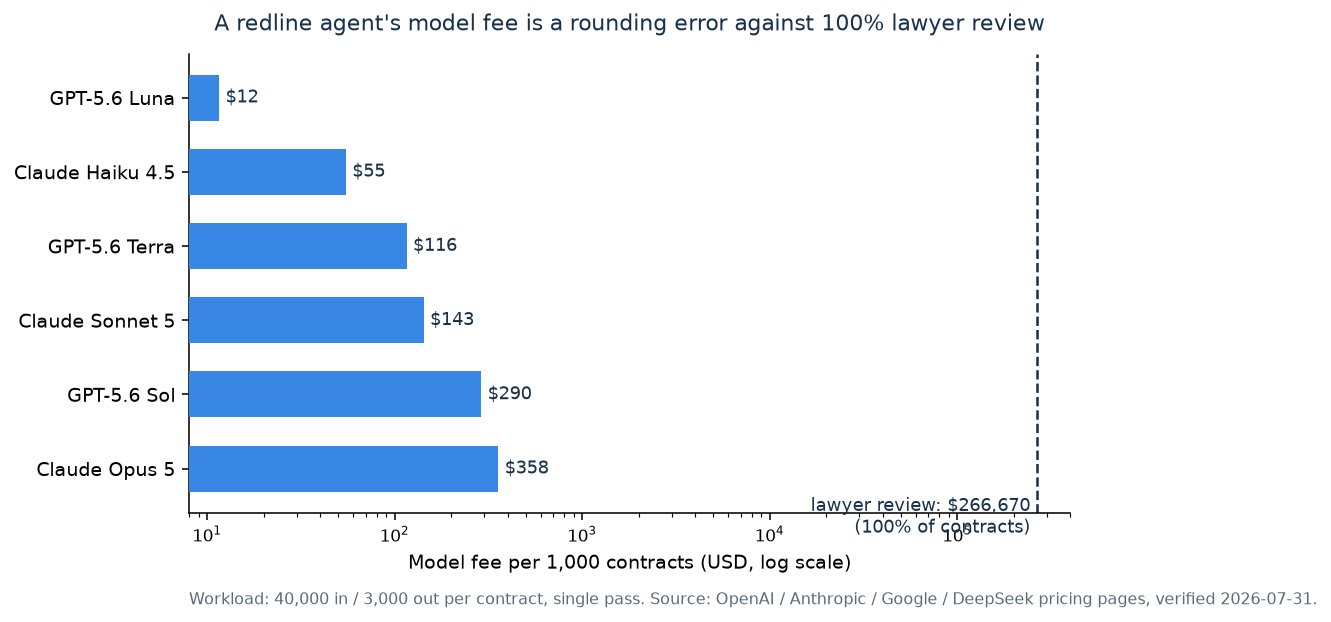
- Model fees run $11.60 to $357.50 per 1,000 contracts across six models on a 40,000-token-in, 3,000-token-out single-pass workload. Prices verified 2026-07-31.
- Every contract gets 100% lawyer review. At $400/hour, a 40-minute assisted review is $266.67 of human time per contract. The priciest model, Claude Opus 5 at $0.3575, is 0.134% of that. The lever is lawyer-minutes, not tokens.
- Chunking a 30-page contract that fits in context costs 2.6x more than a single whole-doc pass, because the stable redline playbook rides every chunk. Chunking only pays above a provider's long-context re-rate boundary, like the Gemini 3.1 Pro 200k cliff.
The finding, before the model
A first-pass redlining agent reads a contract, compares each clause against your standard positions, and returns flags plus a risk summary. A lawyer then reviews every flag and signs off. The model never signs anything; it triages. That shape has two properties that break the cost advice you would use on a generic summarizer.
First, the human stays on 100% of contracts, not a 10% escalation tail. A licensed lawyer reviews and owns the final markup, so review time is baked into every contract and dwarfs the model fee by three orders of magnitude. This is not the 10-K summarizer, where the fan-out set the bill. Here the human sets the bill and the model is loose change.
Second, the input is a long document with a stable instruction block. The contract body is unique every time; the redline playbook (your standard clause positions and risk checklist) is identical across every contract. That split decides your architecture: whether you read the whole document in one pass or chunk it, and whether the context window re-rate boundary bites.
We built this from public pricing only. No product data. Every token count is an assumption you can edit; every price is from a provider's live page, captured 2026-07-31.
The workload (edit these)
One contract, first-pass redlined, is the outcome unit: one document in, one set of flags and a risk summary out, then a lawyer.
Assumption           Value                          Note
-------------------  -----------------------------  ---------------------------------------------------------------------------------
Contract body in     28,000 input tokens            ~30 pages of dense contract text, reference tokenizer
Redline playbook in  12,000 input tokens            your standard clause positions + risk checklist + system; stable across contracts
Total input          40,000 tokens                  one whole-doc pass
Flags + summary out  3,000 output tokens            clause extractions, deviation flags, risk summary
Lawyer review        40 min at $400/hour = $266.67  100% of contracts reviewed and signed
Latency              interactive                    a reviewer is waiting, so not batch-eligible by default
Two numbers drive the model bill: the 28,000-token body is 70% of the input and unique to every contract, and the 12,000-token playbook is the other 30% and repeats verbatim. But the number that drives the contract cost is the review row, and it is 750 to 23,000 times larger than the model fee.
The model fee, six models
Same workload, same cost-per-token math, six redline-grade models, single whole-doc pass, cache-cold. One tokenizer note: Claude models from 4.7 on, including Claude Opus 5 and Claude Sonnet 5, produce about 30% more tokens for the same text, so their billed count is higher for an identical contract. We priced that in; mechanics in the tokenizer post. Prices verified 2026-07-31.
Model                                                            Per contract  Per 1,000 contracts
---------------------------------------------------------------  ------------  -------------------
[Claude Opus 5](https://vynaris.com/models#claude-opus-5)        $0.3575       $357.50
[GPT-5.6 Sol](https://vynaris.com/models#gpt-5-6-sol)            $0.2900       $290.00
[Claude Sonnet 5](https://vynaris.com/models#claude-sonnet-5)    $0.1430       $143.00
GPT-5.6 Terra                                                    $0.1160       $116.00
[Claude Haiku 4.5](https://vynaris.com/models#claude-haiku-4-5)  $0.0550       $55.00
[GPT-5.6 Luna](https://vynaris.com/models#gpt-5-6-luna)          $0.0116       $11.60
The spread is 30.8x, from $11.60 to $357.50 per 1,000 contracts. Two more models sit inside that band on this shape: Gemini 3.1 Pro at $0.116 and deepseek-v4-pro at $0.020 per contract. On almost any other workload you would pick the bottom row and move on. On this one the ranking barely matters, and the next section says why.
The 100% review floor: where the money actually is
Every redline gets reviewed and signed by a lawyer. An unaided first pass on a 30-page contract runs about 60 minutes. Good flags cut that to about 40 minutes, because the lawyer verifies the model's findings instead of hunting for them. At a $400/hour blended associate rate, that 40-minute review is $266.67 of human time on every contract.
Model             Cost / contract  Share of the $266.67 review line
----------------  ---------------  --------------------------------
Claude Opus 5     $0.3575          0.134%
Claude Haiku 4.5  $0.0550          0.021%
GPT-5.6 Luna      $0.0116          0.004%
The most expensive model is 0.13% of what the contract costs once you count the lawyer; the cheapest is four thousandths of one percent. The 30.8x model spread that looked decisive one section ago is noise against a $266.67 human line.
That floor inverts the routing question. On a summarizer the model is a rounding error against the minutes the summary saves, so you buy the cheapest model that clears quality. Here the lawyer is in the per-contract cost, so a cleaner redline that shortens review is worth real money. Claude Opus 5 costs $0.3459 more per contract than GPT-5.6 Luna, and a lawyer-second is worth $0.111 at $400/hour. So if the pricier model's cleaner flags save even 3.1 seconds of review, it is already net cheaper than the budget model. The entire 30.8x spread is worth under four seconds of one lawyer's time. Price your own contract and flag sizes before you lock a model in.
Chunk vs whole-doc: the architecture that does move the bill
The model choice barely matters; the architecture moves cost by more than the whole model spread. The question is whether you read the contract in one pass or split it into chunks and merge.
For a 30-page contract, one pass wins and chunking is a mistake. A 40,000-token input fits any current frontier model in a single call. Split it into six chunks and the 12,000-token playbook rides every chunk, plus a merge pass to reconcile flags. That turns 40,000 billed input tokens into 115,000, and on GPT-5.6 Luna the bill goes from $0.0116 to $0.0302, a 2.6x penalty for no benefit. The map-reduce fan-out that was mandatory on an 80,000-token 10-K is pure waste on a contract that already fits.
Chunking only pays when the document crosses a provider's long-context re-rate boundary. Take a 250-page master agreement, about 242,000 input tokens with the playbook. On Gemini 3.1 Pro, crossing 200,000 tokens re-rates the whole request from $2/$12 to $4/$18 per million, so a single pass costs $1.022. Split it into two passes that each stay under 200,000 tokens and the bill drops to $0.610, a 40% saving. We quantified these boundaries in the long-context surcharge post.
The other escape is a flat-rate provider. Claude Opus 5 and Claude Sonnet 5 bill the full 1M-token context at one rate, no cliff, so a master agreement needs no chunking at all: Sonnet 5 is $0.668 in a single flat pass on that 242,000-token contract. OpenAI holds its short-context rate until 272,000 tokens, so GPT-5.6 Terra is $0.520 single-pass. The architecture decision (single-pass, chunk-to-duck-the-cliff, or flat-rate provider) depends on whether your contracts cross a re-rate boundary, and it swings cost more than picking Opus over Luna ever will.
Build notes
A token model does not capture the constraints that actually decide a redline agent.
- Cache the playbook, not the contract. The 12,000-token playbook is identical on every call, so prompt caching that prefix at a 0.1x read rate shaves about 19% off a single-pass Luna call. The 28,000-token body is unique and uncacheable. Caching matters more when you chunk, since the playbook rides every chunk.
- Bulk backfill can batch; live review cannot. A lawyer waiting on a redline needs it now, so the live path pays on-demand rates. Re-running a contract library for a policy change overnight can go through the Batch API at half price.
- Structured output is most of the value. Flags need to land as clause references a lawyer can jump to, not prose. Malformed output the lawyer re-reads costs review minutes, the expensive resource.
- Extraction quality gates the economics. The saved 20 minutes assumes trustworthy flags. A model that misses a real deviation is worse than useless: the lawyer stops trusting the triage and reads unaided again, back to 60 minutes plus a model bill.
When this workload does not need a router
The honest tradeoff: the redline only pays off if it cuts lawyer review time by more than it costs, and it costs almost nothing, so the real risk runs the other way. A model that flags badly, crying wolf on boilerplate, makes the lawyer read every false flag and the original clause, which is slower than an unaided read. Measure minutes saved on real contracts before you trust the triage: a noisy redline has negative ROI even at $0.01 a contract.
If your contracts are homogeneous, all NDAs under 40 pages, run one accurate model in a single pass and skip the router. At GPT-5.6 Luna you are at $11.60 per 1,000 contracts, 0.004% of the review line. A model routing layer earns its keep only when your mix is bimodal: routine agreements alongside 200-page master agreements that cross a re-rate boundary. Then the router's job is architectural, not cost-cutting. It sends big documents to the chunk-or-flat-rate path and small ones straight through. Route to pick the right architecture for the document size and to buy back lawyer minutes on the complex tail, never to shave a bill that is already a rounding error against one lawyer-hour.
FAQ
What does a first-pass contract-redlining agent cost per contract? In model fees, $0.0116 to $0.3575 per contract across GPT-5.6 Luna through Claude Opus 5, on a 40,000-input, 3,000-output single-pass workload. Per 1,000 contracts that is $11.60 to $357.50, a 30.8x spread. Prices verified 2026-07-31.
Why doesn't the cheapest model win here? It does, but the win is meaningless. Every contract gets 100% lawyer review at about $266.67 of human time, so even the priciest model is 0.13% of the per-contract cost. Pick for flag accuracy: a cleaner redline that saves 3 seconds of review already beats the cheapest model.
Should I chunk long contracts? Only when they cross a provider's long-context re-rate boundary. A 30-page contract that fits costs 2.6x more chunked, because the playbook rides every chunk. A 250-page master agreement over Gemini 3.1 Pro's 200k cliff is 40% cheaper chunked, or you avoid the cliff with a flat-rate provider like Claude Sonnet 5.
Does the model replace the lawyer? No. A first-pass redline is triage: it surfaces clauses and deviations for a licensed lawyer to verify and sign. The value is the review minutes it saves, not headcount removed, and 100% of contracts still get human sign-off.
Sources
- OpenAI pricing (GPT-5.6 Sol $5/$30, Terra $2/$12, Luna $0.20/$1.20; long-context >272k tiers), captured 2026-07-31: https://developers.openai.com/api/docs/pricing
- Anthropic pricing (Claude Opus 5 $5/$25, Claude Sonnet 5 $2/$10 standard, Claude Haiku 4.5 $1/$5; full 1M context at standard rate; 4.7+ tokenizer ~30% more tokens; cache read 0.1x), re-verified 2026-08-14: https://platform.claude.com/docs/en/about-claude/pricing
- Google Gemini API pricing (Gemini 3.1 Pro $2/$12 at <=200k, $4/$18 at >200k), captured 2026-07-31: https://ai.google.dev/gemini-api/docs/pricing
- DeepSeek API pricing (deepseek-v4-pro $0.435/$0.87), captured 2026-07-31: https://api-docs.deepseek.com/quick_start/pricing
- Cost model script and per-contract arithmetic: from the assumptions table above.
Prices change. We re-verify every figure in this post monthly and stamp updates. Numbers here are current as of 2026-07-31.
The lesson: a redline agent's bill is not set by the token spread on a pricing page. It is set by a lawyer who reviews 100% of contracts, which makes a 30.8x model spread worth under four seconds of review, and by whether your documents cross a long-context re-rate boundary, which moves cost more than any model choice. Pick the model whose flags your lawyers trust, read short contracts in one pass, chunk or go flat-rate only above the cliff, and spend your effort on extraction quality. Vynaris is an OpenAI-compatible gateway that routes each request to the cheapest right-sized model and shows the per-contract cost so you watch the number that matters. One base URL swap. Get an API key at vynaris.com.