
Blog · · By Dhrumil Barot, Founder
Claude Fable 5.1 cache reads cost $0.25/MTok: why agent bills fall 25%-45%
Claude Fable 5.1 cuts cache reads 75%. A disclosed agent session falls from $8.50 to $5.50, but three breaking changes can erase the saving.
Claude Fable 5.1 cuts cache reads from $1 to $0.25 per million tokens while holding base input and output at $10/$50. On our disclosed cache-heavy agent session, the bill falls from $8.50 to $5.50, a 35.3% cut. Anthropic reports about 25% for typical workloads and up to about 45% for highly agentic work. Prices verified 2026-09-02.
TL;DR
- The only standard token rate that changed from Claude Fable 5 is the cache hit: $1 fell to $0.25 per 1M tokens, a 75% cut.
- A 25% total-bill saving requires cache reads to represent 33.3% of the old bill if token counts and every other charge stay fixed. A 45% saving requires 60%.
- Do not swap the model ID blindly. Forced tool choice now returns a 400, older models cannot read Fable 5.1 thinking blocks, and edited history can invalidate those blocks.
Verdict table
| Decision receipt | Claude Fable 5 | Claude Fable 5.1 | Change |
|---|---|---|---|
| Base input per 1M tokens | $10.00 | $10.00 | None |
| Cache read per 1M tokens | $1.00 | $0.25 | -75% |
| Five-minute cache write per 1M tokens | $12.50 | $12.50 | None |
| One-hour cache write per 1M tokens | $20.00 | $20.00 | None |
| Output per 1M tokens | $50.00 | $50.00 | None |
| Batch input/output per 1M tokens | $5.00/$25.00 | $5.00/$25.00 | None |
| Disclosed agent session | $8.50 | $5.50 | -$3.00, or -35.3% |
The migration is a clear price win only for workloads that already produce cache hits. A new model name does not make changing prefixes cacheable.
The bill moves in proportion to the old cache-read share
Let s be cache reads as a share of the old bill. The cache-read rate falls 75%, while the other listed rates stay fixed. The price-only saving is therefore:
total bill saving = 75% × s
If cache reads were 10% of the old bill, the total falls 7.5%. At a 33.3% share, it falls 25%. At a 60% share, it falls 45%.
| Target total saving | Required cache-read share of old bill |
|---|---|
| 5% | 6.7% |
| 10% | 13.3% |
| 25% | 33.3% |
| 45% | 60.0% |
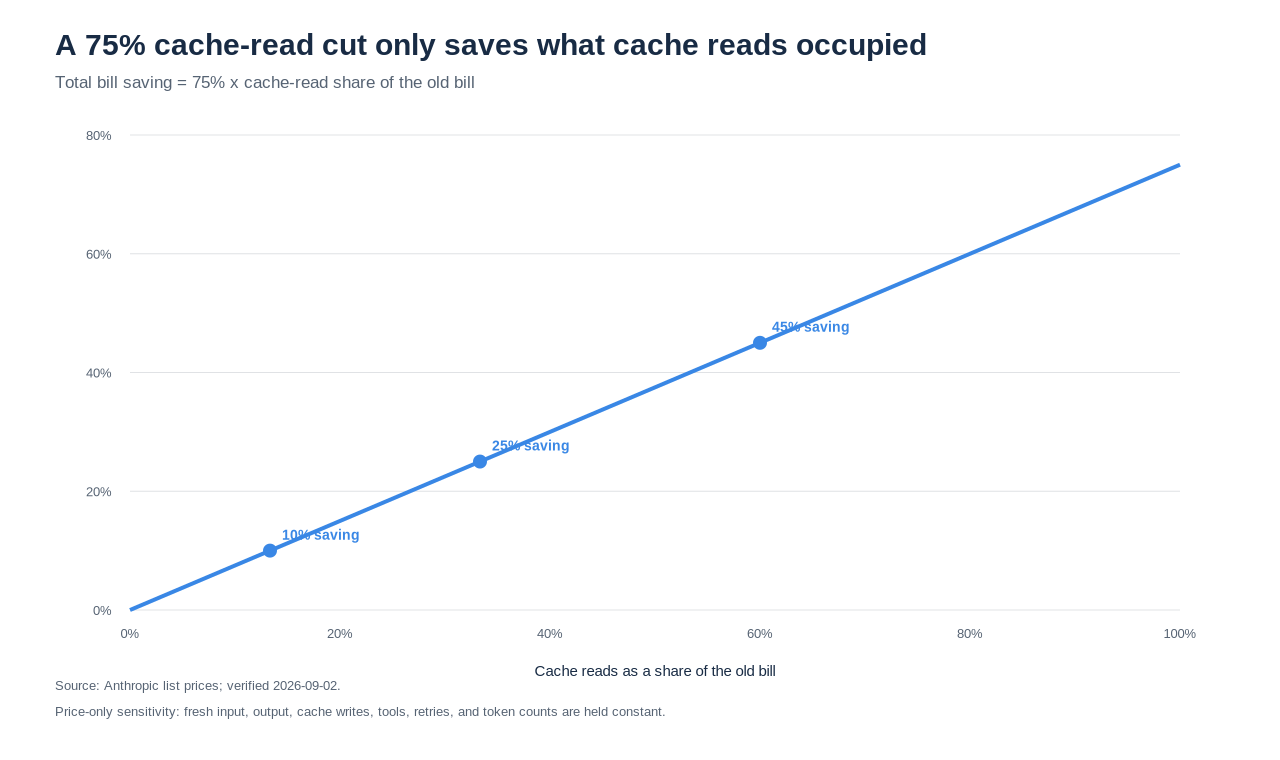
This threshold uses bill share, not token share. One million output tokens costs $50, while one million old cache reads cost $1. Equal token counts do not carry equal weight.
A cache-heavy agent session falls from $8.50 to $5.50
Consider one agent session with 4 million cache-read tokens, 200,000 fresh input tokens, and 50,000 output tokens. We exclude writes, tools, retries, regional premiums, and partner-platform markups so the changed meter stays visible.
Claude Fable 5 costs:
4M × $1/M + 0.2M × $10/M + 0.05M × $50/M = $4 + $2 + $2.50 = $8.50
Claude Fable 5.1 costs:
4M × $0.25/M + 0.2M × $10/M + 0.05M × $50/M = $1 + $2 + $2.50 = $5.50
The absolute saving is $3 per session. Across 1,000 identical sessions, the bill moves from $8,500 to $5,500. Put measured cache-read, fresh-input, and output counts into the LLM cost calculator before forecasting a production saving.
Our prompt-caching break-even analysis covers the write side. The five-minute write still costs 1.25 times base input. The one-hour write still costs 2 times. A cheaper read does not rescue a prefix that changes before reuse.
What Anthropic's 25%-45% range does and does not prove
Anthropic reports an indexed cost move from 100 to about 75 for its typical workload and from 100 to about 55 for highly agentic work. The launch-page caption says these are default-effort workloads measured over four weeks of actual August 2026 usage. Typical usage spans Claude Enterprise, Claude Code, and the API. The agentic group is context-heavy and tool-heavy.
Those are public production aggregates, not a published token trace. The chart does not expose fresh input, cache writes, cache reads, output, tools, or retries as token counts. We can reproduce the 25% and 45% index reductions. We cannot honestly convert them into one universal tokens-per-task recipe.
Under a fixed-token price model, those reductions imply old-bill cache-read shares of 33.3% and 60%. Model behavior can move the observed result. Fable 5.1 may take a different number of turns or tokens than Fable 5. Our full-conversation token-tax analysis shows why one extra agent turn can re-bill a large history.
Three migration checks before claiming the saving
Anthropic's migration guide names three breaking changes for Messages API integrations.
- Forced
tool_choicevaluesanyand namedtoolreturn a 400. Useautowith an explicit instruction and strict schema, or use JSON outputs. - Fable 5.1 can read thinking blocks from earlier Claude models, but most older models cannot read Fable 5.1 blocks. A fallback can drop them and re-plan, adding cost and latency.
- Editing, reordering, or removing earlier turns can invalidate Fable 5.1 thinking blocks. Newer accounts receive a 400 by default. Keep history append-only, strip invalid blocks, or use the documented drop control.
The guide also warns that long loops may issue fewer parallel tool calls. More turns mean more context reads. Measure the full cost per task, not just the cheaper line item.
What this means for routing
Read the usage object before changing a model routing rule. Compute cache-read dollars as a share of the current Fable 5 bill. Multiply that share by 75% for a first price-only estimate.
Then run the same accepted-task eval on both versions. Track cache reads, fresh input, output, attempts, tool calls, latency, and fallback behavior. Keep batch processing separate: Anthropic still lists a 50% discount on base input and output, while cache multipliers stack with other pricing modifiers.
Honest tradeoff: a cheaper cache read can hide a worse loop
Do not migrate a stable revenue path only for a forecasted 5% token saving. A forced-tool failure, a dropped thinking block, or one extra serial tool turn can erase it. The price cut is strongest for context-heavy loops with proven cache hits and migration tests.
The opposite mistake is dismissing the change because $10/$50 stayed fixed. At a 60% old-bill cache share, the price-only saving is 45%. That is large enough to change unit economics without changing the model's headline rate.
Sources
- Anthropic API pricing, all token and Batch rates verified 2026-09-02.
- Anthropic's Fable 5.1 launch report, reported workload reductions and measurement scope verified 2026-09-02.
- Claude Fable 5.1 model page, model ID, availability, rates, and breaking-change summary verified 2026-09-02.
- Anthropic's Fable 5.1 migration guide, integration caveats verified 2026-09-02.
- Reproducible arithmetic and chart data:
artifacts/claude-fable-51-cache-read-price-cut-agent-cost-math.pyand its CSV output.