
Blog · · By Dhrumil Barot, Founder
Agentic Benchmarks: 9 Leaderboards Worth Using, With Cost
Agentic benchmarks test AI agents on multi-step tasks. SWE-bench Verified, Terminal-Bench 4.1, tau2-bench, GAIA, BrowseComp, WebArena, OSWorld and HAL: what each measures and which report cost per run.
TL;DR: Agentic benchmarks score AI agents on multi-step tasks in real environments: fixing GitHub issues (SWE-bench Verified), working in a terminal (Terminal-Bench 4.1), serving customers with tools (tau2-bench), browsing (BrowseComp, WebArena, GAIA) and operating a desktop (OSWorld). Only some leaderboards show cost per run: Terminal-Bench, the SWE-bench cost charts and Princeton's HAL do, and on Terminal-Bench 4.1 a 4.3-point accuracy gap came with a 55x cost gap. Vynaris uses this kind of public eval evidence to decide when a cheaper model can take an agent's call, and shows the price of every request on a receipt.
Get my API key → and route agent calls to a cheaper model only where the evidence supports it.
Agentic benchmarks are test suites where a model, wrapped in an agent scaffold, must plan, call tools and act over many steps, and is graded on the outcome (tests pass, the right answer is found, the database ends in the right state) rather than on one reply. To compare coding agents, start with SWE-bench Verified and Terminal-Bench. For tool-using support agents, use tau2-bench. For browsing, use BrowseComp and GAIA. For computer use, use OSWorld. Then check whether the leaderboard reports cost, because the same accuracy can cost 10x more on a different model or scaffold.
Start here: the five-minute path
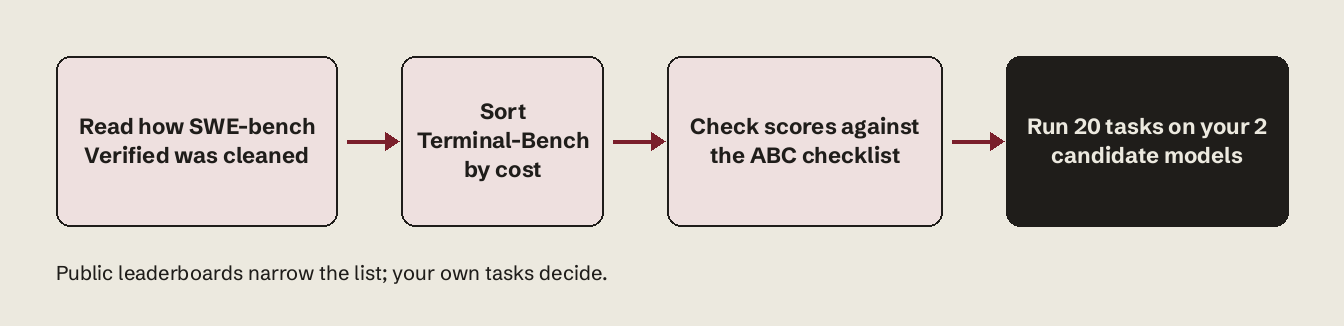
If you have one afternoon, do this in order:
- Read the SWE-bench Verified announcement to learn how a benchmark gets cleaned (500 tasks kept after 93 developers screened 1,699).
- Open the Terminal-Bench leaderboard and sort by cost, not rank.
- Skim the Agentic Benchmark Checklist so you know which scores to distrust.
- Pick the one benchmark closest to your workload from the lists below and run 20 tasks on your two candidate models.
How Vynaris uses agentic benchmarks
Vynaris is an OpenAI and Anthropic-compatible gateway. Its routing starts every request with frontier capability and "routes down only when current eval evidence certifies a cheaper model for that task", as the Vynaris homepage puts it. The site is explicit about where that evidence comes from: "We don't publish house benchmarks". Quality claims come from published research and independent benchmarks like the ones on this page, and each response carries a receipt with the model that served it, what it cost and the direct list price, which you can export.
What this means for this subject:
- You keep your SDK, prompts and tool definitions; you change
base_urltohttps://api.vynaris.com/v1and set the model toauto. - The receipt gives you the cost per request on your own agent traffic, which no public leaderboard can.
- What Vynaris does not do: it does not run SWE-bench or Terminal-Bench for you or publish its own leaderboard. Use the tools below for that.
Which agentic benchmarks matter, at a glance
| Benchmark | What it tests | Size / version | Reports cost? | Leaderboard |
|---|---|---|---|---|
| SWE-bench Verified | Fix real Python GitHub issues | 500 tasks | Yes, cost charts | swebench.com |
| Terminal-Bench 4.1 | Hard tasks in a terminal | v4.1 | Yes, cost and tokens per run | tbench.ai |
| tau2-bench | Tool use with a simulated user | airline, retail, telecom | No | GitHub repo |
| GAIA | General assistant questions | 466 questions | No | Hugging Face |
| BrowseComp | Find hard-to-find facts online | 1,266 questions | No | OpenAI paper |
| WebArena | Tasks on self-hosted websites | suite of 4 | No | webarena.dev |
| OSWorld | Real desktop tasks | 369 tasks, 2.0 out | No | os-world.github.io |
| HAL | Many benchmarks, one harness | 9 benchmarks | Yes, every entry | hal.cs.princeton.edu |
Sizes and features from each project's own page, read 2026-11-21.
Coding agent benchmarks
- SWE-bench Verified: the default for coding agents. Each task is a GitHub issue plus the repository; a patch counts only if the project's tests pass. The site also hosts Lite, Full, Multimodal, Multilingual and Bash Only boards, and charts of resolved rate against average cost. Free.
- SWE-bench Verified announcement: why the 500-task subset exists. Read it before quoting any SWE-bench number.
- Terminal-Bench: agents complete hard command-line tasks. Version 4.1 lists model, agent harness, resolution rate with error bars, tokens and cost for every entry. Free to read; running it costs your API spend plus sandbox time.
- Terminal-Bench run guide: how to run it yourself with Harbor. Some tasks need GPUs, so you need a sandbox with GPU access.
What is the difference between SWE-bench and Terminal-Bench?
SWE-bench Verified asks for a code patch to a Python repository and grades it with the repository's tests. Terminal-Bench gives the agent a shell and grades whether the task got done, which covers builds, data work, system setup and debugging beyond Python patches. SWE-bench measures "can it fix this issue"; Terminal-Bench measures "can it get this job done at a command line". Use both if you are choosing a coding agent.
Which benchmark should I use to compare coding agents?
Use SWE-bench Verified for Python bug fixing and Terminal-Bench 4.1 for broader engineering work, and compare cost per resolved task, not rank. The harness matters as much as the model: the same model sits at different scores under Claude Code, Codex or a custom scaffold. Then confirm on 20 to 50 tasks from your own repository, because benchmark tasks are public and your code is not. Token use also varies run to run; see why coding agent token cost varies 30x.
The honest tradeoff: if your agent fails rarely and its calls are cheap already, the time spent benchmarking can cost more than the savings. Benchmark when the monthly bill or the failure cost is large.
Which agent leaderboards report cost alongside accuracy?
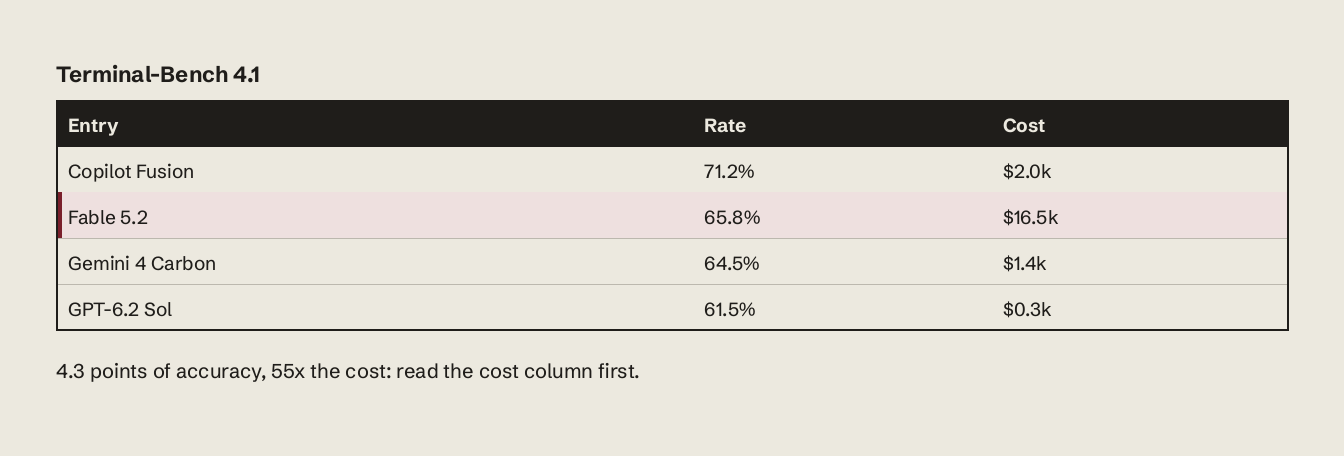
Three do it well: Terminal-Bench, the SWE-bench charts and HAL. Cost changes the ranking. On Terminal-Bench 4.1 (read 2026-11-21):
| Entry | Resolution rate | Tokens | Run cost |
|---|---|---|---|
| Copilot Fusion (max), GitHub Copilot | 71.2% | 3.3B | $2.0k |
| Fable 5.2 (max), Claude Code | 65.8% | 15.7B | $16.5k |
| Gemini 4 Carbon (high), Antigravity CLI | 64.5% | 3.8B | $1.4k |
| GPT-6.2 Sol (max), Codex | 61.5% | 1.1B | $0.3k |
GPT-6.2 Sol scored 4.3 points below Fable 5.2 (61.5% vs 65.8%, both with error bars near ±2.8%) at $0.3k versus $16.5k: 16.5 / 0.3 = 55x the run cost. The top entry, Copilot Fusion, beat Fable 5.2 by 5.4 points at about one eighth of its cost ($2.0k vs $16.5k).
If you want to translate a run cost into your own volume, plug token counts into the LLM cost calculator. We worked the same comparison per task in our coding agent cost-per-task leaderboard.
- HAL: Holistic Agent Leaderboard: Princeton's "standardized, cost-aware, and third-party leaderboard", 9 benchmarks and 26,597 rollouts. On AssistantBench, o3 Medium scored 38.8% for $15.15 while GPT-5 Medium scored 35.2% for $41.69. HAL has paused adding new models to focus on reliability, so treat its model list as dated.
Tool-use and customer-service agent benchmarks
- tau2-bench: Sierra's benchmark for an agent that talks to a simulated user while calling tools against a database, in airline, retail and telecom domains. It now has a voice mode (
--audio-native). Best fit if your agent handles support or bookings. Free, open source. - Agentic Benchmark Checklist: found flaws that misstate performance by up to 40% on SWE-bench Verified and tau-bench. Useful before trusting any single number.
Web browsing, research and computer-use benchmarks
- BrowseComp: questions with short, checkable answers that are hard to find. In OpenAI's check, human trainers could not solve 888 of 1,255 problems (70.8%). Best for research and deep-search agents.
- GAIA paper: general assistant questions that need reasoning, files, browsing and tools; simple for people, hard for agents.
- GAIA leaderboard: submit answers on the test set and compare by level.
- WebArena-x: WebArena (NeurIPS 2024 oral) runs agents on self-hosted copies of real sites; the suite adds WebArena-Infinity, VisualWebArena and TheAgentCompany, which simulates work inside a company.
- OSWorld: 369 tasks on real Ubuntu, Windows and macOS apps (361 if you drop 8 Google Drive tasks). OSWorld-Verified fixed community-reported tasks in July 2025, and OSWorld 2.0 was released on 2026-06-26. Use it for agents that click and type.
How do I run an agent benchmark on my own models?
Pick the benchmark closest to your task, run a small slice first, and record cost per task next to pass rate:
# Terminal-Bench 4.1 through Harbor (needs a GPU sandbox such as Modal)
uv tool install 'harbor[modal]'
harbor run -d terminal-bench/terminal-bench@4.1.0
harbor view jobs
# tau2-bench text mode
tau2 run --benchmark textPoint the agent at an OpenAI-compatible endpoint so every candidate model runs through the same harness. With Vynaris as the base URL, each request returns a receipt with its cost, so cost per task is a sum, not an estimate. Our Claude Code gateway guide shows the setup for Claude Code.
FAQ
What are agentic benchmarks?
They are tests where an AI agent completes multi-step tasks with tools in a real or simulated environment and is graded on the result, for example whether a patch passes tests or a booking ends in the right state.
What is the best agentic coding benchmark?
SWE-bench Verified is the most cited; Terminal-Bench 4.1 is broader and shows cost and tokens for every entry. Use both.
Which agentic AI benchmarks show cost?
Terminal-Bench, the SWE-bench cost charts and HAL. tau2-bench, GAIA, BrowseComp, WebArena and OSWorld report accuracy only.
Are agentic benchmark scores reliable?
Partly. The Agentic Benchmark Checklist found errors of up to 40% on SWE-bench Verified and tau-bench, so check error bars, the harness used and whether the task set was cleaned.
Is there one agent benchmark leaderboard for everything?
No. HAL comes closest with 9 benchmarks in one harness, but it has paused adding new models. Pick per task type.
Want the cheapest model that still passes your agent's tasks? Get my API key →: Vynaris routes down only when eval evidence supports it, and every response carries its receipt.