
Blog · · Updated · By Dhrumil Barot, Founder
Coding agent API cost: an agent-friendly CLI cuts tokens per success 31% to 45%
Hugging Face's ~1,000-run benchmark finds raw API/SDK workflows use 1.3–1.8x tokens and up to 6x on complex tasks. Prices verified 2026-08-20.
Hugging Face's ~1,000-run benchmark finds that an agent-friendly CLI cuts token-normalized cost per verified success by 31% to 45% versus raw APIs or SDKs. Complex GPT-5.5 tasks use up to 6x fewer tokens. Claude Sonnet 4.6 also gains 10 percentage points of task success. Prices verified 2026-08-20.
TL;DR
- Raw API or SDK workflows use 1.3x to 1.6x the tokens on Claude Code and 1.6x to 1.8x on Codex. The worst published multi-step task reaches 6.0x.
- Success moves from 84% to 94% on Claude Sonnet 4.6 and from 92% to 93% on GPT-5.5. After both effects, the CLI lowers token-normalized cost per verified success by 31.3% to 44.1% on Sonnet and 38.2% to 45.0% on GPT-5.5.
- An exact dollar claim is not available from the public benchmark. Its transcripts omit billable input, output and cache counters. Our editable 8k-input/2k-output scenario therefore reports defensible dollar bounds, not a fake invoice.
Verdict table
| Measure | Agent-friendly hf CLI | Raw API / Python SDK | Verdict |
|---|---|---|---|
| Claude Sonnet 4.6 task success | 94% | 84% | CLI leads by 10 points |
| Sonnet total-token index | 1.0x | 1.3x to 1.6x | CLI uses 23.1% to 37.5% fewer tokens |
| Sonnet token-normalized cost per success | 1.0x | 1.455x to 1.790x | CLI costs 31.3% to 44.1% less |
| GPT-5.5 task success | 93% | 92% | Near parity |
| GPT-5.5 total-token index | 1.0x | 1.6x to 1.8x | CLI uses 37.5% to 44.4% fewer tokens |
| GPT-5.5 token-normalized cost per success | 1.0x | 1.617x to 1.820x | CLI costs 38.2% to 45.0% less |
| Best fit | Multi-step Hub operations | One-shot reads or unsupported operations | Choose by task shape |
The result is not “CLIs always win.” Raw calls beat the CLI on two simple GPT-5.5 reads. The advantage appears when a high-level command compresses several dependent API operations.
What Hugging Face measured
Hugging Face defined 18 Hub tasks, including repository writes, file copies, bucket synchronization and model metadata reads. Each fresh coding agent received one interface: the hf CLI, curl, or the Python SDK. Each task and interface ran 10 times, except one capped billable task.
That produced about 520 runs per agent and roughly 1,000 graded runs across Claude Code with Claude Sonnet 4.6 and Codex with GPT-5.5. A separate grader queried the live Hub after each run. It did not trust the agent's TASK_COMPLETE claim. This matters because the benchmark recorded 11 false success reports in the Sonnet raw-tools arm versus two with the CLI.
The intervention is an agent-computer interface, not a model swap. Higher-level commands collapse REST call chains, return compact structured output and provide the next valid command. The clean harness had no custom MCP servers or repository instruction files.
The public bucket contains 140 transcript files totaling 7.69 MB. We inspected the representative CLI and SDK transcripts. They show prompts, messages, tool calls, grades and model labels. They do not contain API usage objects or billable token counters.
The editable cost model
We need a task shape before converting tokens into dollars. We use 8,000 input tokens and 2,000 output tokens for one CLI attempt. This is an illustrative workload, not a benchmark average.
| Assumption | Claude Sonnet 4.6 | GPT-5.5 | Source or derivation |
|---|---|---|---|
| Input tokens per CLI attempt | 8,000 | 8,000 | Editable scenario |
| Output tokens per CLI attempt | 2,000 | 2,000 | Editable scenario |
| Input price per 1M | $3.00 | $5.00 | Provider pages |
| Cached input price per 1M | $0.30 | $0.50 | Provider pages |
| Output price per 1M | $15.00 | $30.00 | Provider pages |
| CLI attempt cost, no cache | $0.054 | $0.100 | Input bill + output bill |
| CLI cost per verified success | $0.057447 | $0.107527 | Attempt cost / measured success |
The basic formula is:
attempt cost
= input tokens / 1,000,000 × input price
+ cached input tokens / 1,000,000 × cached input price
+ output tokens / 1,000,000 × output price

cost per verified success
= attempt cost / independently graded success rate
Change the assumptions in the saved math script or use the Vynaris calculator when you know your own input, cache and output counters.
Dollar bounds, not pretend precision
The benchmark gives a total-token multiplier. It does not say which extra tokens were input, output or prompt caching hits. Those meters have different prices, so one exact dollar multiplier cannot be recovered.
We bound the uncached bill by assigning every extra raw-tools token to input for the low case and to output for the high case. That is deliberately conservative.
| Model | CLI attempt | Raw attempt bound | CLI per success | Raw per success bound |
|---|---|---|---|---|
| Claude Sonnet 4.6 | $0.054 | $0.063 to $0.144 | $0.057447 | $0.075000 to $0.171429 |
| GPT-5.5 | $0.100 | $0.130 to $0.340 | $0.107527 | $0.141304 to $0.369565 |
For Sonnet, the low raw bound adds 3,000 input tokens to the 10,000-token CLI task. The high bound adds 6,000 output tokens. GPT-5.5 adds 6,000 input tokens at the low end or 8,000 output tokens at the high end.
A 75% cache hit rate lowers the CLI attempt to $0.0378 on Sonnet and $0.073 on GPT-5.5. It does not resolve the raw-tools bill. We still need to know whether the extra raw tokens were cacheable input, fresh input or output. The public receipts do not answer that.
Success changes the denominator
Token ratios alone understate the Sonnet result. The CLI completes 94% of tasks, while raw tools complete 84%. Normalize both to a verified success:
Sonnet raw / CLI token cost per success
= raw token multiplier × CLI success / raw success
= 1.3 to 1.6 × 0.94 / 0.84
= 1.455x to 1.790x

GPT-5.5 raw / CLI token cost per success
= 1.6 to 1.8 × 0.93 / 0.92
= 1.617x to 1.820x
This is cost per task with an independently checked denominator. It is stronger than cost per self-reported completion. Our earlier 30x coding-agent variance analysis compares agent configurations. This benchmark isolates the tool interface instead.
The advantage is concentrated in multi-step work
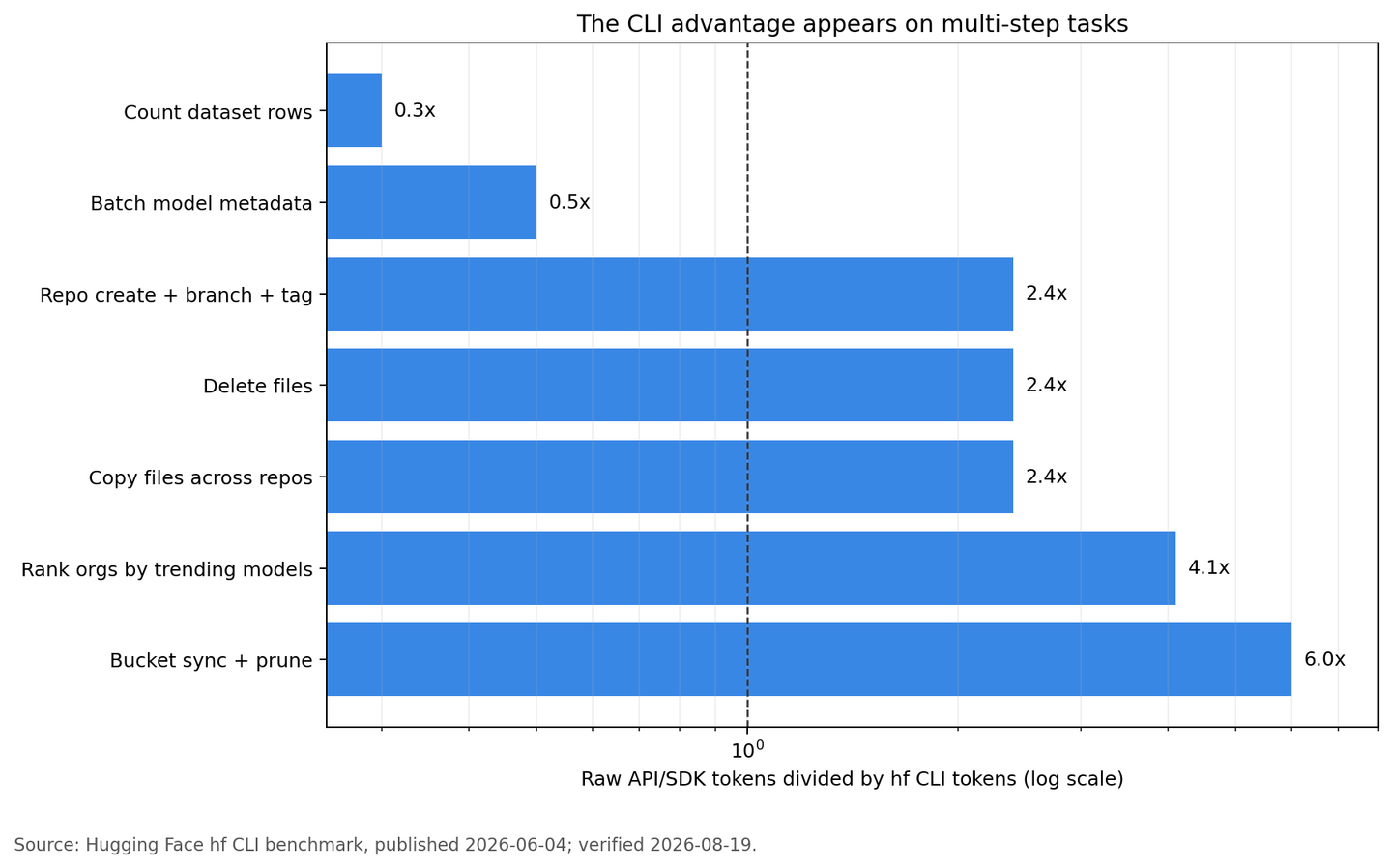
Bucket create, sync and prune reaches 6.0x. Ranking organizations by trending models reaches 4.1x. Repository creation with a branch and tag, deleting files, and copying files across repositories each reach 2.4x.
The two counterexamples are useful. Batch model metadata uses 0.5x as many tokens with raw tools. Counting dataset rows uses 0.3x. A direct endpoint can be the shorter interface when the task is one read with a stable schema.
This is why “wrap every API in a CLI” is bad advice. Add a command when it compresses a workflow, validates arguments, formats dense output, or makes retries safe. Keep the raw endpoint when one request already expresses the job.
What to build into an agent-facing CLI
Start with the repeated multi-step operations in traces, not the whole API surface. A useful tool schema should expose the task at the same level the user describes it.
Return machine-readable data without decorative output. Put warnings on stderr and data on stdout. Support non-interactive confirmation, dry runs and idempotent retries. Include exact next-command hints when an operation naturally leads to another.
Then grade the external state. Did the branch exist? Did the stale bucket object disappear? Did the copied file land in the destination? Agent narration is not a test result.
The hf skill cut mean tool calls from 10.4 to 6.9 on Sonnet and from 10.1 to 7.3 on GPT-5.5. Hugging Face says token use stayed about flat or ticked up because the skill adds fixed context. The CLI structure delivered the token saving; the skill mainly reduced command discovery. Our scaffolding overhead analysis explains why extra instructions can reduce tool calls without reducing billed tokens.
When not to use the CLI
Do not force a CLI into a hot path that already needs one stable HTTP call. The benchmark's simple reads show that the abstraction can add tokens. Raw APIs also win when you need a new field before the CLI exposes it, require streaming primitives, or must control request semantics exactly.
There is an operational tradeoff too. A CLI becomes another versioned dependency. Its output contract, exit codes and retry behavior must remain stable. A thin wrapper that merely renames endpoints creates maintenance cost without compressing work.
The practical rule is narrow: use the highest-level reliable interface that expresses the whole task. Measure verified outcomes and billable counters on your workload before standardizing it.
FAQ
How much can an agent-friendly CLI reduce token use?
Hugging Face reports 1.3x to 1.8x raw-tools overhead overall. On published GPT-5.5 tasks, the range runs from 0.3x for a simple raw read to 6.0x for bucket creation, synchronization and pruning.
Does 6x fewer tokens mean 6x lower cost?
Not necessarily. Input, cached input and output have different rates. The benchmark does not publish their split, so a precise dollar ratio is unavailable.
Why divide by task success?
Failed attempts still consume tokens. Cost per successful task captures both spend and whether the requested state change actually happened.
Should every agent API ship a CLI?
No. Build one for repeated multi-step jobs where high-level commands compress several calls. A single well-documented endpoint can remain cheaper for one-shot reads.
Sources
- Hugging Face, Designing the hf CLI as an agent-optimized way to work with the Hub, benchmark design, success rates and token ratios read 2026-08-20.
- Hugging Face public benchmark transcripts, 140-file receipt set inspected 2026-08-20.
- Anthropic model pricing, Claude Sonnet 4.6 input, cache and output rates verified 2026-08-20.
- Anthropic models overview, Claude Sonnet 4.6 name and model ID verified 2026-08-20.
- OpenAI GPT-5.5 model page, GPT-5.5 name, ID and token rates verified 2026-08-20.
- Reproducible arithmetic:
artifacts/agent-friendly-cli-vs-raw-api-token-cost-per-successful-task-math.py.