
Blog · · Updated · By Dhrumil Barot, Founder
LiteLLM vs OpenRouter vs managed gateways: the $490/mo labor floor a fee audit hides
A $0 self-hosted LiteLLM gateway carries a ~$490/mo labor floor, making it the priciest option below ~$9k/mo of spend. OpenRouter's 5.5% wins the low end, a $49 flat managed plan the middle. Total-cost-of-ownership math, prices verified 2026-07-18.
A fee audit says self-hosted LiteLLM is the cheapest gateway, because its software fee is $0. Add the two costs a fee audit leaves out, infrastructure and engineer-hours, and the picture inverts: a modestly-run LiteLLM carries a $490/month labor floor on our assumptions, which makes it the most expensive option below about $9,000/month of inference spend. OpenRouter's 5.5% wins the low end and a $49/month managed plan wins the middle. Prices verified 2026-07-18.
We already published the fee-only audit of six gateways: hold the underlying spend constant, compare only the surcharge. That is the right way to compare fees and the wrong way to choose a gateway, because for a self-hosted proxy the fee is the one number that is zero and every other cost is hidden. This post puts the hidden costs back. Total cost of ownership = fee + infrastructure + engineering labor + failover engineering. Every figure is derived in an editable script; nothing is measured from inside any product.
The verdict
gateway            fee shape              ongoing ops   pick it when
------------------------------------------------------------------------------
OpenRouter         5.5% of spend          none          spend < ~$900/mo, or you
                   ($0.80 min)                          want instant multi-provider
                                                        failover with zero setup
Portkey / Helicone $49 / $79 flat/mo      none          ~$900/mo up to your LiteLLM
                                                        crossover; flat fee + built-in
                                                        failover, no servers
LiteLLM OSS        $0 software            you own it    spend above your crossover
                   (self-host)                          (~$3.5k-$23k/mo) AND you have
                                                        ops capacity or a data-residency
                                                        mandate
The number that decides it is not the fee. It is how many engineer-hours the self-hosted option eats, and what those hours cost. That single assumption swings the answer by a factor of six.
The three cost shapes
An inference gateway sits between your app and the model providers: one API, model routing, fallbacks, logging, spend caps. The three ways to run one price completely differently.
OpenRouter — a percentage, no servers. OpenRouter charges 5.5% when you buy credits with a card ($0.80 minimum), then passes provider prices through with no markup on inference. Its BYOK path is 5% of model cost after the first 1M requests each month are free. There is nothing to deploy, patch, or page. Ops cost is genuinely zero; the fee scales straight with spend.
Managed gateways — a flat fee, no servers. Portkey's Production plan is $49/month (plus $9 per 100k requests over 100k); Helicone Pro is $79/month. Neither marks up tokens. You configure it in the browser in minutes, and multi-provider failover ships in the box. The fee is fixed, so it is a large percentage of a small bill and a rounding error on a large one.
LiteLLM — $0 fee, real servers. LiteLLM's open-source proxy is free software. The cost moved, it did not disappear: you run the process (usually two instances for high availability, plus Redis for rate limits and caching, plus a load balancer), you write and maintain the model definitions, you build the fallback chains, and you carry the pager when a provider changes an API at 2am.
Putting real numbers on LiteLLM's "$0"
Editable assumptions for a modest production LiteLLM deployment:
line item              value        note
---------------------------------------------------------------------
infrastructure         $90/mo       2 small HA instances + managed Redis + LB
setup labor            16 hours     deploy, model defs, fallback chains, dashboards
  amortized            /12 months   spread over year one
ongoing ops            4 hours/mo   upgrades, new model defs, incident response
loaded engineer rate   $100/hour    fully-loaded cost (edit to your market)
=> steady-state TCO    $490/mo      $90 infra + 4h x $100 (fee is $0)
=> year-one TCO        $623/mo      + 16h setup / 12
That $490/month is a floor, not a ceiling, and it does not move when your spend does. Which is the whole point: a self-hosted gateway costs roughly the same to run whether it fronts $500 or $50,000 of inference.
The one table that changes the decision
Add-on cost per month over the same inference spend, base assumptions (managed and OpenRouter carry no ongoing ops):
spend/mo   OpenRouter   Portkey   Helicone   LiteLLM (steady)
------------------------------------------------------------
$100       $5.50        $49       $79        $490
$1,000     $55          $49       $79        $490
$10,000    $550         $49       $79        $490
$50,000    $2,750       $49       $79        $490
$100,000   $5,500       $49       $79        $490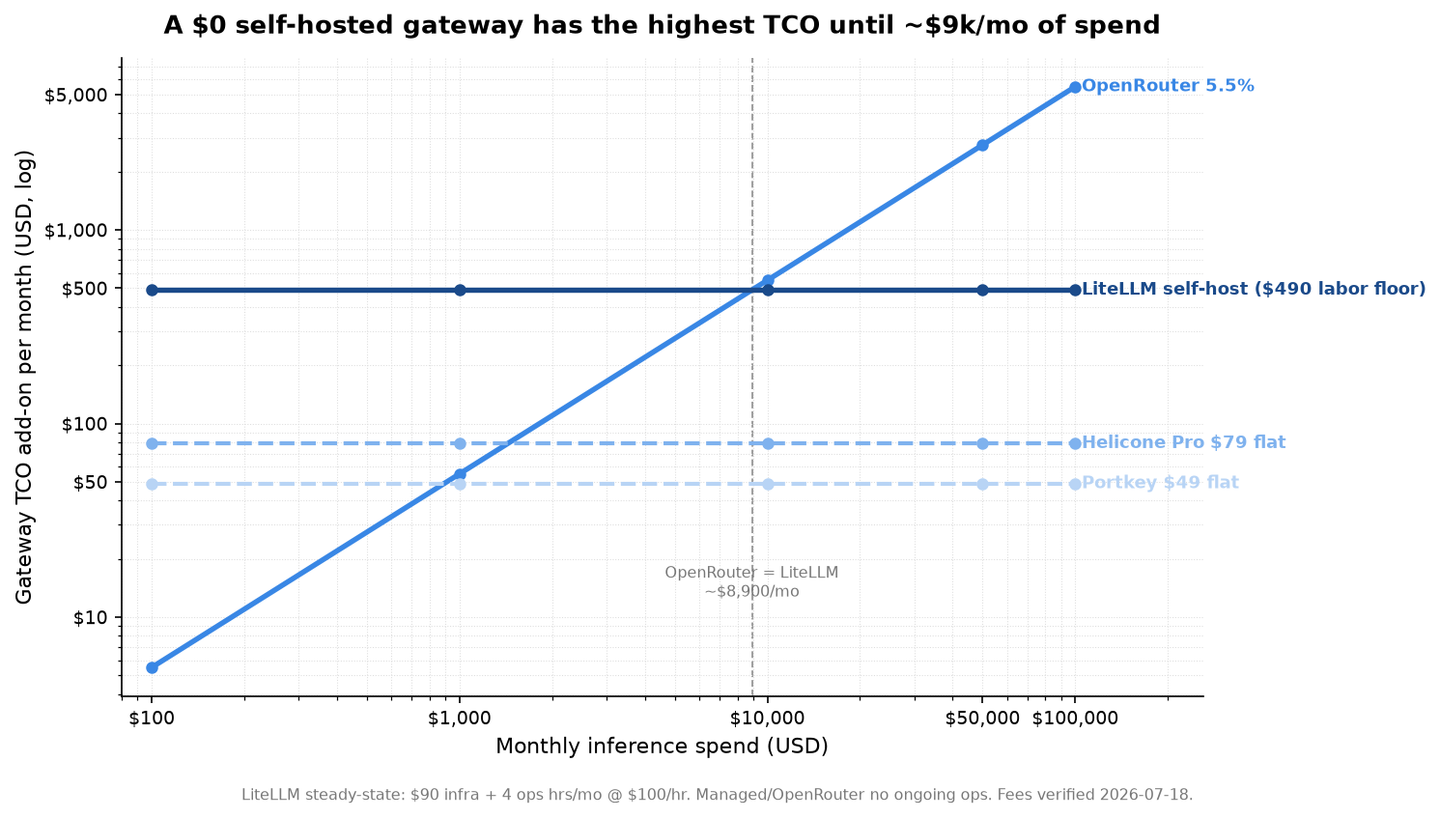
Read the $100 and $1,000 rows. At $1,000/month of inference, LiteLLM's $490 TCO is nine times OpenRouter's $55 and ten times Portkey's $49. The "free" gateway is the single most expensive way to route a small bill, because its cost is labor and labor does not shrink with spend. This is the exact opposite of the fee audit's conclusion, and it is the number that actually lands on your budget.
Now read the $100,000 row. OpenRouter's percentage has climbed to $5,500/month while LiteLLM still costs $490. Percentage fees have no ceiling; a labor floor does. If your spend is genuinely large, self-hosting stops being the expensive option and becomes the cheap one, provided the ops load stays near four hours a month. Run your real spend and ops-hours through the calculator before you commit either way.
The crossover moves with your engineer rate
The spend where self-hosted LiteLLM beats OpenRouter's 5.5% is not a constant. Solve 0.055 x spend = LiteLLM TCO and it swings entirely on two dials you control: how many hours the proxy eats and what an hour costs you.
LiteLLM ops load    @ $50/hr     @ $100/hr    @ $150/hr
---------------------------------------------------------
2 hours/month       $3,455/mo    $5,273/mo    $7,091/mo
4 hours/month       $5,273/mo    $8,909/mo    $12,545/mo
8 hours/month       $8,909/mo    $16,182/mo   $23,455/mo
Below the crossover, OpenRouter's percentage is cheaper than your labor. Above it, your labor is cheaper than the percentage. A team with a cheap contractor and a boring, stable proxy crosses over around $3,500/month; a team paying a senior engineer whose LiteLLM instance needs real attention does not cross over until past $23,000/month. There is no single right answer, only your labor number.
Against the flat managed plans the arithmetic is blunter: Portkey's $49 beats OpenRouter's percentage above $891/month of spend, and Helicone's $79 above $1,436/month. Both undercut LiteLLM's $490 labor floor almost everywhere a normal business operates.
The honest tradeoff: LiteLLM's win is not cost
On these assumptions, a flat managed plan is cheaper than self-hosted LiteLLM at essentially every spend a typical company runs, because $49 flat is less than a $490 labor floor. So why self-host at all? Not to save money at $10k/month. You self-host for the things a fee cannot buy:
- Data residency. Traffic never leaves your VPC. For a regulated workload, that alone can be the requirement, and no managed gateway satisfies it.
- No vendor in the path. OpenRouter and managed gateways are a dependency on someone else's uptime and someone else's pricing page. Self-hosting removes both.
- Unbounded-scale economics. At $1,000,000/month of inference, OpenRouter's 5.5% is $55,000/month and LiteLLM is still ~$490. The labor floor that made LiteLLM look absurd at $1,000/month makes it the only sane option at extreme scale.
The mirror-image tradeoff: OpenRouter and managed gateways hand you multi-provider failover and observability with zero engineering, while LiteLLM makes failover your job. When a provider has an outage, OpenRouter reroutes automatically; with LiteLLM you are only as covered as the fallback chain you wrote and last tested. That failover engineering is real work, and it is the TCO line the fee-only audit omitted entirely. We worked the broader build-vs-buy tradeoff in three router architectures compared.
Where this model is wrong
- Your ops load is the load-bearing guess. We used 4 hours/month. A rock-solid deployment behind a platform team might cost 1 hour; a flaky one during a provider migration can cost 20. The crossover table exists because this number, not the fee, decides everything.
- Infra varies widely. $90/month is a modest HA setup. Run it on a single box and it drops; run it on a hardened multi-region cluster and it climbs past the labor line.
- Managed plans meter requests. Portkey's $49 includes 100k requests, then $9 per 100k. A high-volume, low-cost-per-call workload can add overage even while the token bill stays small. Check request counts, not just dollars.
- Routing savings are not in this table, on purpose. This compares the cost of running a gateway, not the spend a gateway can cut. A right-sized routing layer that moves 30% of calls to a cheaper model saves more than any fee difference here; that saving depends on your traffic and we do not publish figures we cannot show you deriving.
Pitch, clearly labeled
Vynaris is a managed, OpenAI-compatible gateway: a percentage fee (3% on the first $500/month, 1% after), no servers to run, and per-request routing that shows its receipts. On TCO it sits in the managed column, near-zero ops with a fee that stays small as you scale, and it routes each request to the cheapest model that clears your quality bar. If you want the control of self-hosting, LiteLLM is a genuinely good proxy and we will not pretend otherwise; if you want routing without the pager, that is our pricing and docs. Run your own numbers first.
FAQ
Is LiteLLM actually free? The software is $0. Running it is not: infrastructure plus engineer-hours put a floor near $490/month on our assumptions, before you route a single token. Free software, paid operations.
When does self-hosting LiteLLM beat OpenRouter? When 0.055 x monthly spend exceeds your LiteLLM TCO. On base assumptions that is about $8,900/month; it ranges from $3,500 to $23,000 depending on your ops hours and engineer rate.
Which is cheapest for a small project? A percentage gateway (OpenRouter, or a low-percentage managed plan). At $100-1,000/month of spend, a flat $49 plan and a self-hosted $490 floor are both worse than a few percent of a small bill.
Which is cheapest at scale? A flat managed plan on pure fee ($49-79 regardless of spend), or self-hosted LiteLLM once your spend is high and your ops load stays low. OpenRouter's percentage is the most expensive at high spend.
Does any of these mark up tokens? No. OpenRouter, Portkey, Helicone, and LiteLLM all pass provider cost-per-token through. The cost is in the fee shape and the operations, not the tokens. See the full fee audit for the surcharge-only comparison.
Sources
- OpenRouter fees (5.5% credits, 5% BYOK after 1M free req/mo), verified 2026-07-18: https://openrouter.ai/docs/faq
- Portkey pricing ($49 Production + $9/100k overage), verified 2026-07-16: https://portkey.ai/pricing
- Helicone pricing (Pro $79/mo), verified 2026-07-16: https://helicone.ai/pricing
- LiteLLM (open-source proxy, self-host), verified 2026-07-16: https://www.litellm.ai/enterprise
- All arithmetic:
litellm-vs-openrouter-vs-managed-gateways-tco-math.py, assumptions editable inline.
Related: the six-gateway fee audit · three router architectures compared